
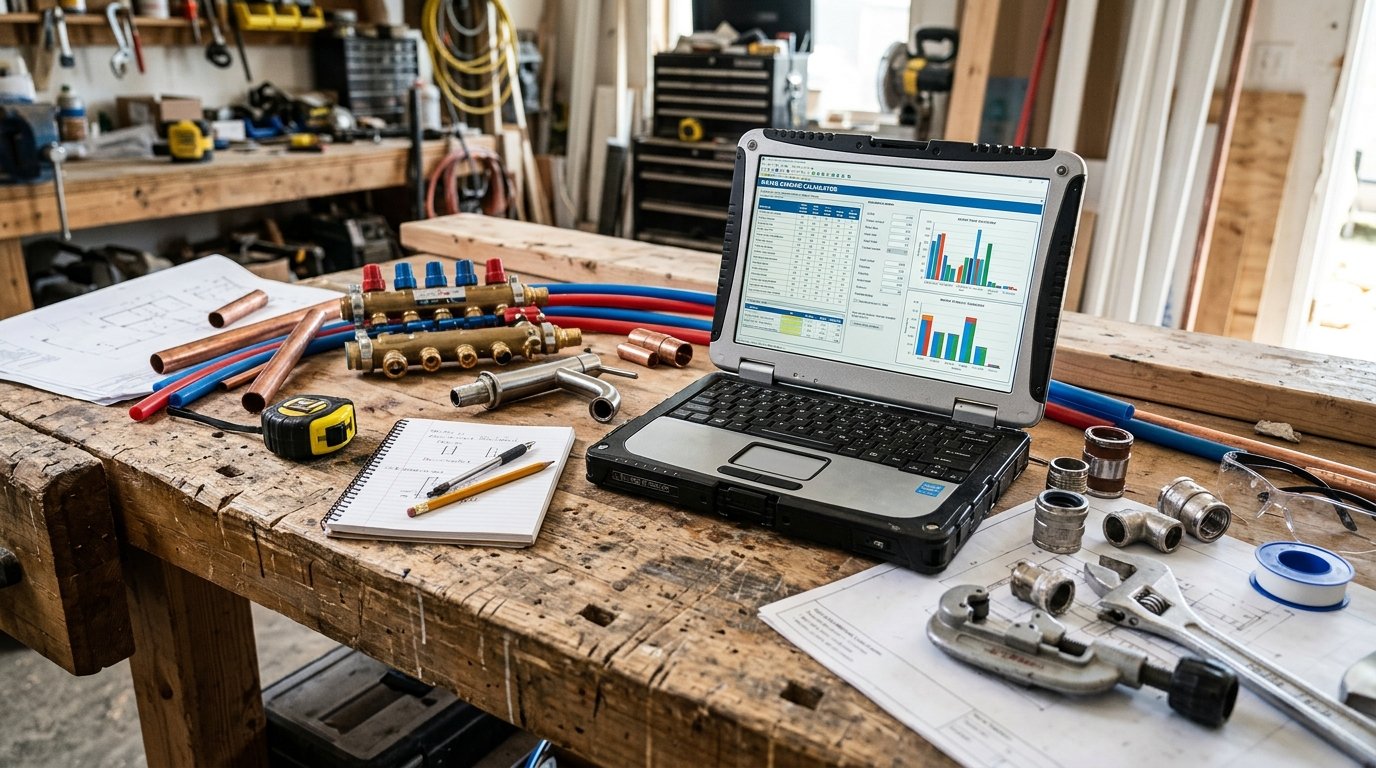
Water Demand / Flow Rate Calculator: Peak Flow from Fixtures & Pipe Sizing
Every plumbing system is designed around one critical number: the peak water demand. Not the average, not the daily total — the peak, the maximum flow required when the building is at its busiest. Get this number wrong and the consequences are immediate: low pressure at the shower when someone flushes a toilet, an undersized incoming supply pipe, a booster pump that cannot keep up, or a storage tank that empties faster than it fills. Get it right and the system delivers consistent pressure and flow, whatever is happening elsewhere in the building.
Our Water Demand Calculator is a free online tool that estimates the peak water demand of a building from its fixtures and occupancy. It supports two industry-standard calculation methods — simultaneous flow and loading units — plus hot/cold split, recommended incoming pipe size, and velocity checks. It is designed for plumbing engineers, contractors, and DIY designers working on domestic and light commercial systems.
In this guide, we will show you how to use the calculator, explain the two peak-demand methods, walk through four real-world examples, and answer eight of the most frequently asked questions about water demand.
Water Demand / Flow Rate
Construction CalculatorPeak water demand: simultaneous flow, fixture units, hot water split, incoming pipe sizing.
What is the Water Demand Calculator?
The Water Demand Calculator is a free online tool that estimates the peak water demand of a building. It uses two parallel methods to determine the peak flow:
- Simultaneous flow method — sum of all connected fixture flows, multiplied by a user-set simultaneity factor (50–70% typical). This is a simple, transparent method used widely in domestic design.
- Loading units method (BS EN 806-3) — sum of all fixture loading units (FU), converted to flow via the BS EN 806-3 approximation: Q = 0.1 × √(LU). This is the standard approach in UK and European plumbing design.
The calculator uses the higher of the two results as the design peak, giving a conservative estimate. It then calculates hot and cold water peak demand separately, using standard hot-water fractions per fixture (shower 100%, basin 70%, kitchen sink 60%, washing/dishwasher 30%, WC 0%). Finally, it recommends the incoming supply pipe DN from the design peak and a user-set target velocity.
The output includes:
- Connected flow (all fixtures)
- Connected flow (hot side)
- Total loading units (FU)
- Peak demand by simultaneous flow method
- Peak demand by loading units method
- Design peak (governing value)
- Design peak in L/s and m³/h
- Hot water peak demand
- Cold water peak demand
- Diversity factor
- Required internal pipe bore
- Recommended DN
- Actual velocity at the recommended DN
- Velocity warning
The tool is part of a suite of plumbing and HVAC calculators available on our website. For related calculations, you can use our Pipe Diameter From Flow Calculator, Flow Rate Converter, Water Tank Volume Calculator, and Water Bill Estimator.
Why Accurate Water Demand Matters
Water demand is the foundation of every plumbing design decision. Get it wrong and the entire system suffers.
Pipe Sizing
The incoming supply pipe must carry the peak flow without excessive velocity. If the pipe is undersized, velocity and pressure drop increase, and pressure at the furthest fixtures collapses. The recommended DN is a direct function of peak demand.
Storage Tank Sizing
If the building has a cold water storage tank or a break tank, the tank must hold enough water to cover peak demand between fill cycles. Peak demand determines how quickly the tank empties; supply pressure and fill rate determine how quickly it refills. Sizing the tank without knowing peak demand is guesswork.
Booster Pumps
In buildings with insufficient mains pressure, a booster pump is required. The pump must be sized for the peak flow, not the average. An undersized pump cannot deliver the peak, and a shower becomes a trickle when the dishwasher is running.
Hot Water Cylinder Sizing
Hot water cylinders are sized for both volume (how much hot water can be drawn before the cylinder cools) and recovery rate (how quickly the cylinder reheats). Peak hot water demand drives both. An undersized cylinder runs cold after two consecutive showers.
Legionella and Water Hygiene
Oversized pipework and low flow increase the risk of stagnation and bacterial growth. Undersized pipework causes high velocity, noise, and erosion. Correct sizing — matching pipe bore to actual demand — is a water hygiene requirement in many jurisdictions.
Compliance
Building codes and standards (BS EN 806-3, IPC, UPC, and others) specify design methods and minimum pipe sizes. Using the correct method — loading units, fixture units, or simultaneous flow — is part of compliance.
Cost and Efficiency
Larger pipes cost more, take longer to install, and hold more water (which must be heated and circulated). Smaller pipes cost less but may not deliver peak demand. Accurate sizing gives the best balance.
For more information on plumbing design, you can refer to Wikipedia’s article on plumbing or the Chartered Institute of Plumbing and Heating Engineering (CIPHE).
How to Use the Water Demand Calculator
Using the calculator is straightforward. Here is a breakdown of each field.
1. Fixtures
Enter the number of each fixture type in the building. The calculator uses standard flow values per fixture:
| Fixture | Flow (L/min) | Hot fraction | Loading units |
|---|---|---|---|
| Basin / WHB | 6 | 70% | 1.5 |
| WC cistern | 4 | 0% | 2.0 |
| Shower | 9 | 100% | 3.0 |
| Bath | 12 | 100% | 4.0 |
| Kitchen sink | 8 | 60% | 3.0 |
| Washing machine | 10 | 30% | 2.5 |
| Dishwasher | 10 | 30% | 2.5 |
| Urinal | 4 | 0% | 1.5 |
| Bidet | 6 | 50% | 1.5 |
| Outdoor tap | 12 | 0% | 3.0 |
These values are typical for domestic and light commercial installations in temperate climates.
2. Simultaneity
- Simultaneity factor: The percentage of fixtures assumed to be running at the same time during peak. 50–70% is typical for domestic; commercial systems usually assume a lower factor (more fixtures means more diversity).
- System type: Domestic (1.00×) or Commercial (1.15×). Commercial systems add a safety factor because peak times are less predictable.
3. Incoming pipe
- Target pipe velocity: The maximum velocity allowed in the incoming supply pipe. 1.5 m/s is standard; some designs allow 2.0 m/s; above 2.5 m/s becomes noisy and erodes.
Once you enter all values, the calculator displays the connected load, peak demand by each method, hot and cold peak demand, recommended pipe size, and velocity check.
Understanding the Calculations
To make the most of the calculator, it is important to understand each output and the underlying formulas.
Connected Flow
Sum of flow for every fixture in the building. This is the maximum possible flow if every fixture ran at full rate simultaneously — which never happens, but it is the starting point for both methods.
Loading Units (FU)
Each fixture has a loading unit rating that reflects both its flow and its typical usage pattern. Loading units are the foundation of BS EN 806-3 and other national standards. Total loading units = Σ(count × FU per fixture).
Method A: Simultaneous Flow
peak = connected flow × simultaneity factor
The simultaneity factor reflects the fact that not every fixture runs at the same time. A household of four people with three basins, two WCs, one shower, one bath, one kitchen sink, one washing machine, one dishwasher, and one outdoor tap might have 60% simultaneity at peak — meaning 60% of the connected flow is the design peak.
Method B: Loading Units (BS EN 806-3)
peak (L/s) = 0.1 × √(total LU)
This formula is the standard approximation used in BS EN 806-3 for domestic installations. For a total of 50 LU, peak = 0.71 L/s = 42 L/min. For 100 LU, peak = 1.0 L/s = 60 L/min.
The formula is not linear — doubling the loading units does not double the flow. This reflects the natural diversity in larger systems: the more fixtures, the lower the fraction that runs at peak.
Design Peak
The calculator uses max(simultaneous, loading units) as the design peak. This gives the most conservative estimate and protects against the assumptions of either single method.
Hot and Cold Split
Using per-fixture hot fractions, the calculator estimates the peak hot water demand and the peak cold water demand. This is useful for sizing the hot water cylinder, the hot water pipework, and the cold water distribution.
Diversity Factor
diversity = peak demand / connected flow
A diversity factor of 0.5 means half the connected load is assumed at peak. Typical domestic values: 0.4–0.7. Low diversity (below 0.3) suggests the system is oversized; high (above 0.8) suggests it is borderline undersized.
Incoming Pipe Sizing
From the continuity equation Q = A × v:
D (m) = √(4Q / (π × v))
Where Q is in m³/s, v is the target velocity in m/s, and D is the internal bore in metres.
The calculator rounds up to the next standard DN size: 10, 15, 20, 25, 32, 40, 50, 65, 80, or 100 mm.
Velocity Check
At the recommended DN, actual velocity = Q / (π × (D/2)²). The calculator flags:
- Above 2.5 m/s: noise and erosion risk
- Below 0.5 m/s (with significant flow): sediment risk
- Between 0.5 and 2.5 m/s: acceptable
Understanding these components helps you interpret the results and adjust your design. For more information on plumbing standards, you can refer to the Chartered Institute of Plumbing and Heating Engineering (CIPHE) or Wikipedia’s article on plumbing.
Example Calculations
Let’s run through four common scenarios.
Example 1: Typical Family Home, 3 Bed, 1 Bathroom
Inputs:
- Basins: 3
- WC: 2
- Showers: 1
- Baths: 1
- Kitchen sinks: 1
- Washing machines: 1
- Dishwashers: 1
- Outdoor taps: 1
- Simultaneity: 60%
- System: Domestic
- Velocity: 1.5 m/s
Calculations:
- Connected flow = 3×6 + 2×4 + 1×9 + 1×12 + 1×8 + 1×10 + 1×10 + 1×12 = 18 + 8 + 9 + 12 + 8 + 10 + 10 + 12 = 87 L/min
- Connected hot flow = 3×6×0.70 + 0 + 1×9×1.00 + 1×12×1.00 + 1×8×0.60 + 1×10×0.30 + 1×10×0.30 + 0 = 12.6 + 9 + 12 + 4.8 + 3 + 3 = 44.4 L/min
- Loading units = 3×1.5 + 2×2.0 + 1×3.0 + 1×4.0 + 1×3.0 + 1×2.5 + 1×2.5 + 1×3.0 = 4.5 + 4 + 3 + 4 + 3 + 2.5 + 2.5 + 3 = 26.5 FU
- Simultaneous peak = 87 × 0.60 = 52.2 L/min
- BS EN 806-3 peak = 0.1 × √26.5 = 0.515 L/s = 30.9 L/min
- Design peak = max(52.2, 30.9) = 52.2 L/min = 0.87 L/s
- Peak hot = 44.4 × 0.60 = 26.6 L/min = 0.444 L/s
- Peak cold = (87-44.4) × 0.60 = 25.6 L/min = 0.426 L/s
- Diversity = 52.2 / 87 = 0.60
- Pipe bore = √(4 × 0.87e-3 / (π × 1.5)) = √(7.38e-4) = 0.0272 m = 27.2 mm → DN32
- Actual velocity at DN32 = 0.87e-3 / (π × 0.016²) = 1.08 m/s
- Velocity: OK
Example 2: Studio Flat, Single Occupant
Inputs:
- Basins: 1
- WC: 1
- Showers: 1
- Kitchen sinks: 1
- Washing machines: 1
- Simultaneity: 60%
- Domestic, 1.5 m/s
Calculations:
- Connected flow = 6 + 4 + 9 + 8 + 10 = 37 L/min
- Connected hot = 4.2 + 0 + 9 + 4.8 + 3 = 21 L/min
- LU = 1.5 + 2 + 3 + 3 + 2.5 = 12 FU
- Simultaneous peak = 22.2 L/min
- BS peak = 0.1 × √12 = 0.346 L/s = 20.8 L/min
- Design peak = 22.2 L/min = 0.37 L/s
- Pipe bore = √(4 × 3.7e-4 / (π × 1.5)) = 0.0177 m = 17.7 mm → DN20
- Actual v at DN20 = 3.7e-4 / (π × 0.01²) = 1.18 m/s
Example 3: Large Family Home, 5 Bed, 3 Bathrooms
Inputs:
- Basins: 5
- WC: 4
- Showers: 3
- Baths: 2
- Kitchen sinks: 1
- Washing machines: 1
- Dishwashers: 2
- Outdoor taps: 2
- Simultaneity: 55%
- Domestic, 1.5 m/s
Calculations:
- Connected flow = 30 + 16 + 27 + 24 + 8 + 10 + 20 + 24 = 159 L/min
- Connected hot = 21 + 0 + 27 + 24 + 4.8 + 3 + 6 = 85.8 L/min
- LU = 7.5 + 8 + 9 + 8 + 3 + 2.5 + 5 + 6 = 49 FU
- Simultaneous peak = 159 × 0.55 = 87.5 L/min
- BS peak = 0.1 × √49 = 0.70 L/s = 42 L/min
- Design peak = 87.5 L/min = 1.46 L/s
- Pipe bore = √(4 × 1.46e-3 / (π × 1.5)) = 0.0352 m = 35.2 mm → DN40
- Actual v at DN40 = 1.46e-3 / (π × 0.02²) = 1.16 m/s
Example 4: Small Café with Public WCs
Inputs:
- Basins: 4
- WC: 4
- Urinals: 2
- Kitchen sinks: 2
- Dishwashers: 1
- Simultaneity: 50%
- Commercial
- Velocity: 2.0 m/s
Calculations:
- Connected flow = 24 + 16 + 8 + 16 + 10 = 74 L/min
- System multiplier = 1.15 → connected adjusted = 85.1 L/min
- Connected hot = 4×6×0.7 + 0 + 0 + 2×8×0.6 + 1×10×0.3 = 16.8 + 0 + 0 + 9.6 + 3 = 29.4 × 1.15 = 33.8 L/min
- LU = 4×1.5 + 4×2 + 2×1.5 + 2×3 + 1×2.5 = 6 + 8 + 3 + 6 + 2.5 = 25.5 × 1.15 = 29.3 FU
- Simultaneous peak = 85.1 × 0.50 = 42.6 L/min
- BS peak = 0.1 × √29.3 = 0.541 L/s = 32.5 L/min
- Design peak = 42.6 L/min = 0.71 L/s
- Pipe bore = √(4 × 7.1e-4 / (π × 2.0)) = 0.0213 m = 21.3 mm → DN25
- Actual v at DN25 = 7.1e-4 / (π × 0.0125²) = 1.45 m/s
These four examples show the calculator across a wide range of buildings. The pipe size scales predictably with peak demand, and the two peak methods rarely differ by more than 50%.
Benefits of Using the Water Demand Calculator
Tips for Accurate Water Demand Estimation
- Count fixtures accurately. Every basin, WC, shower, bath, kitchen sink, washing machine, dishwasher, and outdoor tap matters. Missing one can under-size the peak demand.
- Use realistic simultaneity. 60% is a good default for domestic. For larger buildings, use lower (50% or less) because more fixtures rarely run simultaneously.
- Check both methods. The simultaneous method and the loading unit method rarely agree exactly. Using max() gives the more conservative estimate.
- Include hot water demand. Peak hot water demand drives cylinder sizing and hot water pipework.
- Do not forget outdoor taps. An outdoor tap has a high flow rate (12 L/min) and can dominate peak demand if the system is otherwise small.
- Check velocity. Above 2.5 m/s, pipe noise becomes audible. Above 3.0 m/s, erosion accelerates. Below 0.5 m/s, sediment can settle.
- Round up to the next DN. You cannot buy a theoretical bore — pipes come in standard sizes.
- Consider future additions. A growing family, a new bathroom, or an extension all add fixtures. Size for a 10–20% margin.
- Match system type to occupancy. Commercial/light buildings (cafés, small offices) have less predictable patterns and benefit from the 15% safety factor.
- Verify with a professional. For buildings above 20 fixtures, or anything with a complex supply, have a plumbing engineer verify the design.
For more information on plumbing design, you can refer to the Chartered Institute of Plumbing and Heating Engineering (CIPHE) or Wikipedia’s article on plumbing.
Common Mistakes to Avoid
- Under-counting fixtures. Missing a WC or an outdoor tap changes the peak demand.
- Using the connected flow as the peak. Not all fixtures run at once — but assuming they do is heavily over-sized, and assuming 100% simultaneity is unrealistic.
- Using an arbitrary simultaneity. 50–70% is the standard range; values outside it should be justified by engineering judgment.
- Ignoring hot water. Hot water peak demand drives cylinder sizing, pipe sizing, and energy cost.
- Undersizing the incoming supply. An undersized pipe causes pressure loss, noise, and poor flow at the furthest fixtures.
- Not checking velocity. Ignoring velocity leads to noisy or eroded systems.
- Forgetting outdoor taps. In small buildings, outdoor taps can double the design peak.
- Not allowing for future additions. Systems that are sized exactly to current fixtures cannot grow.
- Ignoring commercial safety factor. Commercial buildings have less predictable usage and need a 10–20% margin.
- Not consulting a professional. For large buildings or critical installations, always verify with a plumbing engineer.
Frequently Asked Questions (FAQ)
Conclusion
The Water Demand / Flow Rate Calculator is an essential tool for plumbers, plumbing engineers, contractors, and DIY designers. It estimates peak water demand using two standard methods — simultaneous flow and loading units — plus hot/cold split, recommended incoming pipe size, and velocity checks. By following the tips in this article and using the calculator, you can confidently size incoming supplies, storage tanks, booster pumps, and distribution pipework for any domestic or light commercial building.
Whether you are designing a single-bathroom flat or a large family home with multiple bathrooms, accurate water demand estimation is the foundation of a reliable plumbing system. Try the Water Demand Calculator today and take the guesswork out of your peak flow calculations.





3 Comments