
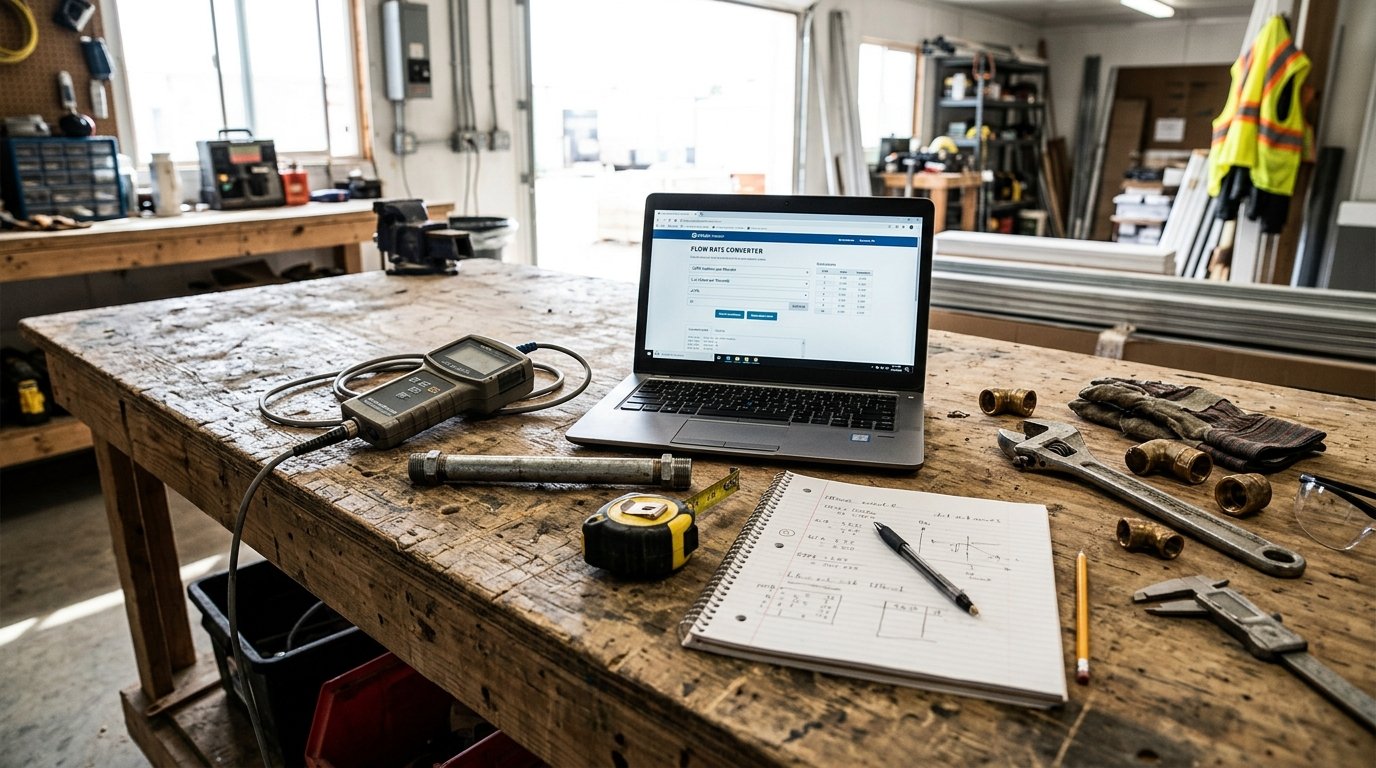
Flow Rate Converter: Convert L/s, L/min, m³/h, GPM & GPH
Flow rate is one of those measurements that follows engineers, plumbers, HVAC technicians, and DIYers into every project. It appears on pump curves, pipe sizing tables, irrigation specifications, HVAC datasheets, and plumbing standards. And it is rarely expressed in the same unit twice. A UK engineer might work in litres per second. An American contractor reads gallons per minute. A European specification quotes cubic metres per hour. An irrigation datasheet uses litres per hour. A water treatment plant quotes cubic metres per second. Without a reliable way to move between those units, simple tasks become error-prone and expensive.
Our Flow Rate Converter is a free online tool that takes the guesswork out of flow-rate conversion. It converts between nine units — litres per second, litres per minute, litres per hour, cubic metres per second, cubic metres per hour, US gallons per minute, UK gallons per minute, US gallons per hour, and UK gallons per hour — instantly, accurately, and without any need to remember conversion factors. Whether you are sizing a pipe, checking a pump curve, specifying a shower, balancing an HVAC system, or designing an irrigation zone, this converter gives you the numbers you need in every unit that matters.
In this guide, we will explain how to use the converter, walk through the underlying conversion factors, show real-world examples across plumbing, HVAC, irrigation, and water treatment, and answer eight of the most frequently asked questions about flow rate units.
Flow Rate Converter
Construction CalculatorConvert flow rates between L/s, L/min, L/h, m³/s, m³/h, GPM (US/UK) and GPH (US/UK).
What is the Flow Rate Converter?
The Flow Rate Converter is a free online tool that converts a single flow rate value into nine different units simultaneously. You enter a value and choose the input unit; the converter returns the equivalent flow rate in every other unit, grouped into Metric and Imperial for clarity.
The calculation uses precise conversion constants, including the exact definitions of the US gallon (3.785411784 L) and the UK imperial gallon (4.54609 L). All conversions are performed through litres per second as the base unit, ensuring that the results are internally consistent and free from rounding errors.
The tool is part of a suite of plumbing and HVAC calculators available on our website. For related calculations, you can use our Pipe Diameter From Flow Calculator, Pipe Volume Calculator (Litres), Water Tank Volume Calculator, and Water Demand / Flow Rate Calculator.
Why Flow Rate Conversion Matters
Flow rate appears in almost every branch of building services, plumbing, and process engineering — and each discipline has its own preferred unit. Mixing units without converting correctly leads to undersized pumps, oversized pipes, failed inspections, and expensive callbacks.
Pump Selection
Pump curves are typically published in m³/h or L/min in Europe and GPM in North America. If you read the curve in the wrong unit, you select a pump that delivers either too much or too little flow for the system. In a domestic heating system, a 20% flow error can leave radiators cold. In a commercial chilled water system, it can cause chiller tripping or unstable control.
Pipe Sizing
Pipe sizing charts are published in multiple unit systems. A UK chart may use L/s; a US chart may use GPM. If you mix them, you can end up with an undersized pipe that produces excessive velocity, noise, and pressure drop — or an oversized pipe that wastes material and slows system response.
Shower and Tap Specifications
Shower and tap flow rates are often quoted in L/min in Europe and GPM in the US. A rainfall shower might be specified at 12 L/min; a US equivalent at 3.2 GPM. If you cannot convert between them, you cannot compare products accurately or demonstrate compliance with water efficiency regulations.
Irrigation Design
Sprinkler and drip irrigation systems are often specified in L/h per zone. Pump and valve sizing may use m³/h. Conversion errors here lead to dry zones, uneven coverage, and wasted water. In large agricultural or landscape projects, small unit errors compound across dozens of zones.
HVAC and Chilled Water
Cooling coils and air handling units are rated in L/s or m³/h for chilled water and GPM for condenser water. Getting the units right is critical for balancing the system and achieving the design ΔT — a critical parameter for chiller efficiency.
Cooling Towers and Boilers
Cooling tower make-up and blowdown rates are typically quoted in m³/h. Boiler feedwater rates are often in L/min or GPM. Without conversion, chemical dosing and water treatment calculations become unreliable, leading to scaling, corrosion, or biological growth.
Building Regulations and Compliance
Many building codes specify flow rates in a specific unit. For example, the UK Part G specifies shower flow rates in L/min, while US codes often reference GPM. Compliance requires the ability to convert between them.
For more information on flow rate, you can refer to Wikipedia’s article on volumetric flow rate or the Engineering Toolbox.
How to Use the Flow Rate Converter
The converter has only two input fields, making it one of the simplest engineering tools you will ever use.
1. Convert From
Select the unit of the value you are entering:
- Litres per second (L/s): Common in UK and European engineering, especially for heating and chilled water.
- Litres per minute (L/min): Common in plumbing fixtures, showers, taps, and small pumps.
- Litres per hour (L/h): Common in irrigation, water treatment, and small-flow applications.
- Cubic metres per second (m³/s): Common in large civil and infrastructure projects — rivers, dams, and major pumping stations.
- Cubic metres per hour (m³/h): Common in HVAC, pumps, water treatment, and cooling towers.
- US gallons per minute (GPM US): Common in North American plumbing and HVAC.
- UK gallons per minute (GPM UK): Common in older UK imperial specifications.
- US gallons per hour (GPH US): Common in US small-flow and dosing applications.
- UK gallons per hour (GPH UK): Common in older UK small-flow applications.
2. Value
Enter the numeric flow rate. Decimals are supported. The converter accepts positive and negative values; negative flow rates represent reverse flow and are handled correctly.
Once you click calculate, the tool displays the equivalent flow rate in all nine units simultaneously, grouped into Metric (L/s, L/min, L/h, m³/s, m³/h) and Imperial (GPM US, GPM UK, GPH US, GPH UK).
Understanding the Conversion Factors
All conversions use litres per second as the base unit. This ensures that every conversion is internally consistent — a value converted from L/min to m³/h will produce exactly the same result as a value converted from m³/h to L/min, regardless of the direction.
Conversion Constants
| Unit | Value in L/s |
|---|---|
| 1 L/s | 1.000000 |
| 1 L/min | 0.016667 |
| 1 L/h | 0.000278 |
| 1 m³/s | 1000.000 |
| 1 m³/h | 0.277778 |
| 1 GPM (US) | 0.063090 |
| 1 GPM (UK) | 0.075768 |
| 1 GPH (US) | 0.001052 |
| 1 GPH (UK) | 0.001263 |
Reverse Conversions From 1 L/s
| Unit | Value |
|---|---|
| L/min | 60.000 |
| L/h | 3600.000 |
| m³/s | 0.001 |
| m³/h | 3.600 |
| GPM (US) | 15.850 |
| GPM (UK) | 13.198 |
| GPH (US) | 951.019 |
| GPH (UK) | 791.889 |
Why the Constants Differ
- US gallon: Defined as exactly 3.785411784 litres.
- UK imperial gallon: Defined as exactly 4.54609 litres.
- Cubic metre: 1000 litres.
- Minute: 60 seconds.
- Hour: 3600 seconds.
The US gallon is approximately 83% of the UK imperial gallon. This difference is the source of most flow-rate conversion errors in international projects. A flow rate quoted as 10 GPM in the US is 12.0 GPM in the UK — a 20% discrepancy that can lead to significant design errors if not caught.
Reference Table of Common Flow Rates
| L/s | L/min | L/h | m³/h | GPM (US) | GPM (UK) |
|---|---|---|---|---|---|
| 0.1 | 6.0 | 360 | 0.36 | 1.59 | 1.32 |
| 0.5 | 30.0 | 1800 | 1.80 | 7.93 | 6.60 |
| 1.0 | 60.0 | 3600 | 3.60 | 15.85 | 13.20 |
| 2.0 | 120.0 | 7200 | 7.20 | 31.70 | 26.40 |
| 5.0 | 300.0 | 18000 | 18.00 | 79.25 | 65.99 |
| 10.0 | 600.0 | 36000 | 36.00 | 158.50 | 131.98 |
| 20.0 | 1200.0 | 72000 | 72.00 | 317.01 | 263.96 |
| 50.0 | 3000.0 | 180000 | 180.00 | 792.52 | 659.91 |
| 100.0 | 6000.0 | 360000 | 360.00 | 1585.03 | 1319.81 |
Use this table for quick sanity checks or when you need an approximate figure on site. For precise conversions, use the calculator.
Example Conversions
Example 1: Domestic Shower
A European rainfall shower is specified at 12 L/min. What is the equivalent in US GPM?
- Input: 12 L/min
- Convert to L/s: 12 / 60 = 0.2 L/s
- Convert to GPM (US): 0.2 × 15.850 = 3.17 GPM (US)
- Result: 12 L/min ≈ 3.17 GPM (US)
Example 2: Heating Circulator
A heating circulator is rated at 2.5 m³/h. What is the equivalent in L/s and both GPM units?
- Input: 2.5 m³/h
- Convert to L/s: 2.5 × 0.277778 = 0.694 L/s
- Convert to GPM (US): 0.694 × 15.850 = 11.00 GPM (US)
- Convert to GPM (UK): 0.694 × 13.198 = 9.16 GPM (UK)
- Result: 2.5 m³/h ≈ 0.69 L/s ≈ 11.0 GPM (US) ≈ 9.16 GPM (UK)
Example 3: Cooling Tower Make-Up
A cooling tower requires 0.5 m³/h of make-up water. What is the equivalent in L/h and L/min?
- Input: 0.5 m³/h
- Convert to L/s: 0.5 × 0.277778 = 0.1389 L/s
- Convert to L/min: 0.1389 × 60 = 8.33 L/min
- Convert to L/h: 0.1389 × 3600 = 500 L/h
- Result: 0.5 m³/h ≈ 8.33 L/min ≈ 500 L/h
Example 4: US Residential Plumbing
A US plumbing fixture is rated at 2.2 GPM (US). What is the equivalent in L/min and UK GPM?
- Input: 2.2 GPM (US)
- Convert to L/s: 2.2 × 0.063090 = 0.1388 L/s
- Convert to L/min: 0.1388 × 60 = 8.33 L/min
- Convert to GPM (UK): 0.1388 × 13.198 = 1.83 GPM (UK)
- Result: 2.2 GPM (US) ≈ 8.33 L/min ≈ 1.83 GPM (UK)
Example 5: Irrigation Zone
A drip irrigation zone is rated at 400 L/h. What is the equivalent in GPH (US)?
- Input: 400 L/h
- Convert to L/s: 400 / 3600 = 0.1111 L/s
- Convert to GPH (US): 0.1111 × 3600 / 3.785411784 = 105.67 GPH (US)
- Result: 400 L/h ≈ 105.7 GPH (US)
Example 6: Large Civil Project
A stormwater pumping station is rated at 0.5 m³/s. What is the equivalent in L/s and m³/h?
- Input: 0.5 m³/s
- Convert to L/s: 0.5 × 1000 = 500 L/s
- Convert to m³/h: 500 × 3.6 = 1800 m³/h
- Result: 0.5 m³/s = 500 L/s = 1800 m³/h
These examples show how the converter handles values across all nine unit systems, from small plumbing fixtures to large civil infrastructure.
Benefits of Using the Flow Rate Converter
Tips for Accurate Flow Rate Conversion
- Always confirm the gallon type. US and UK gallons are not the same. A US GPM value is 20% higher than the equivalent UK GPM value.
- Check the unit label on the source document. Some older specifications do not state which gallon is used. If the document is British, assume UK GPM. If American, assume US GPM.
- Use L/s as your mental base unit. Every other unit can be derived from L/s by a simple multiplier. This helps you sanity-check results.
- Watch for litre vs imperial pints. In older UK documents, “gallons” may refer to imperial gallons (4.546 L), not US gallons (3.785 L).
- Do not confuse flow rate with volume. Flow rate is a rate (volume per unit time). Volume is a fixed quantity. A 100-litre tank filled at 10 L/min takes 10 minutes.
- Verify with a second method. If a value looks wrong, cross-check using the reference table.
- Consider temperature for mass flow. Water density changes slightly with temperature; for volumetric flow, the difference is negligible, but for mass flow, use temperature-corrected density.
- Do not round intermediate values. Round only at the final step to avoid compounding errors.
- Match the unit to the audience. Metric projects should use L/s, L/min, or m³/h. Imperial projects should use GPM.
- Watch out for GPM US vs GPM UK in international projects. This is the most common source of error in cross-border specifications.
- Use the converter to check pump curves. Pump curves from different manufacturers use different units. Convert to your preferred unit before comparing.
- Keep the reference table handy on site. For quick checks, the table is faster than the calculator.
For more information on flow rate units and conversions, you can refer to Wikipedia’s article on volumetric flow rate or the Engineering Toolbox.
Common Mistakes to Avoid
- Confusing US GPM and UK GPM. A 20% error is baked into every conversion if you mix these up.
- Confusing flow rate with volume. Flow rate is per unit time, not a fixed quantity.
- Assuming 1 m³ = 1000 L is enough. This is correct, but the time component must be converted too.
- Forgetting to divide by 60 for per-minute units. A value in L/s must be multiplied by 60 to get L/min, not by 100.
- Using dry gallons instead of liquid gallons. Dry gallons are used for agricultural commodities, not water flow.
- Mixing metric and imperial in the same calculation. Pick one system and convert at the start.
- Assuming all gallons are the same. US and UK gallons differ; other countries may use their own historical definitions.
- Rounding too early. Round at the final step, not the intermediate ones.
- Not double-checking with a reference. A quick sanity check against the table catches most errors.
- Assuming the same unit across different documents. Specifications from different regions use different units — always check.
Practical Applications
Plumbing
Shower mixers, taps, and baths are specified in L/min or GPM. The converter helps compare products across markets and ensures compliance with local water efficiency regulations such as the UK Part G.
HVAC
Chilled water flow rates are specified in L/s or m³/h in Europe and GPM in North America. The converter simplifies equipment selection, balancing, and commissioning, and supports accurate ΔT calculations.
Irrigation
Sprinkler heads are rated in L/h or L/min. Pumps and valves are rated in m³/h or GPM. The converter makes it easy to size irrigation zones and pumps and to avoid both dry spots and over-watering.
Water Treatment
Cooling tower make-up and blowdown are quoted in m³/h. Chemical dosing systems are often quoted in L/h or GPM. The converter supports accurate dosing calculations and reduces the risk of scaling or biological growth.
Industrial Processes
Process water, cooling water, and CIP (clean-in-place) systems use a mix of metric and imperial units. The converter handles all nine units in one pass and reduces the risk of specification errors.
Fire Protection
Sprinkler system flow rates are specified in L/min or GPM depending on the jurisdiction. Fire pump curves may be in either system. The converter simplifies cross-checks during hydraulic calculations.
For more information on flow rate standards, you can refer to Wikipedia’s article on volumetric flow rate or the American Society of Plumbing Engineers (ASPE).
Frequently Asked Questions (FAQ)
Conclusion
The Flow Rate Converter is an essential tool for plumbers, HVAC engineers, irrigation designers, water treatment specialists, and anyone working with water flow across metric and imperial units. It converts between nine units instantly, including the critical distinction between US and UK gallons, and supports both small plumbing fixtures and large civil infrastructure.
By following the tips in this article and using the converter, you can confidently move between unit systems and avoid the errors that catch so many projects off guard. Whether you are sizing a shower, selecting a pump, commissioning an HVAC system, or designing an irrigation zone, accurate flow rate conversion is the foundation of a well-designed system. Try the Flow Rate Converter today and take the guesswork out of your flow rate calculations.






4 Comments