
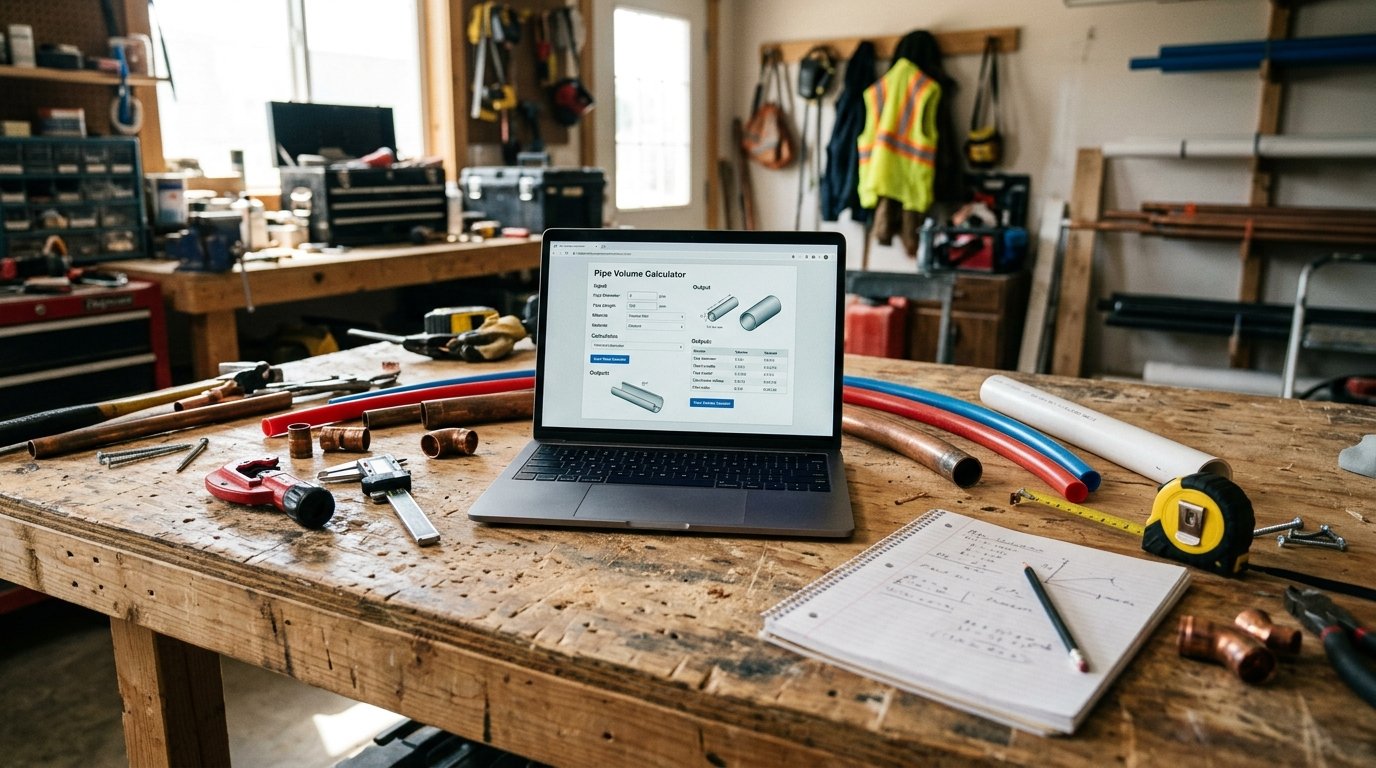
Pipe Volume Calculator (Litres): Litres, Gallons, Mass & Fill Time
Pipe volume is one of those measurements that seems trivial until you actually need it. How much water is sitting in your heating system right now? How much inhibitor do you need to dose? How long will it take to fill the pipe run at a given flow rate? What mass of water is hanging off that ceiling pipe — and will the structure take it? Every one of those questions requires the same calculation: the internal cross-sectional area of the pipe multiplied by its length, adjusted for fill and material.
Our Pipe Volume Calculator is a free online tool that takes the guesswork out of pipe volume estimation. It calculates the internal volume of a pipe run in cubic metres, litres, US gallons, and UK gallons, with accurate internal bores for copper, steel, PEX, and PVC, and supports multiple parallel pipes, fill factor, mass of water, fill/drain time, and pipe cost.
In this guide, we will show you how to use the calculator, explain each input and output, walk through six real-world examples across heating, plumbing, and HVAC, and answer eight of the most frequently asked questions about pipe volume.
Pipe Volume (Litres)
Construction CalculatorInternal volume of a pipe run in litres, gallons, cubic metres and mass of water.
What is the Pipe Volume Calculator?
The Pipe Volume Calculator is a free online tool that determines the internal volume of a pipe or pipe run. It supports four pipe materials (copper, steel, PEX/PERT, PVC/uPVC) plus custom internal diameter, common nominal sizes from DN15 to DN100, parallel pipe count, fill factor, and fill/flush flow rate.
The output includes:
- Internal diameter in mm
- Internal cross-section in mm²
- Number of parallel pipes
- Full pipe volume in m³ and ft³
- Volume at the specified fill factor
- Volume in litres, US gallons, and UK gallons
- Mass of water at fill (kg / lb)
- Fill time in minutes and hours
- Pipe material cost
The tool is part of a suite of plumbing and HVAC calculators available on our website. For related calculations, you can use our Pipe Diameter From Flow Calculator, Flow Rate Converter, Water Tank Volume Calculator, and Water Demand / Flow Rate Calculator.
Why Pipe Volume Matters
Pipe volume is not just an academic number. It drives chemical dosing, system fill time, expansion vessel sizing, structural loads, and heat-up response.
Chemical Dosing and System Volume
Heating and chilled water systems require inhibitor, biocide, or antifreeze at a concentration based on total system volume. If you underestimate the volume of the pipework, you under-dose, and the system corrodes or freezes. If you over-dose, you waste money and may void warranties. Accurate pipe volume is the foundation of accurate chemical dosing.
Expansion Vessel Sizing
Closed heating and cooling systems need an expansion vessel sized for the total water volume and the temperature swing. Pipe volume is a significant part of total system volume — often 20–40% in a domestic system.
Fill and Flush Time
Commissioning a system involves filling, flushing, and pressure testing. Knowing the volume and the fill flow rate tells you how long those operations will take. On a large commercial system with hundreds of metres of pipe, this can be hours.
Mass of Water and Structural Load
Water weighs approximately 1 kg per litre. A 100 m run of DN100 pipe contains 786 litres — nearly 800 kg of water. In large buildings, pipe contents must be accounted for in structural design. Even in a domestic system, a full pipe run can weigh hundreds of kilograms.
Heat-Up Response
Water has high thermal mass. The larger the volume of water in a heating circuit, the slower the system heats up and cools down. Pipe volume is a significant factor in system responsiveness, and in some designs it must be calculated explicitly.
Legionella and Water Hygiene
Water hygiene regulations require flushing and turnover in domestic hot and cold water systems. Pipe volume determines how much water must be drawn through to achieve turnover — a key metric in legionella risk management.
Cost Estimation
Pipe material cost scales with length, but for large projects, the cost of pipe is significant. Adding pipe cost per metre to the calculator gives a rough estimate of the material cost of the pipework.
For more information on pipe volume and hydraulics, you can refer to Wikipedia’s article on piping or the Engineering Toolbox.
How to Use the Pipe Volume Calculator
Using the calculator is straightforward. Here is a breakdown of each field.
1. Pipe
- Pipe length: Enter the total length of pipe in meters or feet. For a pipe run with multiple parallel segments, use the total length of one pipe.
- Pipe material: Select copper, steel (galvanised), PEX/PERT, PVC/uPVC, or “Custom internal diameter”. The material determines the actual internal bore for the nominal size. DN15 is 13.6 mm in copper but 16.1 mm in steel and 11.0 mm in PEX — a significant difference.
- Nominal size: Select the nominal size from DN15 to DN100.
- Custom internal diameter: Enter the internal diameter in meters or inches. Used only when “Custom internal diameter” is selected.
- Parallel pipes: Enter the number of parallel pipes. Default is 1. For a manifold with multiple identical runs, enter the count.
2. Fill
- Fill factor: Enter the fill percentage. 100% for sealed systems (heating, chilled water, domestic water). 70–90% for partially filled drains.
3. Fill time
- Fill / flush flow rate: Enter the flow rate in L/min used for filling or flushing. Used to compute fill time. Set to 0 to skip the fill time output.
4. Costs
- Pipe cost per metre: Enter the local cost per metre of pipe. Used to estimate pipe material cost. Set to 0 to skip.
Once you enter all values, the calculator displays the internal diameter, cross-section, number of pipes, volume in m³ and ft³ (full and at fill), volume in litres and gallons, mass of water, fill time, and pipe cost.
Understanding the Calculations
To make the most of the calculator, it is important to understand each output and the underlying formulas.
Internal Cross-Section Area
Area = π × (d/2)² where d is the internal diameter in metres.
For DN15 copper with d = 13.6 mm:
Area = π × (0.0068)² = 1.453e-4 m² = 145.3 mm².
Volume Per Pipe
Volume = Area × Length.
For a 20 m pipe with cross-section 1.453e-4 m²:
V = 1.453e-4 × 20 = 2.906e-3 m³ = 2.906 L.
Fill Factor
The fill factor scales the volume for partially filled pipes:
V_fill = V_full × fill / 100
For a fully flooded sealed system, fill = 100%.
Volume Across Parallel Pipes
Total volume = Single pipe volume × number of parallel pipes.
Litres and Gallons
- 1 m³ = 1000 L
- 1 L = 0.264172 US gallons
- 1 L = 0.219969 UK imperial gallons
The US and UK gallons differ by about 20%. For critical international work, make sure you use the right one.
Mass of Water
Mass = Volume × Density.
At 20 °C, fresh water density is 998 kg/m³. The calculator uses this value to estimate mass, which is useful for structural loads, chemical dosing calculations, and heat-up response.
Fill Time
Fill time = Volume (L) / Fill flow rate (L/min).
For a 50 L system filled at 10 L/min, fill time = 5 minutes.
Internal Diameter by Material
The following table shows the internal diameters used for each material and size:
| Size | Copper | Steel | PEX | PVC |
|---|---|---|---|---|
| DN15 | 13.6 | 16.1 | 11.0 | 13.0 |
| DN20 | 17.6 | 21.7 | 16.0 | 17.0 |
| DN22 | 20.2 | 23.7 | 17.8 | 18.8 |
| DN25 | 22.9 | 27.3 | 20.4 | 21.0 |
| DN28 | 25.6 | 30.3 | 22.8 | 24.0 |
| DN32 | 29.6 | 36.0 | 26.2 | 27.2 |
| DN40 | 37.6 | 41.8 | 32.6 | 34.0 |
| DN50 | 47.6 | 53.0 | 40.8 | 42.6 |
| DN65 | 63.0 | 68.8 | 53.0 | 56.0 |
| DN80 | 77.6 | 80.5 | 65.0 | 68.0 |
| DN100 | 97.6 | 105.5 | 82.0 | 88.0 |
Note that a “DN25 pipe” has four different internal bores depending on the material — that is why the calculator asks for both material and size.
Pipe Cost
Cost = Length × Parallel pipes × Cost per metre.
Understanding these components helps you interpret the results and adjust your design. For more information on pipe sizing and material standards, you can refer to Wikipedia’s article on piping or the Engineering Toolbox.
Example Calculations
Let’s run through six examples across heating, plumbing, and HVAC.
Example 1: Domestic Heating System, 60 m of DN22 Copper
Inputs:
- Length: 60 m
- Material: Copper
- Size: DN22
- Parallel pipes: 1
- Fill: 100%
- Flow: 10 L/min
Calculations:
- d = 20.2 mm = 0.0202 m
- Area = π × 0.0101² = 3.205e-4 m² = 320.5 mm²
- V_full = 3.205e-4 × 60 = 0.01923 m³ = 19.23 L
- V_fill = 19.23 L (100%)
- Mass = 19.23 × 0.998 = 19.19 kg
- Fill time = 19.23 / 10 = 1.92 min
- US gal = 19.23 × 0.264172 = 5.08 gal
- UK gal = 19.23 × 0.219969 = 4.23 gal
Example 2: Commercial Chilled Water Riser, 150 m of DN100 Steel
Inputs:
- Length: 150 m
- Material: Steel
- Size: DN100
- Parallel pipes: 1
- Fill: 100%
- Flow: 50 L/min
Calculations:
- d = 105.5 mm
- Area = π × 0.05275² = 8.740e-3 m² = 8740 mm²
- V_full = 8.740e-3 × 150 = 1.311 m³ = 1311 L
- Mass = 1311 × 0.998 = 1308 kg (over 1.3 tonnes!)
- Fill time = 1311 / 50 = 26.2 min = 0.437 h
- US gal = 1311 × 0.264172 = 346.3 gal
- UK gal = 1311 × 0.219969 = 288.4 gal
Example 3: Manifold with 8 Parallel PEX Runs
Inputs:
- Length: 25 m
- Material: PEX
- Size: DN20
- Parallel pipes: 8
- Fill: 100%
- Flow: 15 L/min
Calculations:
- d = 16.0 mm
- Area = π × 0.008² = 2.011e-4 m²
- V_one = 2.011e-4 × 25 = 5.027e-3 m³ = 5.027 L
- V_total = 5.027 × 8 = 40.22 L
- Mass = 40.22 × 0.998 = 40.14 kg
- Fill time = 40.22 / 15 = 2.68 min
Example 4: Gravity Drain at 80% Fill, 40 m of DN50 PVC
Inputs:
- Length: 40 m
- Material: PVC
- Size: DN50
- Parallel pipes: 1
- Fill: 80%
- Flow: 0
Calculations:
- d = 42.6 mm
- Area = π × 0.0213² = 1.425e-3 m² = 1425 mm²
- V_full = 1.425e-3 × 40 = 0.057 m³ = 57.0 L
- V_fill = 57.0 × 0.80 = 45.6 L
- Mass at fill = 45.6 × 0.998 = 45.51 kg
- Fill time = not shown (flow = 0)
Example 5: Long-Distance Mains, 200 m of DN32 PEX
Inputs:
- Length: 200 m
- Material: PEX
- Size: DN32
- Parallel pipes: 1
- Fill: 100%
- Flow: 20 L/min
Calculations:
- d = 26.2 mm
- Area = π × 0.0131² = 5.392e-4 m²
- V_full = 5.392e-4 × 200 = 0.1078 m³ = 107.8 L
- Mass = 107.8 × 0.998 = 107.6 kg
- Fill time = 107.8 / 20 = 5.39 min
Example 6: Heating Header with 4 Parallel DN40 Steel Pipes, with Cost
Inputs:
- Length: 30 m
- Material: Steel
- Size: DN40
- Parallel pipes: 4
- Fill: 100%
- Flow: 40 L/min
- Pipe cost per metre: $12
Calculations:
- d = 41.8 mm
- Area = π × 0.0209² = 1.372e-3 m²
- V_one = 1.372e-3 × 30 = 0.04116 m³ = 41.16 L
- V_total = 41.16 × 4 = 164.6 L
- Mass = 164.6 × 0.998 = 164.3 kg
- Fill time = 164.6 / 40 = 4.12 min
- Pipe cost = 30 × 4 × $12 = $1,440
These examples show how the calculator handles a wide range of lengths, materials, sizes, and parallel configurations.
Benefits of Using the Pipe Volume Calculator
Tips for Accurate Pipe Volume Calculation
- Use the material-specific internal bore. DN is not the same as ID — the same DN pipe has different bores in copper, steel, PEX, and PVC.
- Account for parallel pipes. Manifolds and multi-pipe runs are common in heating and chilled water systems.
- Use 100% fill for sealed systems. Fill factor only matters for drains or partially filled pipes.
- Add a safety margin for chemical dosing. Add 10–20% to pipe volume to account for fittings, valves, and the boiler or chiller itself.
- Include fittings in fill time. Elbows, tees, and valves slow the fill rate. Add 10–30% to fill time for a conservative estimate.
- Verify water density if temperature is unusual. The calculator uses 998 kg/m³ at 20 °C. Hot water is slightly lighter, cold water slightly heavier.
- Check structural loads. A full DN100 steel pipe weighs more than 1 tonne per 100 m. Make sure structural engineers are aware.
- Use fill time for commissioning. Flushing at 1.5× the pipe volume is typical for commissioning. The calculator gives you the base volume; multiply by the flush ratio.
- Add pipe cost for large projects. Pipe material cost scales with length × parallel pipes × unit cost.
- Verify with a professional. For critical systems, have a mechanical engineer verify the design.
- Remember thermal expansion. In hot water systems, water expands by ~4% from 4 °C to 80 °C. Expansion vessels are sized for this.
- Account for the boiler or cylinder. These contain significant additional water — a domestic boiler holds 5–20 L, a cylinder 100–250 L.
For more information on pipe volume and hydraulics, you can refer to Wikipedia’s article on piping or the Engineering Toolbox.
Common Mistakes to Avoid
- Using nominal DN as internal diameter. DN15 in copper is 13.6 mm ID, not 15 mm.
- Forgetting parallel pipes. Manifolds with 4, 6, or 8 identical runs are common in heating.
- Ignoring the boiler or cylinder. These add significant volume that must be included in chemical dosing.
- Assuming fill time equals drain time. Drain time is usually different because of air ingress and pressure differences.
- Skipping the fill factor for drains. Partially filled drains contain less water than the full pipe volume.
- Using the wrong gallon type. US and UK gallons differ by 20%.
- Overlooking water mass in structural calculations. Water is heavy — a full DN100 pipe is over 8 kg per metre.
- Forgetting thermal expansion. Water expands with temperature; the sealed system needs an expansion vessel.
- Using approximate density for mass. Use 998 kg/m³ at 20 °C, or adjust for temperature.
- Not consulting a professional. For large or critical systems, always verify with a mechanical engineer.
Frequently Asked Questions (FAQ)
Conclusion
The Pipe Volume Calculator is an essential tool for plumbers, heating engineers, HVAC designers, and contractors. It calculates the internal volume of a pipe or pipe run in litres, cubic metres, and gallons, with accurate internal bores for copper, steel, PEX, and PVC. It also computes the mass of water, fill time, and pipe cost — practical outputs that support chemical dosing, expansion vessel sizing, commissioning planning, and structural load calculations.
Whether you are commissioning a small domestic heating system or sizing a commercial chilled water riser, accurate pipe volume is the foundation of a well-designed system. Try the Pipe Volume Calculator today and take the guesswork out of your pipework calculations.





3 Comments