Septic Tank Sizing Calculator: Flow, Volume, Drainfield & Costs
A septic system is one of the few pieces of infrastructure on a property that you cannot see working — until it fails. Unlike a boiler or a heat pump, a septic tank and drainfield operate silently underground, processing hundreds of litres of wastewater every day, and their design depends on a delicate balance between daily flow, tank volume, retention time, and soil percolation. Get the sizing wrong and you face overflowing tanks, blocked drainfields, contaminated groundwater, and enforcement action from local authorities.
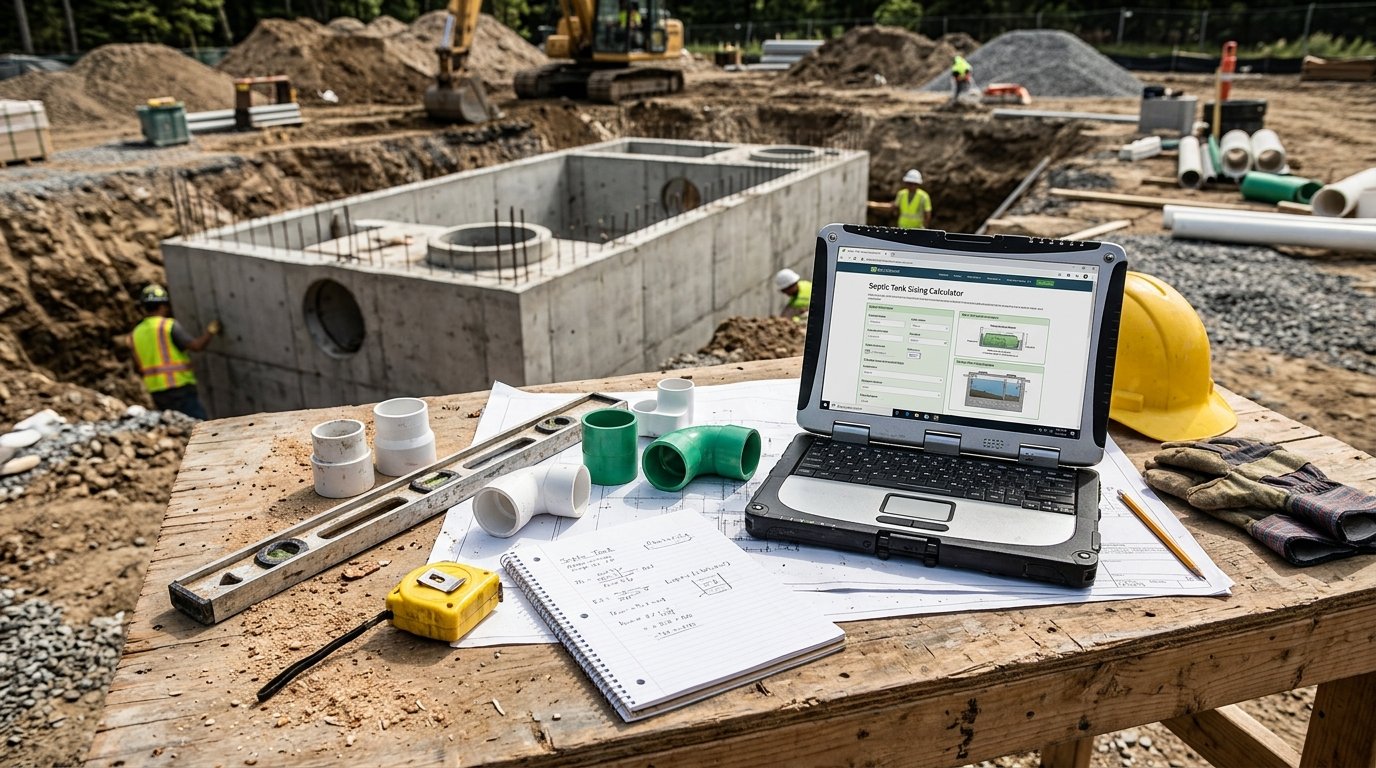
Our Septic Tank Sizing Calculator is a free online tool that takes the guesswork out of septic system design. It calculates the daily wastewater flow, the required tank volume (including sludge and scum allowance and design reserve), the actual tank dimensions, the desludging interval, the drainfield area and trench length, the gravel volume, and the total installed cost. It supports three system types — traditional septic tank, aerobic treatment plant, and cesspool — plus optional reed bed, effluent filter, and pump chamber.
In this guide, we will show you how to use the calculator, explain each input and output, walk through real-world examples for a family home and a small commercial property, and answer eight of the most frequently asked questions about septic tank sizing.
Septic Tank Sizing
Construction CalculatorSeptic tank sizing: daily flow, tank volume, desludging, drainfield and costs.
What is the Septic Tank Sizing Calculator?
The Septic Tank Sizing Calculator is a free online tool that estimates the design parameters of an on-site wastewater treatment system. It supports:
- System types: traditional septic tank + drainfield, aerobic treatment plant, or cesspool.
- Sizing inputs: number of occupants, daily wastewater per person, retention time, sludge and scum allowance, design reserve.
- Tank geometry: cylindrical or rectangular (2:1), width/diameter, wall thickness.
- Sludge management: accumulation rate, desludging cost, desludging interval.
- Drainfield design: soil percolation class, trench width, depth, count, stone backfill factor.
- Secondary treatment: reed bed, effluent filter, pump chamber, vent pipe.
- Compliance: regulatory distance checks to dwelling, watercourse, and well.
- Costs: tank, installation, drainfield, filter, pump, vent.
The output includes:
- Daily wastewater flow
- Liquid capacity, sludge and scum space, base and design tank volume
- Recommended tank volume in L and m³
- Tank height, length, width, footprint, concrete volume
- Sludge accumulation and desludging interval
- Drainfield area, total trench length, length per trench, gravel volume
- Reed bed area, pump chamber volume, vent pipe length
- Compliance warning (or “Distances OK”)
- Itemised costs and total installed cost
The tool is part of a suite of plumbing and HVAC calculators available on our website. For related calculations, you can use our Water Demand / Flow Rate Calculator, Water Tank Volume Calculator, Pipe Volume Calculator (Litres), and Flow Rate Converter.
Why Accurate Septic Tank Sizing Matters
A septic system is a long-term asset that will serve the property for decades. Getting the sizing right is not optional — it is a regulatory requirement in most jurisdictions, and getting it wrong has serious consequences.
Regulatory Compliance
Most building codes require septic systems to be designed by a qualified person, using recognised sizing rules based on daily flow, retention time, and soil conditions. If your system does not meet these rules, you may be refused a permit — or, worse, be required to rebuild it after construction.
Environmental Protection
An undersized or poorly designed septic system can discharge partially treated effluent into groundwater or nearby watercourses, causing contamination and environmental damage. In sensitive areas (near wells, lakes, or rivers), the consequences can be severe and expensive.
Public Health
Septic systems treat wastewater from households and small businesses. If they fail, they can spread pathogens, including bacteria and viruses, that cause serious illness. Correct sizing ensures the effluent is adequately treated before it reaches groundwater.
Cost of Remediation
Replacing a failed septic system costs 2–3× more than installing a new one. Excavation, removal of failed components, soil remediation, and reinstallation are all expensive. Getting the sizing right the first time is the cheapest option by far.
Drainfield Longevity
The drainfield is the most expensive and most fragile part of the system. It relies on the soil to absorb and treat effluent over many years. If the loading rate is too high, the soil becomes clogged and the drainfield fails — a problem that can cost tens of thousands to fix.
Desludging Frequency
Sludge and scum accumulate at roughly 25–40 L per person per year. If the tank is sized without accounting for sludge, the desludging interval becomes short and expensive. Correct sizing gives a realistic desludging interval of 3–5 years for most households.
Property Value
A well-designed, compliant septic system adds value to a rural or off-grid property. An undersized or non-compliant system reduces it — and in some cases, makes the property unsellable.
For more information on septic systems, you can refer to Wikipedia’s article on septic tanks or the United States Environmental Protection Agency (EPA).
How to Use the Septic Tank Sizing Calculator
Using the calculator is straightforward. Here is a breakdown of each field.
1. Household
- Occupants: Enter the number of people using the system. This drives daily wastewater flow and sludge accumulation.
- Wastewater per person: Enter daily wastewater per person in litres. 120–200 L/person/day is typical; check your local code.
2. System
- System type: Select septic tank, treatment plant, or cesspool. Each uses different sizing rules:
- Septic tank: retention-based (usually 2 days), plus sludge and scum allowance. Discharges to a drainfield.
- Treatment plant: aerobic, sized on population equivalent (typically 1.2× daily flow), produces cleaner effluent that can use a smaller drainfield.
- Cesspool: holding tank only — no discharge. Sized to hold 14 days of flow for emptying intervals.
3. Tank Sizing
- Retention time: Days of flow that the tank can retain. Minimum 1–2 days for a septic tank.
- Sludge + scum: Percentage allowance for settled sludge and floating scum. Typically 30–50% of the tank volume.
- Design reserve: Allowance for peak flows and future growth. 25% is typical.
4. Tank Dimensions
- Tank shape: Cylindrical or rectangular (2:1 aspect ratio).
- Tank width / diameter: Used to compute the tank footprint and height.
- Wall thickness: Used to estimate the concrete volume.
5. Sludge
- Sludge accumulation: Litres per person per year. Typically 25–40 L/person/year.
- Desludging cost per m³: Local cost to pump out sludge. Used to estimate the cost per desludging operation.
6. Drainfield
- Soil percolation: Fast (sandy) at 30 L/m²/day, medium (loam) at 20 L/m²/day, slow (clay) at 12 L/m²/day. The loading rate determines the drainfield area.
- Trench width: Typically 0.6–0.9 m.
- Trench depth: Typically 0.6–1.0 m.
- Number of trenches: Parallel distribution trenches. 3 is typical; some designs use 4–6.
- Stone backfill: Volume of gravel around the pipe as a percentage of trench volume. 40% is typical.
7. Secondary
- Reed bed: Optional. Sized at 1.5 m² per person.
- Effluent filter: Optional. Modern requirement in many jurisdictions.
- Pump chamber: Optional. 500 L chamber required when gravity drainage is not possible.
- Vent pipe length: Distance from tank to above the roof line.
8. Distances
- Distance to dwelling: Regulatory minimum typically 7–15 m.
- Distance to watercourse: Regulatory minimum typically 10 m.
- Distance to well / borehole: Regulatory minimum typically 15–50 m.
The calculator checks these distances and displays a warning if any are below the typical minimum.
9. Costs
- Tank price: Local price for the recommended tank size.
- Installation & excavation: Excavation, bedding, backfill.
- Drainfield materials & install: Gravel, perforated pipe, geotextile, labor.
- Effluent filter cost: Local price.
- Pump chamber cost: Local price.
- Vent pipe per metre: Local price per metre.
Once you enter all values, the calculator displays the full output, including daily flow, tank volume, dimensions, desludging interval, drainfield area, gravel volume, compliance warning, and itemised costs.
Understanding the Calculations
To make the most of the calculator, it is important to understand each output and the underlying formulas.
Daily Wastewater Flow
Daily flow = occupants × wastewater per person per day.
For 4 people at 150 L/day: 600 L/day.
Tank Sizing by System Type
Septic tank:
- Liquid capacity = daily flow × retention days (usually 2 days)
- Sludge + scum = liquid capacity × sludge %
- Base tank = liquid + sludge
- Design tank = base × (1 + reserve %)
Treatment plant:
- Liquid capacity = daily flow × 1.2
- Sludge + scum = liquid × sludge %
- Base and design tank as above
- Drainfield loading rate: 30 L/m²/day (treated effluent is cleaner)
Cesspool:
- Liquid capacity = daily flow × 14 days (no discharge)
- No sludge allowance (emptied completely)
- No drainfield
Tank Dimensions
For a cylindrical tank: volume = π × r² × h, so height = volume / (π × r²).
For a rectangular tank with 2:1 aspect ratio: volume = L × W × h, where L = 2W.
Concrete Volume
Approximate wall and base volume:
- Cylindrical: 2πrh × wall thickness + 2 × πr² × wall thickness (walls + base + lid)
- Rectangular: 2(L+W)h × wall thickness + 2 × L × W × wall thickness
This gives a rough estimate of the concrete required for a cast-in-place tank.
Desludging Interval
Sludge accumulates at approximately 25–40 L per person per year. The tank has a fixed sludge storage volume (the sludge allowance in the tank). Desludging interval = sludge capacity / annual sludge production.
For 4 people at 30 L/year = 120 L/year; sludge capacity in a 2-day septic tank = 480 L; interval = 4 years.
Drainfield Area
Drainfield area = daily flow / soil loading rate.
For 600 L/day in medium soil (20 L/m²/day): area = 30 m².
Trench Length
Total trench length = drainfield area / trench width.
For 30 m² / 0.6 m = 50 m total. Divided by 3 trenches = 16.7 m per trench.
Gravel Volume
Gravel volume = trench length × width × depth × stone factor.
For 50 m × 0.6 m × 0.8 m × 0.4 = 9.6 m³ of gravel.
Reed Bed
Sized at 1.5 m² per person. For 4 people: 6 m².
Compliance Distances
Regulatory minimum distances vary by jurisdiction, but typical minimums are:
- Dwelling: 7–15 m
- Watercourse: 10 m
- Well / borehole: 15–50 m
The calculator flags if any distance is below the typical minimum.
Understanding these components helps you interpret the results and adjust your design. For more information on septic system design standards, you can refer to Wikipedia’s article on septic tanks or the United States Environmental Protection Agency (EPA).
Example Calculations
Let’s run through two examples: a family home with a standard septic system, and a small commercial property with a treatment plant.
Example 1: Family Home, 4 Occupants, Standard Septic Tank
Inputs:
- Occupants: 4
- Wastewater per person: 150 L/day
- System type: Septic tank
- Retention: 2 days
- Sludge + scum: 40%
- Reserve: 25%
- Tank shape: Cylindrical
- Tank diameter: 2.0 m
- Wall thickness: 100 mm
- Sludge accumulation: 30 L/person/year
- Desludging cost per m³: $200
- Soil: Medium
- Trench width: 0.6 m
- Trench depth: 0.8 m
- Trench count: 3
- Stone backfill: 40%
- Reed bed: No
- Effluent filter: Yes
- Pump chamber: No
- Vent pipe: 10 m
- Distances: 10 m dwelling, 15 m watercourse, 50 m well
- Tank price: $2,500
- Installation: $4,000
- Drainfield materials: $3,000
- Filter cost: $400
- Vent pipe per m: $8
Calculations:
- Daily flow = 4 × 150 = 600 L/day
- Liquid capacity = 600 × 2 = 1,200 L
- Sludge + scum = 1,200 × 0.40 = 480 L
- Base tank = 1,200 + 480 = 1,680 L
- Design tank = 1,680 × 1.25 = 2,100 L = 2.1 m³
- Tank footprint = π × 1² = 3.142 m²
- Tank height = 2.1 / 3.142 = 0.668 m
- Concrete volume ≈ (2π × 1 × 0.668 × 0.1) + (2 × 3.142 × 0.1) = 0.420 + 0.628 = 1.05 m³
- Sludge accumulation = 4 × 30 = 120 L/year
- Desludging interval = 480 / 120 = 4.0 years
- Cost per desludging = 0.48 × $200 = $96
- Drainfield area = 600 / 20 = 30 m²
- Total trench length = 30 / 0.6 = 50 m
- Per trench = 50 / 3 = 16.7 m
- Gravel volume = 50 × 0.6 × 0.8 × 0.4 = 9.6 m³
- Reed bed = N/A
- Pump chamber = N/A
- Vent pipe = 10 m
- Compliance: All distances OK
- Costs: $2,500 + $4,000 + $3,000 + $400 + (10 × $8) = $9,980 total
Example 2: Small Commercial Property, 20 Occupants, Treatment Plant
Inputs:
- Occupants: 20
- Wastewater per person: 120 L/day
- System type: Treatment plant
- Retention: 2 days (not used; treatment plant uses 1.2×)
- Sludge + scum: 50%
- Reserve: 25%
- Tank shape: Rectangular
- Tank width: 2.5 m
- Wall thickness: 150 mm
- Sludge accumulation: 35 L/person/year
- Desludging cost per m³: $250
- Soil: Fast
- Trench width: 0.6 m
- Trench depth: 0.9 m
- Trench count: 4
- Stone backfill: 40%
- Reed bed: No
- Effluent filter: Yes
- Pump chamber: Yes
- Vent pipe: 15 m
- Distances: 15 m dwelling, 30 m watercourse, 50 m well
- Tank price: $8,000
- Installation: $12,000
- Drainfield materials: $5,000
- Filter cost: $600
- Pump chamber cost: $2,500
- Vent pipe per m: $8
Calculations:
- Daily flow = 20 × 120 = 2,400 L/day
- Liquid capacity = 2,400 × 1.2 = 2,880 L
- Sludge + scum = 2,880 × 0.50 = 1,440 L
- Base tank = 4,320 L
- Design tank = 4,320 × 1.25 = 5,400 L = 5.4 m³
- Tank footprint = 2 × 2.5 × 2.5 = 12.5 m² (rectangular L=5, W=2.5)
- Wait: L = 2 × W = 5.0 m; footprint = 5.0 × 2.5 = 12.5 m²
- Tank height = 5.4 / 12.5 = 0.432 m
- Concrete volume = 2 × (5.0 + 2.5) × 0.432 × 0.15 + 2 × 12.5 × 0.15 = 0.972 + 3.75 = 4.72 m³
- Sludge accumulation = 20 × 35 = 700 L/year
- Desludging interval = 1,440 / 700 = 2.06 years
- Cost per desludging = 1.44 × $250 = $360
- Drainfield area = 2,400 / 30 = 80 m² (treatment plant uses 30 L/m²/day)
- Total trench length = 80 / 0.6 = 133.3 m
- Per trench = 133.3 / 4 = 33.3 m
- Gravel volume = 133.3 × 0.6 × 0.9 × 0.4 = 28.8 m³
- Pump chamber = 500 L
- Vent pipe = 15 m
- Compliance: OK
- Costs: $8,000 + $12,000 + $5,000 + $600 + $2,500 + (15 × $8) = $28,220 total
These examples show how the calculator handles a domestic septic tank and a small commercial treatment plant.
Benefits of Using the Septic Tank Sizing Calculator
Tips for Accurate Septic System Sizing
- Confirm daily wastewater per person. Local codes often specify a minimum (e.g., 150 L/person/day). Use the code value, not the household’s actual consumption.
- Check the retention requirement. Most codes require 1–2 days retention for a septic tank. Some require more.
- Account for sludge and scum. 30–50% of the tank volume should be reserved for sludge and scum. If you skip this, the tank will need desludging far more often.
- Use a percolation test. Soil classification (fast / medium / slow) is approximate. A percolation test gives the actual loading rate.
- Consider tank shape and site access. Cylindrical tanks are common but rectangular tanks fit more easily into tight sites.
- Plan desludging access. A tank that cannot be reached by a vacuum tanker cannot be emptied. Ensure access is provided at design stage.
- Check distances carefully. Regulatory minimum distances from dwelling, watercourse, and well are non-negotiable.
- Consider treatment plant vs septic tank. Treatment plants produce cleaner effluent and can use smaller drainfields, but they need power and regular maintenance.
- Include a reserve. Peak flows (guests, holidays, rainfall infiltration) can exceed daily average by 50% or more.
- Use a reed bed where space allows. Reed beds provide secondary treatment and improve effluent quality.
- Add an effluent filter. Modern regulations in many jurisdictions require an effluent filter to protect the drainfield.
- Verify with a professional. For any system that serves a dwelling, have a qualified engineer or septic designer verify the design.
For more information on septic system standards, you can refer to Wikipedia’s article on septic tanks or the United States Environmental Protection Agency (EPA).
Common Mistakes to Avoid
- Undersizing the tank. A tank that is too small fills with sludge quickly, requiring frequent desludging and causing carryover into the drainfield.
- Oversizing the tank. An oversized tank retains wastewater for too long, leading to anaerobic conditions and poor treatment.
- Ignoring sludge allowance. Sludge and scum occupy 30–50% of tank volume. If you size for liquid only, the tank will fail early.
- Skipping the drainfield sizing. The drainfield is not an afterthought — it is the treatment component. Size it correctly for the daily flow and soil.
- Using the wrong loading rate. Sandy soil accepts 30 L/m²/day; clay accepts only 12. Using the wrong rate leads to drainfield failure.
- Forgetting the compliance distances. A tank too close to a well or watercourse is non-compliant and a health hazard.
- Not providing desludging access. A tank that cannot be pumped out will fail within a few years.
- Skipping the reserve. Peak flows can exceed average by 50% or more. A 25% reserve is minimum.
- Ignoring pump chamber requirements. Gravity drainage is not always possible. A pump chamber adds cost but is often essential.
- Not consulting a professional. Septic design is regulated. Always have a qualified engineer or designer verify the sizing.
Frequently Asked Questions (FAQ)
Conclusion
The Septic Tank Sizing Calculator is an essential tool for homeowners, engineers, and contractors designing on-site wastewater systems. It calculates daily flow, tank volume, dimensions, desludging interval, drainfield area, gravel volume, and total installed cost — with compliance checks for regulatory distances and support for septic tanks, treatment plants, and cesspools.
Whether you are planning a new rural property, upgrading an existing system, or designing a small commercial installation, accurate septic sizing is the foundation of a reliable, compliant, and long-lasting system. Try the Septic Tank Sizing Calculator today and take the guesswork out of your wastewater design.