Sprinkler / Irrigation Heads Calculator: Flow, Pressure & Cost
Irrigation is one of those disciplines that looks simple until you actually try to design it. Sprinkler head spacing, flow rates, overlap, zone sequencing, pipe sizing, soil infiltration, plant water requirement, source pressure, elevation — every one of these factors interacts with the others, and getting any of them wrong leads to dry patches, runoff, wasted water, or a failed system that never delivers what it promised. The difference between a professionally designed irrigation system and a DIY layout is not just cost — it is reliability.
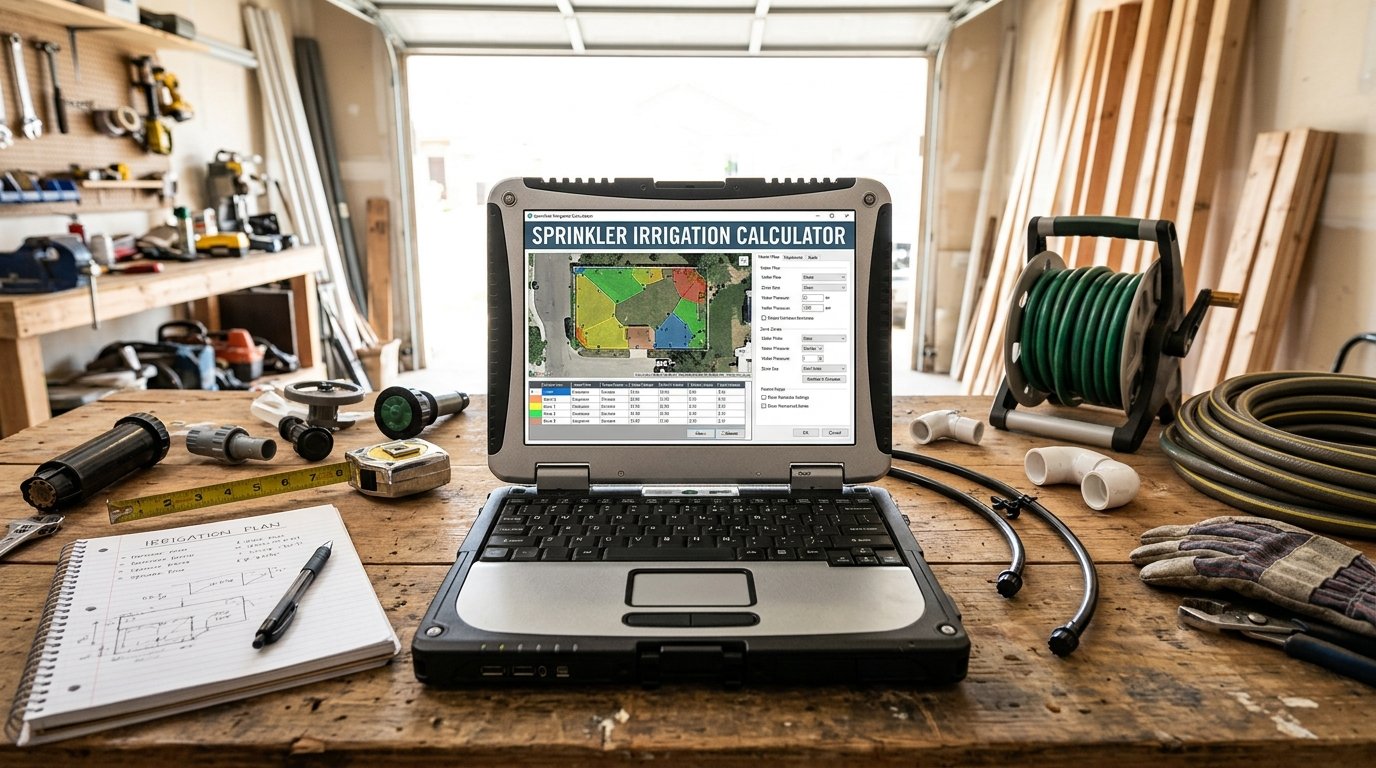
Our Sprinkler / Irrigation Heads Calculator is a free online tool that takes the guesswork out of irrigation design. It calculates head count, flow per zone, pipe bore, application rate, runtime, pressure requirement, water use, and total installed cost — with checks against soil infiltration, available supply flow, and available supply pressure. It supports spray heads, rotor heads, and drip line, with optional backflow preventer, filter/regulator, and rain sensor.
In this guide, we will show you how to use the calculator, explain each input and output, walk through two full design examples — a domestic garden and a commercial landscape — and answer eight of the most frequently asked questions about irrigation systems.
Sprinkler / Irrigation Heads
Construction CalculatorIrrigation design: head count, zone flow, pipe sizing, application rate, runtime, water use and costs.
What is the Sprinkler / Irrigation Head Calculator?
The Sprinkler / Irrigation Head Calculator is a free online tool that designs the key parameters of a sprinkler or drip irrigation system. It supports:
- Head types: spray, rotor, drip line / emitters.
- Head specifications: radius, flow per head, overlap factor, drip emitter density.
- Zone configuration: number of sequential zones.
- System checks: available supply flow, available supply pressure, total pipe length, elevation gain, pipe velocity.
- Application targets: plant type (lawn, beds, shrubs, trees), soil infiltration class, growing season length.
- Costs: heads, zone valves, controller, backflow preventer, filter/regulator, rain sensor, water cost per m³.
The output includes:
- Irrigated area
- Heads / emitters required
- Heads per zone
- Flow per zone
- Pipe bore required
- Required pressure at head
- Pipe friction loss
- Elevation loss
- Required source pressure
- Application rate (mm/h)
- Soil max infiltration (mm/h)
- Target water requirement (mm/week)
- Runtime per zone (min/week)
- Water per week and per season (m³)
- Annual water cost
- Overall status (Design OK or warnings)
- Itemised costs and total installed cost
The tool is part of a suite of plumbing and HVAC calculators available on our website. For related calculations, you can use our Pipe Diameter From Flow Calculator, Flow Rate Converter, Pipe Volume Calculator (Litres), and Water Demand / Flow Rate Calculator.
Why Accurate Irrigation Design Matters
Irrigation is one of the largest uses of water in residential and commercial landscapes. A poorly designed system wastes water, drowns plants, causes runoff, and requires constant adjustment. A well-designed system delivers the right amount of water to the right place at the right time, with minimal waste and maximum plant health.
Water Conservation
In many jurisdictions, outdoor water use is regulated — especially during drought. A properly designed system with matched precipitation rates, correct zoning, and soil-appropriate application rates uses 30–50% less water than a poorly designed one. With rising water costs, that saving pays back the design investment within a few seasons.
Plant Health
Plants need the right amount of water at the right rate. Overwatering causes root rot, fungal disease, and nutrient leaching. Underwatering causes stress, wilting, and death. Matching application rate to soil infiltration and plant water requirement ensures healthy plants with minimal intervention.
Runoff and Erosion
If the application rate exceeds the soil infiltration rate, water runs off the surface instead of soaking in. This wastes water, causes erosion, and can carry pollutants into stormwater systems. The calculator checks this and warns when the design would cause runoff.
Pressure and Flow Balance
Sprinkler heads are rated for a specific pressure — typically 2 bar for spray, 3 bar for rotor, and 1.5 bar for drip. If pressure at the head is too low, the spray pattern collapses and coverage becomes uneven. If it is too high, heads mist and waste water. The calculator computes friction loss and elevation so you can verify the source can deliver the required pressure.
Zone Design
Splitting a system into zones is not optional for most properties. A single zone with too many heads exceeds available flow and drops pressure. Multiple zones run sequentially, each with a manageable head count and flow. The calculator computes the flow and head count per zone.
System Longevity
A well-designed system runs within its components’ ratings — heads at the right pressure, valves below their flow limits, pipe at reasonable velocity, controller delivering the right runtime. A poorly designed system stresses every component and requires constant repair.
Compliance and Backflow Prevention
Most jurisdictions require a backflow preventer (also called a vacuum breaker or RPZ valve) on any irrigation system connected to a potable water supply. This prevents irrigation water from contaminating the drinking water supply. The calculator includes this as an optional cost.
For more information on irrigation design, you can refer to Wikipedia’s article on irrigation sprinklers or the Irrigation Association.
How to Use the Sprinkler / Irrigation Head Calculator
Using the calculator is straightforward. Here is a breakdown of each field.
1. Area
- Area length: Enter the length of the area to be irrigated.
- Area width: Enter the width of the area to be irrigated.
The calculator computes area = length × width.
2. Heads
- Head type: Select spray, rotor, or drip line.
- Spray head: Small radius (~4 m), high flow (8–15 L/min), best for small lawns and beds.
- Rotor head: Large radius (~10 m), high flow (20–40 L/min), best for large lawns.
- Drip line: Line emitters, low flow (2–4 L/min per emitter), best for beds, hedges, and planters.
- Head radius: For spray and rotor, the distance the head throws water. Typically 4 m for spray, 10 m for rotor.
- Flow per head: Flow rate of one head, in L/min.
- Overlap factor: Head-to-head overlap percentage. 30% is typical; 50% for windy or sloped sites.
- Drip emitter density: For drip line, the number of emitters per m². Typically 2–8.
- Number of zones: Sequential zones. Each zone runs one at a time. 3–6 zones is typical for a domestic garden.
3. System
- Available supply flow: The flow rate available from the tap or pump, in L/min. Leave 0 to skip the check.
- Available supply pressure: Static pressure at the source, in bar. Leave 0 to skip the check.
- Total pipe length: Main line + laterals, in metres. Used for friction loss.
- Elevation gain: Height from source to the highest head, in metres.
- Pipe velocity: Design velocity for the pipework. 1.5 m/s is typical.
4. Application
- Plant type: Lawn (30 mm/week), flower beds (20), shrubs (15), trees (10).
- Soil infiltration rate: Sand (>30 mm/h), loam (15–30), clay (5–15).
- Growing season length: Weeks per year the system runs. 30 weeks is typical for temperate climates.
5. Costs
Enter local prices for heads, valves, controller, backflow preventer, filter/regulator, rain sensor, and water per m³. Leave 0 to skip any line item.
Once you enter all values, the calculator displays the full design output, including head count, zone flow, pipe bore, pressure requirements, application rate, runtime, water use, warnings, and costs.
Understanding the Calculations
To make the most of the calculator, it is important to understand each output and the underlying formulas.
Head Count
For spray and rotor heads, the effective radius after overlap is:
eff_r = radius / (1 + overlap / 100)
The coverage area per head is π × eff_r². Head count = ceil(area / coverage).
For drip line, head count = ceil(area × emitter density).
Heads Per Zone
heads_per_zone = ceil(head_count / zones).
Zones run sequentially, so only one zone draws water at a time.
Zone Flow
zone_flow = heads_per_zone × flow_per_head.
Pipe Bore
From the continuity equation Q = A × v:
D = √(4Q / (π × v))
Where Q is in m³/s, v is the design velocity in m/s, and D is the internal diameter in metres.
Required Pressure
required_pressure = pressure_at_head + friction_loss + elevation_loss
- Pressure at head: 2 bar (spray), 3 bar (rotor), 1.5 bar (drip).
- Friction loss: Hazen-Williams formula with C = 145 for PVC.
- Elevation loss: 0.0981 bar per metre of elevation.
Application Rate
application_rate (mm/h) = (zone_flow / zone_area) × 60
1 L/min distributed over 1 m² for 1 hour = 60 mm depth.
Soil Infiltration Check
If application_rate exceeds soil infiltration, the calculator warns of runoff risk.
Typical infiltration rates: sand 30+, loam 15–30, clay 5–15 mm/h.
Runtime
runtime_per_zone (min/week) = target_mm / application_rate × 60.
Water Use
water_per_week (m³) = target_mm × area / 1000.
water_per_season (m³) = water_per_week × season_weeks.
Water Cost
annual_water_cost = water_per_season × water_cost_per_m³.
Status
The calculator reports Design OK or a warning list of:
- Supply flow too low (zone flow exceeds supply)
- Supply pressure too low (required pressure exceeds supply)
- Application exceeds infiltration (runoff risk)
Understanding these components helps you interpret the results and adjust your design. For more information on irrigation design, you can refer to the Irrigation Association or Wikipedia’s article on irrigation sprinklers.
Example Calculations
Let’s run through two examples: a domestic garden and a commercial landscape.
Example 1: Domestic Garden, 20 m × 15 m Lawn, Spray Heads
Inputs:
- Area: 20 × 15 = 300 m²
- Head type: Spray
- Head radius: 4 m
- Flow per head: 10 L/min
- Overlap: 30%
- Zones: 3
- Supply flow: 40 L/min
- Supply pressure: 3 bar
- Pipe length: 60 m
- Elevation: 0 m
- Pipe velocity: 1.5 m/s
- Plant: Lawn (30 mm/week)
- Soil: Loam (20 mm/h)
- Season: 30 weeks
- Costs: head $5, valve $25, controller $120, backflow $80, filter 0, rain sensor 0, water $2.50/m³
Calculations:
- Effective radius = 4 / 1.3 = 3.08 m
- Coverage per head = π × 3.08² = 29.8 m²
- Head count = ceil(300/29.8) = 11
- Heads per zone = ceil(11/3) = 4
- Zone flow = 4 × 10 = 40 L/min
- Zone area = 100 m²
- Pipe bore: Q = 40/1000/60 = 6.67e-4 m³/s; D = √(4×6.67e-4/(π×1.5)) = 0.0238 m = 23.8 mm
- Head pressure required: 2 bar
- Friction loss: h/m ≈ 0.02 m/m; ×60 = 1.2 m; × 0.0981 = 0.118 bar
- Required source pressure: 2.0 + 0.118 + 0 = 2.118 bar
- Supply pressure 3 bar ≥ 2.118 bar → OK
- Supply flow 40 ≥ 40 → OK (just)
- Application rate = 40/100 × 60 = 24 mm/h
- Soil infiltration 20 mm/h → Warning: application exceeds infiltration (24 > 20)
- Runtime per zone = 30/24 × 60 = 75 min/week
- Water per week = 30 × 300 / 1000 = 9 m³
- Water per season = 9 × 30 = 270 m³
- Annual water cost = 270 × $2.50 = $675
- Heads cost: 11 × $5 = $55
- Valves: 3 × $25 = $75
- Controller: $120
- Backflow: $80
- Total: $330
Example 2: Commercial Landscape, 60 m × 40 m Lawn, Rotor Heads, Elevation
Inputs:
- Area: 60 × 40 = 2,400 m²
- Head type: Rotor
- Head radius: 10 m
- Flow per head: 30 L/min
- Overlap: 40%
- Zones: 8
- Supply flow: 120 L/min
- Supply pressure: 4 bar
- Pipe length: 250 m
- Elevation: 6 m
- Pipe velocity: 1.5 m/s
- Plant: Lawn (30 mm/week)
- Soil: Sand (>30 mm/h)
- Season: 28 weeks
- Costs: head $18, valve $45, controller $450, backflow $180, filter 0, rain sensor $120, water $2.50/m³
Calculations:
- Effective radius = 10 / 1.4 = 7.14 m
- Coverage per head = π × 7.14² = 160.2 m²
- Head count = ceil(2400/160.2) = 15
- Heads per zone = ceil(15/8) = 2
- Zone flow = 2 × 30 = 60 L/min
- Zone area = 300 m²
- Pipe bore: Q = 60/1000/60 = 1.0e-3 m³/s; D = √(4×1.0e-3/(π×1.5)) = 0.0291 m = 29.1 mm
- Head pressure required: 3 bar
- Friction loss: h/m ≈ 0.014 m/m; ×250 = 3.5 m; × 0.0981 = 0.343 bar
- Elevation loss: 6 × 0.0981 = 0.589 bar
- Required source pressure: 3.0 + 0.343 + 0.589 = 3.932 bar
- Supply pressure 4 bar ≥ 3.932 bar → OK (just)
- Supply flow 120 ≥ 60 → OK
- Application rate = 60/300 × 60 = 12 mm/h
- Sand infiltration 30 mm/h → OK
- Runtime per zone = 30/12 × 60 = 150 min/week
- Water per week = 30 × 2400 / 1000 = 72 m³
- Water per season = 72 × 28 = 2,016 m³
- Annual water cost = 2,016 × $2.50 = $5,040
- Heads cost: 15 × $18 = $270
- Valves: 8 × $45 = $360
- Controller: $450
- Backflow: $180
- Rain sensor: $120
- Total: $1,380
Both examples show how the calculator balances head count, zone flow, pipe sizing, and pressure — and how application rate can vary dramatically depending on head type and zone configuration.
Benefits of Using the Sprinkler / Irrigation Head Calculator
Tips for Accurate Irrigation Design
- Verify soil infiltration with a percolation test. Soil class is a rough guide — the actual rate can vary significantly over a site.
- Match application rate to infiltration. If application exceeds infiltration, increase zones or use drip.
- Use head-to-head spacing for even coverage. Overlap ensures uniform precipitation; without it, you get dry spots.
- Split into zones based on supply flow. Zone flow must not exceed available flow.
- Verify pressure with a gauge. Static pressure at the source is not the same as dynamic pressure during operation.
- Account for pressure loss in the pipe. Long runs and small diameters lose significant pressure.
- Do not forget elevation. 6 m of elevation costs 0.6 bar of pressure.
- Use matched precipitation. All heads in a zone should have the same precipitation rate for even watering.
- Consider drip for beds and hedges. Drip delivers water directly to the root zone, wasting none.
- Install a backflow preventer. Required in most jurisdictions to protect the potable water supply.
- Add a rain sensor or smart controller. Saves water by skipping cycles after rainfall.
- Verify with a professional. For large or commercial systems, have an irrigation designer verify the layout.
For more information on irrigation design, you can refer to the Irrigation Association or Wikipedia’s article on irrigation sprinklers.
Common Mistakes to Avoid
- Under-counting heads. Without proper overlap, coverage will be uneven.
- Over-loading a zone. Too many heads on one zone exceeds supply flow and drops pressure.
- Undersizing pipe. Small pipe causes excessive velocity and pressure loss.
- Ignoring elevation. A sloped site loses significant pressure to elevation.
- Using spray on large lawns. Spray heads are efficient at small scale but waste flow at large scale.
- Ignoring soil infiltration. High application rate causes runoff and wasted water.
- Skipping backflow prevention. Required by code and protects drinking water.
- No rain sensor. Wasting water by running the system after rain.
- Undersizing the controller. A controller that cannot run all zones in one day leads to inconsistent watering.
- Not winterizing. In cold climates, unprotected irrigation systems freeze and crack.
Frequently Asked Questions (FAQ)
Conclusion
The Sprinkler / Irrigation Head Calculator is an essential tool for homeowners, landscape contractors, and irrigation designers. It calculates head count, zone flow, pipe bore, pressure requirement, application rate, runtime, water use, and total installed cost — with checks against soil infiltration, available supply flow, and available supply pressure. By following the tips in this article and using the calculator, you can design an irrigation system that delivers even coverage, uses water efficiently, and meets code requirements.
Whether you are installing a simple garden sprinkler system or designing a commercial landscape, accurate irrigation design is the foundation of a healthy, water-efficient landscape. Try the Sprinkler / Irrigation Head Calculator today and take the guesswork out of your irrigation layout.