
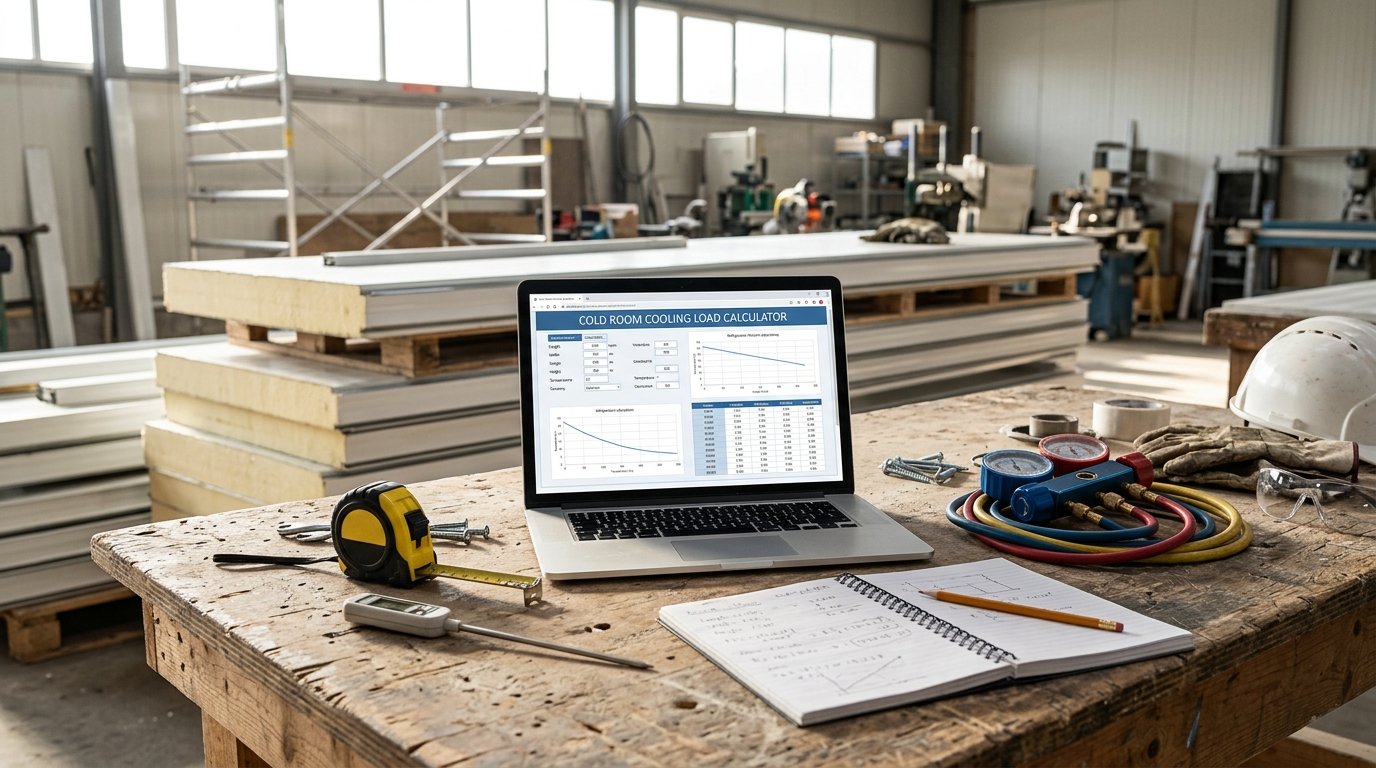
Cold Room Cooling Load Calculator: Estimate kW, Panels & Costs
Cold rooms are the silent infrastructure of the modern food chain. They keep fresh produce at 2 °C, hold meat at −20 °C, and protect pharmaceuticals at precisely controlled temperatures. Behind every reliable cold room is a refrigeration system that has been sized correctly — and behind every correctly sized system is an accurate cooling load calculation. Get the load wrong by 20% and you either pay for oversized equipment that never runs efficiently, or you discover on the hottest day of the year that your product is warming up faster than the system can cool it.
Our Cold Room Cooling Load Calculator is a free online tool that takes the guesswork out of refrigeration design. It breaks the total cooling load into four transparent components — transmission, product, infiltration, and internal gains — and calculates each one using recognised engineering methods. It supports chilled and frozen rooms, multiple insulation thicknesses, multi-stage product cooling (including the latent heat of freezing), door-opening rates, occupancy, lighting, equipment, defrost power, and a safety margin. It also estimates daily and annual energy, running cost, and equipment cost. Whether you are a refrigeration engineer, an installer, a facilities manager, or a food business owner, this calculator gives you the numbers you need to specify the right system.
In this guide, we will show you how to use the calculator, explain each input and output, walk through real-world examples for both chilled and frozen rooms, and answer the questions we hear most often. We will also share practical tips to ensure your cold room design is efficient, compliant, and cost-effective.
Cold Room Cooling Load
Construction CalculatorCold room load: transmission, product, infiltration, internal gains and equipment.
What is the Cold Room Cooling Load Calculator?
The Cold Room Cooling Load Calculator is a free online tool that estimates the refrigeration capacity required to maintain a set temperature inside an insulated cold room. It uses standard engineering methods to calculate each of the four load components that make up the total refrigeration demand:
- Transmission load — heat conducted through the insulated walls, ceiling, and floor.
- Product load — heat removed from the product entering the room, including sensible cooling above freezing, latent heat of freezing, and sensible cooling of the frozen product below freezing.
- Infiltration load — heat introduced by air exchange through door openings and construction seepage.
- Internal gains — heat from people, lighting, equipment, and defrost cycles.
The calculator supports panel thicknesses from 50 mm to 200 mm, inside temperatures from +5 °C down to −25 °C, ambient temperatures up to tropical conditions, and multi-stage product cooling for frozen goods. It returns the total cooling load in kW, average load, daily and annual energy, annual running cost, and equipment cost.
The tool is part of a suite of materials and quantities calculators available on our website. For related calculations, you can use our Chiller Sizing Calculator, Air Conditioner Sizing Calculator, Cooling Tower Sizing Calculator, and Data Centre Cooling Calculator.
Why Accurate Cold Room Load Calculation Matters
A cold room is a controlled environment. Its refrigeration system must remove heat at exactly the rate at which heat enters the room. If it removes heat too slowly, temperature rises and product quality suffers. If it removes heat too quickly, it short-cycles, wastes energy, and may not dehumidify properly. There is no margin for guesswork. Accurate load calculation is the foundation of every reliable, efficient cold room.
Product Safety and Compliance
Food safety regulations require cold rooms to maintain defined temperature ranges at all times. Chilled products are typically held at 0–5 °C, while frozen products are held at −18 °C or below. If the refrigeration system cannot maintain these temperatures during peak loading, product quality degrades and safety is compromised. Accurate load calculation ensures compliance with HACCP and equivalent food safety standards worldwide.
Energy Efficiency
Refrigeration is one of the largest energy users in food retail, hospitality, and food processing. A well-designed cold room uses the minimum energy required to maintain temperature. An oversized system wastes energy through short cycling; an undersized system wastes it by running continuously at full load. Accurate load calculation, combined with the right equipment selection, reduces energy consumption year-round and improves the bottom line.
Equipment Lifespan
Compressors, evaporators, and controls all have a designed operating cycle. Short cycling and continuous full-load operation both shorten equipment life. A correctly sized system runs at its optimal point, with longer run cycles and fewer starts. This reduces wear and extends the life of the capital investment.
Capital Cost
Refrigeration equipment is expensive. Oversizing wastes capital on capacity that is rarely used, and it increases the size of the electrical supply, pipework, and structural support. Undersizing leads to callbacks, retrofits, and unhappy clients. Accurate load calculation ensures you pay for the right capacity, no more and no less.
Product Quality
Temperature fluctuations damage product quality. In chilled rooms, fluctuations cause condensation, mould, and spoilage. In frozen rooms, they cause freezer burn, ice crystal growth, and texture changes. A correctly sized system maintains stable temperature and protects product quality across the entire storage cycle.
For more information on cold room principles and refrigeration fundamentals, you can refer to Wikipedia’s article on cold rooms or the ASHRAE Handbook.
How to Use the Cold Room Cooling Load Calculator
Using the calculator is straightforward. Here is a breakdown of each field.
1. Cold Room Dimensions
- Room length: Enter the internal length of the cold room in meters or feet.
- Room width: Enter the internal width of the cold room in meters or feet.
- Room height: Enter the internal height of the cold room in meters or feet.
These three values define the internal volume and the surface area of the insulated envelope, which is the basis for the transmission load calculation.
2. Temperatures
- Room temperature: Enter the design inside temperature. Chilled rooms: 0–5 °C. Frozen rooms: −18 to −25 °C. Blast freezers operate lower still but require specialist design.
- Ambient temperature: Enter the design ambient temperature surrounding the cold room. This should be the highest expected temperature in the surrounding space, not the annual average.
The difference between these two values is the design ΔT, which drives transmission and infiltration loads.
3. Insulation
- Panel thickness: Select the polyurethane (PU) panel thickness: 50 mm, 75 mm, 100 mm, 125 mm, 150 mm, or 200 mm. Chilled rooms typically use 75–100 mm; frozen rooms use 150–200 mm. Thicker panels have lower U-values and reduce transmission load. The calculator uses industry-standard U-values for each thickness, from 0.44 W/m²·K at 50 mm down to 0.11 W/m²·K at 200 mm.
4. Product
This is where the calculator goes beyond the typical rule-of-thumb approach. Instead of treating product load as a single figure, it uses a multi-stage method when the room temperature is below the product’s freezing point.
- Product per day: Enter the mass of product entering the room per day in kg.
- Specific heat (above freezing): Enter the specific heat of the product in kJ/kg·K. Typical values: meat ~3.2, fruit ~3.8, water ~4.18. This value is used for chilled products and for the first stage of freezing.
- Specific heat (frozen): Enter the specific heat of the product below freezing. Typical values: frozen meat ~1.7, frozen fruit and vegetables ~2.0, ice ~2.1 kJ/kg·K.
- Product inlet temp: Enter the temperature of the product when it enters the room. Warm product requires more refrigeration energy.
- Freezing point: Enter the freezing point of the product. Water freezes at 0 °C; meat at approximately −1.7 °C; fruit at approximately −0.8 °C. The multi-stage freezing calculation is only triggered when the room temperature is below this value.
- Water content: Enter the percentage of water in the product. Set 0 for chilled goods, 70–85% for frozen goods. The latent heat of freezing (334 kJ/kg) is only applied when the room temperature is below the freezing point, because water in chilled product does not freeze.
- Pull-down time: Enter the time in hours over which the incoming product is cooled. 24 hours represents continuous loading throughout the day. Shorter times represent batch loading and require higher instantaneous capacity.
5. Infiltration
- Door opening: Select the door-opening frequency: none (sealed), rare (a few per day), normal (regular access), or busy (constant access). Busier doors dramatically increase the infiltration load.
- Door area: Enter the total area of the door opening in m² or ft². Larger doors permit more air exchange per opening.
6. Internal Gains
- Lighting: Enter the lighting power in W. LED lighting minimises this contribution.
- People working: Enter the number of people working inside the cold room. Each person adds approximately 250 W due to metabolic heat and the extra clothing they wear.
- Equipment: Enter the power of equipment inside the room — forklifts, racking lights, evaporator fan motors — in W.
- Defrost power: Enter the defrost power in W. This applies only to frozen rooms. Set 0 for chilled rooms.
7. Safety
- Safety margin: Enter a percentage for the safety margin. 10–20% is typical. This accounts for uncertainties in the load estimate, future additions, and pull-down conditions.
8. Running Conditions
- Average load factor: Enter the fraction of design load the system runs at on average. 60–80% is typical for well-controlled rooms. This is used to calculate realistic annual energy, rather than assuming continuous full-load operation.
- Running hours per year: Enter the expected annual running hours. 6000 hours is typical for a continuously operating cold room; fewer hours for seasonal operations.
9. Pricing
- Condensing unit per kW: Enter the local installed cost per kW of cooling for the condensing unit.
- Evaporator per kW: Enter the local installed cost per kW of cooling for the evaporator.
- Electricity price: Enter the local price per kWh.
Once you enter all values, the calculator instantly displays room volume, envelope area, panel U-value, design ΔT, transmission load, product load, infiltration load, internal gains, total cooling load, average load, daily energy, annual energy, annual running cost, and equipment cost.
Understanding the Calculations
To make the most of the calculator, it is important to understand each output and the underlying formulas. The methods used here are consistent with recognised refrigeration design practice.
Transmission Load
Heat conduction through the insulated envelope. The formula is U × envelope area × ΔT. The envelope area includes walls, ceiling, and floor. Panel U-values depend on thickness and are calculated for standard PU panels:
| Panel Thickness | U-value (W/m²·K) |
|---|---|
| 50 mm | 0.44 |
| 75 mm | 0.30 |
| 100 mm | 0.22 |
| 125 mm | 0.18 |
| 150 mm | 0.15 |
| 200 mm | 0.11 |
Product Load — Multi-Stage Calculation
Product load is the heat that must be removed from incoming product. For chilled goods, this is a single sensible cooling stage. For frozen goods, the calculation is split into three stages:
- Sensible cooling above freezing: product mass per second × specific heat (above freezing) × (inlet temperature − freezing point).
- Latent heat of freezing: product mass per second × water content fraction × 334 kJ/kg.
- Sensible cooling of the frozen product: product mass per second × specific heat (frozen) × (freezing point − room temperature).
The latent stage is the most important and the most commonly missed in simplified calculations. Freezing 1 kg of water requires 334 kJ of energy — enough to cool the same mass of water by 80 K in the liquid state. For a busy frozen room handling hundreds of kilograms per day, omitting latent heat underestimates the load by 50% or more.
Infiltration Load
Heat introduced by air exchange through door openings and construction seepage. The calculator uses a simplified method: baseline seepage of 0.5 air changes per hour, plus a door-opening contribution proportional to door area and access frequency. The enthalpy difference between ambient and cold air is assumed to be 20 kJ/kg for typical chilled and frozen applications.
Internal Gains
Heat from people, lighting, equipment, and defrost. People contribute approximately 250 W each inside a cold room. Lighting and equipment are entered directly. Defrost power applies to frozen rooms only.
Total Cooling Load
Sum of transmission, product, infiltration, and internal gains, multiplied by (1 + safety margin / 100).
Energy and Cost
- Daily energy (at design load): total load × 24 hours. Represents the worst-case daily consumption.
- Average load: total load × average load factor. Represents the typical operating point.
- Annual energy: average load × running hours per year.
- Annual running cost: annual energy × electricity price.
- Equipment cost: condensing unit cost + evaporator cost, based on total kW.
Understanding these components helps you interpret the results and adjust the design. For more information on refrigeration loads and refrigerants, you can refer to Wikipedia’s article on refrigeration.
Example Calculations
Let’s run through two examples to see how the calculator works in different scenarios.
Example 1: Chilled Room for Fresh Produce
Inputs:
- Room length: 4 m
- Room width: 3 m
- Room height: 2.5 m
- Room temperature: 2 °C
- Ambient temperature: 25 °C
- Panel thickness: 100 mm PU (U = 0.22)
- Product per day: 500 kg
- Specific heat (above freezing): 3.8 kJ/kg·K
- Product inlet temp: 15 °C
- Water content: 0%
- Pull-down time: 24 h
- Door opening: Normal
- Door area: 2 m²
- Lighting: 100 W
- People: 2
- Equipment: 200 W
- Defrost: 0 W
- Safety margin: 15%
- Load factor: 70%
- Condensing unit: $400 per kW
- Evaporator: $300 per kW
- Electricity: $0.15/kWh
- Running hours: 6000 h
Calculations:
- Floor area = 4 × 3 = 12 m²
- Volume = 12 × 2.5 = 30 m³
- Envelope = 2 × (4 + 3) × 2.5 + 12 + 12 = 35 + 24 = 59 m²
- ΔT = 25 − 2 = 23 K
- Transmission = 0.22 × 59 × 23 = 298.5 W
- Product sensible = (500 / 86,400) × 3800 × 13 = 285.9 W
- Product latent = 0 (chilled product)
- Product load = 285.9 W
- Infiltration = (30 × 1.2 × 0.5 + 2 × 3 × 300) × 20 × 1000 / 86,400 = (18 + 1800) × 20,000 / 86,400 = 420.8 W
- Internal = 100 + (2 × 250) + 200 = 800 W
- Subtotal = 298.5 + 285.9 + 420.8 + 800 = 1805.2 W
- With 15% margin = 2076 W = 2.08 kW
- Average load = 2.08 × 0.70 = 1.45 kW
- Annual energy = 1.45 × 6000 = 8707 kWh
- Annual cost = 8707 × $0.15 = $1,306
- Condensing unit cost = 2.08 × $400 = $830
- Evaporator cost = 2.08 × $300 = $623
- Equipment total = $1,453
Result: The cold room requires approximately 2.08 kW of cooling. At an average load factor of 70%, annual running cost is about $1,306, and equipment cost is about $1,453.
Example 2: Frozen Room for Meat Storage
Inputs:
- Room length: 6 m
- Room width: 4 m
- Room height: 2.8 m
- Room temperature: −20 °C
- Ambient temperature: 25 °C
- Panel thickness: 200 mm PU (U = 0.11)
- Product per day: 800 kg
- Specific heat (above freezing): 3.2 kJ/kg·K
- Specific heat (frozen): 1.7 kJ/kg·K
- Product inlet temp: 10 °C
- Freezing point: −1.7 °C
- Water content: 75%
- Pull-down time: 24 h
- Door opening: Rare
- Door area: 2.5 m²
- Lighting: 150 W
- People: 1
- Equipment: 400 W
- Defrost: 600 W
- Safety margin: 20%
- Load factor: 70%
- Condensing unit: $500 per kW
- Evaporator: $350 per kW
- Electricity: $0.12/kWh
- Running hours: 6500 h
Calculations:
- Floor area = 6 × 4 = 24 m²
- Volume = 24 × 2.8 = 67.2 m³
- Envelope = 2 × (6 + 4) × 2.8 + 24 + 24 = 56 + 48 = 104 m²
- ΔT = 25 − (−20) = 45 K
- Transmission = 0.11 × 104 × 45 = 514.8 W
- Stage 1 (cooling to freezing point) = (800 / 86,400) × 3200 × (10 − (−1.7)) = 0.009259 × 3200 × 11.7 = 346.7 W
- Stage 2 (latent heat) = (800 / 86,400) × 0.75 × 334,000 = 0.009259 × 0.75 × 334,000 = 2319.4 W
- Stage 3 (cooling frozen to room temp) = (800 / 86,400) × 1700 × (−1.7 − (−20)) = 0.009259 × 1700 × 18.3 = 288.0 W
- Product load = 346.7 + 2319.4 + 288.0 = 2954.1 W
- Infiltration = (67.2 × 1.2 × 0.5 + 2.5 × 1 × 300) × 20 × 1000 / 86,400 = (40.32 + 750) × 20,000 / 86,400 = 182.9 W
- Internal = 150 + 250 + 400 + 600 = 1400 W
- Subtotal = 514.8 + 2954.1 + 182.9 + 1400 = 5051.8 W
- With 20% margin = 6062.2 W = 6.06 kW
- Average load = 6.06 × 0.70 = 4.24 kW
- Annual energy = 4.24 × 6500 = 27,560 kWh
- Annual cost = 27,560 × $0.12 = $3,307
- Condensing unit cost = 6.06 × $500 = $3,030
- Evaporator cost = 6.06 × $350 = $2,121
- Equipment total = $5,151
Result: The frozen room requires approximately 6.06 kW of cooling. At an average load factor of 70%, annual running cost is about $3,307, and equipment cost is about $5,151.
These examples show how room size, temperature difference, panel thickness, product properties, and door management affect the total cooling requirement.
Benefits of Using the Cold Room Cooling Load Calculator
Tips for Accurate Cold Room Load Calculation
- Use the correct inside temperature. Chilled rooms: 0–5 °C. Frozen rooms: −18 to −25 °C. Blast freezers operate lower still and need specialist design.
- Use the highest expected ambient temperature. The design condition is the hottest day, not the annual average.
- Choose the right panel thickness. Thicker panels reduce transmission load but cost more. Balance capital cost against lifetime energy savings.
- Use realistic product data. Specific heat, freezing point, and water content vary significantly between meat, fish, fruit, vegetables, and dairy. Use values from a reliable source.
- Do not ignore latent heat. For frozen products, latent heat of freezing is often the largest single component. The calculator handles this automatically.
- Account for pull-down time. Batch loading requires more capacity than continuous loading.
- Estimate door openings honestly. Busy doors can double or triple the infiltration load.
- Include all internal gains. Lighting, people, equipment, and defrost all add heat.
- Add a safety margin. 10–20% is typical, but larger margins may be justified for critical applications or uncertain product data.
- Verify with a professional. For large or critical cold rooms, have a qualified refrigeration engineer review the design.
For more information on refrigeration standards, you can refer to the ASHRAE Handbook or Wikipedia’s article on cold rooms.
Common Mistakes to Avoid
- Using the wrong inside temperature. A frozen room at −25 °C has a much higher transmission load than a chilled room at +2 °C.
- Ignoring product load. Product load can easily be the largest component in a busy cold room.
- Forgetting latent heat. For frozen products, latent heat of freezing is essential. Ignoring it leads to undersizing.
- Using specific heat for liquid for frozen products. Once water is frozen, the specific heat drops significantly. The multi-stage calculation handles this correctly.
- Underestimating infiltration. Door openings and seepage can account for 20–40% of the total load.
- Using the wrong panel U-value. Thicker panels have lower U-values. Using the wrong value skews the transmission load.
- Skipping internal gains. People, lighting, equipment, and defrost all add heat.
- Ignoring the safety margin. Uncertainties and future load require a margin.
- Using peak load for annual energy. Annual energy depends on the average load profile, not just the peak.
- Skipping professional verification. For large or critical cold rooms, always consult a refrigeration engineer.
How to Reduce Cold Room Load and Running Costs
If your calculated load or running cost is higher than expected, here are ways to reduce it without compromising product safety:
- Increase panel thickness. Thicker panels reduce transmission load, often paying back the additional capital cost within a few years.
- Improve door management. Use strip curtains, air curtains, or fast-acting doors to reduce infiltration.
- Reduce door-opening frequency. Train staff to minimise opening times and consolidate loads.
- Use LED lighting. LEDs produce less heat than incandescent or fluorescent lamps.
- Minimise occupancy. People add heat. Limit the number of people working inside the cold room.
- Use efficient equipment. High-efficiency evaporator fan motors and low-power equipment reduce internal gains.
- Optimise defrost cycles. Use demand defrost instead of timed defrost to reduce unnecessary defrost energy.
- Pre-cool product before loading. Reducing the product inlet temperature reduces product load.
- Schedule loading. Load product during cooler parts of the day or when the refrigeration system has spare capacity.
- Use floating suction pressure. Allow the evaporating temperature to float up when load is low, reducing compressor energy.
- Maintain the system. Clean evaporator coils, check refrigerant charge, and replace worn door seals.
- Get multiple quotes. Compare refrigeration suppliers for the best price and performance.
Frequently Asked Questions (FAQ)
Conclusion
The Cold Room Cooling Load Calculator is an essential tool for refrigeration engineers, installers, facilities managers, and food business owners. It helps you estimate transmission, product, infiltration, and internal loads in kW, with multi-stage product cooling that correctly captures latent heat of freezing for frozen goods. It also provides realistic annual energy and running cost estimates based on average load factor, plus equipment cost. By following the tips in this article and using the calculator, you can confidently specify the right refrigeration system and avoid costly sizing mistakes.
Whether you are designing a small walk-in cooler or a large frozen storage facility, accurate load calculation is the foundation of product safety, energy efficiency, and equipment longevity. Try the Cold Room Cooling Load Calculator today and take the guesswork out of your refrigeration design.


2 Comments