Water Bill Estimator Calculator: Calculate Household Water Cost & Usage
Water is one of those utility costs that creeps up quietly. Unlike electricity or gas, most households do not have a real-time meter showing them what they use. The bill arrives, you pay it, and the number is what it is. But water usage is not a mystery — it is arithmetic. Showers, toilets, taps, washing machines, dishwashers, garden watering: every one of those has an average volume, and the sum of them is your monthly usage. Once you know the volume, the bill is just price × quantity plus a fixed fee. And once you know the breakdown, you can see exactly where the biggest savings are.
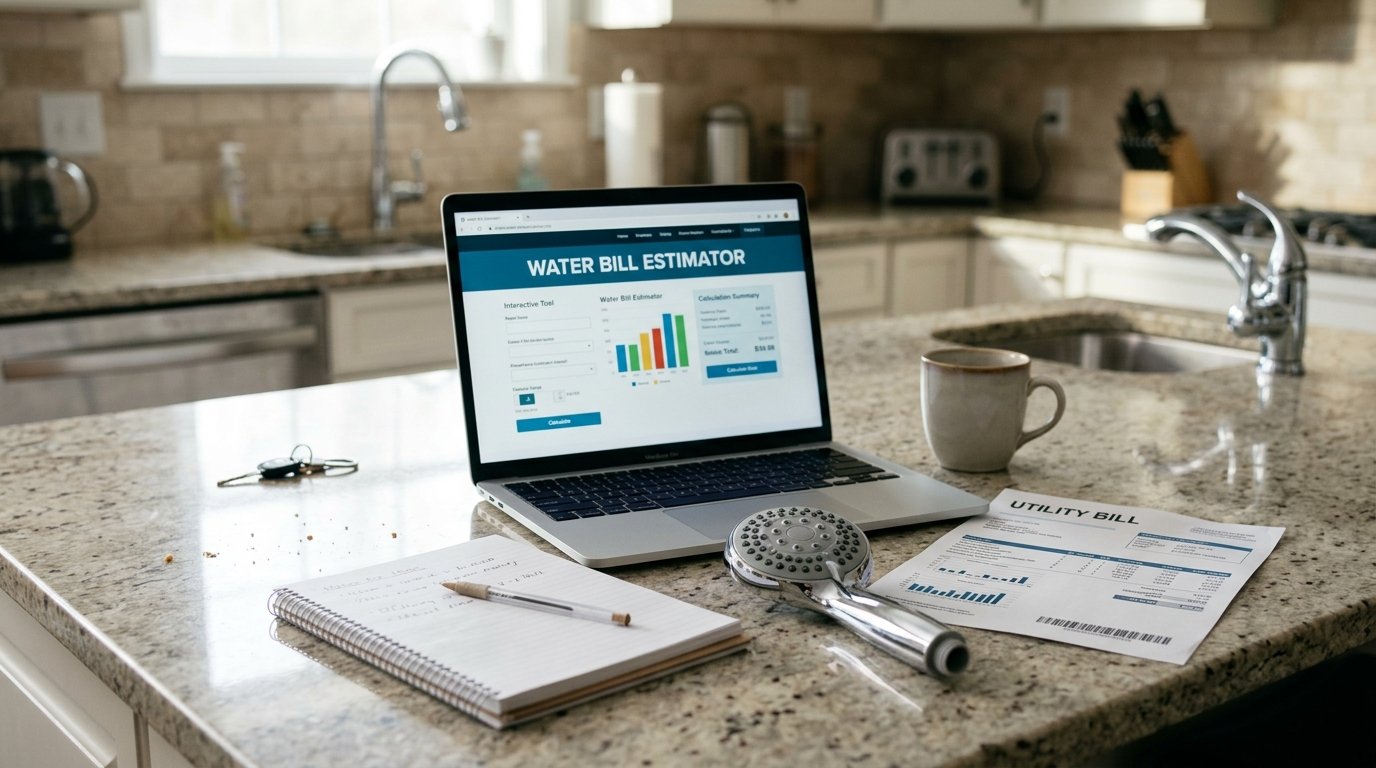
Our Water Bill Estimator Calculator is a free online tool that takes the guesswork out of household water cost. It calculates monthly and annual usage by category (showers, baths, toilets, taps, washing, dishwasher, outdoor), then converts that volume into your monthly and annual water bill using your local price per m³ and fixed monthly fee. It also calculates the hot water energy cost — the hidden part of the water bill that appears on your gas or electricity statement — and gives you a complete picture of household water spend.
In this guide, we will show you how to use the estimator, explain each input and output, walk through six real-world household scenarios, and answer eight of the most frequently asked questions about water usage and bills.
Water Bill Estimator
Construction CalculatorEstimate household water usage, monthly/annual bill, hot water energy cost and efficiency savings.
What is the Water Bill Estimator Calculator?
The Water Bill Estimator is a free online tool that estimates household water consumption and the resulting bill from a set of everyday usage parameters. It supports:
- Household inputs: number of people, showers per person per week, average shower length, shower flow rate, baths per person per week, bath volume.
- Other uses: toilet flushes per person per day, flush volume, tap usage per person per day, hot water fraction of taps, washing machine loads per week and litres per load, washing machine hot water fraction, dishwasher loads per week and litres per load, dishwasher hot water fraction, outdoor water use per month.
- Energy inputs: hot water temperature, cold water supply temperature, energy source (gas / electric / heat pump), efficiency override, energy price per kWh.
- Pricing inputs: water price per m³, tier 1 threshold, tier 2 price, fixed monthly fee.
The output includes:
- Monthly volume by category: showers, baths, toilets, taps, washing machine, dishwasher, outdoor
- Total monthly and annual usage in m³
- Water usage charge (with tiered pricing if configured)
- Fixed monthly fee
- Monthly and annual water bill
- Hot water volume and the temperature rise
- Efficiency/COP used
- Monthly hot water energy in kWh
- Annual hot water energy in kWh
- Monthly and annual hot water energy cost
- Total annual cost (water + energy)
The tool is part of a suite of plumbing and HVAC calculators available on our website. For related calculations, you can use our Water Demand / Flow Rate Calculator, Flow Rate Converter, Water Tank Volume Calculator, and Pipe Volume Calculator (Litres).
Why Accurate Water Bill Estimation Matters
Water is cheap per cubic metre, but the annual bill for a family of four in a developed economy can easily exceed $500–$1,000 — and in regions with combined supply and sewerage charges, it can be much higher. Understanding where the water goes and how much it costs is the first step toward controlling it.
Identify the Big Consumers
For most households, showers and toilets are the two largest indoor consumers. Showers can account for 25–35% of indoor water use; toilets for another 20–30%. Washing machines and taps are 15–20% each. Once you know the breakdown, you can target the biggest categories.
Quantify the Savings From Upgrades
Low-flow shower heads, dual-flush toilets, efficient washing machines, aerated taps — each of these reduces water use by 20–50% in its category. The estimator lets you see how much those upgrades would save before you invest in them.
Understand the Hot Water Energy Cost
The energy used to heat water is often 15–25% of a household energy bill. Showers, baths, and hot taps all consume hot water, which is heated from 10 °C (cold supply) to 60 °C (storage). The estimator calculates the energy required and converts it to kWh and cost using your local energy price and system efficiency.
Plan for a New Home or Renovation
When building a new house or renovating a bathroom, the estimator helps you understand the long-term cost implications of design decisions — a large soaking tub, a rainfall shower, or a whole-house greywater system.
Meet Water Efficiency Requirements
Many jurisdictions now require new homes to meet water efficiency standards (e.g., the UK Part G, Water Efficiency Calculator, or equivalent). The estimator provides the underlying numbers needed for those calculations.
Detect Leaks and Anomalies
If you know your expected usage, you can quickly spot a sudden increase — often a sign of a leak, a running toilet, or a change in behaviour. A 300 L/month jump in usage is a $50–$100 mistake if it goes unnoticed.
For more information on water usage, you can refer to Wikipedia’s article on water efficiency or the US Environmental Protection Agency (EPA) WaterSense programme.
How to Use the Water Bill Estimator
Using the estimator is straightforward. Here is a breakdown of each field.
1. Household
- People in household: The number of people using water.
- Showers per person per week: Typical 5–7.
- Average shower length: Typical 5–10 minutes.
- Shower flow rate: Standard 8–12 L/min, low-flow 6–8 L/min.
- Baths per person per week: Set 0 if no baths.
- Water per bath: Typical 120–180 L.
2. Other uses
- Toilet flushes per person per day: Typical 4–6.
- Toilet flush volume: Old toilets 9–12 L, modern dual-flush 4–6 L.
- Taps use per person per day: Hand washing, drinking, cooking — typical 10–20 L.
- Taps hot water fraction: Typical 50–70% of tap water is hot.
- Washing machine loads per week: Household total.
- Water per wash load: Typical 40–60 L.
- Washing hot water fraction: Only if hot fill — set 0 for cold fill.
- Dishwasher loads per week: Household total.
- Water per dishwasher load: Typical 10–15 L.
- Dishwasher hot water fraction: Only if hot fill — set 0 for cold fill.
- Outdoor use per month: Garden watering, car washing, pool top-up.
3. Energy
- Hot water temperature: Storage or delivery temperature — typically 60 °C.
- Cold water supply temperature: Typical 8–15 °C depending on season.
- Energy source: Gas boiler (85% efficient), electric resistance (100%), or heat pump (COP 3.0).
- Efficiency / COP override: Leave 0 to use the source default, or enter a specific value.
- Energy price per kWh: Local electricity or gas price.
4. Pricing
- Water price per m³ (tier 1): Include both supply and sewerage if metered together.
- Tier 1 threshold: Leave 0 for single-rate pricing.
- Water price per m³ (tier 2): Only used above the threshold.
- Fixed monthly fee: Standing charge.
Once you enter all values, the estimator displays usage by category, total and annual usage, water bill, hot water energy cost, and total annual spend.
Understanding the Calculations
To make the most of the estimator, it is important to understand each output and the underlying formulas.
Monthly Volumes by Category
| Category | Formula |
|---|---|
| Showers | people × showers/week × minutes × flow × 4.33 |
| Baths | people × baths/week × bath volume × 4.33 |
| Toilets | people × flushes/day × flush volume × 30 |
| Taps | people × taps per person per day × 30 |
| Washing machine | loads/week × litres/load × 4.33 |
| Dishwasher | loads/week × litres/load × 4.33 |
| Outdoor | m³/month × 1000 |
The weekly → monthly conversion factor is 4.33 (365 days / 12 months / 7 days). Monthly → daily uses 30.
Hot Water Volumes
Not all water is heated. The estimator assigns the following hot water fractions:
| Category | Hot fraction |
|---|---|
| Showers | 100% |
| Baths | 100% |
| Taps | user-set (typically 60%) |
| Washing machine | user-set (typically 30% if hot fill) |
| Dishwasher | user-set (typically 30% if hot fill) |
| Toilets | 0% |
| Outdoor | 0% |
Hot Water Energy
The energy required to heat water is:
Q = m × c × ΔT
Where m is the mass of water in kg, c is the specific heat capacity (4.18 kJ/kg·K), and ΔT is the temperature rise. For a 1,000 L household using 300 L of hot water per week at a 50 K temperature rise:
Q = 300 × 4.18 × 50 = 62,700 kJ = 17.4 kWh thermal.
The input energy depends on the system efficiency:
- Gas boiler: kWh input = kWh thermal / 0.85
- Electric resistance: kWh input = kWh thermal / 1.00
- Heat pump: kWh input = kWh thermal / COP
Water Bill
If tiered pricing is configured:
- Usage cost = min(total, threshold) × price_1 + max(0, total − threshold) × price_2
Otherwise:
- Usage cost = total × price_1
Monthly bill = usage cost + fixed fee.
Annual bill = monthly bill × 12.
Total Annual Cost
Annual total = annual water bill + annual hot water energy cost.
Understanding these components helps you interpret the results and adjust your usage. For more information on water efficiency, you can refer to the US Environmental Protection Agency (EPA) WaterSense programme or Wikipedia’s article on water efficiency.
Reference Table of Typical Water Use
| Fixture | Typical volume | Efficient alternative | Savings |
|---|---|---|---|
| Shower | 9 L/min | Low-flow 7 L/min | 22% |
| Toilet flush | 9 L (old) | Dual-flush 4.5 L | 50% |
| Bath | 150 L | Shallower bath (100 L) | 33% |
| Washing machine | 50 L/load | Efficient 40 L/load | 20% |
| Dishwasher | 12 L/load | Efficient 9 L/load | 25% |
| Tap | 8 L/min | Aerated 4 L/min | 50% |
These values are typical for developed economies. Actual use varies by country, culture, and household behaviour.
Example Calculations
Let’s run through six household scenarios to see how the estimator works.
Example 1: Family of Four, Standard Usage, Moderate Prices
Inputs:
- People: 4
- Showers/week: 6 per person
- Shower length: 8 min
- Shower flow: 9 L/min
- Baths/week: 1 per person
- Bath volume: 150 L
- Flushes/day: 5 per person
- Flush volume: 6 L
- Taps: 15 L/person/day (60% hot)
- Washing machine: 4 loads/week × 50 L (30% hot)
- Dishwasher: 5 loads/week × 12 L (30% hot)
- Outdoor: 2 m³/month
- Water price: $3.50/m³
- Fixed fee: $15/month
- Energy source: Gas, 85%
- Energy price: $0.10/kWh
- Hot temp: 60 °C, Cold temp: 10 °C
Calculations:
- Showers = 4 × 6 × 8 × 9 × 4.33 = 7,482 L = 7.48 m³
- Baths = 4 × 1 × 150 × 4.33 = 2,598 L = 2.60 m³
- Toilets = 4 × 5 × 6 × 30 = 3,600 L = 3.60 m³
- Taps = 4 × 15 × 30 = 1,800 L = 1.80 m³
- Washing = 4 × 50 × 4.33 = 866 L = 0.87 m³
- Dishwasher = 5 × 12 × 4.33 = 260 L = 0.26 m³
- Outdoor = 2.00 m³
- Total = 18.61 m³/month
- Annual = 223.3 m³
- Usage cost = 18.61 × $3.50 = $65.14
- Monthly bill = $65.14 + $15 = $80.14
- Annual bill = $961.68
- Hot water: showers 7.48 + baths 2.60 + taps 1.08 + wash 0.26 + dish 0.08 = 11.50 m³ = 11,500 L
- Energy = 11,500 × 4.18 × 50 / 3600 = 667.7 kWh thermal
- Input = 667.7 / 0.85 = 785.6 kWh/month
- Annual hot water energy = 9,427 kWh
- Energy cost = 785.6 × $0.10 = $78.56/month
- Annual energy = $942.72
- Total annual = $961.68 + $942.72 = $1,904.40
Example 2: Family of Two, Efficient Fixtures
Inputs:
- People: 2
- Showers/week: 5
- Shower length: 6 min
- Shower flow: 7 L/min (low-flow)
- Baths: 0
- Toilets: dual-flush 4 L
- Taps: 12 L/person/day
- Washing: 3 loads × 45 L
- Dishwasher: 4 × 10 L
- Outdoor: 1 m³
- Water price: $3.00/m³
- Fixed fee: $12
- Energy: Gas 85%, $0.10/kWh
Calculations:
- Showers = 2 × 5 × 6 × 7 × 4.33 = 1,818 L = 1.82 m³
- Baths = 0
- Toilets = 2 × 5 × 4 × 30 = 1,200 L = 1.20 m³
- Taps = 2 × 12 × 30 = 720 L = 0.72 m³
- Washing = 3 × 45 × 4.33 = 584 L = 0.58 m³
- Dishwasher = 4 × 10 × 4.33 = 173 L = 0.17 m³
- Outdoor = 1.00 m³
- Total = 5.49 m³/month
- Annual = 65.9 m³
- Usage = 5.49 × $3.00 = $16.47
- Monthly bill = $28.47; annual = $341.64
- Hot water ≈ 1.82 + 0 + 0.43 + 0.17 + 0.05 = 2.47 m³ = 2,470 L
- Energy = 2,470 × 4.18 × 50 / 3600 / 0.85 = 168.6 kWh/month
- Cost = $16.86/month = $202.32/year
- Total = $543.96/year
Example 3: Single Person, High Usage, Electric Water Heating
Inputs:
- People: 1
- Showers: 7/week × 10 min × 12 L/min (rainfall shower)
- Baths: 2/week × 180 L
- Toilets: 6 flushes × 6 L
- Taps: 20 L/day
- Washing: 2 loads × 55 L
- Dishwasher: 3 × 13 L
- Outdoor: 0.5 m³
- Water price: $4.00/m³
- Energy: Electric 100%, $0.20/kWh
- Hot temp: 60, Cold: 10
Calculations:
- Showers = 1 × 7 × 10 × 12 × 4.33 = 3,637 L = 3.64 m³
- Baths = 1 × 2 × 180 × 4.33 = 1,559 L = 1.56 m³
- Toilets = 1 × 6 × 6 × 30 = 1,080 L = 1.08 m³
- Taps = 1 × 20 × 30 = 600 L = 0.60 m³
- Washing = 2 × 55 × 4.33 = 476 L = 0.48 m³
- Dish = 3 × 13 × 4.33 = 169 L = 0.17 m³
- Outdoor = 0.50 m³
- Total = 8.03 m³/month
- Usage = $32.12; monthly = $32.12 (no fixed fee); annual = $385.44
- Hot water ≈ 3.64 + 1.56 + 0.36 + 0.14 + 0.05 = 5.75 m³
- Energy = 5,750 × 4.18 × 50 / 3600 / 1.0 = 333.8 kWh/month
- Cost = 333.8 × $0.20 = $66.76/month = $801.12/year
- Total annual = $1,186.56
- Note: Electric water heating almost doubles the annual cost.
Example 4: Large Family, Six People, Average Use, Tiered Pricing
Inputs:
- People: 6
- Showers: 6/week × 8 min × 10 L/min
- Baths: 1/week × 150 L
- Toilets: 5 × 6 L
- Taps: 15 L/person/day
- Washing: 8 loads × 55 L
- Dishwasher: 7 × 13 L
- Outdoor: 4 m³
- Water price tier 1: $3.50/m³
- Tier 1 threshold: 20 m³/month
- Tier 2 price: $4.20/m³
- Fixed fee: $15
- Energy: Gas 85%, $0.10/kWh
Calculations:
- Showers = 6 × 6 × 8 × 10 × 4.33 = 12,470 L = 12.47 m³
- Baths = 6 × 1 × 150 × 4.33 = 3,897 L = 3.90 m³
- Toilets = 6 × 5 × 6 × 30 = 5,400 L = 5.40 m³
- Taps = 6 × 15 × 30 = 2,700 L = 2.70 m³
- Washing = 8 × 55 × 4.33 = 1,905 L = 1.91 m³
- Dish = 7 × 13 × 4.33 = 394 L = 0.39 m³
- Outdoor = 4.00 m³
- Total = 30.77 m³
- Tiered usage cost = 20 × $3.50 + 10.77 × $4.20 = $70 + $45.23 = $115.23
- Monthly bill = $115.23 + $15 = $130.23; annual = $1,562.76
- Hot water: showers 12.47 + baths 3.90 + taps 1.62 + wash 0.57 + dish 0.12 = 18.68 m³
- Energy = 18,680 × 4.18 × 50 / 3600 / 0.85 = 1,276 kWh/month
- Cost = $127.60/month = $1,531.20/year
- Total annual = $3,093.96
Example 5: Retired Couple, Low Usage, Heat Pump Water Heating
Inputs:
- People: 2
- Showers: 4/week × 5 min × 7 L/min
- Baths: 0
- Toilets: 4 × 4 L
- Taps: 10 L/person/day
- Washing: 2 × 45 L
- Dish: 3 × 10 L
- Outdoor: 1 m³
- Water price: $3.00/m³
- Energy: Heat pump COP 3.0, $0.15/kWh
Calculations:
- Showers = 2 × 4 × 5 × 7 × 4.33 = 1,212 L = 1.21 m³
- Toilets = 2 × 4 × 4 × 30 = 960 L = 0.96 m³
- Taps = 2 × 10 × 30 = 600 L = 0.60 m³
- Washing = 2 × 45 × 4.33 = 390 L = 0.39 m³
- Dish = 3 × 10 × 4.33 = 130 L = 0.13 m³
- Outdoor = 1.00 m³
- Total = 4.29 m³/month = 51.5 m³/year
- Water bill monthly = $12.87 + fixed = ~$25; annual = $300 (assuming $12 fixed)
- Hot water: 1.21 + 0 + 0.36 + 0.12 + 0.04 = 1.73 m³ = 1,730 L
- Energy = 1,730 × 4.18 × 50 / 3600 / 3.0 = 33.5 kWh/month
- Cost = 33.5 × $0.15 = $5.03/month = $60.36/year
- Total annual ≈ $360–$400
Example 6: Leak Detection Case — Running Toilet
Inputs:
- Same as Example 1, but with one running toilet adding 200 L/day
- Extra volume = 200 × 30 = 6,000 L = 6 m³/month
- Extra annual = 72 m³
- At $3.50/m³ → $252 additional water + $252 sewerage (if metered)
- Total additional cost = $504/year from one running toilet.
This is why leak detection matters. The estimator shows what “normal” usage looks like — the rest is anomaly.
Benefits of Using the Water Bill Estimator
Tips for Accurate Water Bill Estimation
- Read your actual bill first. Your utility bill will tell you the price per m³ and any fixed charges. Use those numbers, not defaults.
- Count shower habits honestly. A family that thinks it takes “quick showers” often averages 8–10 minutes, not 5.
- Measure shower flow with a bucket test. A 10 L bucket, timed fill — gives the actual flow rate of your shower head.
- Check toilet flush volume. Older toilets use 9–12 L per flush. Dual-flush modern toilets use 4–6 L.
- Include hot water energy. It is the largest hidden cost of water use — often 30–50% of the total.
- Match the energy source and efficiency. Gas boilers are 80–90% efficient, electric resistance 100%, heat pumps COP 2.5–4.0.
- Consider seasonal variation. Outdoor use is higher in summer; cold water supply temperature is lower in winter.
- Use tiered pricing if applicable. Many utilities charge more above a threshold. Enter both prices.
- Watch for leaks. A dripping tap, a running toilet, or a leaking pipe wastes hundreds of litres per month.
- Add a safety margin. Real households use 10–20% more than their calculated baseline, because of guests, cleaning, and one-off tasks.
- Compare with benchmarks. Typical household usage is 150–250 L/person/day in developed economies.
- Verify with a professional. For planning or compliance purposes, use a recognised water efficiency calculator or consultant.
For more information on water efficiency, you can refer to the US Environmental Protection Agency (EPA) WaterSense programme or Wikipedia’s article on water efficiency.
Common Mistakes to Avoid
- Ignoring hot water energy. Many households focus on the water bill alone and miss the bigger energy cost.
- Using default flow rates. Measure your own — the difference between 6 L/min and 12 L/min is enormous.
- Forgetting outdoor use. Garden watering, car washing, and pool top-up can add 5–20 m³/month in summer.
- Missing the fixed fee. Many utilities charge a standing charge, which is often $10–$30/month.
- Assuming single-rate pricing. Some utilities use tiered pricing, especially in water-scarce regions.
- Confusing US and UK gallons. Different units — make sure your bill uses the same units.
- Overlooking leaks. A running toilet can add $500/year to your water bill.
- Estimating shower time by memory. People consistently underestimate their shower length by 30–50%.
- Not accounting for guests. Holiday periods and family visits increase usage significantly.
- Ignoring seasonal variation. Winter and summer usage can differ by 30–50% for gardens and pools.
Frequently Asked Questions (FAQ)
Conclusion
The Water Bill Estimator is an essential tool for households, landlords, planners, and utility analysts. It calculates monthly and annual water usage by category, converts that into the water bill using your local price and fixed fee, and separately quantifies the hidden cost of hot water energy. By following the tips in this article and using the estimator, you can see exactly where your water goes, how much it costs, and where the biggest savings are.
Whether you are trying to reduce your utility bills, planning a renovation, or simply understand your household consumption, accurate water usage estimation is the foundation of any efficiency strategy. Try the Water Bill Estimator today and take the guesswork out of your water and hot water costs.