Appliance Running Cost Calculator: Estimate Your Electricity Costs Accurately
Household appliances are convenient, but they can also be a significant part of your electricity bill. From refrigerators that run 24/7 to washing machines and air conditioners, understanding how much each appliance costs to run helps you manage your energy budget and make informed decisions. Our Appliance Running Cost Calculator is a free online tool that estimates the daily, monthly, and annual electricity cost of running any household appliance.
In this guide, we’ll show you how to use the calculator, explain the calculations, provide real-world examples, and answer common questions. We’ll also share tips to reduce your appliance running costs.
Appliance Running Cost
Construction CalculatorElectricity usage and annual cost of running a household appliance.
What is the Appliance Running Cost Calculator?
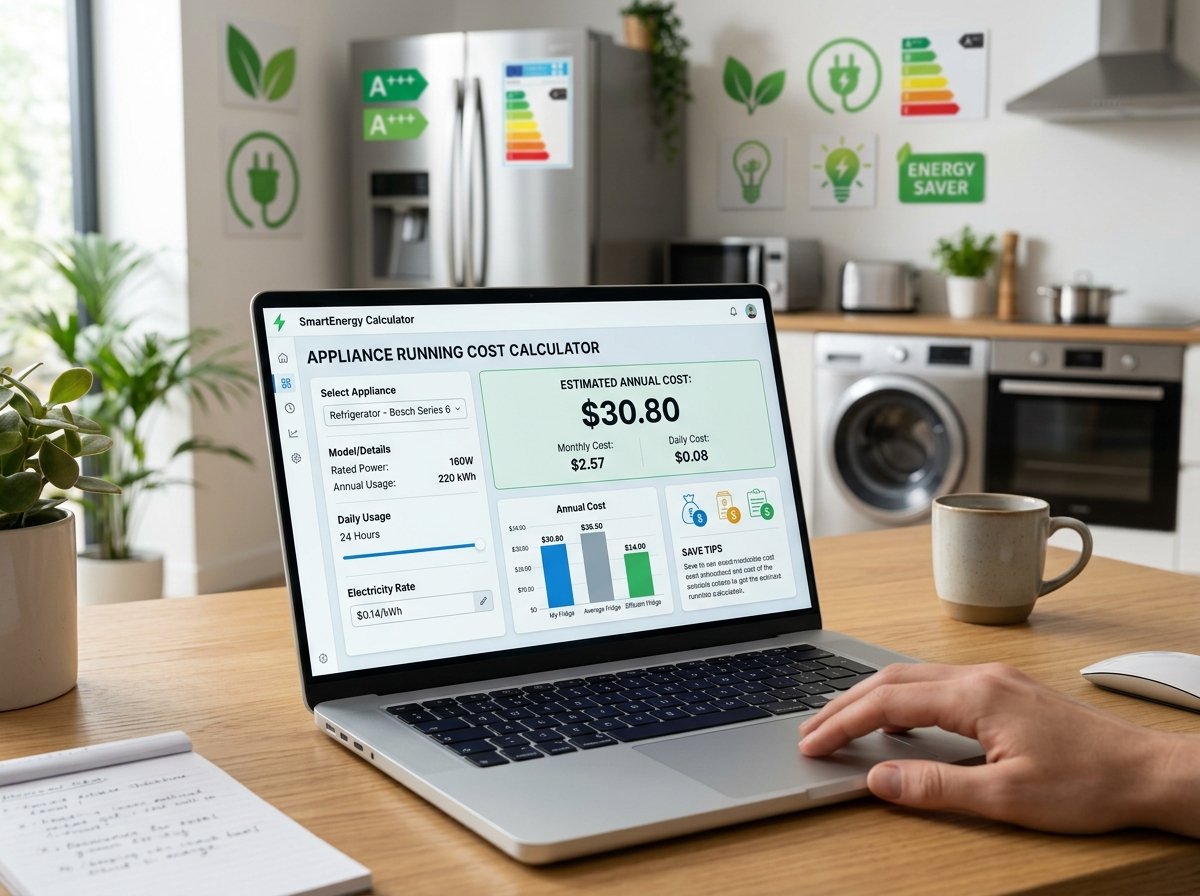
The Appliance Running Cost Calculator is a free online tool that calculates the electricity usage and cost of running a household appliance based on its power rating, average hours of use per day, days of use per year, and your local electricity tariff. It provides a clear breakdown of daily kWh, annual kWh, monthly cost, and annual cost. The calculator is part of a suite of construction and renovation calculators available on our website, including the Tiling Job Cost Calculator, Roofing Job Cost Calculator, Flooring Job Cost Calculator, and Material Cost Calculator.
How to Use the Appliance Running Cost Calculator
Using the calculator is straightforward. Here’s a breakdown of each field:
1. Appliance
- Appliance: Select the appliance from the dropdown list. You can choose from presets like Fridge, Washing Machine, Dishwasher, Air Conditioner, Space Heater, Water Heater, Oven, or select “Custom” to enter your own power rating. The presets automatically fill the power rating based on typical values.
- Power rating: If you selected “Custom”, enter the power rating of your appliance in watts (W). This is usually printed on the appliance nameplate or in the manual. If you selected a preset, this field is ignored.
2. Usage
- Hours per day: Enter the average number of hours the appliance runs per day. For a fridge, this might be 24 hours (though it cycles on and off, the average power draw is lower, but the preset already accounts for typical usage). For a washing machine, it might be 1–2 hours per day.
- Days per year: Enter the number of days per year the appliance is used. For year-round appliances like a fridge, use 365. For seasonal appliances like an air conditioner, use the number of days you actually use it (e.g., 120 for summer).
3. Cost
- Electricity price: Enter your local electricity tariff per kilowatt-hour (kWh). You can find this on your electricity bill. It’s usually expressed in cents or dollars per kWh.
Once you enter all values, the calculator instantly displays:
- Power rating used
- Daily usage in kWh
- Annual usage in kWh
- Monthly cost
- Annual cost
Understanding the Cost Components
To make the most of the calculator, it’s important to understand the calculations behind it.
- Power rating (W): This is the rate at which the appliance consumes electricity. It’s measured in watts. A kilowatt (kW) is 1,000 watts. The preset values are typical for each appliance category, but your specific model may differ. Always check the nameplate for accuracy.
- Daily usage (kWh): This is calculated as
power (W) × hours per day ÷ 1000. For example, a 1,000 W appliance running for 2 hours uses 2,000 Wh = 2 kWh per day. - Annual usage (kWh): This is
daily usage × days per year. For example, 2 kWh × 365 = 730 kWh per year. - Monthly cost: This is
annual usage ÷ 12 × electricity price. For example, 730 kWh ÷ 12 × $0.15/kWh = $9.13 per month. - Annual cost: This is
annual usage × electricity price. For example, 730 kWh × $0.15 = $109.50 per year.
Understanding these components helps you identify which appliances consume the most energy and where you can save. For more information on electricity consumption, you can refer to Wikipedia’s article on kilowatt-hour.
Example Calculations
Let’s run through a few examples to see how the calculator works in different scenarios.
Example 1: Refrigerator
- Appliance: Fridge (preset 150 W)
- Hours per day: 24 (but the preset 150 W is an average that accounts for cycling)
- Days per year: 365
- Electricity price: $0.15/kWh
Calculations:
- Daily usage: 150 W × 24 h ÷ 1000 = 3.6 kWh
- Annual usage: 3.6 kWh × 365 = 1,314 kWh
- Monthly cost: 1,314 ÷ 12 × $0.15 = $16.43
- Annual cost: 1,314 × $0.15 = $197.10
Example 2: Washing Machine
- Appliance: Washing machine (preset 2000 W)
- Hours per day: 1.5
- Days per year: 150 (used a few times a week)
- Electricity price: $0.20/kWh
Calculations:
- Daily usage: 2000 W × 1.5 h ÷ 1000 = 3 kWh
- Annual usage: 3 kWh × 150 = 450 kWh
- Monthly cost: 450 ÷ 12 × $0.20 = $7.50
- Annual cost: 450 × $0.20 = $90.00
Example 3: Air Conditioner
- Appliance: Air conditioner (preset 1200 W)
- Hours per day: 8
- Days per year: 120
- Electricity price: $0.25/kWh
Calculations:
- Daily usage: 1200 W × 8 h ÷ 1000 = 9.6 kWh
- Annual usage: 9.6 kWh × 120 = 1,152 kWh
- Monthly cost: 1,152 ÷ 12 × $0.25 = $24.00 (but this is averaged over the year; actual monthly cost during summer would be higher)
- Annual cost: 1,152 × $0.25 = $288.00
Note: For seasonal appliances, the monthly cost shown is an average over 12 months. Your actual monthly bills will vary.
Benefits of Using the Appliance Running Cost Calculator
- Accuracy: Get precise estimates of electricity usage and cost.
- Time-saving: Instantly calculate costs without manual math.
- Transparency: See a clear breakdown of daily, annual, and monthly costs.
- Flexibility: Compare different appliances, usage habits, and tariffs.
- Energy awareness: Identify which appliances cost the most to run and adjust usage.
Tips for Accurate Appliance Running Cost Estimation
- Find the true power rating: The nameplate on the appliance shows the maximum power draw. However, many appliances cycle on and off, so the average power is lower. For example, a fridge might have a 150 W rating but actually run at that power only when the compressor is on. The preset values are averages.
- Measure actual usage: If you want precise numbers, use a plug-in energy monitor to measure actual kWh consumption over a period. This is especially useful for appliances with variable power like washing machines.
- Adjust hours per day realistically: Don’t overestimate. A washing machine might run 1–2 hours per cycle, but you might do 3–4 loads per week. Calculate the average daily hours.
- Consider seasonal variation: For air conditioners and heaters, use the number of days you actually use them. The calculator averages monthly cost over the year, but your bills will be higher in peak months.
- Check your electricity tariff: Electricity prices vary by time of day, season, and total usage. If you have a time-of-use plan, use the average rate or calculate separately for peak and off-peak.
- Account for standby power: Many appliances consume power even when turned off. This is called standby or vampire power. It can add up over time. The calculator does not include standby power unless you factor it into hours per day.
- Update regularly: Electricity prices change. Recalculate periodically to keep your estimates accurate.
For more information on energy consumption and efficiency, you can refer to resources like Energy.gov or Wikipedia’s article on home energy consumption.
How to Reduce Appliance Running Costs
If your estimated costs are higher than you’d like, here are practical ways to reduce them:
- Use energy-efficient appliances: Look for ENERGY STAR certified appliances. They use less electricity for the same performance.
- Run full loads: For washing machines and dishwashers, wait until you have a full load. This reduces the number of cycles.
- Adjust temperature settings: Lower your water heater temperature, set your fridge to the recommended temperature (3–4°C for fridge, -18°C for freezer), and adjust your air conditioner thermostat.
- Use timers and smart plugs: Turn off appliances when not in use. Smart plugs can schedule off times and eliminate standby power.
- Maintain appliances: Clean fridge coils, replace filters, and service your HVAC system regularly. Well-maintained appliances run more efficiently.
- Air dry clothes: Instead of using a dryer, hang clothes to dry. This can save a significant amount of electricity.
- Use cold water for washing: Heating water accounts for most of a washing machine’s energy use. Wash clothes in cold water when possible.
- Insulate your water heater: An insulating blanket can reduce heat loss and save energy.
- Consider solar panels: If you have solar, run appliances during peak sunlight hours to use your own generated electricity.
Frequently Asked Questions (FAQ)
Conclusion
The Appliance Running Cost Calculator is an essential tool for anyone looking to understand and manage their electricity bills. It helps you estimate the cost of running individual appliances, compare usage scenarios, and identify opportunities to save energy and money. By following the tips in this article and using the calculator, you can take control of your home energy costs.
Whether you’re curious about your fridge’s impact on your bill or planning to buy a new appliance, accurate running cost estimation is key to smart energy decisions. Try the Appliance Running Cost Calculator today and take the guesswork out of your electricity budget.