Frequently Asked Questions (FAQ)
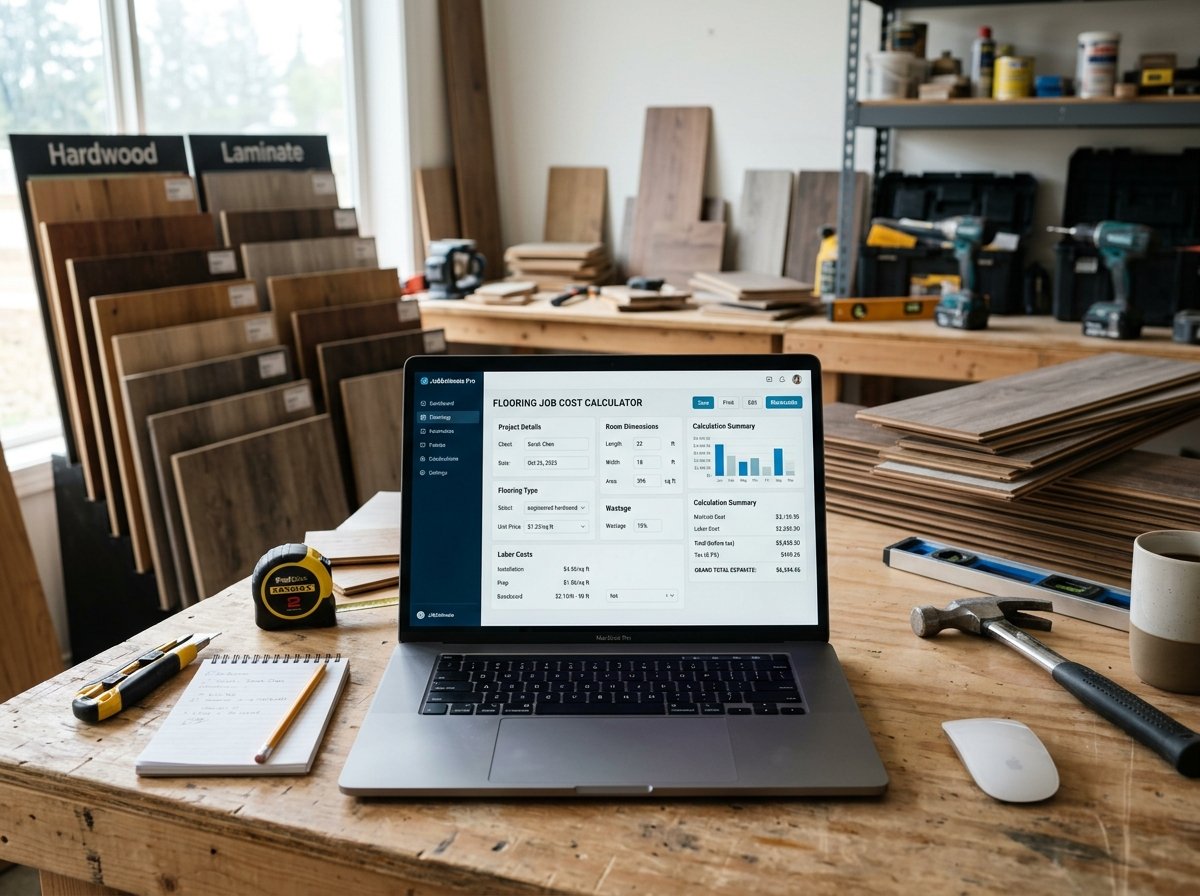
Flooring is one of the most visible and impactful elements of any room. Whether you’re installing laminate in a bedroom, tiles in a bathroom, or hardwood in a living area, accurate cost estimation is essential for budgeting. Our Flooring Job Cost Calculator helps you quickly determine the total cost of your flooring project, including material, underlay, skirting, and labour.
In this guide, we’ll show you how to use the calculator, provide real-world examples, and answer common questions. We’ll also share tips to keep your project on budget.
Flooring Job Cost
Construction CalculatorFlooring installation cost: material, underlay, skirting, labour and total.
What is the Flooring Job Cost Calculator?
The Flooring Job Cost Calculator is a free online tool that calculates the total cost of a flooring installation based on the floor area, material type, material prices, underlay, skirting, and labour rates. It accounts for waste allowance and adjusts labour costs based on the difficulty of installing different flooring materials. The calculator is part of a suite of construction and renovation calculators available on our website, including the Tiling Job Cost Calculator, Roofing Job Cost Calculator, and Paint Job Cost Calculator. For a complete project estimate, you can also use our Construction Estimate Calculator and Renovation Cost Estimator Calculator.
How to Use the Flooring Job Cost Calculator
Using the calculator is straightforward. Here’s a breakdown of each field:
1. Dimensions
- Floor area: Enter the total area to cover in square meters or square feet. For example, a room 5 m long and 6 m wide has an area of 30 m².
- Wall perimeter: Enter the total length of walls where skirting will be installed. This is used to calculate skirting material. If you don’t need skirting, set to 0.
- Waste allowance: Enter a percentage to account for cuts and offcuts. Typically 5–10% for most flooring. For diagonal or complex patterns, use 10–15%.
2. Material
- Flooring material: Select the type of flooring: laminate, parquet, vinyl/LVT, tile, carpet, or solid hardwood. This affects the labour difficulty multiplier.
- Material price per m²: Enter the price of the flooring material per square meter.
- Underlay price per m²: Enter the cost of underlay per square meter. Set to 0 if not required (e.g., for some vinyl or carpet).
- Skirting price per metre: Enter the cost of skirting per linear metre. Set to 0 to skip skirting.
3. Labour
- Installation rate per m²: Enter the base labour rate per square meter. The calculator automatically adjusts this rate based on the flooring material you selected, reflecting the difficulty of installation.
Once you enter all values, the calculator displays a detailed breakdown, including area with waste, material costs, underlay, skirting, labour, and grand total.
Understanding the Cost Components
To make the most of the calculator, it’s important to understand each cost component.
- Flooring material: This is the main cost. Prices vary widely: laminate and vinyl are economical, parquet and hardwood are premium, tile falls in between. The material price per m² should include the cost of the planks, tiles, or rolls.
- Underlay: Underlay provides cushioning, sound insulation, and moisture protection. It’s essential for laminate, hardwood, and some vinyl. Carpet often comes with its own underlay or is installed with a separate pad. The cost is per square meter of floor area.
- Skirting: Skirting covers the gap between the floor and the wall. It’s priced per linear metre. The calculator uses the wall perimeter to determine the total length needed. Add 10% for cuts and waste.
- Waste allowance: This accounts for cuts, mistakes, and future repairs. For standard installations, 5–10% is sufficient. For diagonal or herringbone patterns, increase to 10–15%.
- Labour: Labour is often the largest cost. The calculator uses multipliers for different materials: laminate (1.0), parquet (1.3), vinyl (0.9), tile (1.5), carpet (0.8), hardwood (1.4). These reflect the time and skill required. You can adjust the base labour rate to match local conditions.
Example Calculations
Let’s run through a few examples to see how the calculator works.
Example 1: Laminate Flooring in a Bedroom
- Floor area: 20 m²
- Perimeter: 18 m
- Waste: 8%
- Material: Laminate
- Material price: $20/m²
- Underlay: $4/m²
- Skirting: $6/m
- Labour rate: $15/m²
Calculations:
- Area with waste: 21.6 m²
- Material cost: 21.6 * $20 = $432
- Underlay cost: 20 * $4 = $80
- Skirting cost: 18 * $6 = $108
- Labour cost: 20 * $15 * 1.0 (laminate) = $300
- Total: $920
Example 2: Tile Flooring in a Bathroom
- Floor area: 8 m²
- Perimeter: 12 m
- Waste: 10%
- Material: Tile
- Material price: $35/m²
- Underlay: $0 (tile doesn’t need underlay)
- Skirting: $0 (tile usually has no skirting)
- Labour rate: $30/m²
Calculations:
- Area with waste: 8.8 m²
- Material cost: 8.8 * $35 = $308
- Underlay cost: $0
- Skirting cost: $0
- Labour cost: 8 * $30 * 1.5 (tile) = $360
- Total: $668
Example 3: Solid Hardwood in a Living Room
- Floor area: 35 m²
- Perimeter: 24 m
- Waste: 10%
- Material: Solid hardwood
- Material price: $60/m²
- Underlay: $5/m²
- Skirting: $8/m
- Labour rate: $25/m²
Calculations:
- Area with waste: 38.5 m²
- Material cost: 38.5 * $60 = $2,310
- Underlay cost: 35 * $5 = $175
- Skirting cost: 24 * $8 = $192
- Labour cost: 35 * $25 * 1.4 (hardwood) = $1,225
- Total: $3,902
These examples show how different materials and room sizes affect the total cost.
Benefits of Using the Flooring Job Cost Calculator
- Accuracy: Avoid underestimating or overestimating your project.
- Time-saving: Get instant results without manual calculations.
- Transparency: See a clear breakdown of materials, underlay, skirting, and labour.
- Flexibility: Compare different flooring materials and prices.
- Professionalism: Create detailed quotes for clients.
For a complete project budget, combine this with our Material Cost Calculator and Labour Cost Calculator. If you’re also renovating other parts of your home, check out the Appliance Running Cost Calculator to estimate energy costs.
Tips for Accurate Flooring Cost Estimation
- Measure carefully: Double-check your floor area and perimeter. For irregular rooms, divide into rectangles and add them up.
- Choose the right waste allowance: For standard layouts, 8% is usually enough. For diagonal or herringbone patterns, increase to 12–15%.
- Check underlay requirements: Some flooring materials require specific underlay. Laminate and hardwood need a foam or acoustic underlay. Vinyl may need a smoothing compound. Tile needs a decoupling membrane or cement board.
- Don’t forget skirting: Skirting is often overlooked. Measure the perimeter of the room, including doorways (subtract door openings if not skirting there).
- Labour rates vary: Labour costs differ by region and complexity. The calculator’s material multiplier gives a good starting point, but you may need to adjust the base rate based on local conditions.
- Account for extras: Don’t forget thresholds, transition strips, adhesives, and sealants. These are not included in the calculator but should be added to your budget.
- Consider room preparation: Old flooring removal, subfloor levelling, and moisture testing may add costs. These are not included.
For more information on flooring materials and installation, you can refer to resources like Wikipedia’s article on flooring or guidelines from the National Wood Flooring Association.
How to Reduce Flooring Costs
If your estimate is higher than expected, here are some ways to reduce costs:
- Choose laminate or vinyl: They are affordable, durable, and easy to install.
- Do the removal yourself: Removing old carpet or laminate can save on labour.
- Buy materials in bulk: Many suppliers offer discounts for large orders.
- Install during off-season: Flooring contractors may offer lower rates in slower months.
- Get multiple quotes: Compare at least three contractors.
- Consider DIY installation: If you’re handy, installing laminate or vinyl yourself can save significantly. However, tile and hardwood are best left to professionals.
Frequently Asked Questions (FAQ)
Conclusion
The Flooring Job Cost Calculator is an essential tool for anyone planning a flooring project. It helps you budget accurately, compare materials, and avoid surprises. By following the tips in this article and using the calculator, you can confidently estimate your flooring costs. Don’t forget to explore our other calculators for all your construction and renovation needs.
Whether you’re installing laminate in a small bedroom or hardwood throughout a house, accurate cost estimation is key to a successful project. Try the Flooring Job Cost Calculator today and take the guesswork out of your budget.