
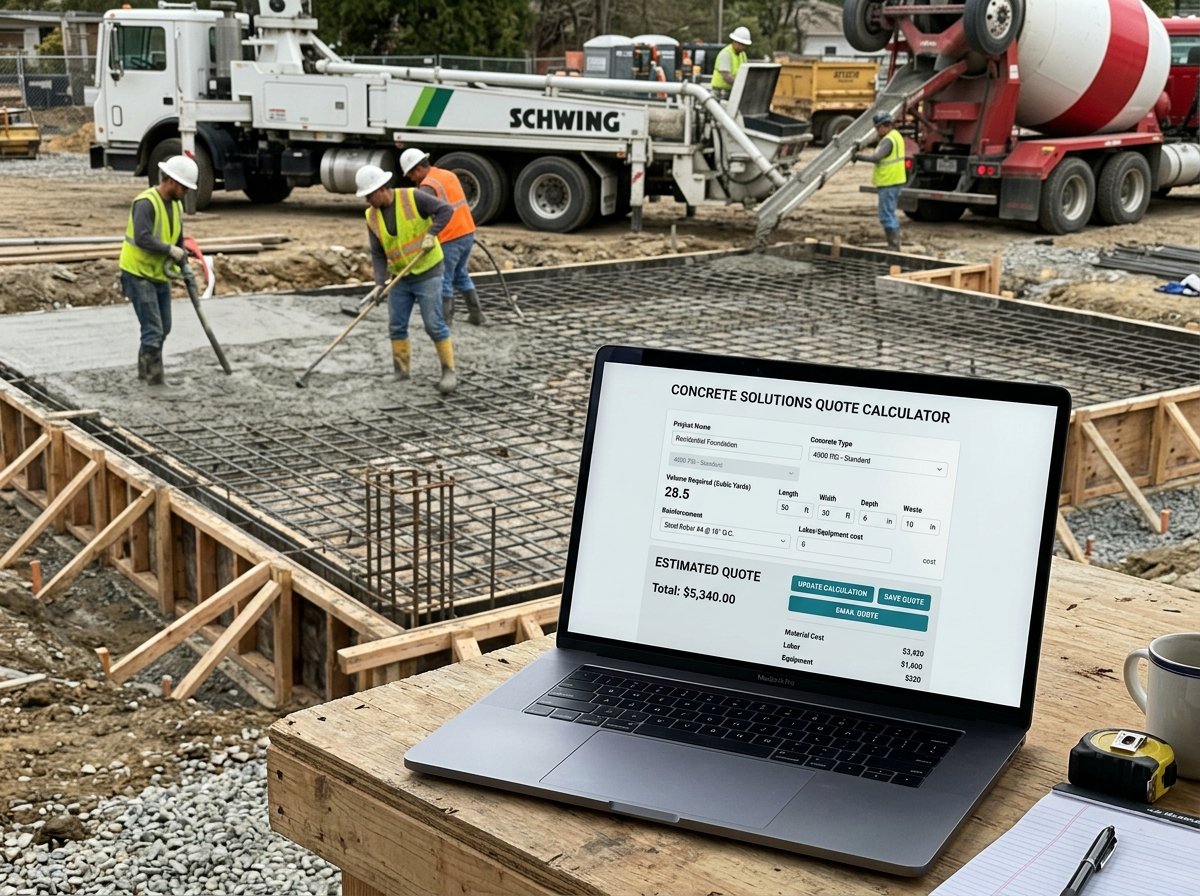
Concrete Quote Calculator: Estimate Concrete Works Costs Accurately
Concrete is the most widely used construction material in the world, forming the backbone of foundations, slabs, columns, beams, and walls. Whether you’re a contractor preparing a bid or a homeowner planning a driveway, getting a realistic quote for concrete works is essential. Underestimating can lead to lost profits or unfinished projects; overestimating can lose you the job. Our Concrete Quote Calculator is a free online tool that helps you quickly estimate the total cost of concrete works, including concrete supply, reinforcement, formwork, labour, and contingency. It provides a clear breakdown so you can present a professional quote with confidence.
In this guide, we’ll show you how to use the calculator, explain each cost component, provide real-world examples, and answer common questions. We’ll also share tips to ensure your concrete quote is accurate and competitive.
Concrete Quote
Construction CalculatorConcrete works quote: concrete, rebar, formwork, labour and delivery.
What is the Concrete Quote Calculator?
The Concrete Quote Calculator is a free online tool that calculates the total cost of a concrete placement project. It supports any concrete volume and grade (C20/25, C25/30, C30/37, C35/45), and accounts for reinforcement (rebar per m³ and price per kg), formwork contact area and price, labour rate per m³, and a contingency percentage. The calculator provides a clear breakdown of rebar weight, concrete cost, reinforcement cost, formwork cost, labour cost, contingency amount, and grand total. The tool is part of a suite of cost and finance calculators available on our website. For related estimates, you can use our Masonry Quote Calculator, Deck Cost Calculator, Roof Repair Cost Calculator, and Plumbing Quote Calculator.
How to Use the Concrete Quote Calculator
Using the calculator is straightforward. Here’s a breakdown of each field:
1. Volume
- Concrete volume: Enter the total volume of concrete to be placed in cubic meters or cubic yards. For example, a 10 m³ slab.
- Concrete grade: Select the concrete grade: C20/25 — standard, C25/30 — slabs, foundations, C30/37 — loaded elements, or C35/45 — special. This is for reference; enter the price per m³ for the selected grade below.
2. Materials
- Concrete price per m³: Enter the ready-mix delivered price for the selected grade. This should include delivery to site.
- Rebar per m³: Enter the reinforcement density in kg/m³. Typically 60–120 kg/m³ depending on structural load. The default is 80 kg/m³.
- Rebar price per kg: Enter the local price per kg of reinforcement.
3. Formwork
- Formwork contact area: Enter the area of formwork in contact with concrete in square meters or square feet. For a slab, this is the perimeter multiplied by the depth; for beams, it’s the sides and soffit.
- Formwork price per m²: Enter the local rate for formwork, whether rental or site-built.
4. Labour
- Labour rate per m³: Enter the labour cost per cubic meter for placement, vibration, and curing. This should reflect local wage rates and crew productivity.
5. Costs
- Contingency: Enter a percentage for unforeseen site conditions. Typically 3–8%. The default is 5%.
Once you enter all values, the calculator instantly displays:
- Rebar weight (kg)
- Concrete cost
- Reinforcement cost
- Formwork cost
- Placement labour cost
- Contingency amount
- Grand total
Understanding the Cost Components
To make the most of the calculator, it’s important to understand each output and the underlying formulas.
- Rebar weight:
concrete volume × rebar per m³. This gives the total mass of reinforcement required. - Concrete cost:
volume × concrete price per m³. This is the cost of ready-mix concrete delivered to site. - Reinforcement cost:
rebar weight × rebar price per kg. This includes cutting, bending, and fixing labour if not separately accounted for. If fixing labour is separate, adjust the labour rate accordingly. - Formwork cost:
formwork contact area × formwork price per m². This covers the cost of formwork materials, erection, and striking. If formwork is reused, the effective cost per m² may be lower; enter the amortised rate. - Labour cost:
volume × labour rate per m³. This is the cost of placing, vibrating, and curing the concrete. It does not include reinforcement fixing or formwork erection, which are covered in their respective rates. - Subtotal: Sum of concrete, reinforcement, formwork, and labour costs.
- Contingency:
subtotal × contingency percentage / 100. This is a reserve for unexpected conditions, such as poor ground, additional excavation, or weather delays. - Grand total: Subtotal + contingency. This is the total quote amount.
Understanding these components helps you adjust your rates and present a transparent quote. For more information on concrete works, you can refer to Wikipedia’s article on concrete.
Example Calculations
Let’s run through a few examples to see how the calculator works in different scenarios.
Example 1: 10 m³ Slab, C25/30, 80 kg/m³ Rebar
- Concrete volume: 10 m³
- Concrete grade: C25/30
- Concrete price: $120/m³
- Rebar per m³: 80 kg/m³
- Rebar price: $1.20/kg
- Formwork area: 30 m²
- Formwork price: $25/m²
- Labour rate: $60/m³
- Contingency: 5%
Calculations:
- Rebar weight = 10 × 80 = 800 kg
- Concrete cost = 10 × $120 = $1,200
- Rebar cost = 800 × $1.20 = $960
- Formwork cost = 30 × $25 = $750
- Labour cost = 10 × $60 = $600
- Subtotal = $1,200 + $960 + $750 + $600 = $3,510
- Contingency = 5% of $3,510 = $175.50
- Total = $3,510 + $175.50 = $3,685.50
- Result: Grand total $3,685.50
Example 2: 25 m³ Foundation, C30/37, 120 kg/m³ Rebar
- Concrete volume: 25 m³
- Concrete grade: C30/37
- Concrete price: $135/m³
- Rebar per m³: 120 kg/m³
- Rebar price: $1.30/kg
- Formwork area: 60 m²
- Formwork price: $30/m²
- Labour rate: $70/m³
- Contingency: 8%
Calculations:
- Rebar weight = 25 × 120 = 3,000 kg
- Concrete cost = 25 × $135 = $3,375
- Rebar cost = 3,000 × $1.30 = $3,900
- Formwork cost = 60 × $30 = $1,800
- Labour cost = 25 × $70 = $1,750
- Subtotal = $3,375 + $3,900 + $1,800 + $1,750 = $10,825
- Contingency = 8% of $10,825 = $866
- Total = $10,825 + $866 = $11,691
- Result: Grand total $11,691
Example 3: 5 m³ Column, C35/45, 150 kg/m³ Rebar
- Concrete volume: 5 m³
- Concrete grade: C35/45
- Concrete price: $150/m³
- Rebar per m³: 150 kg/m³
- Rebar price: $1.40/kg
- Formwork area: 20 m²
- Formwork price: $35/m²
- Labour rate: $80/m³
- Contingency: 5%
Calculations:
- Rebar weight = 5 × 150 = 750 kg
- Concrete cost = 5 × $150 = $750
- Rebar cost = 750 × $1.40 = $1,050
- Formwork cost = 20 × $35 = $700
- Labour cost = 5 × $80 = $400
- Subtotal = $750 + $1,050 + $700 + $400 = $2,900
- Contingency = 5% of $2,900 = $145
- Total = $2,900 + $145 = $3,045
- Result: Grand total $3,045
These examples show how different volumes, grades, and reinforcement densities affect the total cost.
Benefits of Using the Concrete Quote Calculator
Tips for Accurate Concrete Quote Estimation
- Measure concrete volume accurately: Double-check dimensions. For complex shapes, divide into simple geometric forms and sum the volumes.
- Choose the correct concrete grade: C20/25 is standard for mass fill; C25/30 for slabs and foundations; C30/37 for loaded elements; C35/45 for special applications. Higher grades cost more but may be required by design.
- Determine reinforcement density correctly: Typical values range from 60 kg/m³ for lightly reinforced slabs to 150 kg/m³ for heavily loaded columns. Check your structural drawings.
- Calculate formwork area properly: For slabs, it’s the perimeter × depth. For beams, it’s the sides + soffit. For columns, it’s the perimeter × height.
- Use realistic labour rates: Labour for placing and finishing concrete varies by region and complexity. Check local rates.
- Include a contingency: 5–10% is typical. This covers unexpected site conditions, small changes, and waste.
- Consider pump hire: If access is difficult, you may need a concrete pump. Add this as a separate cost.
- Account for curing and protection: In extreme weather, curing costs may increase. Include them in the labour rate or as a separate item.
- Verify with a professional: For structural concrete, have a qualified engineer verify the design and quantities.
For more information on concrete estimating, you can refer to resources like Wikipedia’s article on concrete or guidelines from the American Concrete Institute.
How to Reduce Concrete Costs
If your estimate is higher than expected, here are ways to reduce costs without compromising quality:
- Optimize concrete volume: Work with your engineer to minimize thickness or dimensions while meeting structural requirements.
- Choose a lower grade if suitable: C20/25 is cheaper than C35/45. Use the lowest grade that meets design requirements.
- Optimize reinforcement: Use the minimum steel area required. Avoid over-specifying.
- Reuse formwork: If you have multiple identical elements, formwork can be reused, reducing cost per m².
- Schedule efficiently: Avoid small, separate pours. Combine pours to reduce mobilisation and labour costs.
- Order ready-mix in bulk: Larger orders often get better prices per m³.
- Get multiple quotes: Compare concrete suppliers and formwork contractors.
Frequently Asked Questions (FAQ)
Conclusion
The Concrete Quote Calculator is an essential tool for contractors, builders, and anyone preparing a concrete works estimate. It helps you quickly calculate concrete, reinforcement, formwork, labour, and contingency costs, so you can present a professional quote with confidence. By following the tips in this article and using the calculator, you can ensure your concrete estimates are accurate and competitive. Don’t forget to explore our other cost and finance calculators for all your construction needs.
Whether you’re quoting a small slab or a large foundation, accurate concrete estimation is key to a successful project. Try the Concrete Quote Calculator today and take the guesswork out of your concrete budget.





4 Comments