
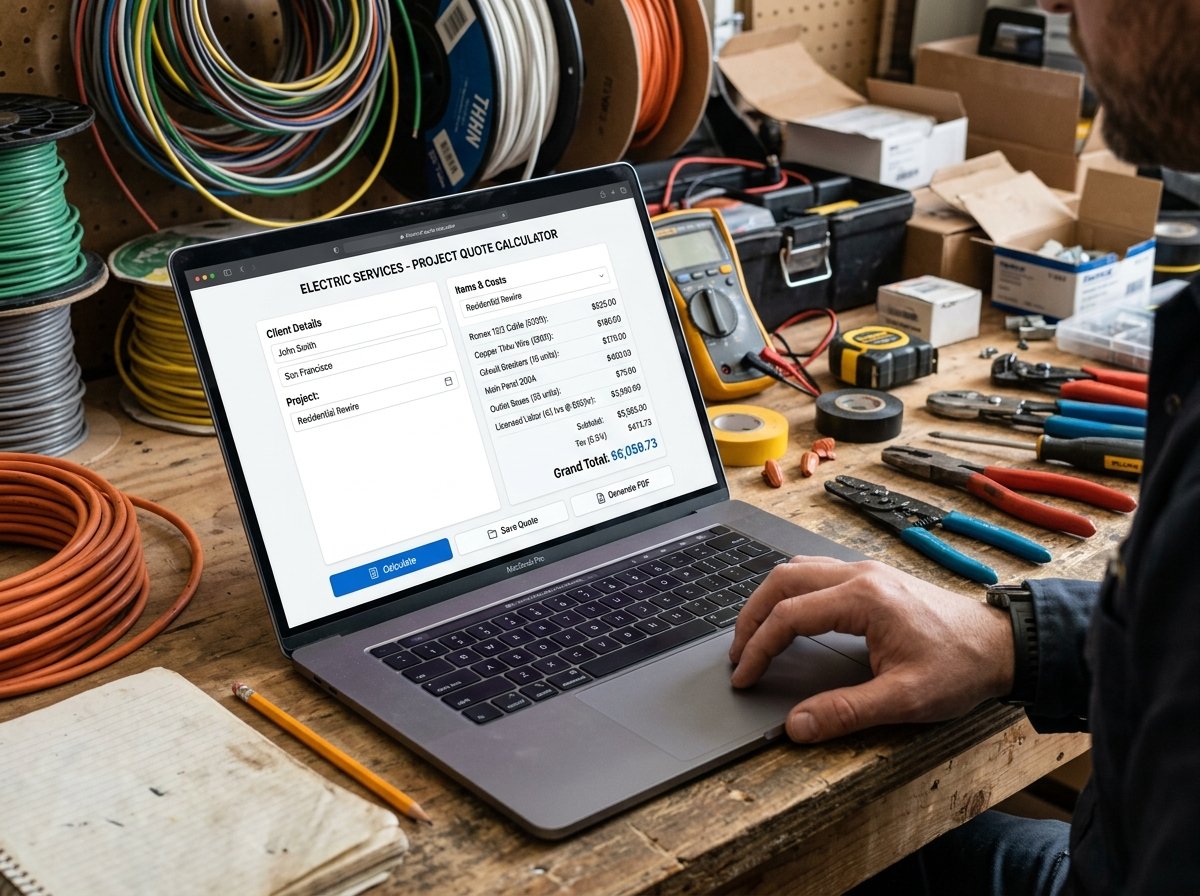
Electrical Quote Calculator: Estimate Electrical Works Costs Accurately
Electrical work is one of the most critical trades in any construction or renovation project. From installing new sockets and switches to wiring a complete distribution board, the costs can add up quickly. Whether you’re an electrician preparing a quote or a homeowner budgeting for a rewire, accurate cost estimation is essential. An underestimated quote can lead to lost profits or unfinished work; an overestimated quote can lose you the job. Our Electrical Quote Calculator is a free online tool that helps you quickly estimate the total cost of electrical works, including points, cable, distribution board, materials, labour, and contingency. It provides a clear breakdown so you can present a professional quote or plan your project with confidence.
In this guide, we’ll show you how to use the calculator, explain each cost component, provide real-world examples, and answer common questions. We’ll also share tips to ensure your electrical quote is accurate and competitive.
Electrical Quote
Construction CalculatorElectrical works quote: points, cable, distribution board, materials and labour.
What is the Electrical Quote Calculator?
The Electrical Quote Calculator is a free online tool that calculates the material and labour costs for electrical installation works. It supports standard points (sockets, switches, light fittings), high-power circuits (oven, boiler, A/C), and low-voltage points (data, TV, intercom). The calculator accounts for cable length and type, distribution board size and price, materials per point, labour per point (standard and high-power/low-voltage), and a contingency percentage. It provides a clear breakdown of total points, cable cost, fitting materials, high-power/low-voltage materials, distribution board cost, labour (standard and high-power), contingency, and grand total. The tool is part of a suite of cost and finance calculators available on our website. For related estimates, you can use our Concrete Quote Calculator for foundations, Door Installation Cost Calculator for interior fit-out, Deck Cost Calculator for outdoor living spaces, and Roof Repair Cost Calculator for roofing works.
How to Use the Electrical Quote Calculator
Using the calculator is straightforward. Here’s a breakdown of each field:
1. Points
- Sockets: Enter the number of socket outlets to be installed.
- Switches: Enter the number of switches (light switches, dimmers, etc.).
- Light fittings: Enter the number of light fittings to be installed.
- High-power circuits: Enter the number of high-power circuits (oven, boiler, air conditioner, etc.). These are installed with a higher labour rate.
- Low-voltage points: Enter the number of low-voltage points (data, TV, intercom, etc.). These also use a higher labour rate.
2. Cable
- Cable length: Enter the total length of cable required in meters or feet.
- Cable type: Select the cable type (3×1.5 mm², 3×2.5 mm², 3×4 mm², 5×6 mm²). This is for reference; enter the price per metre for your selected cable below.
- Cable price per metre: Enter the local price per metre for the selected cable type.
3. Distribution board
- Distribution board: Select the board size: Not required, Small (up to 12 ways), Medium (24 ways), or Large (36+ ways). If “Not required” is selected, no board cost is added.
- Board with breakers: Enter the local price for the selected board size, including breakers.
4. Materials per point
- Materials per standard point: Enter the cost of back box, faceplate, and miscellaneous materials per standard point (socket, switch, light).
- Materials per high-power / low-voltage point: Enter the cost of special outlets or modules per high-power or low-voltage point.
5. Labour
- Labour per standard point: Enter the local labour rate per standard point.
- Labour per high-power / low-voltage point: Enter the local labour rate per high-power or low-voltage point. This is usually higher than a standard point.
6. Costs
- Contingency: Enter a percentage for unforeseen costs. Typically 5–10% for electrical works. The default is 8%.
Once you enter all values, the calculator instantly displays:
- Total points
- Cable cost (if cable length and price entered)
- Socket / switch fittings cost
- High-power / low-voltage materials cost
- Distribution board cost
- Standard point labour cost
- High-power / low-voltage labour cost
- Contingency amount
- Grand total
Understanding the Cost Components
To make the most of the calculator, it’s important to understand each output and the underlying formulas.
- Total points:
sockets + switches + lights + heavy + lowcurrent. This is the total number of electrical points in the project. - Standard points:
sockets + switches + lights. These are the most common points and use the standard labour and material rates. - High-power / low-voltage points:
heavy + lowcurrent. These require more specialised materials and take longer to install, hence the higher labour rate. - Cable cost:
cable length × cable price per metre. Cable is a significant material cost, especially for long runs. - Distribution board cost: If a board is selected (not “Not required”), the cost is the price you enter. If “Not required” is selected, the cost is zero.
- Materials per standard point:
standard points × materials per standard point. This covers back boxes, faceplates, and miscellaneous items. - Materials per high-power / low-voltage point:
high-power / low-voltage points × materials per high-power point. This covers special outlets or modules. - Labour (standard):
standard points × labour per standard point. - Labour (high-power / low-voltage):
high-power / low-voltage points × labour per high-power point. - Subtotal: Sum of cable, board, materials, and labour.
- Contingency:
subtotal × contingency percentage / 100. This covers unexpected issues like additional cable, damaged fittings, or extra labour. - Grand total: Subtotal + contingency. This is the total quote amount.
Understanding these components helps you adjust your rates and present a transparent quote. For more information on electrical installation, you can refer to Wikipedia’s article on electrical wiring.
Example Calculations
Let’s run through a few examples to see how the calculator works in different scenarios.
Example 1: Small Residential Rewire
- Sockets: 12
- Switches: 5
- Lights: 8
- High-power circuits: 3 (oven, boiler, A/C)
- Low-voltage points: 3 (data, TV, intercom)
- Cable length: 200 m
- Cable type: 3×2.5 mm²
- Cable price: $1.20/m
- Distribution board: Medium (24 ways)
- Board price: $350
- Materials per standard point: $8
- Materials per high-power point: $15
- Labour per standard point: $35
- Labour per high-power point: $60
- Contingency: 8%
Calculations:
- Standard points = 12 + 5 + 8 = 25
- High-power / low-voltage points = 3 + 3 = 6
- Total points = 25 + 6 = 31
- Cable cost = 200 × $1.20 = $240
- Board cost = $350
- Materials (standard) = 25 × $8 = $200
- Materials (high-power) = 6 × $15 = $90
- Labour (standard) = 25 × $35 = $875
- Labour (high-power) = 6 × $60 = $360
- Subtotal = $240 + $350 + $200 + $90 + $875 + $360 = $2,115
- Contingency = 8% of $2,115 = $169.20
- Total = $2,115 + $169.20 = $2,284.20
- Result: Grand total $2,284.20
Example 2: Commercial Fit-Out
- Sockets: 30
- Switches: 15
- Lights: 40
- High-power circuits: 8
- Low-voltage points: 12
- Cable length: 600 m
- Cable type: 3×4 mm²
- Cable price: $2.50/m
- Distribution board: Large (36+ ways)
- Board price: $800
- Materials per standard point: $10
- Materials per high-power point: $25
- Labour per standard point: $40
- Labour per high-power point: $75
- Contingency: 10%
Calculations:
- Standard points = 30 + 15 + 40 = 85
- High-power / low-voltage points = 8 + 12 = 20
- Total points = 105
- Cable cost = 600 × $2.50 = $1,500
- Board cost = $800
- Materials (standard) = 85 × $10 = $850
- Materials (high-power) = 20 × $25 = $500
- Labour (standard) = 85 × $40 = $3,400
- Labour (high-power) = 20 × $75 = $1,500
- Subtotal = $1,500 + $800 + $850 + $500 + $3,400 + $1,500 = $8,550
- Contingency = 10% of $8,550 = $855
- Total = $8,550 + $855 = $9,405
- Result: Grand total $9,405
Example 3: Kitchen Extension
- Sockets: 8
- Switches: 4
- Lights: 6
- High-power circuits: 4 (oven, hob, dishwasher, fridge)
- Low-voltage points: 2 (data, TV)
- Cable length: 120 m
- Cable type: 3×2.5 mm²
- Cable price: $1.30/m
- Distribution board: Small (up to 12 ways)
- Board price: $200
- Materials per standard point: $7
- Materials per high-power point: $18
- Labour per standard point: $30
- Labour per high-power point: $55
- Contingency: 5%
Calculations:
- Standard points = 8 + 4 + 6 = 18
- High-power / low-voltage points = 4 + 2 = 6
- Total points = 24
- Cable cost = 120 × $1.30 = $156
- Board cost = $200
- Materials (standard) = 18 × $7 = $126
- Materials (high-power) = 6 × $18 = $108
- Labour (standard) = 18 × $30 = $540
- Labour (high-power) = 6 × $55 = $330
- Subtotal = $156 + $200 + $126 + $108 + $540 + $330 = $1,460
- Contingency = 5% of $1,460 = $73
- Total = $1,460 + $73 = $1,533
- Result: Grand total $1,533
These examples show how different project sizes, point counts, and rates affect the total cost.
Benefits of Using the Electrical Quote Calculator
Tips for Accurate Electrical Quote Estimation
- Count points accurately: Walk through the project and count every socket, switch, light, high-power circuit, and low-voltage point. Don’t forget outdoor sockets, underfloor heating, and security systems.
- Estimate cable length realistically: Cable runs are rarely straight. Add 10–20% for slack, routing around obstacles, and vertical drops. The calculator allows you to enter the total length; you can adjust for waste separately if needed.
- Choose the correct cable type: Different circuits require different cable sizes. Lighting circuits typically use 1.5 mm², socket circuits 2.5 mm², cookers and showers 4–6 mm². Using the wrong size is unsafe and non-compliant.
- Select the appropriate distribution board: The board must have enough ways for all circuits plus spare capacity. A medium board (24 ways) is common for a 3-bed house. Large boards are for commercial or large residential projects.
- Use realistic material costs: Back boxes, faceplates, and modules vary in price. Premium finishes cost more. Enter a realistic average per point.
- Labour rates vary: Standard points are faster to install than high-power or low-voltage points. Use the higher rate for the latter. Local labour rates also vary by region.
- Include contingency: 5–10% is typical. Electrical work often uncovers unexpected issues, such as old wiring, damaged conduits, or non-compliant earthing.
- Consider testing and certification: The quote should include testing and certification. If not, add it as a separate line item.
- Account for access equipment: High ceilings or restricted access may require scaffolding or specialist equipment. Add these costs separately.
- Verify with a professional: For complex or commercial projects, have a qualified electrician verify the design and quantities.
For more information on electrical estimating, you can refer to resources like Wikipedia’s article on electrical wiring or guidelines from the Institution of Engineering and Technology.
How to Reduce Electrical Costs
If your estimate is higher than expected, here are ways to reduce costs without compromising safety:
- Optimize point locations: Group points to reduce cable runs. For example, place sockets on shared walls.
- Use standard fittings: Standard white plastic faceplates are cheaper than metal or designer ranges.
- Choose a smaller distribution board: If you don’t need many spare ways, a smaller board saves money.
- Do some preparation yourself: If you’re competent, you can chase walls and run cables, leaving the electrician to connect and certify. However, this must comply with local regulations.
- Buy materials yourself: Some contractors mark up materials. Buying directly can save money, but ensure they are compliant.
- Get multiple quotes: Compare electricians for the best price. But never choose solely on price—safety and certification are paramount.
- Phase the work: If budget is tight, prioritize essential points and add extra points later.
Frequently Asked Questions (FAQ)
Conclusion
The Electrical Quote Calculator is an essential tool for electricians, contractors, and homeowners. It helps you estimate the total cost of electrical works, including points, cable, distribution board, materials, labour, and contingency. By following the tips in this article and using the calculator, you can confidently prepare quotes and budgets. Don’t forget to explore our other cost and finance calculators for all your construction needs.
Whether you’re rewiring a single room or fitting out a commercial building, accurate electrical estimation is key to a successful project. Try the Electrical Quote Calculator today and take the guesswork out of your electrical budget.




2 Comments