
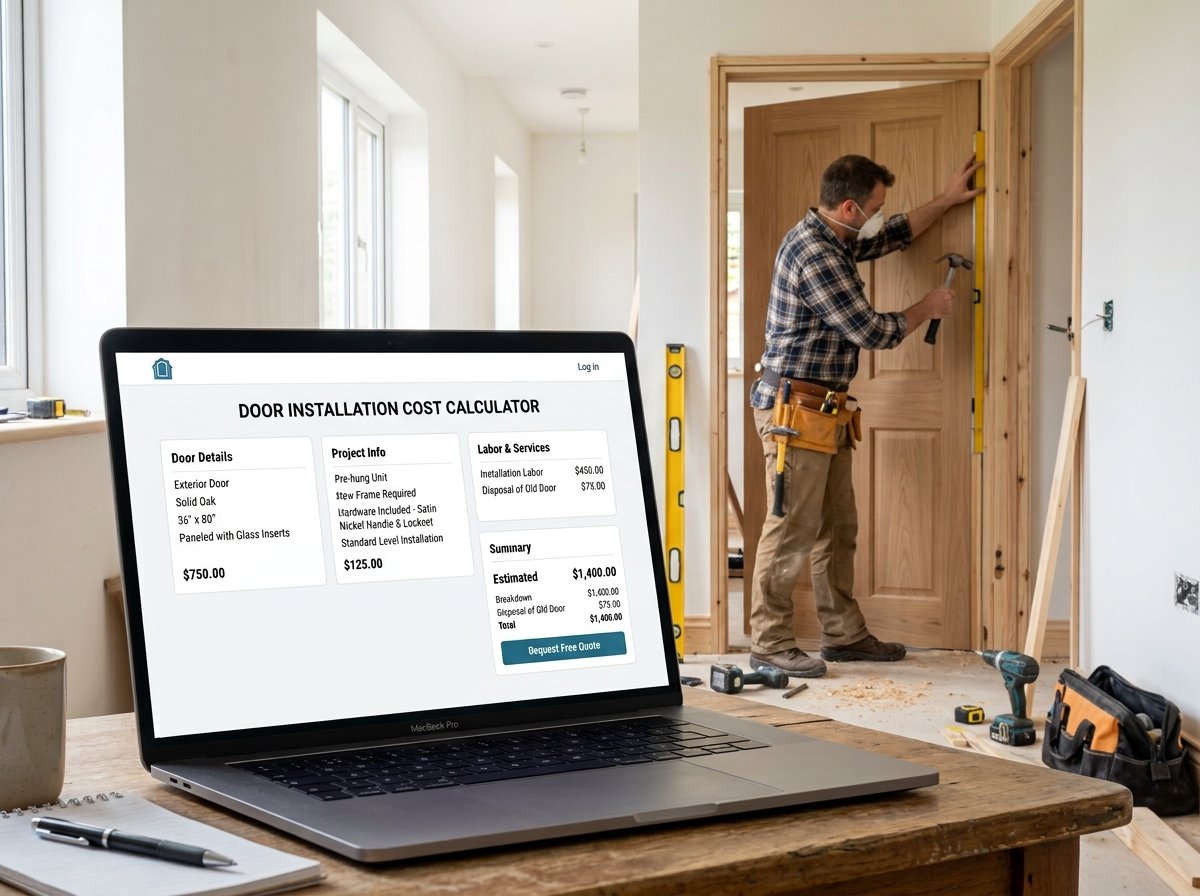
Door Installation Cost Calculator: Estimate Your Door Fitting Costs Accurately
Doors are more than just functional barriers—they affect the aesthetics, security, and energy efficiency of your home. Whether you’re replacing a single interior door or fitting new fire doors throughout a commercial building, getting the costs right is essential. Underestimating can lead to budget overruns; overestimating can lose you a job. Our Door Installation Cost Calculator is a free online tool that helps you quickly estimate the total cost of door installation, including door leaves, frames, ironmongery, labour, and contingency. It provides a clear breakdown so you can present a professional quote or plan your DIY project with confidence.
In this guide, we’ll show you how to use the calculator, explain each cost component, provide real-world examples, and answer common questions. We’ll also share tips to ensure your door installation estimate is accurate and competitive.
Door Installation Cost
Construction CalculatorDoor installation quote: leaf, frame, ironmongery, install and linings.
What is the Door Installation Cost Calculator?
The Door Installation Cost Calculator is a free online tool that calculates the material and labour costs for installing doors. It supports interior, entrance, fire-rated, and sliding doors, and various materials including MDF, veneer, solid timber, steel, and glass/aluminium. The calculator accounts for the number of doors, average width and height, door leaf price, frame/trim price, ironmongery cost, installation rate per door, and a contingency percentage. It provides a clear breakdown of total door area, leaf cost, frame cost, ironmongery cost, installation labour, contingency, and grand total. The tool is part of a suite of cost and finance calculators available on our website. For related estimates, you can use our Window Replacement Cost Calculator, Roof Repair Cost Calculator, Masonry Quote Calculator, and Concrete Quote Calculator.
How to Use the Door Installation Cost Calculator
Using the calculator is straightforward. Here’s a breakdown of each field:
1. Dimensions
- Number of doors: Enter the total number of doors to be installed. For example, 5 interior doors.
- Average width: Enter the average width of a door in meters or inches. Standard interior doors are 0.9 m (900 mm) wide.
- Average height: Enter the average height of a door in meters or inches. Standard height is 2.05 m (2050 mm).
2. Type
- Door purpose: Select the purpose: Interior, Entrance, Fire-rated, or Sliding. Fire-rated and entrance doors usually require a higher labour rate due to additional regulations and hardware.
- Door material: Select the material: MDF, Veneer, Solid timber, Steel, or Glass / aluminium. This is for reference; enter the leaf price for the selected material below.
3. Pricing
- Leaf price per door: Enter the local price for the door leaf (the door itself). This varies widely by material and style.
- Frame / trim per door: Enter the cost of jambs, architrave, and linings per door. If you’re replacing the door within an existing frame, this may be zero.
- Ironmongery per door: Enter the cost of handle, hinges, lock, and any other hardware per door.
- Install rate per door: Enter the labour cost to fit one door, including adjustment and foam. This should reflect local carpenters’ rates.
4. Costs
- Contingency: Enter a percentage for unforeseen costs. Typically 5–10% for a fitting job. The default is 8%.
Once you enter all values, the calculator instantly displays:
- Number of doors
- Total door area (m²)
- Leaves cost
- Frames / trim cost (if entered)
- Ironmongery cost (if entered)
- Installation labour cost
- Contingency amount
- Grand total
Understanding the Cost Components
To make the most of the calculator, it’s important to understand each output and the underlying formulas.
- Total door area:
average width × average height × number of doors. This is for reference only; it helps you understand the scale of the project. - Leaf cost:
number of doors × leaf price per door. The door leaf is the most significant material cost. - Frame / trim cost:
number of doors × frame price per door. If you’re fitting new frames or replacing architrave, this adds up. - Ironmongery cost:
number of doors × ironmongery price per door. Handles, hinges, locks, and closers vary in price. - Installation labour:
number of doors × install rate per door. Labour includes hanging the door, fitting hardware, adjusting for clearance, and applying foam or sealant. - Subtotal: Sum of leaf, frame, ironmongery, and installation costs.
- Contingency:
subtotal × contingency percentage / 100. This covers unexpected issues like damaged doors, additional hardware, or wall adjustments. - Grand total: Subtotal + contingency.
Understanding these components helps you adjust your pricing and present a transparent quote. For more information on door types and installation, you can refer to Wikipedia’s article on doors.
Example Calculations
Let’s run through a few examples to see how the calculator works in different scenarios.
Example 1: 5 Interior Veneer Doors
- Number of doors: 5
- Average width: 0.9 m
- Average height: 2.05 m
- Door purpose: Interior
- Door material: Veneer
- Leaf price: $120 each
- Frame price: $60 each
- Ironmongery: $35 each
- Install rate: $80 each
- Contingency: 8%
Calculations:
- Total door area = 0.9 × 2.05 × 5 = 9.225 m²
- Leaf cost = 5 × $120 = $600
- Frame cost = 5 × $60 = $300
- Ironmongery cost = 5 × $35 = $175
- Install cost = 5 × $80 = $400
- Subtotal = $600 + $300 + $175 + $400 = $1,475
- Contingency = 8% of $1,475 = $118
- Total = $1,475 + $118 = $1,593
- Result: Grand total $1,593
Example 2: 3 Entrance Solid Timber Doors
- Number of doors: 3
- Average width: 0.95 m
- Average height: 2.10 m
- Door purpose: Entrance
- Door material: Solid timber
- Leaf price: $350 each
- Frame price: $120 each
- Ironmongery: $80 each
- Install rate: $150 each
- Contingency: 10%
Calculations:
- Total door area = 0.95 × 2.10 × 3 = 5.985 m²
- Leaf cost = 3 × $350 = $1,050
- Frame cost = 3 × $120 = $360
- Ironmongery cost = 3 × $80 = $240
- Install cost = 3 × $150 = $450
- Subtotal = $1,050 + $360 + $240 + $450 = $2,100
- Contingency = 10% of $2,100 = $210
- Total = $2,100 + $210 = $2,310
- Result: Grand total $2,310
Example 3: 8 Fire-Rated Doors with Steel Material
- Number of doors: 8
- Average width: 0.9 m
- Average height: 2.05 m
- Door purpose: Fire-rated
- Door material: Steel
- Leaf price: $400 each
- Frame price: $150 each
- Ironmongery: $120 each
- Install rate: $200 each
- Contingency: 5%
Calculations:
- Total door area = 0.9 × 2.05 × 8 = 14.76 m²
- Leaf cost = 8 × $400 = $3,200
- Frame cost = 8 × $150 = $1,200
- Ironmongery cost = 8 × $120 = $960
- Install cost = 8 × $200 = $1,600
- Subtotal = $3,200 + $1,200 + $960 + $1,600 = $6,960
- Contingency = 5% of $6,960 = $348
- Total = $6,960 + $348 = $7,308
- Result: Grand total $7,308
These examples show how different door types, quantities, and materials affect the total cost.
Benefits of Using the Door Installation Cost Calculator
Tips for Accurate Door Installation Cost Estimation
- Count doors accurately: Include all doors—interior, exterior, closet, and any doors that need replacement. Don’t forget doors in outbuildings or garages.
- Measure average size: Use a standard size if all doors are similar. If sizes vary significantly, calculate each size separately and sum the costs.
- Choose the right door purpose: Fire-rated doors require special hardware (closers, intumescent strips) and certification, which increases cost. Entrance doors often need higher security hardware.
- Select the appropriate material: MDF is cheapest, solid timber is mid-range, and steel or glass are premium. The material affects both the leaf price and the installation difficulty.
- Account for frames and trim: If you’re replacing the door within an existing frame, you may not need new frames. If the frame is damaged or you want a new look, include frame and architrave costs.
- Don’t forget ironmongery: Handles, hinges, locks, and closers add up. Specify quality hardware that matches the door’s purpose and usage.
- Use realistic labour rates: Installation rates vary by region and door type. Fire doors and entrance doors take longer to fit and adjust. Check local rates.
- Add contingency: 5–10% is typical. This covers unexpected wall repairs, additional hardware, or slight size adjustments.
- Consider disposal: Old doors and packaging need to be removed. If your contractor charges for disposal, add it to the quote.
- Verify with a professional: For fire doors and entrance doors, building regulations may require certified installers. Always check local requirements.
For more information on door installation and regulations, you can refer to resources like Wikipedia’s article on doors or guidelines from the British Woodworking Federation.
How to Reduce Door Installation Costs
If your estimate is higher than expected, here are ways to reduce costs without compromising quality:
- Choose standard sizes: Standard doors are cheaper than custom sizes. If your openings are non-standard, you may need custom doors, which cost more.
- Use MDF or hollow-core doors for interior use: They are lighter and cheaper than solid timber. Solid timber is better for sound insulation and durability.
- Reuse existing frames: If the frames are in good condition, you can save on frame and trim costs.
- Paint instead of replacing: If the doors are structurally sound, painting or refinishing them is much cheaper than replacement.
- Install doors yourself: If you’re handy with carpentry, DIY installation saves labour costs. However, fire doors and entrance doors may require professional installation.
- Buy in bulk: If you’re replacing many doors, negotiate a trade discount with your supplier.
- Get multiple quotes: Compare suppliers and carpenters for the best price.
Frequently Asked Questions (FAQ)
Conclusion
The Door Installation Cost Calculator is an essential tool for homeowners, builders, and contractors. It helps you estimate the total cost of door installation, including leaves, frames, ironmongery, labour, and contingency. By following the tips in this article and using the calculator, you can confidently plan your door replacement or installation project. Don’t forget to explore our other cost and finance calculators for all your construction needs.
Whether you’re replacing a single interior door or fitting fire doors throughout a commercial building, accurate cost estimation is key to a successful project. Try the Door Installation Cost Calculator today and take the guesswork out of your door budget.





2 Comments