
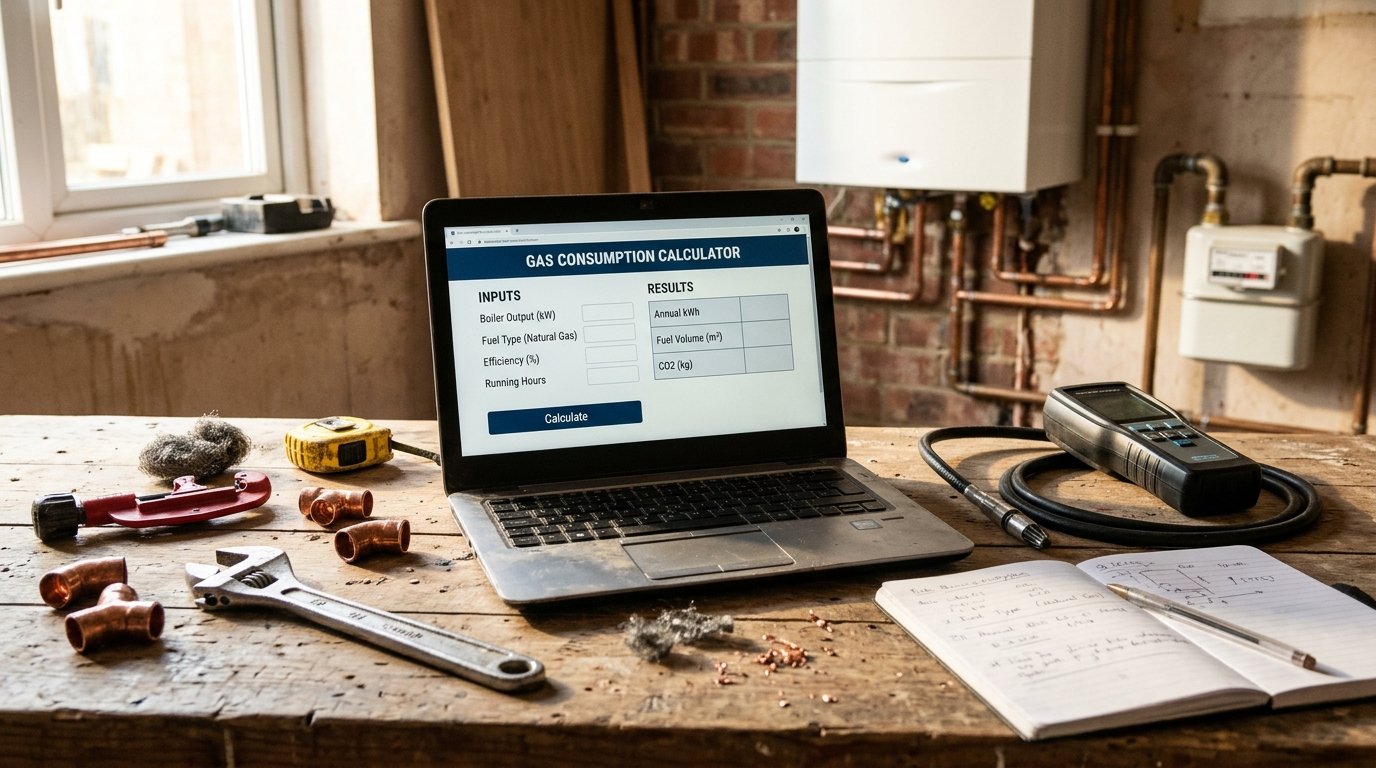
Gas Consumption
Construction CalculatorGas consumption from boiler output, efficiency and running hours, with CO2 and cost.
Gas Consumption Calculator: Boiler Running Cost, Fuel Volume & CO₂
A gas boiler is the single largest energy consumer in most UK homes, and its running cost is driven by three numbers: output, efficiency and running hours. Get any of them wrong and the annual bill estimate can be off by hundreds of pounds. A 24 kW combi boiler running for six effective full-load hours a day over a 180-day heating season consumes roughly 26,000 kWh of gas — but a 90% efficient boiler needs 28,900 kWh of input, while a 98% condensing boiler needs only 26,500 kWh. The difference is not in the boiler’s output; it is in how efficiently that output is delivered.
The Gas Consumption Calculator is a free online tool that estimates annual gas use, daily and monthly energy, fuel volume in m³ or litres, running cost and CO₂ emissions. It handles natural gas, LPG and heating oil, and it flags unrealistic inputs — efficiency below 70%, running hours above 24, or a negative calorific value — before the result is used.
In this guide, we explain how the calculator works, walk through the formulas, show four worked examples, and answer eight of the most frequently asked questions about gas consumption and boiler running costs.
What Is the Gas Consumption Calculator?
The Gas Consumption Calculator is a free online tool that estimates fuel consumption from a boiler’s rated output, efficiency and running hours. It supports:
- Boiler output in kW (typically 12–40 kW for a domestic boiler).
- Fuel type: natural gas (9.7 kWh/m³), LPG (6.9 kWh/L) or heating oil (10.0 kWh/L), with an optional calorific value override.
- Efficiency in percent (modern condensing boilers 90–98%).
- Usage: effective full-load running hours per day and heating days per year.
- Fuel price per kWh for running-cost calculation.
The output includes the boiler output and input power, the efficiency used, running hours per year, hourly/daily/monthly/annual energy input, daily and annual fuel volume, cost per unit of fuel, annual CO₂ emissions, and monthly/annual running cost. Design warnings flag zero output, unrealistic efficiency, hours above 24, days above 365, negative calorific override, and unknown fuel type.
The tool complements whole-home heating calculators. For boiler sizing, pair it with the Boiler Power Sizing Calculator; for room-level loads, use the Room Heat Loss Calculator.
Why Accurate Gas Consumption Estimation Matters
Gas is the most common heating fuel in the UK, and the difference between a good and a poor estimate is not academic — it is the difference between a realistic budget and a winter of surprise bills.
Output Is Not Input
A boiler’s rated output — 24 kW, for example — is the heat delivered to the heating system, not the energy consumed from the gas supply. The input power is higher because the boiler is not 100% efficient. A 24 kW output at 90% efficiency requires 26.67 kW of gas input. At 80% efficiency, it requires 30 kW. The calculator makes this distinction explicit, which is the single most common source of confusion in boiler running-cost estimates.
Efficiency Is the Largest Single Lever
Modern condensing boilers are 90–98% efficient; older non-condensing boilers are 70–80%. The difference on a 24 kW boiler running for 1,080 hours a year is roughly 3,600 kWh of gas — around £250–£350 at 2026 prices. The Energy Saving Trust publishes guidance on condensing boiler efficiency and expected savings, and the calculator uses the efficiency you enter to reflect the actual boiler, not a nominal figure.
Running Hours Are Not Clock Hours
A boiler does not run at full output for every hour it is switched on. It modulates down as the room approaches setpoint, cycles on and off, and may be off entirely during mild weather. The “effective full-load hours” figure — typically 4–8 hours per day over a 180-day season in the UK — captures that modulation. Using 24 hours a day would overestimate consumption by a factor of 3–6. The GOV.UK energy efficiency guidance explains how heating demand varies with weather and building fabric, which is why the hours figure must be realistic.
Fuel Type Changes Volume, Not Energy
A kWh of natural gas, LPG and heating oil delivers the same amount of heat, but the volume required differs. Natural gas has a calorific value of about 9.7 kWh/m³; LPG about 6.9 kWh/L; heating oil about 10.0 kWh/L. The calculator converts annual energy into the correct volume for the selected fuel, so the result can be compared with a gas meter reading or an oil tank dip.
CO₂ Emissions Are Part of the Cost
Natural gas emits about 0.183 kg CO₂ per kWh; LPG 0.214; heating oil 0.249. A household using 26,000 kWh of gas a year emits around 4.8 tonnes of CO₂ from heating alone. The calculator shows the annual figure, which is useful for energy audits and for comparing a heat pump (lower CO₂ per kWh of heat delivered) with a fossil-fuel boiler.
Cost per Unit Is the Comparison Metric
The annual cost is useful, but the cost per m³ or per litre is what you compare against a tariff. The calculator shows both, so a gas tariff quoted in p/kWh can be checked against the meter reading, and an oil quote in p/litre can be converted to p/kWh. The Ofgem price cap information explains how unit rates and standing charges combine, and why the per-kWh figure is the right basis for comparison.
Design Warnings Prevent Silent Errors
The most dangerous gas consumption estimate is the one that looks plausible but is based on a wrong input. An efficiency of 50% (a typo for 90%), a running hours figure of 240 (instead of 24), or a negative calorific value will all produce a number that looks like a result but is not. The calculator flags these cases explicitly, so the estimate is either correct or visibly incomplete.
How to Use the Gas Consumption Calculator
The calculator takes seven inputs. Each is described below.
1. Boiler Output Rating
Enter the boiler’s rated heat output in kW. This is the figure on the datasheet — typically 12–40 kW for a domestic boiler. Do not enter the input power; the calculator derives that from the efficiency.
2. Fuel Type
Select natural gas, LPG or heating oil. The fuel type sets the default calorific value and the CO₂ factor.
3. Calorific Value Override
Leave at 0 to use the preset for the selected fuel. Enter a value in kWh/unit if your supplier quotes a different calorific value — natural gas varies slightly by region, and LPG and oil vary by grade.
4. Boiler Efficiency
Enter the boiler’s efficiency in percent. Modern condensing boilers are 90–98%; older non-condensing boilers are 70–80%. The calculator clamps the value to 100% and warns if it is below 70% or above 100%.
5. Running Hours per Day
Enter the effective full-load hours per day. A typical UK heating season uses 4–8 hours per day; a well-insulated home may be 3–5; a poorly insulated one 8–10. Do not enter 24 — the boiler does not run at full output all day.
6. Heating Days per Year
Enter the number of days the heating is on. A typical UK heating season is 180–210 days; a well-insulated home may be 150; a poorly insulated one 220. The calculator warns if the value is above 365.
7. Fuel Price per kWh
Enter your local tariff in £/kWh. Leave at 0 to skip the cost calculation. The calculator shows monthly and annual cost, plus cost per unit of fuel.
Reading the Output
- Boiler output and input show the difference between heat delivered and fuel consumed.
- Efficiency used confirms the value after clamping.
- Running hours per year is the product of hours per day and days per year.
- Hourly, daily, monthly and annual energy show the consumption at each timescale.
- Daily and annual fuel volume are in m³ for gas, litres for LPG and oil.
- Cost per unit converts the kWh price into a price per m³ or litre.
- Annual CO₂ shows the emissions from the calculated fuel use.
- Monthly and annual cost are shown when a fuel price is entered.
- Design warnings flag inputs that are out of range.
Understanding the Calculations
All calculations are deterministic and can be reproduced by hand. This section lists the formulas.
Input Power
Input power (kW) = boiler output (kW) / efficiency (fraction)
Running Hours
Running hours per year = hours per day × days per year
Annual Energy Input
Annual energy (kWh) = input power × running hours per year
Daily, Monthly, Hourly Energy
Daily energy = annual energy / days per year
Monthly energy = annual energy / 12
Hourly energy = input power (kW) for one hour of full-load running
Fuel Volume
Annual fuel volume = annual energy / calorific value (kWh per unit)
Daily fuel volume = annual fuel volume / days per year
Cost
Annual cost = annual energy × fuel price per kWh
Monthly cost = annual cost / 12
Cost per unit = fuel price per kWh × calorific value (kWh per unit)
CO₂ Emissions
Annual CO₂ (kg) = annual energy × CO₂ factor (kg/kWh)
CO₂ factors: natural gas 0.183, LPG 0.214, heating oil 0.249.
Quick Reference
- 24 kW output at 90% efficiency = 26.67 kW input.
- 26.67 kW × 6 h/day × 180 days = 28,800 kWh/year.
- 28,800 kWh / 9.7 kWh/m³ = 2,969 m³/year natural gas.
- 28,800 kWh × £0.07/kWh = £2,016/year.
- 28,800 kWh × 0.183 kg/kWh = 5,270 kg CO₂/year.
For hot-water energy checks, pair this calculator with the Hot Water Tank Sizing Calculator, which estimates the DHW share of annual gas use.
Worked Examples
Example 1: 24 kW Combi Boiler, 90% Efficiency, 6 h/day, 180 Days
Inputs: 24 kW output, natural gas, no override, 90% efficiency, 6 h/day, 180 days, £0.07/kWh.
- Input power = 24 / 0.90 = 26.67 kW.
- Running hours = 6 × 180 = 1,080 h.
- Annual energy = 26.67 × 1,080 = 28,800 kWh.
- Daily energy = 28,800 / 180 = 160 kWh.
- Monthly energy = 28,800 / 12 = 2,400 kWh.
- Annual fuel = 28,800 / 9.7 = 2,969 m³.
- Daily fuel = 2,969 / 180 = 16.49 m³.
- Cost per m³ = £0.07 × 9.7 = £0.679/m³.
- Annual cost = 28,800 × £0.07 = £2,016.
- Monthly cost = £168.
- Annual CO₂ = 28,800 × 0.183 = 5,270 kg.
Result: a 24 kW combi at 90% efficiency uses about 28,800 kWh of gas a year — roughly 2,969 m³ — costing £2,016 and emitting 5.27 tonnes of CO₂.
Example 2: 18 kW System Boiler, 94% Efficiency, 5 h/day, 200 Days
Inputs: 18 kW output, natural gas, 94% efficiency, 5 h/day, 200 days, £0.07/kWh.
- Input power = 18 / 0.94 = 19.15 kW.
- Running hours = 5 × 200 = 1,000 h.
- Annual energy = 19.15 × 1,000 = 19,149 kWh.
- Annual fuel = 19,149 / 9.7 = 1,974 m³.
- Annual cost = 19,149 × £0.07 = £1,340.
- Annual CO₂ = 19,149 × 0.183 = 3,504 kg.
Result: a smaller, more efficient boiler running fewer hours uses 34% less gas than the 24 kW example — a useful reminder that output and efficiency interact.
Example 3: 30 kW Oil Boiler, 88% Efficiency, 7 h/day, 190 Days
Inputs: 30 kW output, heating oil, 88% efficiency, 7 h/day, 190 days, £0.10/kWh.
- Input power = 30 / 0.88 = 34.09 kW.
- Running hours = 7 × 190 = 1,330 h.
- Annual energy = 34.09 × 1,330 = 45,340 kWh.
- Annual fuel = 45,340 / 10.0 = 4,534 L.
- Daily fuel = 4,534 / 190 = 23.86 L.
- Cost per litre = £0.10 × 10.0 = £1.00/L.
- Annual cost = 45,340 × £0.10 = £4,534.
- Annual CO₂ = 45,340 × 0.249 = 11,290 kg.
Result: an oil boiler of this size uses 4,534 litres a year — a useful check against an oil tank dip — and emits 11.3 tonnes of CO₂.
Example 4: Unrealistic Efficiency — Warning
Same as Example 1 but efficiency = 50%.
- Efficiency is clamped to 90% for calculation.
- Warning: “Efficiency below 70% — likely an input error. Check the boiler rating.”
- Input power = 24 / 0.90 = 26.67 kW (as Example 1).
- Annual energy = 28,800 kWh.
Result: the warning prevents a plausible-looking but wrong result from being used.
For fuel-side costs in the context of hot water, the Hot Water Tank Sizing Calculator estimates the DHW share of annual gas use.
Benefits of Using the Gas Consumption Calculator
Tips for Accurate Gas Consumption Estimation
- Use the boiler’s rated output, not its input. The datasheet output is the heat delivered; the input power is derived from the efficiency.
- Use the real efficiency. A 15-year-old boiler may be 75–80%, not 90%. The difference on a 24 kW boiler is around 3,600 kWh a year.
- Be realistic about running hours. A boiler does not run at full output for 24 hours. Typical effective full-load hours are 4–8 per day.
- Check the heating days against your climate. A UK heating season is typically 180–210 days; a well-insulated home may be 150.
- Use the calorific value from your supplier if available. Natural gas varies slightly by region; the preset is a national average.
- Use the cost per unit to compare tariffs. A tariff quoted in p/kWh can be converted to p/m³ or p/litre using the calorific value.
- Check the result against a meter reading. If the annual m³ figure is far from your meter, re-check the running hours.
- Include hot water. The calculator estimates space heating; domestic hot water adds 20–30% to annual gas use. Use the Hot Water Tank Sizing Calculator to estimate the DHW share.
- Use the CO₂ figure for comparisons. A heat pump using grid electricity emits far less CO₂ per kWh of heat than a gas boiler.
- Use the design warnings. They catch the input errors that produce plausible but wrong numbers.
Common Mistakes to Avoid
- Confusing output and input. A 24 kW boiler does not consume 24 kW of gas; it consumes 24 / efficiency.
- Using 100% efficiency. No boiler is 100% efficient; condensing boilers reach 98% at best.
- Using 24 hours of running per day. The boiler modulates and cycles; effective full-load hours are much lower.
- Using the wrong calorific value. Natural gas, LPG and oil have different values; the calculator applies the correct one for the selected fuel.
- Ignoring the heating days. A 365-day estimate overstates the annual use by a factor of two for a typical UK heating season.
- Forgetting hot water. Space heating and DHW share the same gas supply; the total annual use is higher than the heating-only estimate.
- Ignoring standing charges. The cost per kWh is only part of the bill; standing charges add a fixed annual cost.
- Using a nominal efficiency for an old boiler. The real efficiency may be 10–15 percentage points lower, which changes the estimate significantly.
- Not checking the result against a meter. The calculator is an estimate; the meter is the ground truth.
- Ignoring CO₂. For energy audits and retrofit decisions, emissions matter as much as cost.
How to Reduce Gas Consumption
If the estimate is higher than expected, here are ways to reduce consumption without sacrificing comfort:
- Upgrade to a condensing boiler. Replacing a 75% boiler with a 94% condensing boiler reduces gas use by about 20% for the same heat output.
- Improve controls. A programmable thermostat, weather compensation and smart TRVs reduce running hours and prevent overheating.
- Insulate the building. Loft and cavity wall insulation reduce heat loss, which reduces the required output and running hours.
- Lower the flow temperature. A condensing boiler condenses more at lower return temperatures; 55 °C flow instead of 70 °C improves efficiency by 5–10%.
- Service the boiler annually. A dirty heat exchanger or a misadjusted burner reduces efficiency by 2–5%.
- Use hot water efficiently. A thermostatic shower valve, low-flow shower heads and cylinder insulation reduce DHW gas use.
- Zone the heating. Heating rooms that are used, not the whole house, reduces running hours.
- Consider a heat pump. A well-insulated home can switch from gas to a heat pump, which reduces CO₂ and may reduce running costs depending on tariffs.
Frequently Asked Questions (FAQ)
Conclusion
The Gas Consumption Calculator turns a boiler’s rated output into a realistic annual fuel estimate. It shows the input power, the running hours, the hourly, daily, monthly and annual energy, the fuel volume in m³ or litres, the cost per unit and per year, and the annual CO₂ emissions. It also flags the inputs that most often produce plausible but wrong results: efficiency outside the normal range, running hours above 24, heating days above 365, and a negative calorific value.
Use it for a first-pass running-cost estimate, a check against a gas meter reading, or a comparison between two boilers with different efficiencies. For boiler sizing, pair it with the Boiler Power Sizing Calculator; for room-level heat loss, the Room Heat Loss Calculator; for hot-water energy, the Hot Water Tank Sizing Calculator; and for unit conversions, the BTU / kW Converter Calculator. A realistic gas estimate is the foundation of a heating budget that holds up over a winter.




One Comment