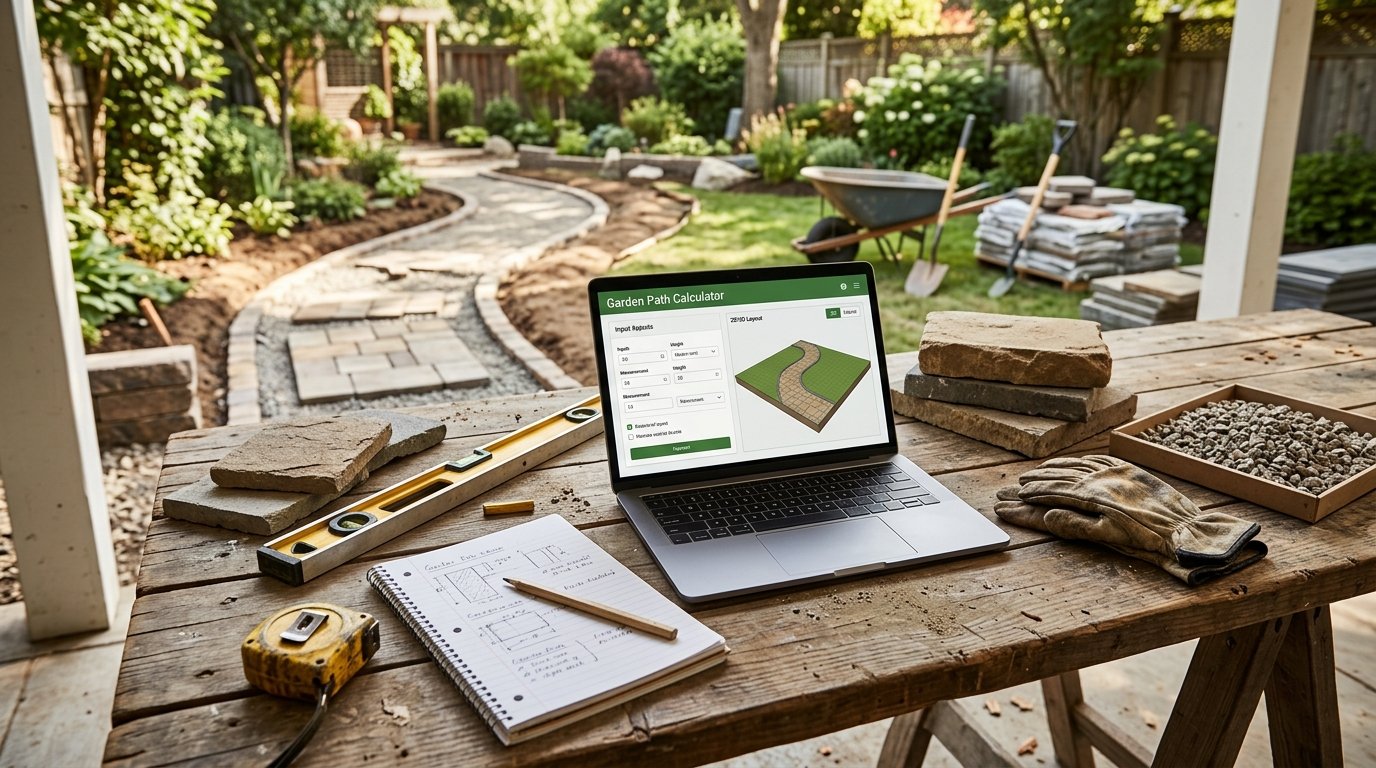
Garden Path Calculator: Pavers, Gravel, Sub-Base & Cost
A garden path is one of those projects that looks simple — a strip of paving from the patio to the shed — but is surprisingly easy to get wrong. The path needs to drain, resist weeds, withstand foot traffic, and look good for years. It also needs the right depth of sub-base: too thin and it sinks underfoot after the first wet winter; too thick and you waste money on material you did not need. And if you have chosen gravel rather than solid pavers, the calculations change completely — gravel is a bulk material measured by volume and mass, not a countable paver.
Our Garden Path Calculator is a free online tool that estimates the materials and costs of a garden path. It handles both solid pavers and bulk gravel, and calculates paver count, gravel volume and mass, sub-base order volume (with compaction) and mass in tonnes, bedding sand volume and mass, geotextile, edge restraints, jointing, labour, delivery, VAT and total installed cost. It also checks the sub-base depth against the recommendation for footpaths.
In this guide, we will show you how to use the calculator, explain each input and output, walk through six real-world examples across paved and gravel paths, and answer eight of the most frequently asked questions about garden paths.
Garden Path
Construction CalculatorGarden path paving: pavers or gravel, sub-base, bedding, edging, geotextile and cost.
What is the Garden Path Calculator?
The Garden Path Calculator is a free online tool that estimates the materials and costs of a garden path paving project. It supports:
- Dimensions: length, width, waste allowance.
- Paver types: concrete block, concrete slabs, natural stone, porcelain, clay brick, and gravel (bulk).
- Paver sizes: 200 × 100 mm, 200 × 200 mm, 300 × 300 mm, 400 × 400 mm, and custom.
- Gravel mode: for bulk gravel paths — includes gravel depth and calculates volume and mass in tonnes, without paver counting or jointing.
- Sub-base: MOT Type 1 or Type 3, with user-defined depth and compaction allowance.
- Bedding sand: for solid pavers only, with user-defined depth and compaction.
- Jointing: kiln-dried sand, polymeric sand, resin, mortar, or none.
- Geotextile membrane: recommended as standard.
- Edging: optional perimeter edge restraint.
- Pricing: paver/gravel price per m², sub-base per m³, sand per m³, joint per m², geotextile per m², edge per metre, labour per m², delivery, VAT.
The output includes:
- Path area, area with waste, perimeter
- Pavers per m² and total paver count (skipped for gravel)
- Gravel order volume and mass in tonnes (for gravel only)
- Sub-base order volume (with compaction) and mass in tonnes
- Depth check against the footpath recommendation
- Bedding sand order volume and mass in tonnes
- Geotextile area (with 10% overlap)
- Itemised costs: pavers or gravel, sub-base, bedding, jointing, geotextile, edge, labour, delivery
- VAT and grand total
The tool is part of a suite of materials and quantities calculators available on our website. For related calculations, you can use our Grass / Gravel Pavers Calculator, Paving Patio Calculator, Garden Patio Pavers Calculator, and Block Paving Driveway Calculator.
Why Accurate Garden Path Estimation Matters
A garden path is a small project compared to a driveway or patio, but the same failure modes apply — and because paths are narrow, the quantities and the compaction allowances are easy to underestimate.
Sub-Base Depth and Settlement
A path needs a compacted sub-base of about 75–100 mm. Under that, the pavers settle — especially in wet weather, when the sub-grade softens. The calculator flags if the entered sub-base depth falls below the recommended minimum.
Drainage and Water Management
Paths channel water. If the sub-base is too thin, water pools in the path; if the geotextile is missing, fines migrate upward and clog the sub-base, causing ponding. Both the depth and the geotextile matter.
Gravel Is Not Pavers
The biggest mistake in path estimation is treating gravel as if it were a paver. Gravel is ordered by volume or weight, not by paver count. It also has a different compaction behaviour and a different waste profile. The calculator branches the calculation correctly: gravel → bulk volume and mass; solid pavers → paver count and jointing.
Edging — The Line Item Everyone Forgets
Paths need edge restraint on both sides — especially gravel paths, where gravel without edging spreads into the garden within a season. The calculator adds edge cost as a line item: length × price per metre.
Geotextile
Every path benefits from geotextile, whether paved or gravel. For gravel, it prevents the gravel migrating down into the sub-base; for pavers, it prevents fines migrating up. Either way, it is one of the cheapest parts of the project and the most valuable for longevity.
Cost and Time
A garden path is typically 8–20 m² — small enough that materials seem cheap, but with delivery charges, sub-base, bedding, geotextile, edging, labour and VAT, the total adds up quickly. Accurate estimation avoids buying too much or too little.
For more information on garden paths, you can refer to Wikipedia’s article on garden design or the Interpave guidance.
How to Use the Garden Path Calculator
Using the calculator is straightforward. Here is a breakdown of each field.
1. Dimensions
- Path length: Enter the length in meters or feet.
- Path width: Enter the width in meters or feet. 1.0–1.5 m is typical for a single-person path; wider if it will be used by wheelbarrows or garden equipment.
- Waste allowance: 10% is typical; diagonal or curved paths need 15%.
2. Paver
- Paver type: Select concrete block, concrete slab, natural stone, porcelain, clay brick, or gravel. Gravel is treated as a bulk material (see below).
- Paver size: Select 200 × 100 mm, 200 × 200 mm, 300 × 300 mm, 400 × 400 mm, or custom. Used only for solid pavers.
- Custom width/length: Used only when “Custom size” is selected.
3. Gravel
- Gravel depth: Used only when paver type is gravel. 40–70 mm is typical for a garden path; deeper for driveways.
4. Sub-base
- Sub-base depth: 75–100 mm is typical for a path.
- Sub-base compaction: Typically 10–15% — order loose material.
- Sub-base material: MOT Type 1 (crushed, 2.25 t/m³) or Type 3 (open-graded, 2.10 t/m³).
5. Bedding
- Bedding sand depth: Used only for solid pavers. Typically 30 mm.
- Bedding compaction: Typically 10%.
6. Jointing
- Jointing: Kiln-dried sand, polymeric sand, resin, mortar, or none. Used only for solid pavers.
7. Geotextile
- Geotextile membrane: Recommended as standard. The calculator adds 10% overlap.
8. Edging
- Edge restraint length: Both sides of the path. For a straight path, 2 × length. Set 0 if no edging.
9. Pricing
Enter local prices for each component. Leave 0 to skip.
10. Tax
- VAT / tax rate: Enter the applicable rate, or 0 if not applicable.
Once you enter all values, the calculator displays the full output, including areas, paver count or gravel volume and mass, sub-base volume and mass, bedding volume and mass, geotextile area, depth check, itemised costs, and total.
Understanding the Calculations
To make the most of the calculator, it is important to understand each output and the underlying formulas.
Pavers Per m²
Pavers per m² = 1 / (width × length).
Examples:
- 200 × 100 mm → 50 pcs/m²
- 200 × 200 mm → 25 pcs/m²
- 300 × 300 mm → 11.11 pcs/m²
- 400 × 400 mm → 6.25 pcs/m²
Paver Count (solid pavers)
Pavers = ceil(area with waste × pavers per m²).
Gravel Volume and Mass
Gravel installed_vol = area × gravel depth.
Gravel order_vol = installed_vol × (1 + compaction / 100).
Gravel mass = installed_vol × 1.70 t/m³ (compacted decorative gravel).
The gravel surface cost is computed as area with waste × price per m², matching the same simple surface pricing used for pavers.
Sub-base Volume and Mass
installed_vol = area × sub-base depth.
order_vol = installed_vol × (1 + compaction / 100).
mass = installed_vol × density.
Densities:
- MOT Type 1: 2.25 t/m³
- MOT Type 3: 2.10 t/m³
Depth Check
Recommended sub-base depth for footpaths: 75 mm. Warning shown if entered depth is more than 5 mm below.
Bedding Sand
installed_vol = area × bed depth.
order_vol = installed_vol × (1 + compaction / 100).
mass = installed_vol × 1.60 t/m³ (damp sand).
Jointing
joint_cost = area × price per m². Only for solid pavers.
Geotextile
geo_area = area × 1.10 (10% overlap).
geo_cost = geo_area × price per m².
Edging
edge cost = edge length × price per metre.
Labour
labour cost = area × labour rate × difficulty factor.
Difficulty factors:
- Concrete block: 1.00
- Concrete slab: 1.10
- Natural stone: 1.30
- Porcelain: 1.35
- Clay brick: 1.15
- Gravel: 0.60
VAT and Total
VAT = subtotal × VAT / 100.
Total = subtotal + VAT.
Understanding these components helps you interpret the results and adjust your order. For more information on garden path design, you can refer to Wikipedia’s article on garden design or the Interpave guidance.
Reference Table of Common Paver Sizes
| Paver size | Pavers per m² | Typical use |
|---|---|---|
| 200 × 100 mm | 50.0 | Block paving (standard) |
| 200 × 200 mm | 25.0 | Block paving, larger format |
| 300 × 300 mm | 11.11 | Slabs, paths |
| 400 × 400 mm | 6.25 | Large slabs |
| Custom | Calculated | Bespoke |
Example Calculations
Let’s run through six examples across paved and gravel paths.
Example 1: Simple Paved Path, 12 m², Concrete Block
Inputs:
- Length: 10 m, width: 1.2 m → 12 m²
- Waste: 10%
- Paver: Concrete block, 200 × 100 mm
- Sub-base: Type 1, 80 mm, compaction 12%
- Bed: 30 mm, compaction 10%
- Jointing: Kiln-dried sand
- Geotextile: Yes
- Edging: 22 m
- Prices: paver $22/m², sub-base $55/m³, sand $55/m³, joint $4/m², geo $2/m², edge $10/m, labour $30/m², delivery $80, VAT 0%
Calculations:
- Area = 12 m²; waste → 13.2 m²
- Perimeter = 22.4 m
- Pavers per m² = 50; pavers = 660
- Paver cost = 13.2 × $22 = $290.40
- Sub-base installed = 12 × 0.08 = 0.96 m³
- Sub-base order = 0.96 × 1.12 = 1.075 m³
- Sub-base mass = 0.96 × 2.25 = 2.16 t
- Sub-base cost = 1.075 × $55 = $59.13
- Depth OK (80 mm > 75 mm)
- Bedding installed = 12 × 0.03 = 0.36 m³
- Bedding order = 0.396 m³
- Bedding mass = 0.36 × 1.60 = 0.576 t
- Bedding cost = 0.396 × $55 = $21.78
- Joint = 12 × $4 = $48
- Geotextile = 13.2 × $2 = $26.40
- Edge = 22 × $10 = $220
- Labour = 12 × $30 × 1.00 = $360
- Delivery = $80
- Subtotal = $1,105.71
- Total (VAT 0%) = $1,105.71
Example 2: Narrow Gravel Path, 9 m², Bulk Gravel
Inputs:
- Length: 10 m, width: 0.9 m → 9 m²
- Waste: 10%
- Paver: Gravel
- Gravel depth: 50 mm
- Sub-base: Type 1, 75 mm, compaction 12%
- Geotextile: Yes
- Edging: 20 m
- Prices: gravel $18/m² (surface), sub-base $55/m³, geo $2/m², edge $10/m, labour $15/m², delivery $80, VAT 20%
Calculations:
- Area = 9 m²; waste → 9.9 m²
- Gravel volume installed = 9 × 0.05 = 0.45 m³
- Gravel order = 0.45 × 1.12 = 0.504 m³
- Gravel mass = 0.45 × 1.70 = 0.765 t
- Gravel surface cost = 9.9 × $18 = $178.20
- Sub-base installed = 9 × 0.075 = 0.675 m³
- Sub-base order = 0.675 × 1.12 = 0.756 m³
- Sub-base mass = 0.675 × 2.25 = 1.519 t
- Sub-base cost = 0.756 × $55 = $41.58
- Depth OK (75 mm)
- Bedding: skipped (gravel)
- Joint: skipped
- Geotextile = 9.9 × $2 = $19.80
- Edge = 20 × $10 = $200
- Labour = 9 × $15 × 0.60 = $81
- Delivery = $80
- Subtotal = $600.58
- VAT = $120.12
- Total = $720.70
Example 3: Wide Paved Path, 18 m², Concrete Slabs
Inputs:
- Length: 12 m, width: 1.5 m → 18 m²
- Waste 10% → 19.8 m²
- Paver: Concrete slab, 300 × 300 mm
- Sub-base: Type 1, 100 mm, compaction 12%
- Bed: 30 mm, compaction 10%
- Jointing: Polymeric
- Geotextile: Yes
- Edging: 27 m
- Prices: paver $32/m², sub-base $55/m³, sand $55/m³, joint $6/m², geo $2/m², edge $12/m, labour $35/m², delivery $100, VAT 20%
Calculations:
- Pavers per m² = 11.11; pavers = 220
- Paver cost = 19.8 × $32 = $633.60
- Sub-base installed = 1.8 m³; order = 2.016 m³; mass = 4.05 t; cost = $110.88
- Depth OK
- Bedding installed = 0.54 m³; order = 0.594 m³; cost = $32.67
- Joint = 18 × $6 = $108
- Geotextile = 19.8 × $2 = $39.60
- Edge = 27 × $12 = $324
- Labour = 18 × $35 × 1.10 = $693
- Delivery = $100
- Subtotal = $2,041.75
- VAT = $408.35
- Total = $2,450.10
Example 4: Long Gravel Path with Geotextile and Edging, 30 m²
Inputs:
- Length: 25 m, width: 1.2 m → 30 m²
- Waste 10% → 33 m²
- Paver: Gravel, 60 mm depth
- Sub-base: Type 3 (open-graded), 75 mm, compaction 12%
- Geotextile: Yes
- Edging: 50 m
- Prices: gravel $20/m², sub-base $60/m³, geo $2/m², edge $12/m, labour $18/m², delivery $200, VAT 20%
Calculations:
- Gravel volume installed = 30 × 0.06 = 1.8 m³
- Gravel order = 2.016 m³; mass = 3.06 t
- Gravel surface cost = 33 × $20 = $660
- Sub-base installed = 2.25 m³; order = 2.52 m³; mass = 4.725 t (Type 3); cost = $151.20
- Depth OK
- Geotextile = 33 × $2 = $66
- Edge = 50 × $12 = $600
- Labour = 30 × $18 × 0.60 = $324
- Delivery = $200
- Subtotal = $2,001.20
- VAT = $400.24
- Total = $2,401.44
Example 5: Mixed Natural Stone Path, 15 m²
Inputs:
- Length: 10 m, width: 1.5 m → 15 m²
- Waste 10% → 16.5 m²
- Paver: Natural stone, 400 × 400 mm
- Sub-base: Type 1, 100 mm, compaction 12%
- Bed: 30 mm, compaction 10%
- Jointing: Polymeric
- Geotextile: Yes
- Edging: 23 m
- Prices: paver $55/m², sub-base $55/m³, sand $55/m³, joint $6/m², geo $2.50/m², edge $12/m, labour $40/m², delivery $100, VAT 20%
Calculations:
- Pavers per m² = 6.25; pavers = 104
- Paver cost = 16.5 × $55 = $907.50
- Sub-base installed = 1.5 m³; order = 1.68 m³; mass = 3.375 t; cost = $92.40
- Bedding installed = 0.45 m³; order = 0.495 m³; cost = $27.23
- Joint = 15 × $6 = $90
- Geotextile = 16.5 × $2.50 = $41.25
- Edge = 23 × $12 = $276
- Labour = 15 × $40 × 1.30 = $780
- Delivery = $100
- Subtotal = $2,314.38
- VAT = $462.88
- Total = $2,777.26
Example 6: Depth Warning Case
Same as Example 1, but user enters 50 mm sub-base. Calculator shows:
- Depth warning: “Below 75 mm recommended for paths”
- Sub-base volume drops accordingly, but the warning tells the user the path will likely settle.
This is one of the most useful features — it catches a common design mistake before excavation starts.
Benefits of Using the Garden Path Calculator
Tips for Accurate Garden Path Estimation
- Measure accurately. A 10% width error changes all quantities.
- Allow proper waste. 10% for straight paths; 15% for curved or diagonal.
- Check the sub-base depth. 75 mm minimum for paths. Under-depth is the most common cause of settlement.
- Choose the right paver for the traffic. Concrete block is cheap and durable; natural stone is beautiful but slippery when wet; gravel is cheap but needs good edging.
- Do not skip geotextile. Cheap and essential.
- Allow for compaction. Order 10–15% more than installed volume.
- Do not over-bed the pavers. 30 mm is standard.
- Choose the right jointing. Kiln-dried sand is cheapest but washes out; polymeric and resin last much longer.
- Consider gravel if the path is informal or winding. Gravel is more forgiving of curves and irregular shapes.
- Edge gravel paths carefully. Gravel spreads without edging.
- Plan drainage. A path should shed water — not pond it.
- Verify with a professional. For long paths or complex layouts, have a landscaper or paving contractor verify the design.
For more information on garden path design, you can refer to Wikipedia’s article on garden design or the Interpave guidance.
Common Mistakes to Avoid
- Treating gravel as pavers. Gravel is ordered by volume or mass, not paver count.
- Underestimating the sub-base. 75 mm is the minimum for a path; less causes settlement.
- Skipping geotextile. Saves $20 and costs thousands in premature failure.
- No edge restraints. Gravel spreads without edging; the paver field also spreads without restraint.
- Wrong jointing. Kiln-dried sand is cheap but washes out; polymeric and resin last much longer.
- Ignoring compaction. Loose material settles 10–15%; without allowance, you will run short.
- No waste allowance. Diagonal and curved paths need 15%, not 10%.
- No VAT. 20% VAT significantly changes the total cost.
- Forgetting delivery. Bulk bags of sub-base and gravel are heavy.
- Not checking drainage. A path that ponds water becomes a slip hazard.
How to Reduce Garden Path Costs
If your estimate is higher than expected, here are ways to reduce costs without compromising quality:
- Choose concrete block over natural stone or porcelain. Concrete is 40–60% cheaper.
- Choose gravel over solid pavers. Gravel is 30–50% cheaper per m², plus faster to install.
- Use kiln-dried sand jointing. Cheaper than polymeric or resin.
- Reduce the edge restraint length. Only edge where required.
- Do the excavation yourself. Digging is labour-intensive.
- Compare suppliers. Bulk prices vary 20–30%.
- Skip the geotextile only on solid sub-bases. Not recommended, but possible if the sub-grade is stable.
- Time the project well. Avoid peak landscaping season.
- Get multiple quotes. Compare at least three contractors for installation.
- Choose a shorter, narrower path. Fewer m² = less cost.
Frequently Asked Questions (FAQ)
Conclusion
The Garden Path Calculator is an essential tool for homeowners, landscapers, garden designers, and paving contractors. It estimates paver count OR gravel volume and mass, sub-base order volume (with compaction), sub-base mass in tonnes, bedding sand volume and mass, geotextile area, edge restraints, jointing, labour, delivery, VAT and total installed cost — with a footpath depth check that catches design mistakes early, and a dedicated gravel mode that treats bulk material correctly.
Whether you are building a simple paved path, a wide concrete-slab path, or a long gravel walkway, accurate estimation of garden path materials is the foundation of a durable, drainage-safe, and cost-effective installation. Try the Garden Path Calculator today and take the guesswork out of your garden path project.