
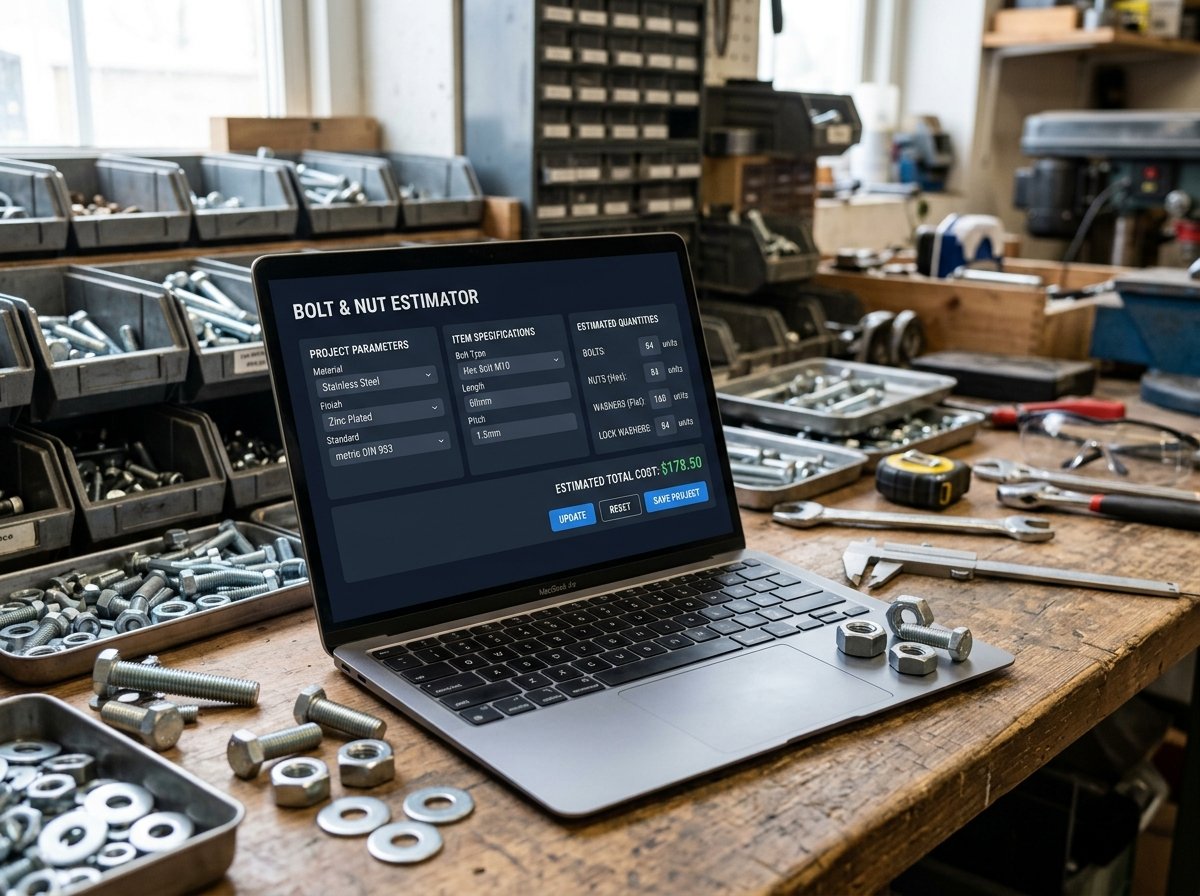
Bolts & Nuts Estimator Calculator: Estimate Fasteners and Costs Accurately
Bolts, nuts, and washers are the unsung heroes of construction and engineering. From steel connections and timber framing to machinery bases and cladding supports, they hold everything together. But ordering the wrong quantity or type can lead to delays, rework, or even structural failure. An undersupply stops work; an oversupply wastes money. Our Bolts & Nuts Estimator Calculator is a free online tool that helps you quickly determine the number of bolts, nuts, and washers required, estimate the total mass, and calculate the cost based on your chosen type, size, grade, and finish.
In this guide, we’ll show you how to use the calculator, explain the calculations, provide real-world examples, and answer common questions. We’ll also share tips to ensure your fastener procurement is accurate and cost-effective.
Bolts & Nuts Estimator
Construction CalculatorBolts & nuts: quantity, washers, grade, galvanising and cost.
What is the Bolts & Nuts Estimator Calculator?
The Bolts & Nuts Estimator Calculator is a free online tool that calculates the quantity and cost of bolts, nuts, and washers for a given connection. It supports various bolt types (hex, socket, countersunk, carriage, eye, U-bolt, threaded rod), sizes (M8 to M24 or custom), grades (4.8, 8.8, 10.9, 12.9, A2, A4 stainless), and finishes (plain, zinc, hot-dip galvanised, sheradised, Xylan). The calculator accounts for count method (manual or from connection length), bolt spacing, waste allowance, washer and nut configuration, and local pricing for bolts, nuts, and washers. It provides a clear breakdown of bolt size, total bolts, nuts, washers, approximate bolt mass, and costs for each component. The tool is part of a suite of materials and quantities calculators available on our website. For related calculations, you can use our Anchor Bolts & Wall Fixings Calculator, Nails & Screws Estimator Calculator, and Timber Connectors Calculator.
How to Use the Bolts & Nuts Estimator Calculator
Using the calculator is straightforward. Here’s a breakdown of each field:
1. Bolt
- Bolt type: Select the type of bolt: Hex bolt, Socket head cap screw, Countersunk screw, Carriage bolt, Eye bolt, U-bolt, or Threaded rod. This is informational only; enter the price for your chosen type below.
- Bolt size: Select the nominal diameter: M8, M10, M12, M16, M20, M24, or Custom.
- Custom diameter: If you selected “Custom”, enter the diameter in meters or inches. For example, 0.016 m = 16 mm.
- Bolt length: Enter the length under the head in meters or inches. For example, 0.060 m = 60 mm.
- Grade: Select the bolt grade: 4.8 (mild steel), 8.8 (high tensile), 10.9 (high strength), 12.9 (very high strength), A2 stainless, or A4 stainless (marine). This is informational; enter the price for your chosen grade below.
- Finish: Select the finish: Plain / self-colour, Zinc plated, Hot-dip galvanised, Sheradised, or Xylan / PTFE. This is informational; enter the price for your chosen finish below.
2. Quantity
- Count method: Select Manual count or From connection length. Only the selected method is used.
- Number of bolts: If “Manual count” is selected, enter the total number of bolts required.
- Total connection length: If “From connection length” is selected, enter the total length of the connection in meters or feet.
- Bolt spacing: Enter the centre-to-centre distance between bolts in meters or inches.
- Waste / spares: Enter a percentage for waste and spares. Typical value is 5%.
3. Washers
- Washers: Select None, Plain washers (each end), Spring washers, or Plain + spring washers. Plain washers each end means two per bolt (one under the head, one under the nut). Spring washers means one per bolt. Plain + spring means three per bolt.
4. Nuts
- Nuts: Select One nut per bolt, Two nuts (locknut), Nyloc nuts, or No nuts (into threaded hole). One nut = 1 per bolt, two nuts = 2 per bolt, Nyloc = 1 per bolt, none = 0.
5. Pricing
- Bolt price each: Enter the local price per bolt for the chosen type, size, grade, and finish.
- Nut price each: Enter the local price per nut. Used only when nuts are selected.
- Washer price each: Enter the local price per washer. Used only when washers are selected.
Once you enter all values, the calculator instantly displays:
- Bolt size (mm)
- Total bolts (including waste)
- Nuts (if selected)
- Washers (if selected)
- Bolt mass (approx., kg)
- Bolt cost
- Nut cost
- Washer cost
- Grand total
Understanding the Cost Components
To make the most of the calculator, it’s important to understand each output and the underlying logic.
- Bolt size (mm): The nominal diameter of the bolt in millimetres. For custom sizes, it is calculated from the custom diameter you enter.
- Total bolts: The number of bolts including waste:
ceil(count × (1 + waste/100)). You should always order extra to cover spares and potential losses. - Nuts: The total number of nuts is
total bolts × nuts per bolt. For “Two nuts (locknut)”, it’s 2 per bolt; for Nyloc, 1 per bolt; for “No nuts”, 0. - Washers: The total number of washers is
total bolts × washers per bolt. For “Plain washers (each end)”, it’s 2 per bolt; for “Spring washers”, 1; for “Plain + spring”, 3; for “None”, 0. - Bolt mass (approx.): Calculated as
total bolts × π × (diameter/2)² × (bolt length × 1.2) × 7850. The 1.2 factor accounts for the volume of the head. This is for reference only; actual mass depends on the specific bolt geometry. - Bolt cost:
total bolts × bolt price each. - Nut cost:
total nuts × nut price each. - Washer cost:
total washers × washer price each. - Grand total: Sum of all costs.
Understanding these components helps you interpret the results and adjust your order. For more information on bolts and fasteners, you can refer to Wikipedia’s article on bolts.
Example Calculations
Let’s run through a few examples to see how the calculator works in different scenarios.
Example 1: Hex Bolts, M16, Manual Count, Plain Washers, One Nut
- Bolt type: Hex bolt
- Bolt size: M16
- Bolt length: 0.060 m (60 mm)
- Grade: 8.8
- Finish: Zinc plated
- Count method: Manual count
- Number of bolts: 50
- Waste: 5%
- Washers: Plain washers (each end)
- Nuts: One nut per bolt
- Bolt price: $1.20 each
- Nut price: $0.40 each
- Washer price: $0.15 each
Calculations:
- Size mm: 16
- Total bolts: ceil(50 × 1.05) = ceil(52.5) = 53
- Nuts: 53 × 1 = 53
- Washers: 53 × 2 = 106
- Bolt mass: 53 × π × (0.008)² × (0.060 × 1.2) × 7850 = 53 × π × 0.000064 × 0.072 × 7850 = 53 × 0.00001447 × 7850 ≈ 6.02 kg
- Bolt cost: 53 × $1.20 = $63.60
- Nut cost: 53 × $0.40 = $21.20
- Washer cost: 106 × $0.15 = $15.90
- Total: $63.60 + $21.20 + $15.90 = $100.70
- Result: Total $100.70, bolt mass 6.02 kg
Example 2: Socket Head Cap Screws, M10, From Connection Length, Spring Washers, Nyloc Nuts
- Bolt type: Socket head cap screw
- Bolt size: M10
- Bolt length: 0.040 m (40 mm)
- Grade: 12.9
- Finish: Plain
- Count method: From connection length
- Total connection length: 5 m
- Bolt spacing: 0.100 m
- Waste: 3%
- Washers: Spring washers
- Nuts: Nyloc nuts
- Bolt price: $0.80 each
- Nut price: $0.50 each
- Washer price: $0.10 each
Calculations:
- Size mm: 10
- Count = floor(5 / 0.1) + 1 = 50 + 1 = 51
- Total bolts: ceil(51 × 1.03) = ceil(52.53) = 53
- Nuts: 53 × 1 = 53
- Washers: 53 × 1 = 53
- Bolt mass: 53 × π × (0.005)² × (0.040 × 1.2) × 7850 = 53 × π × 0.000025 × 0.048 × 7850 = 53 × 0.00000377 × 7850 ≈ 1.57 kg
- Bolt cost: 53 × $0.80 = $42.40
- Nut cost: 53 × $0.50 = $26.50
- Washer cost: 53 × $0.10 = $5.30
- Total: $42.40 + $26.50 + $5.30 = $74.20
- Result: Total $74.20, bolt mass 1.57 kg
Example 3: Threaded Rod, M20, Manual Count, No Washers, Two Nuts
- Bolt type: Threaded rod
- Bolt size: M20
- Bolt length: 0.200 m (200 mm)
- Grade: A2 stainless
- Finish: Plain
- Count method: Manual count
- Number of bolts: 20
- Waste: 10%
- Washers: None
- Nuts: Two nuts (locknut)
- Bolt price: $4.50 each
- Nut price: $0.90 each
- Washer price: $0 (not used)
Calculations:
- Size mm: 20
- Total bolts: ceil(20 × 1.10) = ceil(22) = 22
- Nuts: 22 × 2 = 44
- Washers: 0
- Bolt mass: 22 × π × (0.010)² × (0.200 × 1.2) × 7850 = 22 × π × 0.0001 × 0.24 × 7850 = 22 × 0.0000754 × 7850 ≈ 13.02 kg
- Bolt cost: 22 × $4.50 = $99.00
- Nut cost: 44 × $0.90 = $39.60
- Washer cost: $0
- Total: $99.00 + $39.60 = $138.60
- Result: Total $138.60, bolt mass 13.02 kg
These examples show how different bolt types, sizes, and configurations affect the total cost and mass.
Benefits of Using the Bolts & Nuts Estimator Calculator
Tips for Accurate Bolt and Nut Estimation
- Choose the right bolt type: Hex bolts are general-purpose; socket head cap screws are for machine connections; carriage bolts are for timber; eye bolts for lifting; U-bolts for pipe clamping; threaded rod for cut-to-length applications.
- Select the correct size: Bolt diameter and length must match the connection design. Length under head must be sufficient to accommodate the materials plus nut and washer.
- Use the correct grade: Grade 8.8 is standard for structural steel; 10.9 and 12.9 for high-strength applications; A2/A4 stainless for corrosive environments.
- Consider the finish: Zinc plating is for indoor use; hot-dip galvanising for outdoor; stainless for marine or chemical exposure.
- Count accurately: Use manual count for simple connections; use connection length method for evenly spaced bolts along a beam or plate.
- Allow for waste: 5% is typical, but increase to 10% for complex installations or where loss is likely.
- Washers and nuts: Plain washers distribute load; spring washers prevent loosening; Nyloc nuts are self-locking. Choose based on vibration and load.
- Check mass: For large orders, bolt mass affects shipping and handling. The calculator provides an estimate.
- Verify with a professional: For critical structural connections, have a qualified engineer verify the design.
For more information on fasteners, you can refer to resources like Wikipedia’s article on fasteners or guidelines from the Industrial Fasteners Institute.
How to Reduce Bolt and Nut Costs
If your estimate is higher than expected, here are ways to reduce costs without compromising quality:
- Standardize sizes: Using fewer sizes reduces procurement complexity and cost.
- Choose a lower grade if suitable: Grade 4.8 is cheaper than 8.8, but ensure it meets the load requirements.
- Use plain finish indoors: Zinc plating adds cost; plain finish is cheaper for dry environments.
- Optimize bolt length: Longer bolts cost more. Specify the shortest length that meets the design.
- Buy in bulk: Fasteners are often cheaper in larger quantities.
- Reduce waste: Order accurately and reuse spares where possible.
- Get multiple quotes: Compare suppliers for the best price.
Frequently Asked Questions (FAQ)
Conclusion
The Bolts & Nuts Estimator Calculator is an essential tool for builders, engineers, and procurement specialists. It helps you determine the correct quantity of bolts, nuts, and washers, estimate mass, and calculate costs. By following the tips in this article and using the calculator, you can confidently order your fasteners. Don’t forget to explore our other materials and quantities calculators for all your construction needs.
Whether you’re assembling a steel frame or fixing a timber deck, accurate fastener estimation is key to a successful project. Try the Bolts & Nuts Estimator Calculator today and take the guesswork out of your fastener budget.

2 Comments