
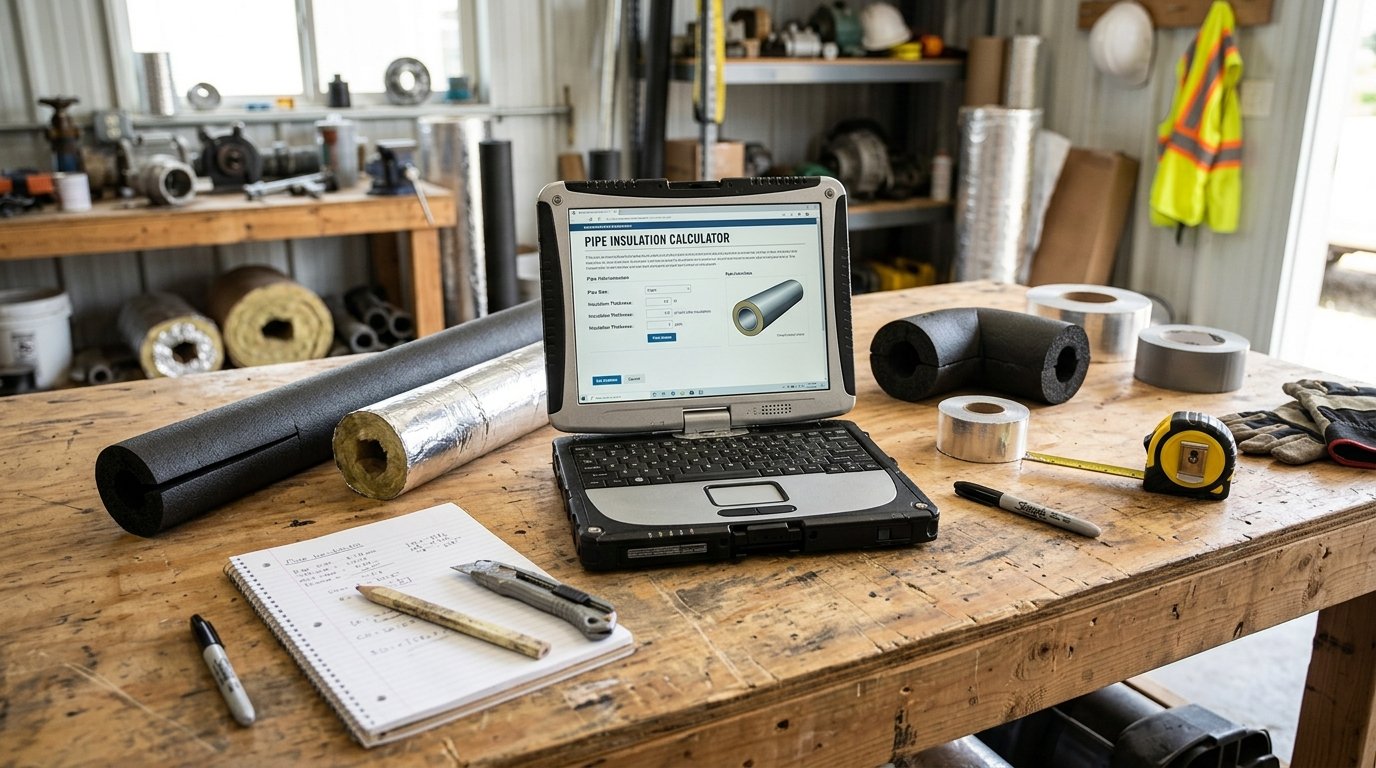
Pipe Insulation Calculator: Lagging, R-Value & Total Cost
Pipe insulation — often called lagging — is one of the most cost-effective energy efficiency measures in any building. An uninsulated heating pipe loses heat to its surroundings continuously, and that heat has already been paid for. Insulated pipework loses 80–90% less, and the material cost is trivial compared to the savings over even a single heating season. But pipe insulation is not a single product — the right material, thickness, and fitting treatment depend on the pipe diameter, the application (heating, chilled water, DHW, industrial), and the environment.
Our Pipe Insulation Calculator estimates the materials and costs of a pipe insulation installation. It calculates the number of insulation pieces from pipe length, R-value from material λ and thickness, insulation mass from the annular volume and density, tape length from circumference at fittings, fittings cost with weighted labour, delivery, VAT and cost per metre. It also flags five common design errors — insulation too thin for the pipe, insulation below frost-protection minimum, thick elastomeric beyond availability, R-value too low to justify the material, and a missing price per piece — before you order.
In this guide, we will show you how to use the calculator, explain each input and output, walk through four examples across materials and pipe sizes, and answer eight of the most frequently asked questions about pipe insulation.
Pipe Insulation
Construction CalculatorPipe insulation: lagging length, diameter, thickness, R-value, mass, tape and cost.
What is the Pipe Insulation Calculator?
The Pipe Insulation Calculator is a free online tool that estimates the quantity and cost of materials for pipe insulation. It supports:
- Pipe details: length, nominal diameter (DN15 to DN54 or custom).
- Insulation types: mineral wool, phenolic foam, elastomeric (Armaflex), and aerogel — each with its own λ and density.
- Insulation thickness: typically 19–50 mm for pipework.
- Piece length: 1 m or 2 m — insulation is supplied in lengths.
- Fittings: bends, tees, valves, and flanges, each with its own price.
- Pricing: insulation per piece, fitting prices, tape per metre, labour per metre, delivery, VAT.
The output includes:
- Pipe diameter and outer diameter with insulation
- Insulation thickness
- R-value in m²K/W
- Insulation volume in m³
- Insulation mass in kg
- Pieces required
- Tape length and fittings count
- Design check warning
- Itemised costs: insulation, fittings, tape, labour, delivery
- VAT, grand total and cost per metre
The tool is part of a suite of insulation calculators available on our website. For related calculations, you can use our Floor Insulation Calculator, Loft Roll Insulation Calculator, Cavity Wall Insulation Calculator, and Party Wall Acoustic Insulation Calculator.
Why Accurate Pipe Insulation Estimation Matters
Pipe insulation is cheap per metre, but specifying it correctly is not trivial. The right material and thickness depend on the pipe diameter, the fluid temperature, the ambient conditions, and the target heat loss. Getting it wrong leads to either wasted material or a system that underperforms.
λ Varies Dramatically Between Materials
The thermal conductivity of pipe insulation ranges from 0.017 W/m·K for aerogel to 0.040 W/m·K for standard mineral wool — a 2.4× difference. That means 25 mm of aerogel provides R 1.47 m²K/W while 25 mm of mineral wool provides R 0.63. Both fit the same pipe, look similar when installed, and often cost significantly different amounts per metre. The corrected calculator reads the material type and uses its λ to compute R-value, and uses its density to compute mass.
Insulation Cost Reflects Thickness — Do Not Multiply Again
A common error in pipe insulation estimation is to apply a “thickness factor” to the price per metre after the user has already entered a price that reflects the chosen thickness. If a contractor quotes $10/m for 25 mm mineral wool and $18/m for 50 mm, applying a 2× thickness factor to the 50 mm price produces $36/m — double the actual cost. The corrected calculator uses the price as entered and applies the thickness factor only to labour (thicker insulation is slower to fit).
The Diameter Drives Volume and Mass
Insulation volume is an annular cylinder between the pipe’s outside diameter and the insulation’s outside diameter. A DN15 pipe with 25 mm insulation has a tiny volume; a DN54 pipe with the same insulation has 3× the volume. Mass follows directly. The corrected calculator computes the annular volume from the true pipe diameter and thickness, then multiplies by the material density to give total mass — critical for checking the load on pipe supports.
Tape Must Wrap Around Fittings
Tape is not just used to seal straight runs — it is used to wrap the insulation at every bend, tee, valve, and flange. The circumference at a DN22 pipe with 25 mm insulation is about 226 mm; a DN54 pipe with 25 mm insulation is about 326 mm. With 8 fittings, that is 1.8–2.6 m of extra tape — small in absolute terms but a real material cost. The corrected calculator includes circumference × fitting count in the tape length.
Fitting Labour Is Not Uniform
A valve needs to be removed, insulated, and refitted — or a removable jacket needs to be installed. A flange needs the same. Bends and tees are simpler. Treating all fittings as equal understates the labour on valve-heavy runs. The corrected calculator applies weighted labour — valves and flanges 2× the bends and tees.
Insulation Has a Minimum Thickness
Frost protection typically requires at least 13 mm of insulation. Condensation control on chilled water or on larger pipes may require 20 mm or more. The corrected calculator warns when the thickness falls below either threshold, and warns when very thick elastomeric is selected (unusual above 100 mm).
VAT and Delivery
Insulation pieces arrive in bulk — often 10 or 20 pieces per bag. Delivery is usually included but can be separate. VAT applies at 20% in the UK, or 5% for qualifying energy-saving materials — check locally.
For more information on pipe insulation standards, you can refer to Wikipedia’s article on pipe insulation or the Thermal Insulation Contractors Association (TICA).
How to Use the Pipe Insulation Calculator
Using the calculator is straightforward. Here is a breakdown of each field.
1. Pipe
- Pipe length: Total length of the run in meters or feet.
- Pipe diameter: DN15, DN22, DN28, DN35, DN42, DN54, or custom.
- Custom pipe diameter: Used only when “Custom” is selected.
2. Insulation
- Insulation type: Mineral wool, phenolic foam, elastomeric, or aerogel. Each has its own λ and density.
- Thickness: Typically 19–50 mm for pipework. Thicker for chillers and outdoor pipework.
3. Pack
- Piece length: 1 m or 2 m — insulation is supplied in length segments.
4. Fittings
- Bends, tees, valves, flanges: Count each. Each is priced and laboured separately.
5. Pricing
Enter local prices for each component. Leave 0 to skip.
6. Extras
- Delivery / skip: Fixed cost.
- VAT / tax rate: Applicable rate, or 0.
Once you enter all values, the calculator displays the full output, including pipe diameter, outer diameter, thickness, R-value, volume, mass, pieces, tape length, fittings, design check, itemised costs, VAT, total and cost per metre.
Understanding the Calculations
To make the most of the calculator, it is important to understand each output and the underlying formulas.
Pipe Diameter
Nominal diameters:
- DN15 = 0.015 m
- DN22 = 0.022 m
- DN28 = 0.028 m
- DN35 = 0.035 m
- DN42 = 0.042 m
- DN54 = 0.054 m
Outer diameter with insulation = pipe diameter + 2 × thickness.
Pieces
pieces = ceil(length / piece length).
R-Value
R = thickness / λ.
λ values:
- Aerogel: 0.017
- Phenolic: 0.025
- Elastomeric: 0.036
- Mineral wool: 0.040
At 25 mm:
- Aerogel: 1.47
- Phenolic: 1.00
- Elastomeric: 0.69
- Mineral wool: 0.63
Volume and Mass
volume = π/4 × (OD² − ID²) × length.
mass = volume × density.
Densities:
- Phenolic: 40 kg/m³
- Elastomeric: 70 kg/m³
- Mineral wool: 100 kg/m³
- Aerogel: 120 kg/m³
Tape Length
tape_len = length + circumference × fitting_count.
circumference = π × OD.
Labour
labour_cost = length × labour rate × (1 + (thickness_factor − 1) × 0.2)
- weighted_fitting_units × labour rate × 1.5.
thickness_factor = thickness / 0.025.
weighted_fitting_units = bends × 1.0 + tees × 1.2 + valves × 2.0 + flanges × 2.0.
Design Check
The calculator performs five checks:
- Insulation < 20 mm on DN28+ pipe — condensation risk.
- Insulation < 13 mm — below frost-protection minimum.
- Elastomeric > 100 mm — unusual, check availability.
- R-value < 0.5 m²K/W — minimal thermal benefit.
- Insulation required but price per piece is zero.
VAT and Total
VAT = subtotal × VAT / 100.
Total = subtotal + VAT.
Cost per metre = total / length.
Understanding these components helps you interpret the results and adjust your order. For more information on pipe insulation standards, you can refer to the Thermal Insulation Contractors Association (TICA) or Wikipedia’s article on pipe insulation.
Reference Table of Insulation Types
| Type | λ (W/m·K) | Density (kg/m³) | R at 25 mm | Typical use |
|---|---|---|---|---|
| Aerogel | 0.017 | 120 | 1.47 | Premium, tight spaces |
| Phenolic | 0.025 | 40 | 1.00 | Chilled water, tight space |
| Elastomeric | 0.036 | 70 | 0.69 | Chilled water, HVAC |
| Mineral wool | 0.040 | 100 | 0.63 | Heating, DHW, general |
Example Calculations
Let’s run through four examples across materials and pipe sizes.
Example 1: 30 m of DN22 Heating Pipe, 25 mm Mineral Wool
Inputs:
- Pipe length: 30 m
- DN22 → 0.022 m
- Insulation: Mineral wool, 25 mm
- Piece length: 1 m
- Bends: 4, Tees: 2, Valves: 2, Flanges: 0
- Prices: piece $3, bend $4, tee $5, valve $10, flange $0, tape $0.80/m, labour $4/m
- Delivery: $30
- VAT: 20%
Calculations:
- OD = 0.022 + 2 × 0.025 = 0.072 m
- Pieces = ceil(30 / 1) = 30
- Insulation cost = 30 × $3 = $90
- Volume = π/4 × (0.072² − 0.022²) × 30 = π/4 × 0.0047 × 30 = 0.111 m³
- Mass = 0.111 × 100 = 11.1 kg
- R = 0.025 / 0.040 = 0.63
- Fittings = 4 × $4 + 2 × $5 + 2 × $10 + 0 = $16 + $10 + $20 = $46
- Tape length = 30 + π × 0.072 × 8 = 30 + 1.81 = 31.81 m
- Tape cost = 31.81 × $0.80 = $25.45
- Labour: weighted units = 4 × 1.0 + 2 × 1.2 + 2 × 2.0 + 0 = 10.4
labour = 30 × $4 × 1.00 + 10.4 × $4 × 1.5 = $120 + $62.40 = $182.40 - Subtotal = $373.85
- VAT = $74.77
- Total = $448.62
- Cost per metre = $14.95
- Design: OK (R 0.63 > 0.5)
Example 2: 40 m of DN35 Chilled Water, 32 mm Phenolic
Inputs:
- Pipe length: 40 m
- DN35 → 0.035 m
- Insulation: Phenolic foam, 32 mm
- Piece length: 2 m
- Bends: 6, Tees: 3, Valves: 4, Flanges: 2
- Prices: piece $8, bend $5, tee $6, valve $12, flange $8, tape $0.90/m, labour $5/m
- Delivery: $50
- VAT: 20%
Calculations:
- OD = 0.035 + 2 × 0.032 = 0.099 m
- Pieces = ceil(40 / 2) = 20
- Insulation cost = 20 × $8 = $160
- Volume = π/4 × (0.099² − 0.035²) × 40 = π/4 × 0.0086 × 40 = 0.270 m³
- Mass = 0.270 × 40 = 10.8 kg
- R = 0.032 / 0.025 = 1.28
- Fittings = 6 × $5 + 3 × $6 + 4 × $12 + 2 × $8 = $30 + $18 + $48 + $16 = $112
- Tape length = 40 + π × 0.099 × 15 = 40 + 4.66 = 44.66 m
- Tape cost = 44.66 × $0.90 = $40.19
- Labour: weighted units = 6 × 1.0 + 3 × 1.2 + 4 × 2.0 + 2 × 2.0 = 18.2
labour = 40 × $5 × 1.12 + 18.2 × $5 × 1.5 = $224 + $136.50 = $360.50 - Subtotal = $722.69
- VAT = $144.54
- Total = $867.23
- Cost per metre = $21.68
- Design: OK
Example 3: 20 m of DN15 Cold Water, 19 mm Elastomeric
Inputs:
- Pipe length: 20 m
- DN15 → 0.015 m
- Insulation: Elastomeric, 19 mm
- Piece length: 2 m
- Bends: 2, Tees: 0, Valves: 1, Flanges: 0
- Prices: piece $6, bend $4, valve $10, tape $0.80/m, labour $4/m
- Delivery: $30
- VAT: 20%
Calculations:
- OD = 0.015 + 2 × 0.019 = 0.053 m
- Pieces = ceil(20 / 2) = 10
- Insulation cost = 10 × $6 = $60
- Volume = π/4 × (0.053² − 0.015²) × 20 = π/4 × 0.00258 × 20 = 0.041 m³
- Mass = 0.041 × 70 = 2.87 kg
- R = 0.019 / 0.036 = 0.53
- Fittings = 2 × $4 + 0 + 1 × $10 = $18
- Tape length = 20 + π × 0.053 × 3 = 20 + 0.50 = 20.50 m
- Tape cost = 20.50 × $0.80 = $16.40
- Labour: weighted units = 2 × 1.0 + 0 + 1 × 2.0 = 4.0
labour = 20 × $4 × 0.85 + 4.0 × $4 × 1.5 = $68 + $24 = $92 - Subtotal = $216.40
- VAT = $43.28
- Total = $259.68
- Cost per metre = $12.98
- Design: OK (R 0.53 > 0.5), though only just — for condensation control a slightly thicker insulation might be prudent
Example 4: 15 m of DN54 Industrial, 13 mm Mineral Wool — Warning
- Insulation < 20 mm on DN28+ → warning “condensation risk”
- Insulation < 13 mm → wait, it’s exactly 13 mm, not below
- R = 0.013 / 0.040 = 0.33 → below 0.5 → warning “minimal thermal benefit”
The user sees the total (cheap because the insulation is thin) but two warnings that tell them this is a false economy.
Benefits of Using the Pipe Insulation Calculator
Tips for Accurate Pipe Insulation Estimation
- Measure the pipe length accurately. Include vertical runs and horizontal runs but not fittings (those are counted separately).
- Confirm the pipe diameter. Use nominal DN unless you know the exact OD — larger pipes need more insulation volume.
- Choose the right material for the application. Mineral wool for heating and DHW; phenolic or elastomeric for chilled water and condensation control; aerogel for tight spaces.
- Use at least 13 mm for frost protection. 20 mm or more for condensation control on larger pipes.
- Count fittings carefully. Valves, flanges, bends, tees — each is priced separately.
- Add tape for wrapping. Tape length = pipe length + circumference × fittings.
- Include delivery and VAT. Both add real cost.
- Check mass on pipe supports. Insulated pipes weigh more — especially on long runs.
- Confirm pipe temperatures. For chilled water, use the closed-cell material (elastomeric or phenolic) to prevent condensation.
- Do not skip the warnings. If the calculator flags a design issue, address it before ordering.
- Do not double-count thickness on material. The price per piece already reflects the chosen thickness.
- Get multiple quotes. Pipe insulation installers vary significantly in price.
For more information on pipe insulation standards, you can refer to the Thermal Insulation Contractors Association (TICA) or Wikipedia’s article on pipe insulation.
Common Mistakes to Avoid
- Applying thickness factor on top of a thickness-specific price. The most common price error — doubling the material cost.
- Forgetting the fittings. Bends, tees, valves, flanges — each needs insulation and labour.
- Underestimating tape. Tape goes around every fitting, not just along straight runs.
- Using the wrong material for the application. Open-cell mineral wool on chilled water traps moisture and fails.
- Insulation too thin for frost protection. Below 13 mm provides minimal protection.
- Ignoring condensation risk on larger pipes. DN28+ pipes need ≥ 20 mm even for heating if the environment is cold.
- Not accounting for mass on pipe supports. Insulated DN54 runs are heavy.
- Forgetting delivery and VAT. Both add real cost.
- Choosing by price alone. Cheap material often fails faster.
- Skipping professional verification. For industrial or chilled water systems, have a specialist verify the specification.
How to Reduce Pipe Insulation Costs
If your estimate is higher than expected, here are ways to reduce costs without compromising performance:
- Choose mineral wool over phenolic or aerogel. Cheaper per metre and adequate for most heating.
- Use phenolic over aerogel where space is tight. Half the price for 70% of the performance.
- Combine delivery. Larger orders reduce per-unit delivery cost.
- Do the installation yourself. Pipe insulation is a DIY-friendly job for accessible pipework.
- Buy in bulk. Insulation pieces are cheaper per metre by the bag.
- Skip the wrap on inaccessible fittings. Only where access is impossible and thermal performance is not critical.
- Compare suppliers. Prices vary 30% between brands.
- Do not over-specify. Standard mineral wool is sufficient for most heating pipework.
- Verify VAT treatment. Energy-saving materials may qualify for reduced rates.
- Get multiple quotes. Compare at least three installers.
Frequently Asked Questions (FAQ)
Conclusion
The Pipe Insulation Calculator is an essential tool for homeowners, installers and facilities managers. It estimates pieces, R-value, volume, mass, tape length, fittings, labour with weighted fitting units, delivery, VAT and cost per metre — with five design warnings that catch the most common errors before ordering.
The corrected calculator now reads the insulation type, applies material-specific λ and density, removes the double-counting thickness factor from the material cost, uses the pipe diameter for volume and tape, applies weighted fitting labour, and warns on inadequate thickness, low R-value, or a missing price. Whether you are lagging a short heating run or insulating a chilled water system, accurate estimation is the foundation of an efficient, cost-effective installation. Try the Pipe Insulation Calculator today and take the guesswork out of your pipe insulation project.