
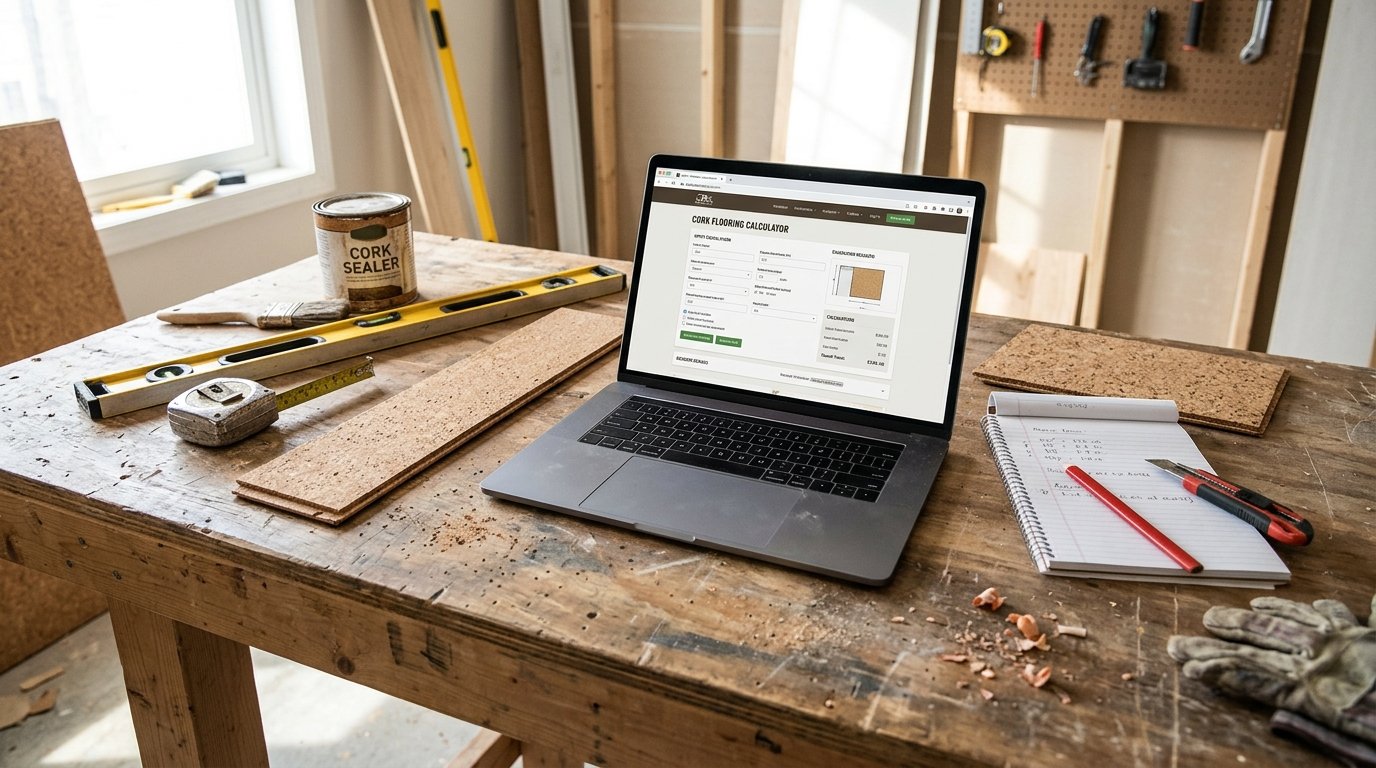
Cork Flooring Calculator: Planks, Adhesive, Sealer & Cost
Cork flooring is one of the most distinctive materials you can put on a floor. It is warm underfoot, quiet, naturally antimicrobial, and — because it is harvested from the bark of the cork oak without felling the tree — genuinely sustainable. It comes in three formats (glue-down tiles, click-lock planks, and sheet / roll) and each has a different installation method, a different adhesive requirement, and a different labour time. It also requires careful subfloor preparation: cork is sensitive to moisture and any unevenness telegraphs through to the surface.
Our Cork Flooring Calculator is a free online tool that estimates the materials and costs of a cork floor installation. It handles all three cork types with type-aware logic — adhesive is applied to glue-down tiles and sheet cork, not to click planks; labour differs by type. It also includes sealer with multiple coats, subfloor prep (self-levelling and moisture barrier), skirting, door transition bars, total cork mass, delivery, VAT and total installed cost.
In this guide, we will show you how to use the calculator, explain each input and output, walk through two detailed examples, and answer eight of the most frequently asked questions about cork flooring.
Cork Flooring
Construction CalculatorCork flooring: planks, adhesive, sealer, subfloor prep, trims and total cost.
What is the Cork Flooring Calculator?
The Cork Flooring Calculator is a free online tool that estimates the quantity and cost of materials for a cork flooring installation. It supports:
- Input modes: room dimensions (length × width) or direct area.
- Cork types: glue-down cork tiles, click cork planks, sheet / roll cork. Each type determines which fixing materials apply and how long the installation takes.
- Pack details: coverage per pack, price per pack, pack weight.
- Adhesive: applied to glue-down tiles and sheet cork, not to click planks.
- Sealer: optional, with a user-defined number of coats (typically 2).
- Subfloor prep: self-levelling compound, moisture barrier, or both.
- Trims: skirting boards and door transition bars.
- Labour: per m², with a difficulty multiplier by type.
- Extras: delivery and VAT.
The output includes:
- Floor area, area with waste, room perimeter (dims mode)
- Pack count and total cork mass in kg / lb
- Itemised costs: cork, adhesive, sealer, self-levelling, moisture barrier, skirting, door bars, labour, delivery
- VAT and grand total
The tool is part of a suite of flooring calculators available on our website. For related calculations, you can use our Bamboo Flooring Calculator, Carpet / Roll Flooring Calculator, Sports Wood Floor Calculator, and Liquid Floor Screed Calculator.
Why Accurate Cork Flooring Estimation Matters
Cork is a premium natural material, and its installation has specific requirements that are easy to overlook at budget stage. Getting the quantities wrong is expensive; getting the specification wrong is a floor failure.
The Three Types Behave Differently
Glue-down cork tiles are the traditional format — thin cork tiles bonded directly to the subfloor. Click cork planks are the modern DIY-friendly format — engineered planks with a locking system, no adhesive. Sheet cork is the specialist format — thin, flexible, usually used for acoustic insulation, always glued. Each type uses different materials and takes different amounts of time to install. The calculator applies the correct adhesive and labour for each.
Adhesive Is Not Optional for Glue-Down and Sheet
Glue-down tiles and sheet cork require adhesive. Only click planks are installed without adhesive. If the calculator (or the fitter) forgets this, the cost of adhesive appears on the final invoice — not in the estimate.
Sealer Protects the Surface
Most cork floors benefit from a sealer — typically 2 coats of water-based polyurethane. Sealer protects against moisture, stains and wear. It is often bundled with the cork product, but if it is sold separately it needs to be in the budget. The calculator applies the sealer price × the number of coats, so two coats of sealer costs twice as much as one.
Subfloor Prep Is Critical
Cork is thinner and more flexible than most hard floors. Any unevenness in the subfloor telegraphs to the surface. Cork is also hygroscopic — it absorbs moisture from the subfloor and can swell or cup. Self-levelling compound over concrete and a moisture barrier over damp subfloors are often necessary. The calculator makes both visible as line items.
Skirting and Transition Bars
Skirting covers the expansion gap and finishes the wall-floor junction. Door transition bars cover the threshold between cork and adjacent flooring. Both add cost and both must be ordered with the floor.
Mass Matters on Upper Floors
Cork is relatively light — around 200–500 kg/m³ — but with packs, adhesive and underlayment the total mass is still significant. The calculator outputs total cork mass from pack weight × pack count. Useful for structural checks on upper floors or lightweight construction.
VAT and Delivery
Cork packs are bulky and often delivered by lorry. Delivery charges and VAT add real cost to the final bill.
For more information on cork flooring, you can refer to Wikipedia’s article on cork or the Forest Stewardship Council for sustainable sourcing.
How to Use the Cork Flooring Calculator
Using the calculator is straightforward. Here is a breakdown of each field.
1. Area
- Input mode: Select “Room dimensions” or “Direct area”. Only one is used.
- Room length / width: Enter dimensions in meters or feet. Used when “Room dimensions” is selected.
- Area: Enter direct area in m² or ft². Used when “Direct area” is selected.
- Waste allowance: Enter percentage for waste. 10% is typical; 15% for diagonal or complex layouts.
2. Product
- Type: Glue-down cork tiles, click cork planks, or sheet / roll cork. Type determines whether adhesive is applied and how much labour time the installation takes.
- Pack coverage: m² per pack. Typically 1.5–2.2 m². Check the packaging.
- Price per pack: Local price. The calculator multiplies by pack count.
- Pack weight: kg per pack. Used for total mass.
3. Fixing
- Adhesive price per m²: Used for glue-down tiles and sheet cork. Set 0 for click planks.
4. Sealer
- Sealer: Select “Not required (pre-finished)” or “Apply cork sealer”. Most cork benefits from sealer.
- Sealer price per m²: Local price.
- Sealer coats: Number of coats, typically 2.
5. Subfloor
- Subfloor preparation: Ready, self-levelling only, or moisture barrier + levelling.
- Self-levelling price per m²: Used when prep is selected.
- Moisture barrier price per m²: Used only for moisture barrier option.
6. Trims
- Skirting length: Total length in meters or feet. Set 0 if not required.
- Skirting price per metre: Local price.
- Door transition bars: Number of doorways needing a strip. Set 0 if none.
- Price per door bar: Local price.
7. Labour
- Labour price per m²: Local rate. The calculator applies a multiplier: click ×0.90, glue ×1.10, sheet ×1.20.
8. Extras
- Delivery / skip: Fixed cost for delivery and waste removal.
- VAT / tax rate: Applicable rate, or 0 if not applicable.
Once you enter all values, the calculator displays the full output, including area, pack count, cork mass, itemised costs, VAT, and grand total.
Understanding the Calculations
To make the most of the calculator, it is important to understand each output and the underlying formulas.
Floor Area
Area = length × width (dimensions mode) or direct area input.
Area with Waste
area_waste = area × (1 + waste / 100).
10% is typical for straight-lay. Diagonal, herringbone, or rooms with many alcoves need 15%.
Pack Count
packs = ceil(area_waste / pack coverage).
Rounded up — you cannot buy partial packs.
Cork Mass
mass = packs × pack weight.
Cork density is typically 200–500 kg/m³, so a 20 m² room with 3 mm cork tiles weighs around 30–60 kg. Engineered click planks are heavier because of the HDF core — 20 m² might be 200–300 kg. The calculator uses pack weight directly, so the result reflects the actual product.
Adhesive
adh_cost = area × adhesive price (glue-down tiles and sheet cork only).
Click planks are installed without adhesive — the fixing cost is zero.
Sealer
seal_cost = area × sealer price × number of coats.
Two coats of sealer cost twice as much as one. Some sealers are included in the cork product; if so, set the price to 0.
Subfloor Prep
- Self-levelling = area × self-levelling price (applies for both “level” and “moisture” modes).
- Moisture barrier = area × moisture barrier price (applies for “moisture” mode only).
Trims
- Skirting = length × price per metre.
- Door bars = count × price per bar.
Labour
labour_cost = area × labour rate × type multiplier.
Type multipliers:
- Click planks: 0.90
- Glue-down tiles: 1.10
- Sheet cork: 1.20
Click is the fastest; glue-down takes longer because each tile is set by hand; sheet cork is the slowest because the sheet must be cut and fitted precisely and glued.
VAT and Total
VAT = subtotal × VAT / 100.
Total = subtotal + VAT.
Understanding these components helps you interpret the results and adjust your order. For more information on cork flooring standards, you can refer to Wikipedia’s article on cork or the National Wood Flooring Association.
Example Calculations
Let’s run through two examples across common cork installations.
Example 1: Bedroom, 20 m², Click Cork Planks, Pre-Finished
Inputs:
- Room dimensions: 5 m × 4 m → 20 m²
- Waste: 10%
- Type: Click planks
- Pack coverage: 1.8 m²
- Price per pack: $65
- Pack weight: 15 kg
- Adhesive: not applicable
- Sealer: No (pre-finished)
- Subfloor: Ready
- Skirting: 18 m at $12/m
- Door bars: 1 at $25
- Labour: $22/m²
- Delivery: $80
- VAT: 20%
Calculations:
- Area = 20 m²; waste → 22 m²
- Perimeter = 18 m
- Packs = ceil(22 / 1.8) = 13
- Cork cost = 13 × $65 = $845
- Mass = 13 × 15 = 195 kg
- Adhesive = $0
- Sealer = $0
- Skirting = 18 × $12 = $216
- Door bars = 1 × $25 = $25
- Labour = 20 × $22 × 0.90 = $396
- Delivery = $80
- Subtotal = $1,562
- VAT = $312.40
- Total = $1,874.40
Example 2: Living Room, 30 m², Glue-Down Tiles, Sealer, Moisture Barrier
Inputs:
- Room dimensions: 6 m × 5 m → 30 m²
- Waste: 12%
- Type: Glue-down tiles
- Pack coverage: 1.5 m²
- Price per pack: $55
- Pack weight: 8 kg
- Adhesive: $5/m²
- Sealer: Yes, $3/m², 2 coats
- Subfloor: Moisture barrier + levelling
- Self-levelling: $8/m²
- Moisture barrier: $3/m²
- Skirting: 22 m at $15/m
- Door bars: 2 at $25
- Labour: $28/m²
- Delivery: $100
- VAT: 20%
Calculations:
- Area = 30 m²; waste → 33.6 m²
- Perimeter = 22 m
- Packs = ceil(33.6 / 1.5) = 23
- Cork cost = 23 × $55 = $1,265
- Mass = 23 × 8 = 184 kg
- Adhesive = 30 × $5 = $150
- Sealer = 30 × $3 × 2 = $180
- Self-levelling = 30 × $8 = $240
- Moisture barrier = 30 × $3 = $90
- Skirting = 22 × $15 = $330
- Door bars = 2 × $25 = $50
- Labour = 30 × $28 × 1.10 = $924
- Delivery = $100
- Subtotal = $3,329
- VAT = $665.80
- Total = $3,994.80
Both examples show how type, sealer, subfloor prep and labour multiplier combine into the final cost.
Benefits of Using the Cork Flooring Calculator
Tips for Accurate Cork Flooring Estimation
- Read the manufacturer’s coverage figure. Pack coverage varies significantly — from 1.5 m² to 2.2 m².
- Measure the room accurately. Alcoves, doorways and chimney breasts add complexity and waste.
- Use the correct waste allowance. 10% for straight-lay; 15% for diagonal or complex.
- Choose the right type for your lifestyle. Click planks are DIY-friendly; glue-down tiles are classic; sheet cork is for specialists.
- Acclimatise the cork. Leave packs in the room for 48 hours before installation.
- Check subfloor moisture. Cork is sensitive to moisture. A moisture meter check is essential.
- Allow for self-levelling. Most concrete subfloors need it; wooden subfloors may need plywood overlay.
- Count sealer coats. Most cork needs 2 coats; some heavy-traffic areas need 3.
- Plan trims with the flooring. Skirting and door bars are often ordered in matching finishes.
- Check the mass on upper floors. Engineered click planks are heavier than you might expect.
- Do not forget VAT and delivery. Both add real cost.
- Verify the labour rate. Glue-down takes longer than click; sheet takes longer than both.
For more information on cork flooring installation, you can refer to the National Wood Flooring Association or Wikipedia’s article on cork.
Common Mistakes to Avoid
- Forgetting adhesive for sheet cork. Sheet cork is glued, not clicked.
- Using the wrong labour rate. Glue-down and sheet take longer than click planks.
- Skipping sealer. Cork without sealer wears out quickly and stains easily.
- Assuming 1 coat is enough. Most cork needs 2 coats; heavy-traffic areas may need 3.
- Ignoring subfloor prep. Uneven subfloor and trapped moisture both cause cork failure.
- Forgetting skirting and door bars. Small line items that add up.
- Underestimating waste. 10% for straight; 15% for diagonal.
- Not checking mass on upper floors. Engineered planks can weigh 10 kg/m² or more.
- No VAT or delivery. Both significantly change the final bill.
- Not acclimatising the cork. Installed cold from the van, cork can cup or swell.
How to Reduce Cork Flooring Costs
If your estimate is higher than expected, here are ways to reduce costs without compromising quality:
- Choose click planks over glue-down tiles. Cheaper material, faster installation.
- Skip the moisture barrier if the subfloor is dry. Test first.
- Apply one coat of sealer instead of two — only where traffic is low.
- Do the skirting yourself. Straightforward carpentry if you have basic tools.
- Buy in bulk. Many suppliers discount for larger orders.
- Compare suppliers. Cork prices vary significantly by brand and origin.
- Time the project off-season. Retailers often discount in quieter months.
- Get multiple quotes. Compare at least three installers if you are not doing it yourself.
Frequently Asked Questions (FAQ)
Conclusion
The Cork Flooring Calculator is an essential tool for homeowners, installers, and specifiers. It estimates pack count, cork mass, adhesive, sealer with coats, subfloor prep, skirting, door bars, labour, delivery, VAT and total installed cost — with type-aware logic for glue-down tiles, click planks and sheet cork.
Whether you are installing a single bedroom or a full property, accurate estimation of cork flooring materials is the foundation of a durable, moisture-safe, and cost-effective installation. Try the Cork Flooring Calculator today and take the guesswork out of your cork floor project.




3 Comments