
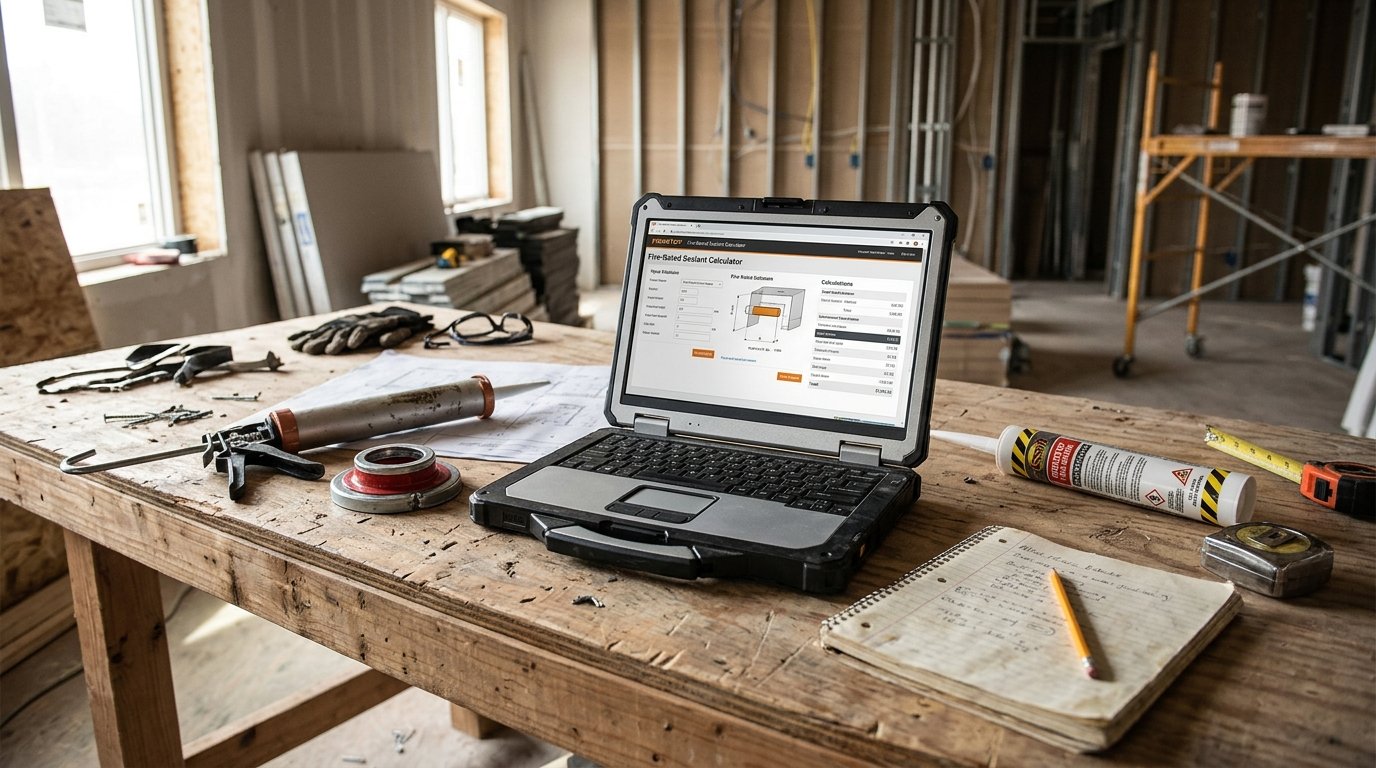
Fire-Rated Sealant Calculator: Estimate Penetration Sealing & Costs
Fire-rated sealant is one of those products that rarely gets attention — until it matters. Every time a pipe, cable, or duct passes through a fire-rated wall, floor, or ceiling, that opening becomes a potential pathway for fire, smoke, and toxic gases. Fire-rated sealant, combined with intumescent collars and wraps, closes those pathways and restores the fire resistance of the compartment. If the sealing is incomplete, underspecified, or applied with the wrong product, the entire passive fire protection strategy of a building can be compromised.
Our Fire-Rated Sealant Calculator is a free online tool that takes the guesswork out of penetration sealing. It estimates the amount of fire-rated sealant, the number of intumescent collars or wraps, labour, certification, and total project cost based on the number and type of penetrations, fire rating, substrate, and local pricing. It supports pipe, cable, and duct penetrations, five fire-rating classes from 30 to 240 minutes, four substrate types, and a range of collar and sealant options. Whether you are a passive fire protection installer, a contractor, a building services engineer, or a facilities manager, this calculator gives you the numbers you need to plan and price the work accurately.
In this guide, we will show you how to use the calculator, explain each input and output, walk through real-world examples, and answer the questions we hear most often. We will also share practical tips to ensure your fire-stopping work is compliant, durable, and correctly certified.
Fire-Rated Sealant
Construction CalculatorFire-rated sealant: service penetrations, pipe wraps, collars, sealant and cost.
What is the Fire-Rated Sealant Calculator?
The Fire-Rated Sealant Calculator is a free online tool that estimates the quantities and costs of materials and labour required for fire-stopping service penetrations. It supports:
- Pipe penetrations — copper, steel, plastic, or mixed. Plastic pipes require intumescent collars or wraps; metal pipes may not.
- Cable penetrations — single cables or bundles, sealed with fire-rated sealant or putty pads.
- Duct penetrations — sealed with fire-rated mortar, sealant, or specialist duct wraps.
The calculator applies physical multipliers for fire rating (30 minutes to 240 minutes) and substrate type (flexible wall, rigid wall, floor, ceiling). It scales sealant consumption with pipe and cable diameter, and with duct size. It then estimates costs for intumescent collars, sealant, labour, and certification.
The tool is part of a suite of materials and quantities calculators available on our website. For related calculations, you can use our Intumescent Sealant Calculator, Acrylic Caulk Calculator, and Silicone / Sealant Quantity Calculator.
Why Fire-Rated Sealant Matters
Fire-rated sealant is not a decorative product. It is a life-safety component, and its correct specification and installation are a legal requirement in most jurisdictions. Here is why it matters so much.
Compartmentation and Escape Routes
Buildings are designed with fire compartments — walls, floors, and ceilings that contain fire and smoke for a specified period. Every service penetration through those compartments is a potential weakness. If it is not correctly sealed, fire and smoke can spread from one compartment to another, cutting off escape routes and endangering occupants.
Life Safety
Most fire deaths are caused by smoke inhalation, not direct contact with flames. Fire-rated sealants are tested for both integrity (E) and insulation (I) performance, meaning they resist the passage of both flames and heat. This buys time for occupants to escape and for the fire service to respond.
Building Regulations and Compliance
Building codes — such as the International Building Code (IBC), Approved Document B in the UK, and the National Construction Code in Australia — require fire-stopping of service penetrations in fire-rated elements. Non-compliance can result in failed inspections, fines, and in serious cases, criminal liability.
Insurance and Warranties
Insurers increasingly require evidence of compliant passive fire protection. A certified fire-stopping installation is part of that evidence. Without it, an insurance claim following a fire may be contested.
Third-Party Certification
In many markets, fire-stopping work must be installed by a third-party certified installer and documented with a certificate of conformity. The Fire-Rated Sealant Calculator includes a line for certification costs so you can factor this into your quote.
Cost of Remediation
Fire-stopping is cheap when done during construction and expensive when retrofitted. Opening up walls and ceilings to correct non-compliant seals is disruptive, slow, and costly. Accurate estimation during the first fix avoids this entirely.
For more information on fire-stopping and passive fire protection, you can refer to Wikipedia’s article on firestop or Wikipedia’s article on passive fire protection.
How to Use the Fire-Rated Sealant Calculator
Using the calculator is straightforward. Here is a breakdown of each field.
1. Penetrations
- Pipe penetrations: Enter the number of pipe penetrations through the fire-rated element.
- Pipe material: Select copper, steel, plastic, or mixed. Plastic pipes require intumescent collars or wraps; metal pipes may not, depending on the fire test.
- Pipe diameter: Enter the nominal pipe diameter in meters or inches. This scales the sealant consumption — larger pipes need more sealant.
- Cable penetrations: Enter the number of cable penetrations or cable bundles.
- Average bundle diameter: Enter the diameter of the sealed cable bundle. This scales the sealant consumption.
- Duct penetrations: Enter the number of duct penetrations. Set 0 if not applicable.
- Duct size: Enter the nominal duct size. This scales the sealant consumption.
2. Fire Rating
- Fire rating: Select the required fire rating: 30 min (E30 / EI30), 60 min (E60 / EI60), 90 min, 120 min (EI120), or 240 min. Higher ratings require more sealant and, in some cases, larger collars.
- Substrate: Select the substrate type: flexible wall (plasterboard), rigid wall (masonry / concrete), floor, or ceiling. Flexible walls require more sealant because the opening deforms under fire conditions.
3. Materials
- Pipe collar: Select intumescent collar, intumescent wrap, or no collar (metal pipes only). Collars are mandatory for plastic pipes and are the most common fire-stopping method for pipe penetrations.
- Sealant type: Select ablative fire sealant, intumescent sealant, fire-stop mortar, or fire-stop putty pads. The sealant type is for navigation only — enter the price for your chosen type below.
4. Pricing
- Collar price each: Enter the local price per intumescent collar or wrap.
- Sealant price per kg: Enter the local price per kilogram of fire-rated sealant.
- Labour price per penetration: Enter the local installation rate per penetration. Certified installers typically charge more than general labourers.
- Fire certificate / inspection: Enter the cost of documentation and sign-off. Set to 0 if not required.
Once you enter all values, the calculator instantly displays total penetrations, collar count (if applicable), sealant mass, and a full cost breakdown.
Understanding the Calculations
To make the most of the calculator, it is important to understand each output and the underlying formulas.
Fire Rating Multiplier
Higher fire ratings require more sealant to achieve the required integrity and insulation. The multipliers used are:
| Rating | Multiplier |
|---|---|
| 30 min | 1.00 |
| 60 min | 1.15 |
| 90 min | 1.30 |
| 120 min | 1.50 |
| 240 min | 2.00 |
Substrate Multiplier
Flexible substrates (plasterboard walls) require more sealant than rigid substrates (masonry or concrete) because the opening deforms more under fire conditions. The multipliers are:
| Substrate | Multiplier |
|---|---|
| Flexible wall | 1.15 |
| Rigid wall | 1.00 |
| Floor | 1.10 |
| Ceiling | 1.10 |
Sealant Consumption per Penetration
Sealant consumption per pipe or cable scales with diameter. The calculator uses a reference diameter of 32 mm for pipes and 20 mm for cables. If your pipe is 64 mm (twice the reference), the sealant consumption doubles. Duct sealant consumption scales directly with duct size relative to a 200 mm reference.
- Pipe: 0.3 kg base for metal, 0.4 kg for mixed, 0.5 kg for plastic, all scaled by (diameter / 32 mm).
- Cable: 0.3 kg base, scaled by (bundle diameter / 20 mm).
- Duct: (duct size / 200 mm) × 2.0 kg.
Total Sealant Mass
Total sealant = (pipe + cable + duct contributions) × fire rating multiplier × substrate multiplier.
Collar Count
Intumescent collars or wraps are counted for every pipe penetration, unless “no collar” is selected. Collars are mandatory for plastic pipes.
Labour
Labour = total penetrations × labour price per penetration.
Certificate
If at least one penetration exists, the certification cost is applied once. This covers documentation, inspection, and sign-off.
Total Cost
Total = collar cost + sealant cost + labour + certificate.
Understanding these components helps you interpret the results and adjust your quote. For more information on fire-stopping standards, you can refer to Wikipedia’s article on firestop or the Association for Specialist Fire Protection (ASFP).
Example Calculations
Let’s run through two examples to see how the calculator works in different scenarios.
Example 1: Plastic Pipe Penetrations in a Plasterboard Wall
Inputs:
- Pipe penetrations: 5
- Pipe material: Plastic
- Pipe diameter: 32 mm (0.032 m)
- Cable penetrations: 3
- Cable bundle diameter: 20 mm (0.020 m)
- Duct penetrations: 0
- Fire rating: 60 min
- Substrate: Flexible wall
- Pipe collar: Intumescent
- Collar price: $18 each
- Sealant price per kg: $25
- Labour per penetration: $30
- Certificate: $150
Calculations:
- Pipe consumption per penetration = 0.5 kg × (0.032 / 0.032) = 0.5 kg
- Cable consumption per penetration = 0.3 kg × (0.020 / 0.020) = 0.3 kg
- Total base consumption = (5 × 0.5) + (3 × 0.3) = 2.5 + 0.9 = 3.4 kg
- Fire rating multiplier (60 min) = 1.15
- Substrate multiplier (flexible) = 1.15
- Total sealant = 3.4 × 1.15 × 1.15 = 4.49 kg
- Collar count = 5
- Collar cost = 5 × $18 = $90
- Sealant cost = 4.49 × $25 = $112.25
- Total penetrations = 5 + 3 + 0 = 8
- Labour cost = 8 × $30 = $240
- Certificate cost = $150
- Grand total = $90 + $112.25 + $240 + $150 = $592.25
Example 2: Mixed Penetrations with a 120-Minute Rating
Inputs:
- Pipe penetrations: 8
- Pipe material: Mixed
- Pipe diameter: 50 mm (0.050 m)
- Cable penetrations: 6
- Cable bundle diameter: 30 mm (0.030 m)
- Duct penetrations: 1
- Duct size: 300 mm (0.300 m)
- Fire rating: 120 min
- Substrate: Rigid wall
- Pipe collar: Intumescent
- Collar price: $22 each
- Sealant price per kg: $28
- Labour per penetration: $35
- Certificate: $200
Calculations:
- Pipe consumption per penetration = 0.4 kg × (0.050 / 0.032) = 0.625 kg
- Cable consumption per penetration = 0.3 kg × (0.030 / 0.020) = 0.45 kg
- Duct consumption = (0.300 / 0.200) × 2.0 = 3.0 kg
- Total base consumption = (8 × 0.625) + (6 × 0.45) + (1 × 3.0) = 5.0 + 2.7 + 3.0 = 10.7 kg
- Fire rating multiplier (120 min) = 1.50
- Substrate multiplier (rigid) = 1.00
- Total sealant = 10.7 × 1.50 × 1.00 = 16.05 kg
- Collar count = 8
- Collar cost = 8 × $22 = $176
- Sealant cost = 16.05 × $28 = $449.40
- Total penetrations = 8 + 6 + 1 = 15
- Labour cost = 15 × $35 = $525
- Certificate cost = $200
- Grand total = $176 + $449.40 + $525 + $200 = $1,350.40
These examples show how diameter, fire rating, substrate, and penetration type affect sealant mass and total cost.
Benefits of Using the Fire-Rated Sealant Calculator
Tips for Accurate Fire-Rated Sealant Estimation
- Confirm the fire rating. The required rating comes from the building’s fire strategy. Do not guess. 60 minutes is common for compartment walls; 120 minutes for structural elements.
- Identify plastic pipes early. Plastic pipes require intumescent collars or wraps, which are the largest single cost item in most fire-stopping packages.
- Measure pipe and cable diameters accurately. Sealant consumption scales linearly with diameter. A 50 mm pipe uses 56% more sealant than a 32 mm pipe.
- Account for substrate. Flexible walls deform under fire and require more sealant than rigid walls.
- Use tested systems. Fire-stopping must be installed using a tested and certificated system. Mixing products from different manufacturers invalidates the certification.
- Include certification. Third-party certification is often required. Factor this into your quote.
- Consider access. Ceilings and risers are harder to work in than walls. If access is difficult, increase the labour rate.
- Verify with the manufacturer. For unusual penetrations, check the manufacturer’s test data before specifying.
- Plan inspections. Fire officers may inspect at first fix and at completion. Budget time for both.
- Document everything. Photograph each penetration before and after sealing. This supports the certificate and future maintenance.
For more information on fire-stopping standards, you can refer to Wikipedia’s article on firestop or the Association for Specialist Fire Protection (ASFP).
Common Mistakes to Avoid
- Using the wrong sealant for the fire rating. A 60-minute sealant is not suitable for a 120-minute wall.
- Omitting collars on plastic pipes. Plastic pipes melt and leave a void. Intumescent collars expand to close that void.
- Sealing only the visible face. Fire-stopping must fill the full depth of the penetration.
- Mixing products from different manufacturers. Fire test certification is system-specific. Mixing invalidates it.
- Forgetting cable bundles. A single cable may not require sealing, but a bundle does. Count bundles, not individual cables.
- Underestimating labour. Certified fire-stoppers charge more than general labourers. Use a realistic rate.
- Ignoring certification. Without a certificate, the installation is not compliant, even if physically correct.
- Not accounting for ducts. Ducts require specialist sealing with mortar or wraps. They are not covered by standard sealant.
- Failing to inspect. Fire-stopping is often hidden behind finishes. Inspect and photograph before closing up.
- Skipping professional verification. For large or complex projects, have a fire engineer review the specification.
Frequently Asked Questions (FAQ)
Conclusion
The Fire-Rated Sealant Calculator is an essential tool for passive fire protection installers, contractors, building services engineers, and facilities managers. It helps you estimate sealant mass, intumescent collars, labour, and certification for fire-rated service penetrations, with correct scaling for diameter, fire rating, and substrate. By following the tips in this article and using the calculator, you can confidently price fire-stopping work and ensure compliance with building regulations.
Whether you are sealing a handful of pipe penetrations in a small project or managing a large fire-stopping package, accurate estimation is the foundation of a compliant, cost-effective installation. Try the Fire-Rated Sealant Calculator today and take the guesswork out of your fire-stopping quantities.





3 Comments