
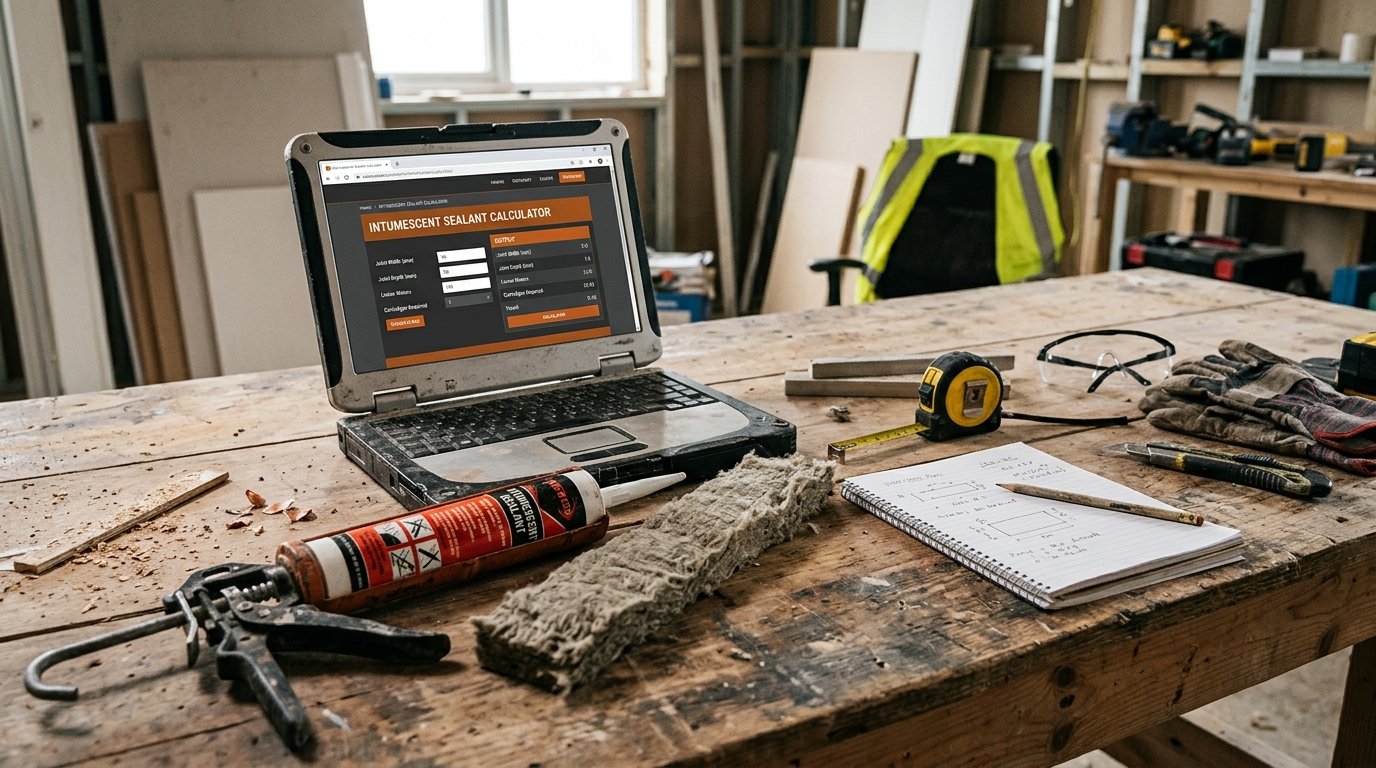
Intumescent Sealant Calculator: Estimate Cartridges & Costs
Fire-rated joints are one of the most overlooked details in modern construction. Every time a wall meets a floor, a door frame meets a wall, or a pipe passes through a compartment, there is a gap. That gap has to be sealed — not with ordinary caulk, but with a product that has been tested to resist fire for a defined period. Intumescent sealant is that product. It expands when heated, fills the void left by burning materials, and maintains the fire integrity of the compartment. If the wrong sealant is used, or the wrong quantity is applied, the entire fire strategy of a building can fail.
Our Intumescent Sealant Calculator is a free online tool that takes the guesswork out of fire-rated joint sealing. It estimates the sealant volume, the number of cartridges required, backing material, primer, certification, labour, and total project cost based on joint length, joint dimensions, joint type, fire rating, and local pricing. It supports linear gaps, head-of-wall joints, service penetration gaps, frame perimeters, and fire-rated expansion joints. It also supports 30, 60, 120, and 240-minute fire ratings, and the major international testing standards (BS EN, UL, ASTM, AS).
In this guide, we will show you how to use the calculator, explain each input and output, walk through real-world examples, and answer the questions we hear most often. We will also share practical tips to ensure your intumescent sealing work is compliant, durable, and correctly certified.
Intumescent Sealant
Construction CalculatorIntumescent sealant for fire-rated joints: linear metres, cartridges, certification.
What is the Intumescent Sealant Calculator?
The Intumescent Sealant Calculator is a free online tool that estimates the quantity of intumescent sealant required to seal fire-rated joints and penetration gaps. It calculates the sealant volume from the joint length, joint width, joint depth, joint type, and fire rating, applies a waste allowance, and converts the volume into the number of cartridges required. It then adds backing material, primer, certification, and labour costs to give the total installed cost.
The calculator supports:
- Joint types: Linear gap (wall or floor), head-of-wall joint, service penetration gap, door or window frame perimeter, and fire-rated expansion joint.
- Fire ratings: 30, 60, 120, and 240 minutes.
- Standards: BS EN 1366-4 / 1366-3, UL 2079 / UL 1479, ASTM E1966 / E814, AS 1530.4 / AS 4072.1.
- Cartridge sizes: 300 mL and 600 mL (sausage), plus custom.
- Backing materials: Mineral wool, PE backing rod, or none.
- Pricing: Cartridge price, backing per metre, primer per metre, certificate, and labour per metre.
The output includes:
- Total joint length
- Sealant volume in litres
- Cartridges required
- Backing length (if used)
- Intumescent sealant, backing, primer, certificate, and labour costs
- Grand total
The tool is part of a suite of materials and quantities calculators available on our website. For related calculations, you can use our Fire-Rated Sealant Calculator, Acrylic Caulk Calculator, and Silicone / Sealant Quantity Calculator.
Why Intumescent Sealant Matters
Intumescent sealant is not a finishing product. It is a life-safety component, and its correct specification, installation, and certification are a legal requirement in most jurisdictions. Here is why it matters so much.
Fire Compartmentation and Escape Routes
Buildings are designed with fire compartments — walls, floors, and ceilings that contain fire and smoke for a specified period. Every joint, gap, and penetration through those compartments is a potential weakness. If it is not correctly sealed with a tested fire-stopping product, fire and smoke can spread from one compartment to another, cutting off escape routes and endangering occupants.
Smoke and Toxic Gas Control
Most fire deaths are caused by smoke inhalation, not direct contact with flames. Intumescent sealants are tested for both integrity (E) and insulation (I) performance, meaning they resist the passage of flames, hot gases, and heat. This buys time for occupants to escape and for the fire service to respond.
Building Regulations and Compliance
Building codes — such as the International Building Code (IBC), Approved Document B in the UK, and the National Construction Code in Australia — require fire-stopping of joints and service penetrations in fire-rated elements. Non-compliance can result in failed inspections, fines, and in serious cases, criminal liability.
Insurance and Warranties
Insurers increasingly require evidence of compliant passive fire protection. A certified fire-stopping installation is part of that evidence. Without it, an insurance claim following a fire may be contested.
Third-Party Certification
In many markets, fire-stopping work must be installed by a third-party certified installer and documented with a certificate of conformity. The Intumescent Sealant Calculator includes a line for certification costs so you can factor this into your quote.
Cost of Remediation
Fire-stopping is cheap when done during construction and expensive when retrofitted. Opening up walls and ceilings to correct non-compliant seals is disruptive, slow, and costly. Accurate estimation during the first fix avoids this entirely.
Movement and Expansion
Intumescent sealants are not just fire barriers — they are also designed to accommodate movement. A wall may move slightly under thermal expansion, or a door frame may shift. The wrong sealant will crack and lose its fire performance. The correct intumescent sealant remains flexible and maintains its tested performance over the life of the building.
For more information on fire-stopping and passive fire protection, you can refer to Wikipedia’s article on firestop or Wikipedia’s article on passive fire protection.
How to Use the Intumescent Sealant Calculator
Using the calculator is straightforward. Here is a breakdown of each field.
1. Joints
- Total joint length: Enter the total length of all joints to be sealed, in meters or feet. For a head-of-wall joint, this is the total length of the joint around the perimeter of the compartment. For a frame perimeter, this is the perimeter of the frame. For a service gap, this is the sum of all penetration perimeters.
- Joint type: Select the type of joint:
- Linear gap (wall/floor): A straight joint between two elements.
- Head-of-wall joint: The joint between the top of a partition wall and the underside of a floor slab or ceiling.
- Service penetration gap: The annular gap around pipes, cables, and ducts.
- Door / window frame perimeter: The joint between a frame and the surrounding wall.
- Fire-rated expansion joint: A joint designed to accommodate movement between two structural elements.
The joint type affects the physical sealant consumption per metre. Service gaps and expansion joints use more sealant; linear gaps use less.
2. Fire Rating
- Fire rating: Select the required fire rating: 30, 60, 120, or 240 minutes. Higher ratings require more sealant and, in some cases, larger backing materials.
- Standard: Select the testing standard: BS EN, UL, ASTM, or AS. This is for navigation only — the price for your chosen product should reflect the standard it complies with.
3. Joints Geometry
- Joint width: Enter the width of the joint in meters or inches. Typical fire joints are 10–30 mm wide. For service penetrations, this is the annular gap between the service and the surrounding construction.
- Sealant depth: Enter the depth of the sealant in the joint in meters or inches. The depth-to-width ratio is typically 1:1.5 to 1:3, depending on the product and the fire rating. A deeper sealant provides better fire resistance but uses more material.
4. Cartridge
- Cartridge size: Select the cartridge size: 300 mL, 600 mL (sausage), or custom. Sausages are typically used in bulk guns and are cheaper per litre for large projects.
- Custom volume: Used only when “Custom” is selected. Enter the volume in litres or gallons.
- Waste allowance: Enter a percentage for nozzle loss, cure shrinkage, and spillage. 10% is typical for intumescent sealants, which are usually applied with more precision than decorative caulk.
5. Backing
- Backing material: Select the backing material: mineral wool, PE backing rod, or none. Backing materials are used to control sealant depth and prevent three-sided adhesion. Mineral wool is the most common choice for fire-rated joints because it is non-combustible and contributes to the fire performance of the joint.
- Backing price per metre: Enter the local price per metre of backing material. Used only when a backing material is selected.
6. Pricing
- Price per cartridge: Enter the local price per cartridge for your chosen size and product.
- Backing price per metre: Enter the local price per metre of backing material.
- Primer price per metre: Enter the local price per metre of primer. Set to 0 if not required.
- Fire certificate: Enter the cost of documentation and sign-off. Set to 0 if not required.
- Labour price per metre: Enter the local installation rate per metre. Fire-rated work is slower and requires a certified installer.
Once you enter all values, the calculator instantly displays total joint length, sealant volume in litres, cartridges required, backing length, and a full cost breakdown.
Understanding the Calculations
To make the most of the calculator, it is important to understand each output and the underlying formulas.
Joint Volume
The volume of sealant required is calculated from the joint geometry:
Volume = joint length × joint width × joint depth × joint type multiplier × fire rating multiplier
Joint Type Multipliers
Different joint types consume different volumes of sealant per metre, because the effective joint shape and the required fill depth vary:
| Joint Type | Multiplier |
|---|---|
| Linear gap | 1.00 |
| Head-of-wall | 1.10 |
| Service gap | 1.20 |
| Frame gap | 1.05 |
| Expansion | 1.25 |
Service gaps and expansion joints use more sealant because the annular gap or expansion joint typically requires deeper fill.
Fire Rating Multipliers
Higher fire ratings require more sealant to achieve the required integrity and insulation:
| Rating | Multiplier |
|---|---|
| 30 min | 1.00 |
| 60 min | 1.15 |
| 120 min | 1.40 |
| 240 min | 1.80 |
Waste Allowance
The calculated volume is increased by the waste allowance to account for nozzle loss, cure shrinkage, and spillage. The formula is:
Volume with waste = volume × (1 + waste / 100)
Cartridge Count
The number of cartridges required is calculated by dividing the volume with waste by the cartridge volume:
Cartridges = ceil(volume with waste / cartridge volume)
Cartridge volumes are converted from millilitres to cubic metres: 300 mL = 0.0003 m³, 600 mL = 0.0006 m³.
Backing Material
Backing material is counted by the metre, equal to the total joint length. Backing is used to control sealant depth and prevent three-sided adhesion. For fire-rated joints, mineral wool is the most common backing because it is non-combustible and contributes to the fire performance of the joint.
Primer
Primer is applied to porous or difficult substrates to improve adhesion. It is counted by the metre, equal to the total joint length.
Certificate
The certificate is a fixed cost, applied once regardless of joint length. It covers documentation, inspection, and sign-off.
Labour
Labour = total joint length × labour price per metre. Fire-rated work is slower and requires a certified installer, so the rate is typically higher than for decorative caulking.
Total Cost
Total = cartridge cost + backing cost + primer cost + certificate + labour.
Understanding these components helps you interpret the results and adjust your quote. For more information on fire-stopping standards, you can refer to Wikipedia’s article on firestop or the Association for Specialist Fire Protection (ASFP).
Example Calculations
Let’s run through two examples to see how the calculator works in different scenarios.
Example 1: Head-of-Wall Joint in a Commercial Office
Inputs:
- Total joint length: 20 m
- Joint type: Head-of-wall
- Fire rating: 60 min
- Standard: BS EN
- Joint width: 0.010 m (10 mm)
- Sealant depth: 0.020 m (20 mm)
- Cartridge size: 600 mL
- Waste: 10%
- Backing: Mineral wool
- Cartridge price: $18
- Backing price per metre: $2.50
- Primer price per metre: $0.50
- Certificate: $150
- Labour price per metre: $12
Calculations:
- Volume = 20 × 0.010 × 0.020 × 1.10 × 1.15 = 0.00506 m³
- Volume with waste = 0.00506 × 1.10 = 0.005566 m³
- Volume in litres = 0.005566 × 1000 = 5.566 L
- Cartridges = ceil(0.005566 / 0.0006) = ceil(9.28) = 10 cartridges
- Cartridge cost = 10 × $18 = $180
- Backing cost = 20 × $2.50 = $50
- Primer cost = 20 × $0.50 = $10
- Certificate = $150
- Labour cost = 20 × $12 = $240
- Grand total = $180 + $50 + $10 + $150 + $240 = $630
Example 2: Service Penetration Gaps with 120-Minute Rating
Inputs:
- Total joint length: 45 m
- Joint type: Service gap
- Fire rating: 120 min
- Standard: UL
- Joint width: 0.030 m (30 mm)
- Sealant depth: 0.050 m (50 mm)
- Cartridge size: Custom (0.4 L)
- Waste: 10%
- Backing: Mineral wool
- Cartridge price: $14
- Backing price per metre: $3.20
- Primer price per metre: $0.60
- Certificate: $200
- Labour price per metre: $15
Calculations:
- Volume = 45 × 0.030 × 0.050 × 1.20 × 1.40 = 0.1134 m³
- Volume with waste = 0.1134 × 1.10 = 0.12474 m³
- Volume in litres = 0.12474 × 1000 = 124.74 L
- Cartridge volume = 0.4 L = 0.0004 m³
- Cartridges = ceil(0.12474 / 0.0004) = ceil(311.85) = 312 cartridges
- Cartridge cost = 312 × $14 = $4,368
- Backing cost = 45 × $3.20 = $144
- Primer cost = 45 × $0.60 = $27
- Certificate = $200
- Labour cost = 45 × $15 = $675
- Grand total = $4,368 + $144 + $27 + $200 + $675 = $5,414
These examples show how joint dimensions, joint type, fire rating, and cartridge size affect the total material requirement and cost.
Benefits of Using the Intumescent Sealant Calculator
Tips for Accurate Intumescent Sealant Estimation
- Confirm the fire rating. The required rating comes from the building’s fire strategy. Do not guess. 60 minutes is common for compartment walls; 120 minutes for structural elements.
- Measure joint width and depth accurately. Volume scales linearly with both dimensions. A small error is amplified over long runs.
- Use the correct depth-to-width ratio. Most intumescent sealants require a depth-to-width ratio of 1:1.5 to 1:3. Do not simply fill the joint to the surface.
- Use backing material. Backing controls the sealant depth and prevents three-sided adhesion, which can cause the sealant to fail under movement.
- Choose mineral wool for fire-rated joints. Mineral wool is non-combustible and contributes to the fire performance of the joint.
- Apply primer where required. Porous substrates and some metals require primer to ensure adhesion.
- Use certified installers. Fire-stopping is a specialist trade. Certified installers have the training, experience, and documentation to deliver compliant work.
- Include certification. Third-party certification is often required. Factor this into your quote.
- Consider access. Ceilings and risers are harder to work in than walls. If access is difficult, increase the labour rate.
- Verify with the manufacturer. For unusual joints or penetrations, check the manufacturer’s test data before specifying.
- Plan inspections. Fire officers may inspect at first fix and at completion. Budget time for both.
- Document everything. Photograph each joint before and after sealing. This supports the certificate and future maintenance.
For more information on fire-stopping standards, you can refer to Wikipedia’s article on firestop or the Association for Specialist Fire Protection (ASFP).
Common Mistakes to Avoid
- Using the wrong sealant for the fire rating. A 60-minute sealant is not suitable for a 120-minute joint.
- Filling the joint to the surface. Sealant depth matters. A shallow seal will fail under fire test conditions.
- Omitting backing material. Without backing, the sealant may adhere to three sides and fail under movement.
- Using acrylic caulk instead of intumescent sealant. Standard caulk is not tested for fire resistance.
- Mixing products from different manufacturers. Fire test certification is system-specific. Mixing invalidates it.
- Sealing only the visible face. Fire-stopping must fill the full depth of the joint.
- Underestimating labour. Certified fire-stoppers charge more than general labourers. Use a realistic rate.
- Ignoring certification. Without a certificate, the installation is not compliant, even if physically correct.
- Failing to inspect. Fire-stopping is often hidden behind finishes. Inspect and photograph before closing up.
- Skipping professional verification. For large or complex projects, have a fire engineer review the specification.
How to Reduce Intumescent Sealant Costs
If your estimate is higher than expected, here are ways to reduce costs without compromising compliance:
- Use sausage cartridges for large projects. Sausages are typically cheaper per litre and produce less packaging waste.
- Optimise joint dimensions. A 10 mm joint uses less sealant than a 15 mm joint. Check that the smaller joint still meets the fire test.
- Use the minimum required depth. The depth-to-width ratio should meet the tested system, but no more.
- Choose standard products. Specialist intumescent sealants are more expensive. Use them only where required.
- Buy in bulk. Trade packs of 12 or 24 cartridges often attract a discount.
- Compare suppliers. Prices vary significantly between merchants. Get multiple quotes for larger projects.
- Reduce waste. Measure carefully and apply with a steady hand. 10% waste is typical, but lower is possible.
- Do the backing and primer yourself. These are less skill-intensive than the sealant application.
- Schedule efficiently. Group joints by type to minimise setup and cleanup.
- Get multiple quotes. Compare fire-stopping contractors for the best price. But never choose solely on price — certification and experience matter.
Frequently Asked Questions (FAQ)
Conclusion
The Intumescent Sealant Calculator is an essential tool for passive fire protection installers, contractors, building services engineers, and facilities managers. It helps you estimate sealant volume, cartridge count, backing material, primer, certification, and total installed cost for fire-rated joints and penetrations. By following the tips in this article and using the calculator, you can confidently price fire-stopping work and ensure compliance with building regulations.
Whether you are sealing a handful of head-of-wall joints in a small project or managing a large fire-stopping package, accurate estimation is the foundation of a compliant, cost-effective installation. Try the Intumescent Sealant Calculator today and take the guesswork out of your fire-rated sealing quantities.



One Comment