
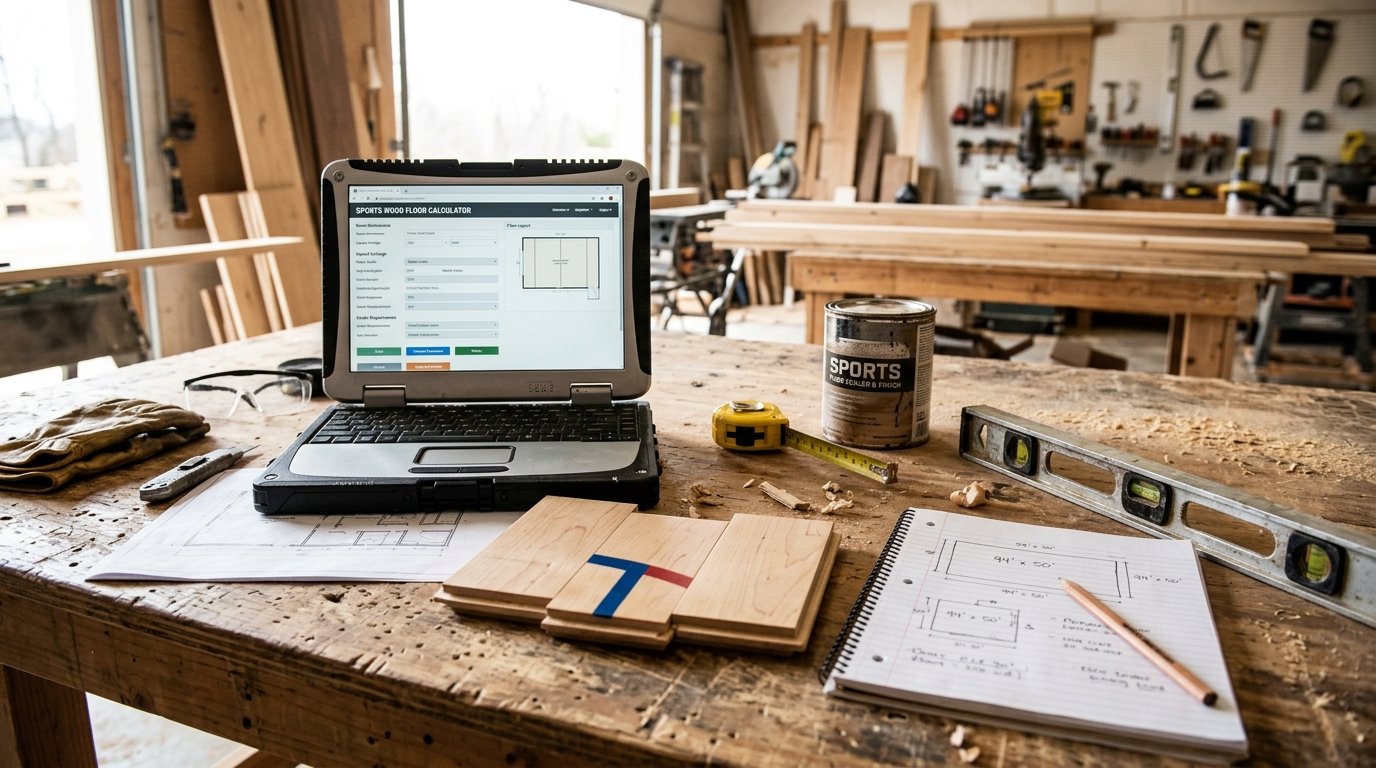
Sports Wood Floor Calculator: Maple, Subfloor & Line Marking Costs
A sports wood floor is a completely different animal from a domestic wooden floor. It is engineered for shock absorption, ball bounce, and consistent traction. It sits on a sprung or batten subfloor system that dissipates impact energy. It uses dense hard maple — the traditional maple strip — because it resists indentation and provides a true ball rebound. It is sealed with multiple coats of water-based polyurethane, and marked with lines for one or more court layouts. Getting the specification and quantities wrong is not just an aesthetic problem — it is a safety and compliance problem, governed by standards such as EN 14904 for indoor sports surfaces.
Our Sports Wood Floor Calculator is a free online tool that estimates the materials and costs of a sports wood floor installation. It calculates total area with run-off margin, subfloor system cost with correct labour multiplier, maple wood cost scaled by wear layer thickness, sealer cost by coat count (or skipped for pre-finished floors), line marking, wood mass in kg and tonnes, delivery, VAT and total installed cost per m². It also flags direct-on-slab installations and insufficient run-off margins — two of the most common design errors on sports floors.
In this guide, we will show you how to use the calculator, explain each input and output, walk through four examples across subfloor systems, and answer eight of the most frequently asked questions about sports wood floors.
Sports Wood Floor
Construction CalculatorSports wood floor: subfloor, maple strip, sealer, line marking, mass and cost.
What is the Sports Wood Floor Calculator?
The Sports Wood Floor Calculator is a free online tool that estimates the quantity and cost of materials for a sports wood floor installation. It supports:
- Court dimensions: length × width, plus run-off margin.
- Subfloor systems: batten on sleeper, sprung floating floor, plywood over concrete, direct on slab.
- Wood species: maple, oak, beech, ash, bamboo — each with a different density and price.
- Wear layer thickness: typically 20–22 mm for maple sports floors.
- Finish type: sealed, oiled, UV-cured, or pre-finished.
- Sealer coats: number of on-site coats (skipped for pre-finished).
- Line marking: painted or taped lines, as a fixed per-court cost.
- Pricing: subfloor per m², wood per m², sealer per m² per coat, line marking fixed, labour per m², delivery, VAT.
The output includes:
- Court area and total area with run-off
- Wear-layer factor (relative to 22 mm reference)
- Wood mass in kg and tonnes
- Design check warning (direct on slab, insufficient run-off)
- Itemised costs: subfloor, wood, finish, line marking, labour, delivery
- Finish note (for pre-finished floors)
- VAT, grand total and cost per m²
The tool is part of a suite of flooring calculators available on our website. For related calculations, you can use our Epoxy Resin Floor Calculator, Raised Access Floor Calculator, Bamboo Flooring Calculator, and Liquid Floor Screed Calculator.
Why Accurate Sports Wood Floor Estimation Matters
A sports wood floor is a long-term investment — 20 to 30 years of service if specified and installed correctly. It is also one of the most expensive flooring systems per m², and the consequences of getting it wrong are more serious than on a domestic floor.
Shock Absorption and Compliance
EN 14904 (and similar national standards) sets minimum shock absorption, vertical deformation and ball rebound requirements for indoor sports floors. A direct-on-slab wood floor with no sprung subfloor will not meet these requirements — it is a compliance failure, not just a comfort issue. The calculator flags direct-on-slab installations, and it flags run-off margins below 2 m.
Subfloor Drives Labour
A sprung floating floor takes significantly more time to install than a direct-on-slab floor. The subfloor system includes battens, sleepers, rubber pads, and multiple layers of plywood or chipboard. The labour multiplier applied by the calculator is 1.30 for sprung, 1.20 for batten, 1.10 for ply, and 1.00 for direct — this reflects the actual difference in installation time, not a marketing preference.
Wood Mass Matters for Structure
A sports wood floor is heavy. A 28 × 15 m court plus run-off is around 500 m². With 22 mm of maple at 750 kg/m³, that is over 8 tonnes of wood alone. Add subfloor, sealer and line marking and the total is closer to 10 tonnes. On upper floors or in lightweight construction, this mass must be verified against the structural design.
Pre-Finished Is Not Free
A pre-finished sports floor arrives already sealed at the factory. That means the on-site sealer line item should be zero — you cannot apply 3 coats of polyurethane to a floor that is already finished. The calculator automatically skips the finish cost when pre-finished is selected, and it produces a note if you have entered coats anyway.
Line Marking Is a Court-Level Cost
Line marking is usually quoted per court, not per m². A single court might cost $500–$1,500 to mark up, depending on the number of lines, colours, and whether tape or paint is used. Multi-court halls may need multiple markings layered on top of each other. The calculator includes line marking as a fixed cost per court.
Run-Off Margin
The run-off margin is the safety zone around the court — the space players use to slow down without hitting a wall. It is not optional, and it is not aesthetic. Under EN 14904, sports halls must provide a minimum run-off margin (typically 2 m, sometimes more for competition courts). If the margin is below 2 m, the calculator warns — this is a compliance issue, not just a design preference.
Cost Per m²
Sports wood floors range from $150/m² for basic sprung systems to $350+/m² for competition courts with high-spec maple and UV-cured finish. The calculator outputs cost per m² so you can benchmark your quote against industry rates.
For more information on sports floor standards, you can refer to Wikipedia’s article on hardwood flooring or the European Standards on sports surfaces (EN 14904).
How to Use the Sports Wood Floor Calculator
Using the calculator is straightforward. Here is a breakdown of each field.
1. Court
- Court length / width: The playing area dimensions, in meters or feet. 28 × 15 m is the standard basketball court.
- Run-off margin: The safety zone around the court. 2 m is the minimum for most indoor sports; more for competition.
2. Subfloor
- Subfloor system: Batten on sleeper, sprung floating floor, plywood over concrete, or direct on slab. The choice determines the labour multiplier and the physical performance of the floor.
- Batten on sleeper: timber battens on timber sleepers, with rubber pads under the sleepers — the classic sports floor system.
- Sprung floating floor: a pre-engineered floating system with steel springs or rubber pads — the highest performance and highest cost.
- Plywood over concrete: a plywood subfloor directly over concrete, with a thin foam layer — used in smaller gyms and multi-purpose halls.
- Direct on slab: no subfloor system; not recommended for sports floors.
3. Wood
- Wood species: maple, oak, beech, ash, or bamboo. Maple is the traditional sports floor choice. Density varies from 700 to 750 kg/m³.
- Wear layer thickness: typically 20–22 mm for maple sports floors. The cost is scaled by the ratio of actual thickness to 22 mm.
4. Finish
- Finish type: sealed, oiled, UV-cured, or pre-finished. Pre-finished floors arrive sealed and should not have an on-site sealer line.
- Sealer coats: number of on-site coats. Typically 3 for water-based polyurethane.
5. Marking
- Line marking: yes or no. If yes, the total per-court cost is added.
6. Pricing
Enter local prices for each component. Leave 0 to skip.
7. Extras
- Delivery / skip: fixed cost for delivery and waste removal.
- VAT / tax rate: applicable rate, or 0 if not applicable.
Once you enter all values, the calculator displays the full output, including court area, area with run-off, wear-layer factor, wood mass, design check, itemised costs, VAT, total and cost per m².
Understanding the Calculations
To make the most of the calculator, it is important to understand each output and the underlying formulas.
Court and Total Area
court_area = length × width.
area = (length + 2 × margin) × (width + 2 × margin).
For 28 × 15 with 2 m margin: court = 420 m²; total = 32 × 19 = 608 m².
Wear-Layer Factor
thick_k = wood_thickness / 0.022.
For 20 mm maple: 20/22 = 0.909. For 22 mm: 1.000.
The factor scales the wood cost — a thinner wear layer costs less material, a thicker one costs more.
Wood Mass
mass_kg = area × wood_thickness × density.
Densities:
- Maple: 750 kg/m³
- Oak: 720 kg/m³
- Beech: 720 kg/m³
- Ash: 700 kg/m³
- Bamboo: 700 kg/m³
For 608 m² of 22 mm maple: 608 × 0.022 × 750 = 10,032 kg (10 t).
Subfloor Cost
subfloor_cost = area × subfloor price per m².
Wood Cost
wood_cost = area × wood price per m² × thick_k.
Finish Cost
Pre-finished → 0.
Otherwise → area × finish price per m² × coats.
Line Marking
Fixed per-court cost from the user input.
Labour
labour_cost = area × labour rate × subfloor multiplier.
Subfloor multipliers:
- Batten: 1.20
- Sprung: 1.30
- Ply: 1.10
- Direct: 1.00
Design Check
The calculator performs two checks:
- Direct on slab: warns that direct-on-slab floors are not compliant with EN 14904 for gyms.
- Run-off margin < 2 m: warns that the safety zone is below the standard minimum.
VAT and Total
VAT = subtotal × VAT / 100.
Total = subtotal + VAT.
Cost per m² = total / area.
Understanding these components helps you interpret the results and adjust your order. For more information on sports floor standards, you can refer to Wikipedia’s article on hardwood flooring or European Standards on sports surfaces (EN 14904).
Reference Table of Wood Densities
| Species | Density (kg/m³) | Typical use |
|---|---|---|
| Maple | 750 | Standard sports floors |
| Oak | 720 | Alternative to maple |
| Beech | 720 | European sports floors |
| Ash | 700 | Lighter alternative |
| Bamboo | 700 | Eco-friendly alternative |
Example Calculations
Let’s run through four examples across subfloor systems.
Example 1: Standard Basketball Court, 28 × 15 m, Sprung Subfloor
Inputs:
- Court: 28 × 15 m, margin 2 m → 608 m²
- Subfloor: Sprung at $70/m²
- Wood: Maple, 22 mm at $85/m²
- Finish: Sealed, 3 coats at $4/m²/coat
- Line marking: $900
- Labour: $30/m²
- Delivery: $400
- VAT: 20%
Calculations:
- Court area = 420 m²; total = 608 m²
- Wear-layer factor = 22/22 = 1.00
- Wood mass = 608 × 0.022 × 750 = 10,032 kg (10.03 t)
- Subfloor = 608 × $70 = $42,560
- Wood = 608 × $85 × 1.00 = $51,680
- Finish = 608 × $4 × 3 = $7,296
- Line marking = $900
- Labour = 608 × $30 × 1.30 = $23,712
- Delivery = $400
- Subtotal = $126,548
- VAT = $25,309.60
- Total = $151,857.60
- Cost per m² = $249.77
- Design: OK
Example 2: Small Gym, 20 × 12 m, Plywood Subfloor
Inputs:
- Court: 20 × 12 m, margin 2 m → 24 × 16 = 384 m²
- Subfloor: Ply over concrete at $35/m²
- Wood: Maple, 20 mm at $75/m²
- Finish: UV-cured, 2 coats at $6/m²/coat
- Line marking: $600
- Labour: $28/m²
- Delivery: $300
- VAT: 20%
Calculations:
- Court = 240 m²; total = 384 m²
- Wear-layer factor = 20/22 = 0.909
- Wood mass = 384 × 0.020 × 750 = 5,760 kg (5.76 t)
- Subfloor = 384 × $35 = $13,440
- Wood = 384 × $75 × 0.909 = $26,179.20
- Finish = 384 × $6 × 2 = $4,608
- Line marking = $600
- Labour = 384 × $28 × 1.10 = $11,827.20
- Delivery = $300
- Subtotal = $56,954.40
- VAT = $11,390.88
- Total = $68,345.28
- Cost per m² = $177.98
- Design: OK
Example 3: Direct-on-Slab Multi-Use Hall — Warn
Inputs:
- Court: 24 × 12 m, margin 1.5 m → 27 × 15 = 405 m²
- Subfloor: Direct at $10/m²
- Wood: Maple, 20 mm at $75/m²
- Finish: Sealed, 3 coats at $4/m²/coat
- Line marking: $500
- Labour: $25/m²
- VAT: 20%
Calculations:
- Design warning: “Direct on slab — no shock absorption, not compliant with EN 14904 for gyms; Run-off < 2 m — safety margin may be non-compliant”
The user sees two clear design problems before the floor is even ordered. The cost will still calculate — the point is to warn, not to block.
Example 4: Pre-Finished Portable Court — Finish Cost Zeroed
Inputs:
- Court: 28 × 15 m, margin 2 m
- Subfloor: Sprung at $70/m²
- Wood: Maple, 22 mm pre-finished at $110/m²
- Finish: Pre-finished
- Coats: 3 (but ignored)
- Line marking: $900
- Labour: $30/m²
- VAT: 20%
Calculations:
- Finish cost = $0 (pre-finished)
- Note: “Pre-finished — on-site sealer cost skipped (coats ignored)”
- Subfloor and wood still apply, plus labour, line marking, VAT
The calculator correctly handles the pre-finished case — the user is not double-charged for on-site sealer that will never be applied.
Benefits of Using the Sports Wood Floor Calculator
Tips for Accurate Sports Wood Floor Estimation
- Choose the correct subfloor system. Sprung for competition courts, ply for multi-use, direct is not recommended for gyms.
- Confirm the run-off margin. 2 m minimum; 3–4 m for competition.
- Read the wood datasheet. Wear-layer thickness affects both cost and longevity.
- Check the wood density. Maple is standard; oak, beech, ash, and bamboo are alternatives with different properties.
- Decide finish early. Pre-finished eliminates on-site sealer; UV-cured is faster than sealed.
- Count sealer coats carefully. Typically 3 coats for water-based; some systems need 4.
- Plan line marking. Fixed per-court cost; multi-court halls need multiple layouts.
- Check the mass on upper floors. 10+ tonnes for a full court — structural verification is essential.
- Do not skip delivery. Wood and subfloor materials are heavy and bulky.
- Verify compliance. EN 14904 (or national equivalents) applies to competition courts — check locally.
- Get multiple quotes. Sports floor specialists vary significantly in price.
- Verify with a professional. For competition or commercial sports floors, have a specialist contractor verify the design.
For more information on sports floor standards, you can refer to the European Standards on sports surfaces (EN 14904) or Wikipedia’s article on hardwood flooring.
Common Mistakes to Avoid
- Direct on slab for a gym. No shock absorption; non-compliant with EN 14904.
- Run-off margin below 2 m. Safety hazard; non-compliant.
- Using 20 mm reference for wear-layer factor. The correct standard is 22 mm.
- Applying on-site sealer to a pre-finished floor. Waste of material and money.
- Forgetting line marking. Fixed per-court cost that must appear in the budget.
- Ignoring wood mass. 10+ tonnes for a full court — structural checks are essential.
- Using the wrong subfloor labour multiplier. Sprung takes 30% longer than direct.
- No delivery or VAT. Both significantly change the total bill.
- Skipping compliance checks. Sports floors are regulated — non-compliance is a liability.
- Not verifying with a professional. For competition courts, specialist verification is essential.
Frequently Asked Questions (FAQ)
Conclusion
The Sports Wood Floor Calculator is an essential tool for contractors, specifiers, schools, and sports facility managers. It estimates subfloor, maple strip, sealer, line marking, wood mass, delivery, VAT and total installed cost per m² — with subfloor-specific labour multipliers, wood-species density, wear-layer scaling, pre-finished handling, and design warnings for direct-on-slab and insufficient run-off.
Whether you are building a small school gym or a full competition court, accurate estimation of sports wood floor materials is the foundation of a safe, compliant, and durable installation. Try the Sports Wood Floor Calculator today and take the guesswork out of your sports floor project.



3 Comments