Sports Court Flooring Calculator: Surface, Underlay & Line Marking
A sports court floor is not a gym floor with lines on it. It is an engineered system — a surface, an underlay, a substrate, and a set of markings — that must all work together to deliver shock absorption, ball rebound, traction, and durability. The wrong surface for the wrong environment fails quickly. A wood floor laid outdoors warps within a season. An acrylic court laid indoors never cures properly. Vinyl on a damp subfloor blisters. And a court with no lines is not a court — it is just a floor.
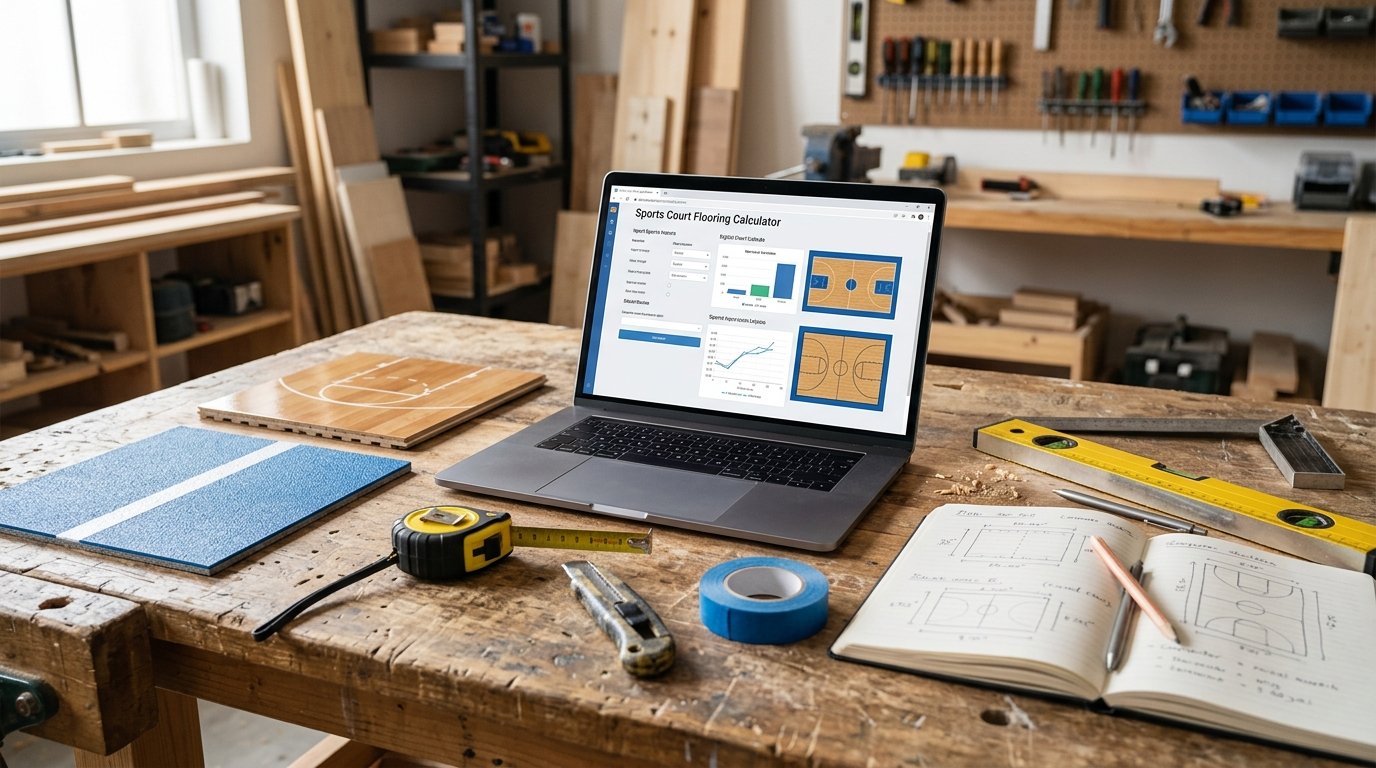
Our Sports Court Flooring Calculator is a free online tool that estimates the materials and costs of a sports court flooring installation. It calculates the court area and total area with run-off, surface system cost, underlay cost, line marking with sport-specific complexity, labour with surface-specific multipliers, delivery, VAT and cost per m². It also flags five design errors — wrong surface for indoor/outdoor, wrong underlay for the surface, insufficient safety margin, and missing line marking — before the floor is ordered.
In this guide, we will show you how to use the calculator, explain each input and output, walk through four examples across surface types and sports, and answer eight of the most frequently asked questions about sports court flooring.
Sports Court Flooring
Construction CalculatorSports court flooring: surface area, layers, line marking, design warnings and total cost.
What is the Sports Court Flooring Calculator?
The Sports Court Flooring Calculator is a free online tool that estimates the quantity and cost of materials for a sports court floor installation. It supports:
- Court dimensions: length × width plus run-off margin.
- Sport: basketball, tennis, badminton, multi-sport, or futsal — affects line-marking complexity.
- Surface systems: vinyl (indoor), polyurethane (indoor/outdoor), acrylic (outdoor), epoxy (indoor), wood (indoor, sprung).
- Environment: indoor or outdoor — used to validate the surface.
- Underlay: none, foam/rubber, or sprung wooden subfloor.
- Line marking: on or off.
- Pricing: surface per m², underlay per m², line marking fixed, labour per m², delivery, VAT.
The output includes:
- Court area and total area with margin
- Design check warning
- Itemised costs: surface, underlay, line marking, labour, delivery
- VAT, grand total and cost per m²
The tool is part of a suite of flooring calculators available on our website. For related calculations, you can use our Sports Wood Floor Calculator, Rubber Gym Flooring Calculator, Raised Access Floor Calculator, and Epoxy Resin Floor Calculator.
Why Accurate Sports Court Flooring Estimation Matters
A sports court is a significant investment — a full indoor basketball court is typically $80,000–$250,000 depending on surface, underlay, and marking. That is a lot of money to spend without knowing whether the specification is even compatible with the environment.
Surface and Environment Must Match
Every sports surface system is designed for a specific environment. Vinyl and epoxy are indoor-only. Acrylic is outdoor-only. Polyurethane can be indoor or outdoor. Wood is indoor-only (and requires a sprung underlay). Using the wrong surface in the wrong environment causes premature failure — acrylic laid indoors never fully cures, wood laid outdoors warps within a season, vinyl laid outdoors blisters. The calculator warns when the surface and environment are mismatched.
Underlay Must Match the Surface
Not every surface uses underlay. Vinyl typically goes on foam or rubber underlay. Wood requires a sprung subfloor. Acrylic goes directly on the slab. Epoxy goes directly on the slab. Polyurethane can be applied directly or on a foam underlay. The calculator flags mismatches — wood without sprung underlay, acrylic with underlay, and so on.
Safety Margin Is Not Optional
Sports courts need a run-off margin around the playing area — the space players use to slow down without hitting a wall. EN 14904 recommends at least 2 m on all sides; competition courts may need more. A margin below 2 m is a safety issue, and the calculator warns.
Line Marking Is Part of the Court
Every sports court needs lines — otherwise it is just a floor. Multi-sport courts need overlapping lines for multiple games, which adds complexity and cost. The calculator applies a sport-specific line-marking multiplier, and it warns when line marking is turned off for a sport that requires it.
Labour Varies by Surface
Wood sports floors take 1.8× the labour of vinyl. Epoxy takes 1.15×. Acrylic takes 1.05×. These multipliers reflect the actual time differences on site — wood is slow because of the sprung subfloor, the strips, the sanding, and the multiple sealer coats. Epoxy is slow because of the substrate prep and multi-coat application. The calculator applies these multipliers so the labour cost reflects the surface.
Cost Per m²
Sports court flooring ranges from $50/m² for basic vinyl on foam to $300+/m² for high-spec sprung wood. The calculator outputs cost per m² so you can benchmark against industry rates and compare quotes.
For more information on sports flooring standards, you can refer to Wikipedia’s article on sports flooring or the European Standards on sports surfaces (EN 14904).
How to Use the Sports Court Flooring Calculator
Using the calculator is straightforward. Here is a breakdown of each field.
1. Court
- Court length / width: The playing area dimensions, in meters or feet. 28 × 15 m is standard basketball.
- Safety margin: The run-off margin around the court. 2 m is the minimum.
2. Sport
- Sport: Basketball, tennis, badminton, multi-sport, or futsal. Multi-sport courts have more complex line markings and a higher line cost multiplier.
3. Surface
- Surface system: Vinyl, polyurethane, acrylic, epoxy, or wood. Each has its own properties and installation requirements.
- Environment: Indoor or outdoor. Used to validate the surface.
4. Underlay
- Underlay: None, foam/rubber, or sprung. Sprung is required for wood surfaces; acrylic goes directly on slab.
5. Marking
- Line marking: On or off. Most sports courts require lines.
6. Pricing
Enter local prices for each component. Leave 0 to skip.
7. Extras
- Delivery / skip: Fixed cost for delivery and waste removal.
- VAT / tax rate: Applicable rate, or 0 if not applicable.
Once you enter all values, the calculator displays the full output, including court area, total area with margin, design check, itemised costs, VAT, total and cost per m².
Understanding the Calculations
To make the most of the calculator, it is important to understand each output and the underlying formulas.
Court Area and Total Area
court_area = length × width.
total_area = (length + 2 × margin) × (width + 2 × margin).
For 28 × 15 m with 2 m margin:
- court = 420 m²
- total = 32 × 19 = 608 m²
Surface Cost
surface_cost = total_area × surface price per m².
Underlay Cost
underlay_cost = (underlay != none) ? (total_area × underlay price) : 0.
Line Marking
line_cost_final = (lines == yes) ? (base cost × sport multiplier) : 0.
Sport multipliers:
- Basketball: 1.00
- Tennis: 1.00
- Badminton: 1.05
- Multi-sport: 1.30
- Futsal: 1.05
Multi-sport courts have overlapping lines from multiple games, so they cost 30% more.
Labour
labour_cost = total_area × labour rate × surface multiplier.
Surface multipliers:
- Vinyl: 1.00
- PU: 1.10
- Acrylic: 1.05
- Epoxy: 1.15
- Wood: 1.80
Wood is nearly twice as slow because of the sprung subfloor, strip layout, sanding, and 3+ sealer coats.
Design Check
The calculator performs five checks:
- Acrylic indoors, wood outdoors, vinyl outdoors, or epoxy outdoors — surface/environment mismatch.
- Wood without sprung underlay.
- Acrylic with any underlay.
- Margin below 2 m.
- No line marking for a sport that requires lines.
VAT and Total
VAT = subtotal × VAT / 100.
Total = subtotal + VAT.
Cost per m² = total / total_area.
Understanding these components helps you interpret the results and adjust your order. For more information on sports flooring standards, you can refer to the European Standards on sports surfaces (EN 14904) or Wikipedia’s article on sports flooring.
Reference Table of Surface Systems
| Surface | Environment | Typical thickness | Underlay | Labour factor |
|---|---|---|---|---|
| Vinyl | Indoor | 6–8 mm | Foam/rubber | 1.00 |
| PU | Indoor / outdoor | 3–5 mm | Foam or none | 1.10 |
| Acrylic | Outdoor | 2–3 mm | None | 1.05 |
| Epoxy | Indoor | 2–4 mm | None | 1.15 |
| Wood | Indoor | 20–22 mm | Sprung (required) | 1.80 |
Example Calculations
Let’s run through four examples across surface systems and sports.
Example 1: Indoor Basketball Court, 28 × 15 m, Vinyl on Foam
Inputs:
- Court: 28 × 15 m, margin 2 m
- Sport: Basketball
- Surface: Vinyl, indoor
- Underlay: Foam
- Lines: Yes
- Prices: surface $65/m², underlay $10/m², line cost $800, labour $25/m²
- Delivery: $400
- VAT: 20%
Calculations:
- Court = 420 m²; total = 608 m²
- Surface = 608 × $65 = $39,520
- Underlay = 608 × $10 = $6,080
- Lines = $800 × 1.00 = $800
- Labour = 608 × $25 × 1.00 = $15,200
- Delivery = $400
- Subtotal = $62,000
- VAT = $12,400
- Total = $74,400
- Cost per m² = $122.37
- Design: OK
Example 2: Outdoor Tennis Court, 23.77 × 10.97 m, Acrylic
Inputs:
- Court: 23.77 × 10.97 m, margin 2 m
- Sport: Tennis
- Surface: Acrylic, outdoor
- Underlay: None
- Lines: Yes
- Prices: surface $45/m², line cost $500, labour $18/m²
- Delivery: $300
- VAT: 20%
Calculations:
- Court = 260.77 m²; total = 27.77 × 14.97 = 415.5 m²
- Surface = 415.5 × $45 = $18,697.50
- Underlay = $0
- Lines = $500 × 1.00 = $500
- Labour = 415.5 × $18 × 1.05 = $7,852.95
- Delivery = $300
- Subtotal = $27,350.45
- VAT = $5,470.09
- Total = $32,820.54
- Cost per m² = $78.99
- Design: OK
Example 3: Indoor Multi-Sport Hall, 28 × 15 m, Wood Sprung
Inputs:
- Court: 28 × 15 m, margin 2 m
- Sport: Multi
- Surface: Wood, indoor
- Underlay: Sprung
- Lines: Yes
- Prices: surface $150/m², underlay $70/m², line cost $1,500, labour $30/m²
- Delivery: $500
- VAT: 20%
Calculations:
- Court = 420 m²; total = 608 m²
- Surface = 608 × $150 = $91,200
- Underlay = 608 × $70 = $42,560
- Lines = $1,500 × 1.30 = $1,950
- Labour = 608 × $30 × 1.80 = $32,832
- Delivery = $500
- Subtotal = $169,042
- VAT = $33,808.40
- Total = $202,850.40
- Cost per m² = $333.63
- Design: OK
Example 4: Acrylic Indoors — Warning
Same as Example 2 but environment set to “indoor”:
- Design warning: “Acrylic is outdoor only — not suitable for indoor courts”
- Cost calculates, but user knows the design will fail.
The calculator catches a design error that would otherwise cost tens of thousands in remedial work.
Benefits of Using the Sports Court Flooring Calculator
Tips for Accurate Sports Court Flooring Estimation
- Match the surface to the environment. Acrylic outdoor, wood indoor, vinyl indoor, PU anywhere, epoxy indoor.
- Match the underlay to the surface. Wood needs sprung; acrylic needs none; vinyl usually on foam.
- Respect the margin. At least 2 m for safety; more for competition courts.
- Plan line marking early. Multi-sport courts need overlapping lines — more cost and more complexity.
- Check the surface thickness against EN 14904. Indoor courts need at least 6 mm; wood needs 20–22 mm.
- Confirm the substrate. All surfaces need a flat, dry, prepared substrate.
- Allow for acclimatisation. Vinyl and wood need 48 hours in the room before installation.
- Plan for delivery. Surfaces arrive on pallets or in rolls — check access.
- Do not forget VAT. 20% VAT significantly changes the total bill.
- Get multiple quotes. Sports floor specialists vary significantly in price.
- Verify compliance. EN 14904 applies to indoor sports surfaces — check locally.
- Consider maintenance. Vinyl and epoxy need periodic cleaning and re-coating; wood needs sanding and re-sealing every 10–15 years.
For more information on sports flooring standards, you can refer to the European Standards on sports surfaces (EN 14904) or Wikipedia’s article on sports flooring.
Common Mistakes to Avoid
- Acrylic indoors. Never cures properly.
- Wood outdoors. Warps and rots within a season.
- Vinyl outdoors. Blisters under UV and moisture.
- Wood without sprung underlay. Wood sports floors require a sprung subfloor — no exceptions.
- Acrylic with underlay. Acrylic is applied directly to slab.
- Margin below 2 m. Safety hazard; non-compliant with EN 14904.
- No line marking. A court without lines is not a court.
- Underestimating labour on wood. Wood is nearly twice the labour of vinyl.
- No delivery or VAT. Both significantly change the total bill.
- Choosing by price alone. Cheap surfaces fail faster and cost more long-term.
How to Reduce Sports Court Flooring Costs
If your estimate is higher than expected, here are ways to reduce costs without compromising safety:
- Choose vinyl over wood for indoor courts. Vinyl is 50–60% cheaper and 45% faster to install.
- Choose acrylic over PU for outdoor courts. Acrylic is cheaper and adequate for most tennis and multi-use outdoor courts.
- Use a smaller margin where regulations allow. 2 m is the minimum; some sports allow less for practice courts.
- Skip the multi-sport line marking if only one sport is played. Saves 30%.
- Do the substrate prep yourself. Cleaning and priming are simple.
- Compare suppliers. Sports surfaces vary 20–30% between brands.
- Time the project off-season. Contractors sometimes offer better rates.
- Get multiple quotes. Compare at least three specialists.
- Consider refurbishment instead of replacement. Existing surfaces can be re-coated.
- Verify VAT treatment. Some public sports facilities may have different rules.
Frequently Asked Questions (FAQ)
Conclusion
The Sports Court Flooring Calculator is an essential tool for facility managers, contractors, and specifiers. It estimates court area, total area with margin, surface cost, underlay cost, line marking with sport-specific complexity, labour with surface multipliers, delivery, VAT and cost per m² — with design warnings that catch the most common errors before the floor is ordered.
The corrected calculator now reads the surface type, applies surface-specific labour multipliers, validates indoor/outdoor compatibility, checks underlay-surface combinations, and warns on insufficient margin or missing line marking. Whether you are building a school gym, a tennis club, or a full multi-sport hall, accurate estimation of sports court flooring materials is the foundation of a safe, compliant, and durable installation. Try the Sports Court Flooring Calculator today and take the guesswork out of your sports court project.