
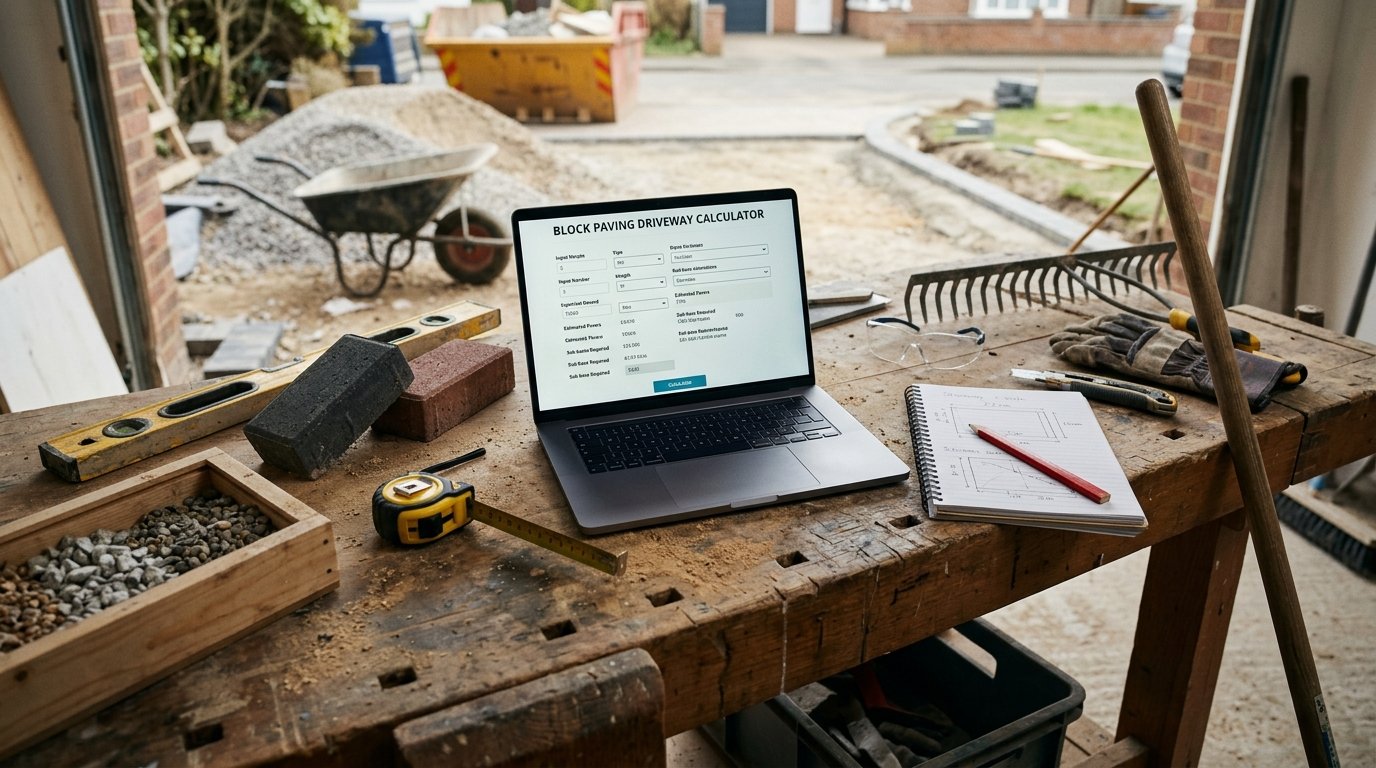
Block Paving Driveway Calculator: Pavers, Sub-Base & Cost
A block paved driveway is one of those improvements that transforms a property. It adds kerb appeal, provides a durable and level parking surface, and — if specified and installed correctly — will last 25–40 years with only routine maintenance. But block paving is also a layered system, and every layer matters. The pavers sit on a bed of sharp sand, which sits on a compacted sub-base, which sits on the sub-grade soil. Get any of those layers wrong and the driveway will deflect, settle, or fail within a few years — long before the pavers themselves wear out.
Our Block Paving Driveway Calculator takes the guesswork out of driveway design. It estimates paver count, sub-base order volume and mass in tonnes, bedding sand volume, jointing material, geotextile membrane, edge restraints, drainage, labour, delivery, VAT and total installed cost. It also checks the sub-base depth against the recommended depth for the selected traffic class — because a 150 mm sub-base that works for a family car will fail under a delivery van.
In this guide, we will show you how to use the calculator, explain each input and output, walk through six real-world examples across domestic and commercial applications, and answer eight of the most frequently asked questions about block paving driveways.
Block Paving Driveway
Construction CalculatorBlock paving driveway: pavers, sub-base, bedding sand, jointing, drainage and cost.
What is the Block Paving Driveway Calculator?
The Block Paving Driveway Calculator is a free online tool that estimates the materials and costs of a block paved driveway. It supports:
- Paver types: concrete block paving, natural stone, porcelain, clay brick, and grass/permeable.
- Paver sizes: 200 × 100 mm, 200 × 200 mm, 240 × 80 mm, and custom.
- Traffic classes: car/SUV, occasional van, regular HGV — with automatic depth check.
- Sub-base: MOT Type 1 or Type 3, with user-defined depth and compaction allowance.
- Bedding sand: with user-defined depth and compaction allowance.
- Jointing: kiln-dried sand, polymeric sand, resin, mortar, or none.
- Geotextile membrane: recommended as standard.
- Drainage: Aco/channel drain or permeable construction.
- Edge restraints: optional perimeter edging.
- Pricing: paver price per m², sub-base per m³, sand per m³, joint per m², geotextile per m², edge per metre, drainage per metre, labour per m², delivery, VAT.
The output includes:
- Driveway area, area with waste, perimeter
- Pavers per m² and total paver count
- Sub-base order volume (with compaction) and mass in tonnes
- Depth check against traffic class recommendation
- Bedding sand order volume and mass in tonnes
- Geotextile area (with 10% overlap)
- Itemised costs: pavers, sub-base, bedding, jointing, geotextile, edge, drainage, labour, delivery
- VAT and grand total
The tool is part of a suite of materials and quantities calculators available on our website. For related calculations, you can use our Grass / Gravel Pavers Calculator, Permeable Pavers Calculator, Paving Patio Calculator, and Garden Patio Pavers Calculator.
Why Accurate Block Paving Estimation Matters
Block paving is one of the most expensive hard landscaping materials per square metre. A 24 m² driveway with good quality pavers, proper sub-base, and professional installation can easily cost $3,000–$8,000. Small estimation errors become large financial ones — and the consequences are not just financial.
Load-Bearing Capacity
The sub-base carries the traffic load. A car weighs around 1.5–2 tonnes distributed over four wheels; a delivery van can weigh 3.5 tonnes; an HGV can weigh 7.5–44 tonnes. A driveway designed for cars will not support a delivery lorry without a thicker sub-base. The calculator flags when the entered depth is below the recommendation for the selected traffic class.
Drainage and Water Management
Block paving — especially permeable construction — is an important part of Sustainable Urban Drainage (SUDS). The sub-base acts as a storage reservoir for rainwater, releasing it slowly into the ground or drainage system. If the sub-base is the wrong type (Type 1 is denser than Type 3), drainage is restricted; if the geotextile is missing, fines clog the sub-base and water cannot drain.
Long-Term Performance
The geotextile membrane is one of the cheapest parts of the driveway — and one of the most important. It prevents fines from the sub-grade soil migrating upward into the sub-base, which would reduce strength and drainage capacity over time. Without it, the driveway will fail prematurely — often in under 5 years instead of 25.
Settlement and Edging
Edge restraints are essential. Block paving is a flexible surface — without proper edging, the paver field spreads under load, joints open up, and the driveway settles. The calculator adds edge restraint cost when the length is entered.
Cost Accuracy
For a typical 24 m² driveway, the sub-base alone weighs over 8 tonnes and costs $400–$800. Bedding sand, pavers, jointing and labour add significantly more. Getting any line item wrong by 20% is a three-figure error. The calculator gives you both volume and mass — so you can price from whichever your supplier uses.
Compliance and Resale Value
Many jurisdictions require permeable paving or SUDS compliance for new driveways above a certain area. A correctly specified driveway supports planning permission and adds resale value. An incorrectly installed one may fail building control.
For more information on block paving, you can refer to Wikipedia’s article on paving or the Interpave guidance.
How to Use the Block Paving Driveway Calculator
Using the calculator is straightforward. Here is a breakdown of each field.
1. Dimensions
- Driveway length: Enter the length in meters or feet.
- Driveway width: Enter the width in meters or feet.
- Waste allowance: Enter a percentage for waste. 10% is typical; complex shapes and multiple access points may require 15%.
2. Paver
- Paver type: Select concrete block, natural stone, porcelain, clay brick, or grass/permeable. This affects labour difficulty — natural stone and porcelain are harder to lay than concrete blocks.
- Paver size: Select 200 × 100 mm, 200 × 200 mm, 240 × 80 mm, or custom.
- Custom width/length: Used only when “Custom size” is selected.
3. Traffic
- Traffic class: Select car/SUV, occasional van, or regular HGV. The calculator uses this to check the sub-base depth against the recommended minimum (150, 200, 250 mm respectively).
4. Sub-base
- Sub-base depth: Enter the installed depth in meters or inches. 150 mm for cars, 200 mm for vans, 250 mm for HGVs.
- Sub-base compaction: Enter a percentage for compaction. 10–15% is typical.
- Sub-base material: MOT Type 1 (crushed, 2.25 t/m³) or MOT Type 3 (open-graded, 2.10 t/m³). Type 1 for strength; Type 3 for permeability.
5. Bedding
- Bedding sand depth: Typically 30 mm. Do not exceed 40 mm — too much bedding reduces stability.
- Bedding compaction: Typically 10% for loose sand.
6. Jointing
- Jointing: Select kiln-dried sand, polymeric sand, resin, mortar, or none. Polymeric and resin jointing are more expensive but resist weed growth and washout better.
7. Geotextile
- Geotextile membrane: Recommended as standard. The calculator adds 10% overlap and multiplies by the price.
8. Edging
- Edge restraint length: Enter the total edge length. For a rectangular driveway, this is usually 2 × (length + width). Set to 0 if no edging.
9. Drainage
- Drainage: Select none, Aco/channel drain, or permeable construction.
- Aco/channel drain: Enter the drainage run length in meters. Used to compute cost.
- Permeable construction: Enter the extra cost per m² for permeable sub-base and jointing.
10. Pricing
Enter local prices for each component. Leave 0 to skip.
11. Tax
- VAT / tax rate: Enter the applicable rate, or 0 if not applicable.
Once you enter all values, the calculator displays the full output, including areas, paver count, sub-base and bedding volumes and masses, geotextile area, depth check, itemised costs, and total.
Understanding the Calculations
To make the most of the calculator, it is important to understand each output and the underlying formulas.
Pavers Per m²
Pavers per m² = 1 / (paver width × paver length).
Examples:
- 200 × 100 mm → 50 pcs/m²
- 200 × 200 mm → 25 pcs/m²
- 240 × 80 mm → 52.08 pcs/m²
Paver Count
Pavers = ceil(area with waste × pavers per m²).
Sub-base Volume and Mass
installed_vol = area × depth.
order_vol = installed_vol × (1 + compaction / 100).
mass = installed_vol × density.
Densities:
- MOT Type 1: 2.25 t/m³
- MOT Type 3: 2.10 t/m³
Depth Check
Recommended sub-base depth:
- Car / SUV: 150 mm
- Occasional van: 200 mm
- Regular HGV: 250 mm
If the entered depth is more than 5 mm below the recommendation, a warning is shown.
Bedding Sand
installed_vol = area × bed depth.
order_vol = installed_vol × (1 + compaction / 100).
mass = installed_vol × 1.60 t/m³ (damp sand).
Jointing
jointing cost = area × price per m².
Geotextile
geo_area = area × 1.10 (10% overlap for laps and edges).
Edging
edge cost = edge length × price per metre.
Drainage
- Aco/channel drain: cost = length × price per metre.
- Permeable construction: cost = area × extra price per m².
Labour
labour cost = area × labour rate × difficulty factor.
Difficulty factors:
- Concrete block: 1.00
- Natural stone: 1.30
- Porcelain: 1.35
- Clay brick: 1.15
- Grass/permeable: 0.75
VAT and Total
VAT = subtotal × VAT / 100.
Total = subtotal + VAT.
Understanding these components helps you interpret the results and adjust your order. For more information on block paving design, you can refer to Wikipedia’s article on paving or the Interpave guidance.
Reference Table of Common Paver Sizes
| Paver size | Pavers per m² | Typical use |
|---|---|---|
| 200 × 100 mm | 50.0 | Standard driveway block |
| 200 × 200 mm | 25.0 | Driveway, larger format |
| 240 × 80 mm | 52.08 | Clay brick pavers |
| Custom | Calculated | Bespoke |
Example Calculations
Let’s run through six examples across domestic and commercial applications.
Example 1: Small Car Driveway, 24 m², Concrete Block
Inputs:
- Length: 8 m, width: 3 m
- Waste: 10%
- Paver: Concrete block, 200 × 100 mm
- Traffic: Car
- Sub-base: Type 1, 150 mm, compaction 12%
- Bed: 30 mm, compaction 10%
- Jointing: Polymeric sand
- Geotextile: Yes
- Edging: 22 m
- Prices: paver $25/m², sub-base $55/m³, sand $60/m³, joint $6/m², geo $2/m², edge $10/m, labour $35/m², delivery $100, VAT 0%
Calculations:
- Area = 24 m²; waste 10% → 26.4 m²
- Perimeter = 22 m
- Pavers per m² = 50; pavers = ceil(26.4 × 50) = 1,320
- Paver cost = 26.4 × $25 = $660
- Sub-base installed = 24 × 0.15 = 3.6 m³
- Sub-base order = 3.6 × 1.12 = 4.032 m³
- Sub-base mass = 3.6 × 2.25 = 8.1 t
- Sub-base cost = 4.032 × $55 = $221.76
- Depth check: 150 mm vs 150 mm → OK
- Bedding installed = 24 × 0.03 = 0.72 m³
- Bedding order = 0.72 × 1.10 = 0.792 m³
- Bedding mass = 0.72 × 1.60 = 1.15 t
- Bedding cost = 0.792 × $60 = $47.52
- Joint cost = 24 × $6 = $144
- Geotextile = 26.4 × $2 = $52.80
- Edge = 22 × $10 = $220
- Labour = 24 × $35 × 1.00 = $840
- Delivery = $100
- Subtotal = $2,286.08
- Total (VAT 0%) = $2,286.08
Example 2: Large Driveway, 60 m², Porcelain Pavers
Inputs:
- Length: 12 m, width: 5 m
- Paver: Porcelain, 200 × 200 mm
- Traffic: Occasional van
- Sub-base: Type 1, 200 mm, compaction 15%
- Bed: 30 mm, compaction 10%
- Jointing: Resin
- Geotextile: Yes
- Edging: 34 m
- Prices: paver $45/m², sub-base $55/m³, sand $60/m³, joint $15/m², geo $2.50/m², edge $12/m, labour $45/m², delivery $150, VAT 20%
Calculations:
- Area = 60 m²; waste 10% → 66 m²
- Perimeter = 34 m
- Pavers per m² = 25; pavers = 1,650
- Paver cost = 66 × $45 = $2,970
- Sub-base installed = 60 × 0.20 = 12.0 m³
- Sub-base order = 12.0 × 1.15 = 13.80 m³
- Sub-base mass = 12.0 × 2.25 = 27.0 t
- Sub-base cost = 13.80 × $55 = $759
- Depth check: 200 mm vs 200 mm → OK
- Bedding installed = 60 × 0.03 = 1.80 m³
- Bedding order = 1.98 m³
- Bedding mass = 1.80 × 1.60 = 2.88 t
- Bedding cost = 1.98 × $60 = $118.80
- Joint = 60 × $15 = $900
- Geotextile = 66 × $2.50 = $165
- Edge = 34 × $12 = $408
- Labour = 60 × $45 × 1.35 = $3,645
- Delivery = $150
- Subtotal = $9,115.80
- VAT = $1,823.16
- Total = $10,938.96
Example 3: Commercial Yard, 150 m², HGV Traffic
Inputs:
- Length: 15 m, width: 10 m
- Paver: Concrete block, 200 × 100 mm
- Traffic: HGV
- Sub-base: Type 1, 250 mm, compaction 15%
- Bed: 30 mm, compaction 10%
- Jointing: Polymeric
- Geotextile: Yes
- Edging: 50 m
- Prices: paver $30/m², sub-base $60/m³, sand $65/m³, joint $7/m², geo $2.50/m², edge $15/m, labour $40/m², delivery $300, VAT 20%
Calculations:
- Area = 150 m²; waste 10% → 165 m²
- Pavers = 8,250
- Paver cost = $4,950
- Sub-base installed = 37.5 m³
- Sub-base order = 43.125 m³
- Sub-base mass = 84.375 t
- Sub-base cost = $2,587.50
- Depth check: 250 mm vs 250 mm → OK
- Bedding installed = 4.5 m³; order = 4.95 m³; cost = $321.75
- Joint = $1,050
- Geotextile = 165 × $2.50 = $412.50
- Edge = 50 × $15 = $750
- Labour = 150 × $40 × 1.00 = $6,000
- Delivery = $300
- Subtotal = $16,371.75
- VAT = $3,274.35
- Total = $19,646.10
Example 4: Long Narrow Side Access, 12 m², 200 × 200 mm
Inputs:
- Length: 8 m, width: 1.5 m
- Paver: Concrete block, 200 × 200 mm
- Traffic: Car
- Sub-base: Type 1, 150 mm, compaction 12%
- Bed: 30 mm, compaction 10%
- Jointing: Kiln-dried sand
- Geotextile: Yes
- Edging: 19 m
- Prices: paver $22/m², sub-base $55/m³, sand $55/m³, joint $4/m², geo $1.80/m², edge $10/m, labour $38/m², delivery $80, VAT 20%
Calculations:
- Area = 12 m²; waste 10% → 13.2 m²
- Pavers = 330
- Paver cost = 13.2 × $22 = $290.40
- Sub-base installed = 1.8 m³; order = 2.016 m³; cost = $110.88
- Depth OK
- Bedding installed = 0.36 m³; order = 0.396 m³; cost = $21.78
- Joint = 12 × $4 = $48
- Geotextile = 13.2 × $1.80 = $23.76
- Edge = 19 × $10 = $190
- Labour = 12 × $38 × 1.00 = $456
- Delivery = $80
- Subtotal = $1,220.82
- VAT = $244.16
- Total = $1,464.98
Example 5: Clay Brick Driveway with Drainage
Inputs:
- Length: 10 m, width: 4 m → 40 m²
- Paver: Clay brick, 240 × 80 mm
- Traffic: Van
- Sub-base: Type 3 (permeable), 200 mm, compaction 12%
- Bed: 30 mm, compaction 10%
- Jointing: Resin
- Geotextile: Yes
- Edging: 28 m
- Drainage: Aco channel, 8 m
- Prices: paver $32/m², sub-base $60/m³, sand $55/m³, joint $15/m², geo $2/m², edge $12/m, drain $65/m, labour $42/m², delivery $150, VAT 20%
Calculations:
- Area = 40 m²; waste 10% → 44 m²
- Pavers = ceil(44 × 52.08) = 2,292
- Paver cost = 44 × $32 = $1,408
- Sub-base installed = 8.0 m³; order = 8.96 m³; mass = 16.8 t; cost = $537.60
- Depth check: 200 mm vs 200 mm (van) → OK
- Bedding installed = 1.2 m³; order = 1.32 m³; cost = $72.60
- Joint = 40 × $15 = $600
- Geotextile = 44 × $2 = $88
- Edge = 28 × $12 = $336
- Drainage = 8 × $65 = $520
- Labour = 40 × $42 × 1.15 = $1,932
- Delivery = $150
- Subtotal = $5,644.20
- VAT = $1,128.84
- Total = $6,773.04
Example 6: Depth Warning Case
Same as Example 1, but user enters 100 mm sub-base for car traffic. Calculator shows:
- Depth warning: “Below 150 mm recommended for this traffic”
- Sub-base volume drops accordingly, but the warning tells the user the design is likely to fail.
This is one of the most useful features — it catches a design mistake before excavation starts.
Benefits of Using the Block Paving Driveway Calculator
Tips for Accurate Block Paving Estimation
- Measure accurately. For complex shapes, divide the area into rectangles and sum them.
- Allow proper waste. 10% for rectangular layouts, 15% for diagonal or basket-weave patterns.
- Choose the right paver for the traffic. Concrete block is fine for driveways; porcelain is beautiful but requires a more experienced installer.
- Check the sub-base depth against traffic class. Car: 150 mm; van: 200 mm; HGV: 250 mm. Under-depth is the most common cause of driveway failure.
- Use the right sub-base. Type 1 for strength; Type 3 for drainage. Do not mix.
- Never skip geotextile. It is cheap and essential.
- Allow for compaction. Order 10–15% more than installed volume.
- Do not over-bed the pavers. 30 mm is standard; more than 40 mm reduces stability.
- Choose the right jointing. Polymeric and resin are more expensive but last longer and resist weeds.
- Include edge restraints on every perimeter. Edging is essential to prevent spread.
- Plan drainage. Aco channels or permeable construction may be required by planning.
- Verify with a professional. For commercial or large installations, always have a contractor confirm the design.
For more information on block paving, you can refer to Wikipedia’s article on paving or the Interpave guidance.
Common Mistakes to Avoid
- Underestimating the sub-base. Sub-base is the single biggest material cost after pavers, and the most common point of failure.
- Using the wrong traffic class. A driveway designed for cars will fail under a delivery lorry.
- Skipping geotextile. Saves $20 and costs thousands in premature failure.
- Too much bedding sand. More than 40 mm reduces stability and creates settlement.
- Ignoring compaction. Loose material settles 10–15%; without allowance, you will run short.
- Wrong jointing. Kiln-dried sand is cheap but washes out; polymeric and resin last much longer.
- No edge restraints. The paver field spreads under load without proper edging.
- No drainage. SUDS compliance is often required, especially for driveways over 5 m².
- No waste allowance. Diagonal and basket-weave patterns need 15%, not 10%.
- No VAT. 20% VAT significantly changes the total cost of a real project.
How to Reduce Block Paving Costs
If your estimate is higher than expected, here are ways to reduce costs without compromising quality:
- Choose concrete block over natural stone or porcelain. Concrete is 30–50% cheaper and perfectly durable.
- Use a smaller paver size. 200 × 100 mm block is cheaper per m² than 200 × 200 mm.
- Choose kiln-dried sand jointing over polymeric or resin. Cheaper upfront; requires more maintenance.
- Use MOT Type 1 if drainage is not critical. Type 3 is more permeable but costs more.
- Skip the Aco channel if surface falls allow. Surface water can often drain naturally.
- Reduce the edge restraint length. Only edge where required by the design.
- Do the excavation yourself. Digging is labour-intensive.
- Compare suppliers. Bulk materials prices vary 20–30%.
- Time the project well. Avoid peak landscaping season.
- Get multiple quotes. Always compare at least three contractors for installation.
Frequently Asked Questions (FAQ)
Conclusion
The Block Paving Driveway Calculator is an essential tool for homeowners, landscapers, paving contractors, and designers. It estimates paver count, sub-base order volume (with compaction), sub-base mass in tonnes, bedding sand volume and mass, geotextile area, edge restraints, jointing, drainage, labour, delivery, VAT and total installed cost — with a traffic-class depth check to catch design mistakes early.
Whether you are building a small car driveway, a long side access, or a commercial yard, accurate estimation of block paving materials is the foundation of a durable, drainage-safe, and cost-effective installation. Try the Block Paving Driveway Calculator today and take the guesswork out of your driveway project.



4 Comments