
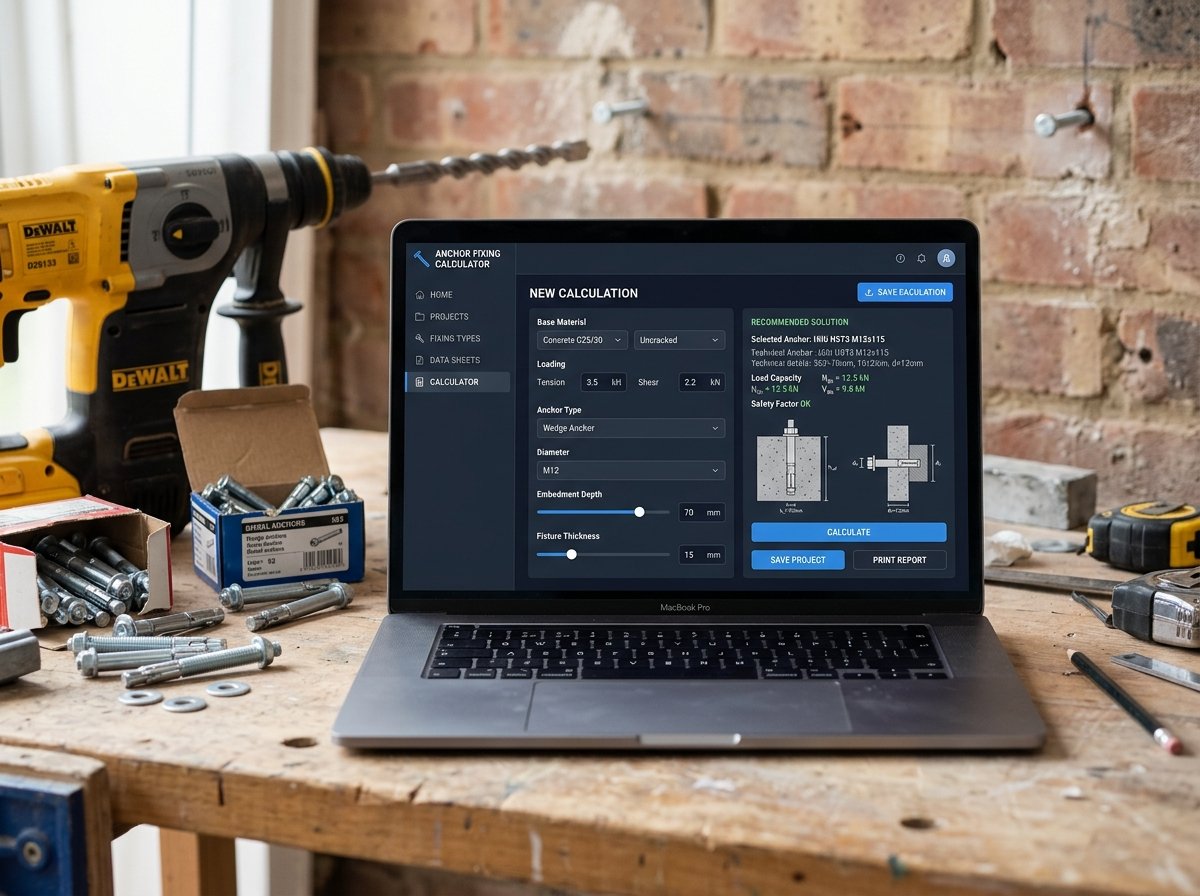
Anchor Bolts & Wall Fixings Calculator: Estimate Anchors and Costs Accurately
Anchor bolts and wall fixings are the critical connection between a structure and its base, or between cladding, railings, and the building envelope. Whether you’re fixing a wall plate, installing a balustrade, or attaching a cladding bracket, choosing the right anchor and estimating the correct quantity is essential for safety and cost control. An undersized or insufficient number of anchors can lead to failure; over-ordering wastes money and time. Our Anchor Bolts & Wall Fixings Calculator is a free online tool that helps you estimate the number of anchors, resin, washers, drilling requirements, and total cost based on your application, anchor type, size, and local pricing.
In this guide, we’ll show you how to use the calculator, explain the calculations, provide real-world examples, and answer common questions. We’ll also share tips to ensure your fixing design is safe, efficient, and cost-effective.
Anchor Bolts & Wall Fixings
Construction CalculatorAnchors: through-bolts, resin anchors, expansion anchors, drilling and cost.
What is the Anchor Bolts & Wall Fixings Calculator?
The Anchor Bolts & Wall Fixings Calculator is a free online tool that calculates the material quantities and costs for mechanical and chemical anchors. It supports various applications (wall plate, railing, cladding bracket, machinery base, column base, timber to masonry, signage), base materials (concrete, brick, hollow block, stone, aerated block), and anchor types (through-bolt, sleeve anchor, wedge anchor, drop-in anchor, resin anchor, frame fixing, concrete screw). The calculator accounts for anchor size, hole diameter and depth, quantity, waste allowance, resin, washers, drilling method, and local pricing for anchors, resin, washers, drill hire, drill bits, and sub-contract drilling. It provides a clear breakdown of anchor size, total anchors, hole dimensions, total hole volume, and costs for each component. The tool is part of a suite of materials and quantities calculators available on our website. For related calculations, you can use our Cladding Support System Calculator, Rainscreen Cladding Calculator, and Stone Cladding Calculator.
How to Use the Anchor Bolts & Wall Fixings Calculator
Using the calculator is straightforward. Here’s a breakdown of each field:
1. Application
- Application: Select the intended use: Wall plate to masonry, Railing / balustrade, Cladding bracket, Machinery base, Column base to slab, Timber to masonry, or Signage / heavy item. This helps you choose the right anchor but does not affect the calculation directly.
- Base material: Select the substrate: Concrete, Solid brick, Hollow block, Stone, or Aerated block (AAC). This is informational; enter the price for the anchor suited to your substrate below.
2. Anchor
- Anchor type: Select the anchor type: Through-bolt, Sleeve anchor, Wedge anchor, Drop-in anchor, Resin anchor (chemical), Frame fixing, or Concrete screw. This is informational; enter the price for your chosen anchor type below.
- Anchor size: Select the size: M6, M8, M10, M12, M16, M20, or Custom.
- Custom diameter: If you selected “Custom”, enter the diameter in meters or inches. For example, 0.010 m = 10 mm.
- Anchor length: Enter the length of the anchor in meters or inches. This is for reference only; it does not affect the calculation.
3. Hole
- Hole diameter: Enter the drill bit size in meters or inches. For example, 0.010 m = 10 mm.
- Hole depth: Enter the depth of the hole in meters or inches. For example, 0.090 m = 90 mm.
4. Quantity
- Number of anchors: Enter the total number of anchors required.
- Waste allowance: Enter the waste percentage for spares and failed fixings. Typical value is 5%.
5. Ancillaries
- Resin (chemical anchors): Select Yes if you are using resin anchors. Only for resin anchors.
- Washers: Select No, Plain washer, or Galvanised washer.
6. Drilling
- Drilling: Select Own drill + bits, Hire SDS drill, or Sub-contract drill. This is informational; the fields below control what is added to the cost.
- Drill bits required: Enter the number of drill bits you need to purchase.
7. Pricing
- Anchor price each: Enter the local price per anchor for your chosen type and size.
- Resin price per anchor: Enter the local price of resin per anchor. Used only when resin anchors are selected.
- Washer price each: Enter the local price per washer. Used only when washers are selected.
- SDS drill hire: Enter the cost of hiring an SDS drill. Used only when “Hire SDS drill” is selected.
- SDS bit price each: Enter the price per drill bit.
- Sub-contract drilling per anchor: Enter the cost per anchor for sub-contract drilling. Used only when “Sub-contract drill” is selected.
Once you enter all values, the calculator instantly displays:
- Anchor size (mm)
- Total anchors (including waste)
- Hole diameter (mm)
- Hole depth (mm)
- Total hole volume (litres)
- Anchor cost
- Resin cost
- Washer cost
- Drilling cost
- Drill bits cost
- Grand total
Understanding the Cost Components
To make the most of the calculator, it’s important to understand each output and the underlying logic.
- Anchor size (mm): The nominal diameter of the anchor in millimetres. For custom sizes, it is calculated from the custom diameter you enter.
- Total anchors: The number of anchors including waste:
ceil(count × (1 + waste/100)). You should always order extra to account for spares and potential failures. - Hole diameter and depth: The dimensions of the drilled hole. These are critical for correct anchor installation. Always follow the anchor manufacturer’s recommendations.
- Total hole volume: The total volume of all drilled holes in litres. It is calculated as
π × (hole diameter / 2)² × hole depth × count × 1000. This is useful for estimating resin consumption. - Anchor cost:
total anchors × anchor price each. You buy whole anchors, so waste is included. - Resin cost:
number of anchors × resin price per anchor(only if resin selected). Note that resin is applied to the actual number of anchors, not the total with waste, because spares are not installed. If a fixing fails, you may need extra resin; consider increasing the waste allowance or resin quantity manually. - Washer cost:
total anchors × washer price each(if washers selected). Washers are needed for every anchor, including spares. - Drilling cost: If you hire an SDS drill, the hire cost is added. If you sub-contract drilling, the cost is
number of anchors × sub-contract price per anchor. If you use your own drill, there is no drilling cost, but you still pay for drill bits. - Drill bits cost:
number of bits × price per bit. This is added regardless of the drilling method, as you may need new bits even if you own a drill. - Grand total: Sum of all material and service costs.
Understanding these components helps you interpret the results and adjust your design. For more information on anchors, you can refer to Wikipedia’s article on anchor bolts.
Example Calculations
Let’s run through a few examples to see how the calculator works in different scenarios.
Example 1: Wall Plate to Concrete, Sleeve Anchors, M10
- Application: Wall plate to masonry
- Base material: Concrete
- Anchor type: Sleeve anchor
- Anchor size: M10
- Hole diameter: 0.010 m (10 mm)
- Hole depth: 0.090 m (90 mm)
- Number of anchors: 20
- Waste: 5%
- Resin: No
- Washers: Plain
- Drilling: Own drill + bits
- Drill bits: 1
- Anchor price: $2.50 each
- Washer price: $0.30 each
- Bit price: $8 each
Calculations:
- Anchor size: 10 mm
- Total anchors: ceil(20 × 1.05) = ceil(21) = 21
- Hole volume: π × (0.005)² × 0.090 × 20 × 1000 = 0.1414 L
- Anchor cost: 21 × $2.50 = $52.50
- Resin cost: $0
- Washer cost: 21 × $0.30 = $6.30
- Drilling cost: $0 (own drill)
- Drill bits cost: 1 × $8 = $8
- Total: $52.50 + $6.30 + $8 = $66.80
- Result: Total $66.80
Example 2: Cladding Bracket to Brick, Resin Anchors, M12
- Application: Cladding bracket
- Base material: Solid brick
- Anchor type: Resin anchor (chemical)
- Anchor size: M12
- Hole diameter: 0.012 m (12 mm)
- Hole depth: 0.110 m (110 mm)
- Number of anchors: 40
- Waste: 8%
- Resin: Yes
- Washers: Galvanised
- Drilling: Hire SDS drill
- Drill bits: 2
- Anchor price: $3.00 each
- Resin price: $4.50 per anchor
- Washer price: $0.50 each
- Drill hire: $60
- Bit price: $12 each
Calculations:
- Anchor size: 12 mm
- Total anchors: ceil(40 × 1.08) = ceil(43.2) = 44
- Hole volume: π × (0.006)² × 0.110 × 40 × 1000 = 0.4975 L
- Anchor cost: 44 × $3.00 = $132.00
- Resin cost: 40 × $4.50 = $180.00 (applied to 40 anchors, not 44)
- Washer cost: 44 × $0.50 = $22.00
- Drilling cost: $60 (hire)
- Drill bits cost: 2 × $12 = $24
- Total: $132 + $180 + $22 + $60 + $24 = $418
- Result: Total $418
Example 3: Railing to Stone, Through-Bolts, M16, Sub-Contract Drilling
- Application: Railing / balustrade
- Base material: Stone
- Anchor type: Through-bolt
- Anchor size: M16
- Hole diameter: 0.016 m (16 mm)
- Hole depth: 0.150 m (150 mm)
- Number of anchors: 12
- Waste: 5%
- Resin: No
- Washers: Plain
- Drilling: Sub-contract drill
- Drill bits: 0
- Anchor price: $5.00 each
- Washer price: $0.40 each
- Sub-contract per anchor: $8.00
- Bit price: $0
Calculations:
- Anchor size: 16 mm
- Total anchors: ceil(12 × 1.05) = ceil(12.6) = 13
- Hole volume: π × (0.008)² × 0.150 × 12 × 1000 = 0.362 L
- Anchor cost: 13 × $5.00 = $65.00
- Resin cost: $0
- Washer cost: 13 × $0.40 = $5.20
- Drilling cost: 12 × $8.00 = $96.00
- Drill bits cost: $0
- Total: $65 + $5.20 + $96 = $166.20
- Result: Total $166.20
These examples show how different anchor types, sizes, and drilling methods affect the total cost.
Benefits of Using the Anchor Bolts & Wall Fixings Calculator
Tips for Accurate Anchor Estimation
- Choose the right anchor for the substrate: Concrete requires different anchors than brick or aerated block. Resin anchors are excellent for hollow or weak substrates. Mechanical anchors are faster but may not be suitable for all materials.
- Follow manufacturer’s hole dimensions: The hole diameter and depth must match the anchor specification. Using the wrong drill bit can compromise the fixing.
- Account for waste: Always order extra anchors (5–10%) to cover spares and potential failures. The calculator applies waste to anchors and washers.
- Consider resin consumption: The total hole volume helps you estimate how much resin you need. Resin is often sold in cartridges with a specific yield. Check the manufacturer’s data.
- Washers are essential: Washers distribute the load and prevent damage to the fixture. Use the correct type for the environment (e.g., galvanised for outdoor use).
- Drilling method affects cost: Hiring an SDS drill is cost-effective for small jobs. For large projects, sub-contract drilling may be more efficient.
- Don’t forget drill bits: Masonry bits wear out, especially in hard stone. Order spare bits.
- Check edge distances and spacing: Anchors must be placed at the correct distance from edges and each other to avoid cracking the substrate. Follow the manufacturer’s recommendations.
- Verify with a professional: For critical structural fixings, have a qualified engineer verify your design.
For more information on anchor selection, you can refer to resources like Wikipedia’s article on anchor bolts or guidelines from the British Standards Institution.
How to Reduce Anchor Fixing Costs
If your estimate is higher than expected, here are ways to reduce costs without compromising safety:
- Choose a smaller anchor: If the load allows, a smaller diameter anchor costs less and requires less drilling.
- Use mechanical anchors instead of resin: Mechanical anchors are often cheaper and faster to install, but they may not be suitable for all substrates.
- Optimize the number of anchors: Work with an engineer to determine the minimum number required for the load.
- Do your own drilling: If you own a suitable drill, you save on hire or sub-contract costs.
- Buy in bulk: Anchors, washers, and resin are often cheaper in larger quantities.
- Reuse drill bits: With care, drill bits can be used for multiple holes. But always have spares.
- Get multiple quotes: Compare suppliers for anchors and drilling services.



2 Comments