
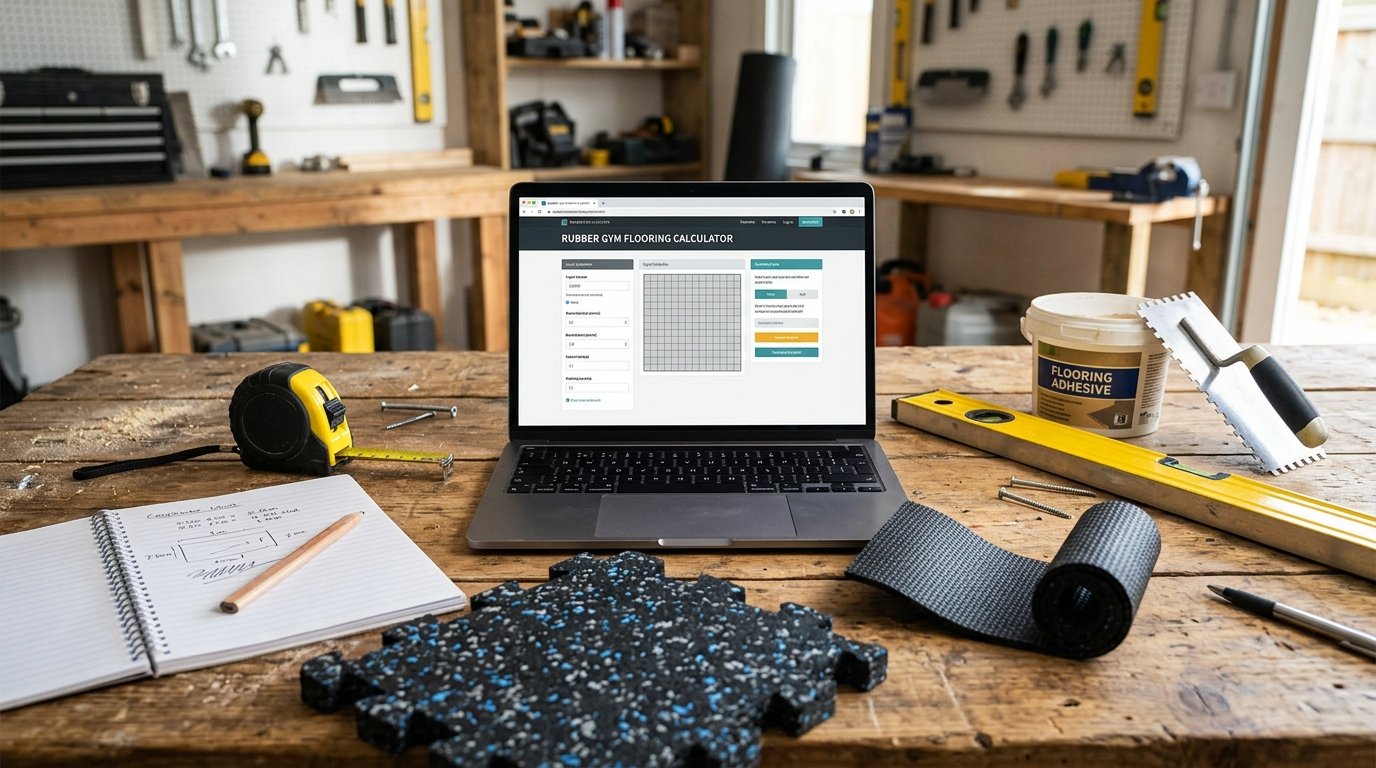
Rubber Gym Flooring Calculator: Tiles, Rolls, Adhesive & Mass
Rubber gym flooring is the material that makes a gym feel like a gym. It absorbs impact, damps noise, protects the subfloor, resists sweat, cleaning chemicals and heavy dropped weights, and provides the grip that stops plates sliding across the floor. It comes in three formats — interlocking tiles, rolls, and gym mats — and each one behaves differently during installation. Tiles are laid as individual pieces with a finite pack coverage; rolls must be cut to width; mats are usually laid loose with edge trim. Getting the quantity and specification wrong leads to a floor that is either short of material mid-installation or heavier than the structural design allows.
Our Rubber Gym Flooring Calculator is a free online tool that estimates the materials and costs of a rubber gym floor installation. It handles interlocking tiles, rolls and mats, calculates pack count with waste, roll-based purchased area for roll format, rubber mass from thickness, adhesive for glue-down, edge trim, subfloor prep (self-levelling and moisture barrier), labour with fixing multiplier, delivery, VAT and cost per m². It also flags four common design errors — glue fixing without adhesive price, rolls with insufficient waste, loose-lay rolls, and 10 mm rubber without a load check.
In this guide, we will show you how to use the calculator, explain each input and output, walk through four examples across tiles and rolls, and answer eight of the most frequently asked questions about rubber gym flooring.
Rubber / Gym Flooring
Construction CalculatorRubber gym flooring: tiles, rolls or mats, adhesive, edge trim, mass and cost.
What is the Rubber Gym Flooring Calculator?
Frequently Asked Questions (FAQ)
The Rubber Gym Flooring Calculator is a free online tool that estimates the quantity and cost of materials for a rubber gym floor installation. It supports:
- Input modes: room dimensions or direct area.
- Formats: interlocking tiles, rolls, gym mats.
- Thickness: 4 mm, 6 mm, 8 mm, or 10 mm — with mass calculation for structural checks.
- Pack coverage: m² per pack, typically 2.0 m² for tiles.
- Roll width: for roll-format installations.
- Waste allowance: typically 8% for tiles; 10–15% for rolls.
- Fixing methods: loose lay (interlocking) or glue-down.
- Subfloor prep: self-levelling compound, moisture barrier, or none.
- Edge trim: linear metres.
- Pricing: pack, adhesive per m², edge trim per metre, labour per m², delivery, VAT.
The output includes:
- Floor area and area with waste
- Roll linear metres and purchased area (for roll format)
- Packs required
- Total rubber mass in kg and tonnes
- Design check warning
- Itemised costs: rubber, adhesive, self-levelling, moisture barrier, edge trim, labour, delivery
- VAT, grand total and cost per m²
The tool is part of a suite of flooring calculators available on our website. For related calculations, you can use our Sports Wood Floor Calculator, Epoxy Resin Floor Calculator, Raised Access Floor Calculator, and Laminate Flooring Calculator.
Why Accurate Rubber Flooring Estimation Matters
Rubber is one of the densest flooring materials — around 1,000 kg/m³. That means mass is always significant, and getting it wrong can overload a floor or under-order material.
Roll Width Drives Waste
If you buy rubber tiles, waste is small — you cut a tile at the edges and that’s it. If you buy rolls, waste depends entirely on the roll width. A 5 m wide room with 1.5 m rolls needs four strips across the width, which produces 1 m of offcut per strip. The purchased area is much larger than the floor area. The calculator computes roll-based area automatically from roll width and room dimensions.
Mass Matters on Upper Floors
Rubber density is around 1,000 kg/m³. A 6 mm rubber floor weighs about 6 kg/m². A 10 mm floor weighs about 10 kg/m². On a 100 m² gym, that is 600–1,000 kg of rubber alone, plus subfloor, adhesive, and equipment. The calculator outputs total mass in kg and tonnes, and flags 10 mm floors with a load warning.
Thickness Is Functional, Not Cosmetic
4 mm is for cardio zones. 6 mm is standard for weight rooms. 8 mm is for heavy free weights. 10 mm is for Olympic lifting and heavy-impact zones. Using the wrong thickness leads to premature failure at drop points — the rubber delaminates or compresses permanently.
Adhesive Is Not Optional for Glue-Down
Glue-down rubber requires a proper adhesive. If the calculator (or the fitter) forgets this, the cost of adhesive appears on the final invoice, not in the estimate. The corrected calculator includes a warning when glue is selected without an adhesive price.
Subfloor Prep Is Critical
Rubber is flexible but not self-levelling. Any unevenness in the subfloor telegraphs through to the surface, causing premature wear and visible dips. Self-levelling compound over concrete is often necessary. The calculator includes this as a separate line item.
Edge Trim Finishes the Job
Edge trim covers the exposed cut edges of the rubber against walls, doors, and transitions. It is often forgotten at budget stage but is essential for a professional finish.
VAT and Delivery
Rubber rolls and tiles are heavy and bulky. Delivery and VAT add real cost to the final bill.
For more information on rubber flooring, you can refer to Wikipedia’s article on rubber flooring or the Rubber Flooring Institute.
How to Use the Rubber Gym Flooring Calculator
Using the calculator is straightforward. Here is a breakdown of each field.
1. Area
- Input mode: “Room dimensions” or “Direct area”.
- Room length / width: Enter dimensions in meters or feet.
- Area: Enter direct area in m² or ft².
- Waste allowance: 5–8% for tiles; 10–15% for rolls.
2. Product
- Format: Interlocking tiles, rolls, or gym mats.
- Thickness: 4 mm, 6 mm, 8 mm, or 10 mm.
- Pack coverage: m² per pack — typically 2.0 m² for tiles.
- Roll width: m per roll — typically 1.5 m for rolls.
3. Fixing
- Fixing: Loose lay (interlocking) or glue-down.
- Loose lay: For interlocking tiles and gym mats.
- Glue-down: For rolls and some tiles.
4. Subfloor
- Subfloor preparation: Ready, self-levelling, or moisture barrier + levelling.
- Self-levelling price per m²: Used for both level and moisture modes.
- Moisture barrier price per m²: Used only for moisture mode.
5. Trims
- Edge trim length: Typically the room perimeter. Set 0 if not required.
6. Pricing
Enter local prices for each component. Leave 0 to skip.
7. Extras
- Delivery / skip: Fixed cost for delivery and waste removal.
- VAT / tax rate: Applicable rate, or 0 if not applicable.
Once you enter all values, the calculator displays the full output, including area, roll linear metres and purchased area (roll format), packs, mass, design check, itemised costs, VAT, total and cost per m².
Understanding the Calculations
To make the most of the calculator, it is important to understand each output and the underlying formulas.
Area and Waste
area = length × width (dims) or direct area.
area_waste = area × (1 + waste / 100).
Tiles: 5–8%. Rolls: 10–15%.
Roll-Based Purchased Area
For rolls and dimensions:
- strips = ceil(short_dimension / roll_width)
- linear = strips × long_dimension
- purchased = linear × roll_width × (1 + waste / 100)
Example: 8 × 6 m, roll 1.5 m wide:
- strips = ceil(6/1.5) = 4
- linear = 4 × 8 = 32 m
- purchased = 32 × 1.5 × 1.08 = 51.84 m²
- versus floor area 48 m² — extra 3.84 m² is waste.
Packs
packs = ceil(purchased_area / pack coverage).
Rubber Mass
mass_kg = purchased_area × (thickness_mm / 1000) × 1000.
Rubber density is approximately 1,000 kg/m³, so mass in kg/m² equals thickness in mm.
- 4 mm → 4 kg/m²
- 6 mm → 6 kg/m²
- 8 mm → 8 kg/m²
- 10 mm → 10 kg/m²
Adhesive (Glue-Down Only)
adhesive_cost = area × adhesive price per m².
Subfloor Prep
- Self-levelling = area × self-levelling price (applies for both “level” and “moisture” modes).
- Moisture barrier = area × moisture barrier price (applies for “moisture” mode only).
Edge Trim
edge_cost = edge length × price per metre.
Labour
labour_cost = area × labour rate × fixing multiplier.
Fixing multipliers:
- Loose lay: 0.85
- Glue-down: 1.15
Design Check
The calculator performs four checks:
- Glue fixing but no adhesive price.
- Rolls with waste below 10%.
- Loose-lay rolls (unusual).
- 10 mm rubber with a load warning.
VAT and Total
VAT = subtotal × VAT / 100.
Total = subtotal + VAT.
Cost per m² = total / area.
Understanding these components helps you interpret the results and adjust your order. For more information on rubber flooring standards, you can refer to Wikipedia’s article on rubber flooring or the Rubber Flooring Institute.
Reference Table of Typical Thicknesses
| Thickness | Mass (kg/m²) | Typical use |
|---|---|---|
| 4 mm | 4 | Cardio zones, stretching |
| 6 mm | 6 | Standard weights areas |
| 8 mm | 8 | Heavy free weights |
| 10 mm | 10 | Olympic lifting, drop zones |
Example Calculations
Let’s run through four examples across tile and roll formats.
Example 1: Home Gym, 6 × 4 m = 24 m², 6 mm Tiles, Loose Lay
Inputs:
- Room: 6 × 4 m → 24 m²
- Waste: 8%
- Format: Interlocking tiles, 6 mm
- Pack coverage: 2.0 m²
- Fixing: Loose lay
- Subfloor: Ready
- Edge trim: 20 m
- Prices: pack $55, edge $10/m, labour $8/m²
- Delivery: $80
- VAT: 20%
Calculations:
- Area = 24 m²; waste → 25.92 m²
- Packs = ceil(25.92 / 2.0) = 13
- Rubber cost = 13 × $55 = $715
- Mass = 25.92 × 6 = 155.5 kg (0.16 t)
- Adhesive = $0
- Edge trim = 20 × $10 = $200
- Labour = 24 × $8 × 0.85 = $163.20
- Delivery = $80
- Subtotal = $1,158.20
- VAT = $231.64
- Total = $1,389.84
- Cost per m² = $57.91
Example 2: Commercial Gym, 8 × 6 m = 48 m², 8 mm Rolls, Glue-Down
Inputs:
- Room: 8 × 6 m → 48 m²
- Waste: 12%
- Format: Rolls, 8 mm
- Roll width: 1.5 m
- Fixing: Glue-down
- Subfloor: Moisture barrier + levelling ($8/m² level + $3/m² moisture)
- Edge trim: 28 m
- Prices: pack $150, adhesive $5/m², edge $15/m, labour $12/m²
- Delivery: $200
- VAT: 20%
Calculations:
- Roll-based: strips = ceil(6/1.5) = 4; linear = 32 m; purchased = 32 × 1.5 × 1.12 = 53.76 m²
- Packs = ceil(53.76 / 2.0) = 27
- Rubber cost = 27 × $150 = $4,050
- Mass = 53.76 × 8 = 430 kg (0.43 t)
- Adhesive = 48 × $5 = $240
- Level = 48 × $8 = $384
- Moisture = 48 × $3 = $144
- Edge trim = 28 × $15 = $420
- Labour = 48 × $12 × 1.15 = $662.40
- Delivery = $200
- Subtotal = $6,100.40
- VAT = $1,220.08
- Total = $7,320.48
- Cost per m² = $152.51
- Design: OK
Example 3: Olympic Lifting Zone, 20 m², 10 mm Tiles — Warning
Inputs:
- Room: 5 × 4 m → 20 m²
- Waste: 8%
- Format: Tiles, 10 mm
- Pack coverage: 2.0 m²
- Fixing: Loose lay
- Subfloor: Ready
- Edge trim: 18 m
- Prices: pack $95, edge $15/m, labour $10/m²
- Delivery: $150
- VAT: 20%
Calculations:
- Packs = ceil(21.6 / 2.0) = 11
- Rubber cost = 11 × $95 = $1,045
- Mass = 21.6 × 10 = 216 kg
- Design warning: “10 mm rubber is heavy (~10 kg/m²) — verify floor load capacity”
- Subtotal ≈ $1,045 + $270 + $170 + $150 = $1,635
- VAT = $327
- Total ≈ $1,962
- Cost per m² = $98.10
- Design: load warning
The user sees the cost but also a clear reminder to check the structural load.
Example 4: Glue Fixing Without Adhesive Price — Warning
Same as Example 2 but adh_m2 = 0:
- Design warning: “Glue fixing but no adhesive price — cost excludes adhesive”
- Subtotal drops by $240
- User sees a cheaper total but a clear warning that adhesive is missing
This is the most valuable feature — it catches a common omission before the floor is ordered.
Benefits of Using the Rubber Gym Flooring Calculator
Tips for Accurate Rubber Gym Flooring Estimation
- Choose thickness by use. 4 mm cardio, 6 mm standard weights, 8 mm heavy weights, 10 mm Olympic.
- Check roll width. Roll-based purchases can use 20% more material than the floor area — the calculator handles this.
- Allow proper waste. 5–8% for tiles; 10–15% for rolls.
- Confirm adhesive price for glue-down. The calculator warns if glue is selected but the adhesive price is zero.
- Include subfloor prep. Gym floors need a flat, dry subfloor — self-levelling and moisture barrier as required.
- Order edge trim. Every exposed edge needs a trim against walls and doors.
- Check mass on upper floors. 10 mm rubber is 10 kg/m² — a 100 m² floor is 1 tonne.
- Plan acclimatisation. Leave rubber in the room for 24–48 hours before installation.
- Choose loose lay for modular gyms. Tiles can be replaced individually without touching the rest.
- Do not forget delivery. Rolls and tile packs are heavy and bulky.
- Verify VAT treatment. Commercial gyms may have different rules — check locally.
- Get multiple quotes. Rubber flooring specialists vary significantly in price.
For more information on rubber flooring standards, you can refer to the Rubber Flooring Institute or Wikipedia’s article on rubber flooring.
Common Mistakes to Avoid
- Forgetting adhesive for glue-down. The most serious error — glue fixing without an adhesive line item is “free” installation.
- Underestimating waste on rolls. Roll width cuts add 10–15% over floor area.
- Ignoring mass. 10 mm rubber is 10 kg/m² — check the structural load.
- Using the wrong thickness for the zone. 4 mm in a free-weights area will fail.
- Skipping subfloor prep. Uneven subfloor telegraphs through to the surface.
- Forgetting edge trim. Exposed edges look unfinished and are a trip hazard.
- Loose-laying rolls. Rolls are normally glued; loose-lay rolls curl at the edges.
- Not acclimatising. Rubber installed cold can shrink or gap.
- No delivery or VAT. Both significantly change the total bill.
- Choosing by price alone. Cheap rubber delaminates or compresses faster.
How to Reduce Rubber Gym Flooring Costs
If your estimate is higher than expected, here are ways to reduce costs without compromising quality:
- Choose 4 mm or 6 mm over 10 mm where appropriate. 10 mm is only needed for Olympic lifting.
- Choose tiles over rolls. Rolls often use 20% more material than floor area.
- Choose loose lay over glue-down. Faster and no adhesive cost.
- Do the subfloor prep yourself. Level a small area with a self-levelling compound.
- Use standard trim profiles. Custom edges are more expensive.
- Do the loose-lay installation yourself. Interlocking tiles are within reach of a competent DIYer.
- Compare suppliers. Rubber prices vary 20–30%.
- Order in bulk. Multi-zone gyms qualify for larger orders.
- Time the project off-season. Retailers discount in quieter months.
- Get multiple quotes. Compare at least three installers.
Frequently Asked Questions (FAQ)
Conclusion
The Rubber Gym Flooring Calculator is an essential tool for gym owners, installers, and specifiers. It estimates packs, roll-based purchased area, rubber mass, adhesive, subfloor prep, edge trim, labour, delivery, VAT and total installed cost per m² — with format-aware logic and design warnings that catch the most common mistakes before ordering.
The corrected calculator now handles roll-based cuts, computes mass from thickness, includes subfloor prep, and warns when glue is selected without adhesive, rolls have insufficient waste, or 10 mm rubber is specified without a load check. Whether you are setting up a home gym or a commercial fitness facility, accurate estimation of rubber flooring materials is the foundation of a safe, durable, and cost-effective installation. Try the Rubber Gym Flooring Calculator today and take the guesswork out of your gym floor project.




One Comment