
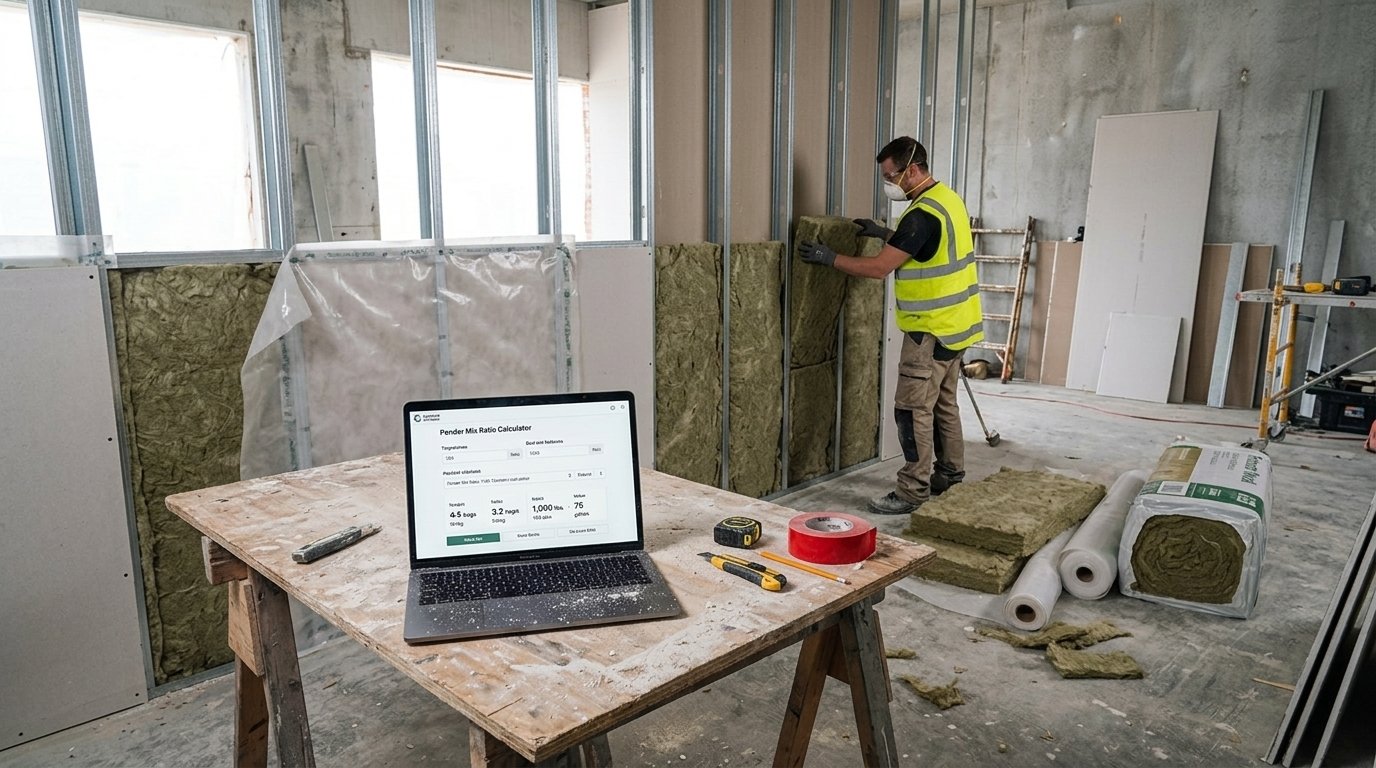
Drywall Insulation Calculator: Estimate Stud Wall Insulation & Costs
Insulating a stud wall is one of the most effective ways to improve energy efficiency, reduce noise, and enhance comfort in any building. Whether you are renovating a room, building a new partition, or upgrading an existing wall, the right insulation and vapour barrier are essential. However, estimating the materials and costs can be tricky because insulation coverage varies by type, thickness, and pack size. Under-ordering leads to delays; over-ordering wastes money and storage space.
Our Drywall Insulation Calculator is a free online tool that takes the guesswork out of stud wall insulation projects. It helps you quickly estimate the number of insulation packs, vapour barrier area, acoustic sealant, and total labour costs based on your wall dimensions and chosen materials.
In this guide, we will show you how to use the calculator, explain each cost component, provide detailed examples, and answer common questions. We will also share tips to ensure your stud wall insulation project meets building regulations and stays on budget.
Drywall Insulation (Stud Wall)
Construction CalculatorInsulation within a stud wall: mineral wool, PIR, vapour barrier and cost.
What is the Drywall Insulation Calculator?
The Drywall Insulation Calculator is a free online tool that calculates material quantities and costs for insulating stud walls. It supports various insulation types (mineral wool roll, mineral wool slab, PIR, EPS, XPS, wood fibre, sheep wool, spray foam), user-defined thickness, pack coverage, waste allowance, vapour barrier options, acoustic sealant, and local pricing for all components.
The tool is part of a suite of materials and quantities calculators available on our website. For related calculations, you can use our Drywall Sheets (Walls) Calculator, Metal Stud & Track Profiles Calculator, Acoustic Drywall Calculator, and Fire-Rated Drywall Calculator.
Why Stud Wall Insulation Matters
Stud wall insulation is not just about comfort—it is a critical component of building performance. Insulation reduces heat loss in winter, keeps interiors cooler in summer, and can significantly reduce energy bills. It also improves acoustic performance, making rooms quieter and more private. In some cases, insulation is required by building regulations to meet minimum thermal performance standards.
A typical insulated stud wall consists of:
- Stud frame (metal or timber)
- Insulation (mineral wool, PIR, EPS, etc.)
- Vapour barrier (on the warm side)
- Acoustic sealant at perimeters
- Drywall boards (on one or both sides)
The performance of the wall depends on all components working together. Using the wrong insulation thickness, omitting the vapour barrier, or leaving gaps can compromise thermal and acoustic performance. That is why accurate estimation is not just about cost—it is about compliance and comfort.
How to Use the Drywall Insulation Calculator
Using the calculator is straightforward. Here is a breakdown of each field.
1. Wall Dimensions
- Wall length: Enter the total length of the wall in meters or feet.
- Wall height: Enter the total height of the wall in meters or feet.
- Openings area: Enter the total area of doors and windows in square meters or square feet. This is deducted from the gross area to give the net insulated area.
2. Stud Details
- Stud size: Select the stud size (e.g., 47 × 89 mm, 47 × 140 mm). This determines the maximum insulation thickness you can fit. The calculator displays the stud depth for reference.
- Stud spacing: Enter the centre-to-centre spacing (e.g., 400 mm or 600 mm). This field is for reference only; insulation quantity does not depend on spacing.
3. Insulation Details
- Insulation type: Select the insulation material: mineral wool roll, mineral wool slab, PIR board, EPS board, XPS board, wood fibre, sheep wool, or spray foam. This is for navigation; enter the price for your chosen type below.
- Insulation thickness: Enter the thickness in millimetres. This should match or be slightly less than the stud depth. The calculator uses a 90 mm baseline to adjust the price per pack if your thickness differs.
- Pack coverage: Enter the coverage per pack in square meters. Check the packaging for this value.
- Waste allowance: Enter a percentage for waste. 5% is typical for insulation, but complex walls may require more.
4. Vapour Barrier
- Vapour barrier: Select “Not required”, “Yes (polythene 500 gauge)”, or “Foil-backed (radiant barrier)”. A vapour barrier is required on the warm side of the insulation to prevent moisture migration.
- Vapour barrier price per m²: Enter the local price per square meter. Used only when a vapour barrier is selected.
- Vapour tape per metre: Enter the local price per metre of tape. Used only when a vapour barrier is selected.
5. Acoustic Sealant
- Acoustic sealant per metre: Enter the local price per metre of acoustic sealant. This is applied at the top and bottom plates and around openings to reduce air leakage and noise.
6. Pricing
Enter local prices for:
- Insulation pack price
- Vapour barrier price per m²
- Vapour tape per metre
- Labour price per m²
Once you enter all values, the calculator instantly displays gross wall area, net insulated area, stud depth, insulation thickness, insulation packs, vapour barrier area, acoustic sealant length, and a full cost breakdown.
Understanding the Cost Components
To make the most of the calculator, it is important to understand each output and the underlying formulas.
- Gross wall area: length × height. This is the total wall area before deducting openings.
- Net insulated area: gross area − openings area. This is the area actually insulated.
- Net area with waste: net area × (1 + waste/100). This accounts for material lost during cutting and fitting.
- Stud depth: The physical depth of the selected stud, used to check compatibility with insulation thickness.
- Insulation thickness: The thickness you entered, displayed for reference.
- Thickness factor: thickness / 90. This adjusts the pack price if your insulation is thicker or thinner than the 90 mm baseline.
- Insulation packs: ceil(net area with waste / pack coverage). You buy whole packs, so the calculator rounds up.
- Insulation cost: packs × pack price × thickness factor.
- Vapour barrier area: net area. This is the area to be covered by the vapour barrier.
- Vapour barrier cost: net area × vapour barrier price per m².
- Vapour tape cost: perimeter × tape price per metre. The perimeter is 2 × (length + height).
- Acoustic sealant length: 2 × (length + height) + an allowance for openings. This is the length of sealant required.
- Acoustic sealant cost: sealant length × price per metre.
- Labour cost: net area × labour price per m².
- Grand total: Sum of insulation, vapour barrier, vapour tape, acoustic sealant, and labour costs.
Understanding these components helps you interpret the results and adjust your order. For more information on insulation standards, you can refer to Energy.gov’s insulation guide or Wikipedia’s article on drywall.
Example Calculations
Let’s run through two examples to see how the calculator works in different scenarios.
Example 1: Mineral Wool Slab in a 10 m × 2.7 m Wall with 3 m² Openings
Inputs:
- Wall length: 10 m
- Wall height: 2.7 m
- Openings area: 3 m²
- Stud size: 47 × 89 mm
- Stud spacing: 400 mm
- Insulation type: Mineral wool slab
- Insulation thickness: 90 mm
- Pack coverage: 4 m²
- Waste: 5%
- Vapour barrier: Yes (polythene)
- Acoustic sealant per metre: $2
- Pack price: $30
- Vapour barrier price per m²: $1.50
- Vapour tape per metre: $0.80
- Labour price per m²: $12
Calculations:
- Gross area = 10 × 2.7 = 27 m²
- Net area = 27 − 3 = 24 m²
- Net with waste = 24 × 1.05 = 25.2 m²
- Thickness factor = 90 / 90 = 1.0
- Packs = ceil(25.2 / 4) = ceil(6.3) = 7 packs
- Insulation cost = 7 × $30 × 1.0 = $210
- Vapour barrier area = 24 m²
- Vapour barrier cost = 24 × $1.50 = $36
- Perimeter = 2 × (10 + 2.7) = 25.4 m
- Vapour tape cost = 25.4 × $0.80 = $20.32
- Opening allowance = 4 × sqrt(3) × 2 = 4 × 1.732 × 2 = 13.86 m
- Sealant length = 25.4 + 13.86 = 39.26 m
- Sealant cost = 39.26 × $2 = $78.52
- Labour cost = 24 × $12 = $288
- Total = $210 + $36 + $20.32 + $78.52 + $288 = $632.84
Example 2: PIR Board in a 15 m × 3 m Wall with 5 m² Openings, No Vapour Barrier
Inputs:
- Wall length: 15 m
- Wall height: 3 m
- Openings area: 5 m²
- Stud size: 47 × 140 mm
- Stud spacing: 600 mm
- Insulation type: PIR board
- Insulation thickness: 120 mm
- Pack coverage: 2.88 m²
- Waste: 7%
- Vapour barrier: No
- Acoustic sealant per metre: $2.50
- Pack price: $45
- Vapour barrier price per m²: $0 (not used)
- Vapour tape per metre: $0 (not used)
- Labour price per m²: $15
Calculations:
- Gross area = 15 × 3 = 45 m²
- Net area = 45 − 5 = 40 m²
- Net with waste = 40 × 1.07 = 42.8 m²
- Thickness factor = 120 / 90 = 1.333
- Packs = ceil(42.8 / 2.88) = ceil(14.86) = 15 packs
- Insulation cost = 15 × $45 × 1.333 = $900 (approx)
- Vapour barrier cost = $0
- Vapour tape cost = $0
- Perimeter = 2 × (15 + 3) = 36 m
- Opening allowance = 4 × sqrt(5) × 2 = 4 × 2.236 × 2 = 17.89 m
- Sealant length = 36 + 17.89 = 53.89 m
- Sealant cost = 53.89 × $2.50 = $134.73
- Labour cost = 40 × $15 = $600
- Total = $900 + $0 + $0 + $134.73 + $600 = $1,634.73
These examples show how different insulation types, thicknesses, and vapour barrier options affect the total cost.
Benefits of Using the Drywall Insulation Calculator
Tips for Accurate Stud Wall Insulation Estimation
- Measure the wall accurately: Double-check length and height. For irregular walls, divide into rectangles and calculate separately.
- Deduct openings correctly: Subtract the total area of doors and windows to get the net insulated area.
- Choose the right insulation thickness: Insulation thickness should match the stud depth. If you use thinner insulation, you lose thermal performance; if thicker, it may not fit.
- Select the correct insulation type: Mineral wool is cost-effective and fire-resistant; PIR offers higher R-value per inch; sheep wool is eco-friendly. Choose based on performance and budget.
- Check pack coverage: Coverage varies by manufacturer and product. Always check the packaging.
- Account for waste: Insulation is cut to fit around studs, sockets, and openings. A 5–10% waste allowance is realistic.
- Do not skip the vapour barrier: A vapour barrier prevents moisture from entering the insulation, which can reduce performance and lead to mould. It is required on the warm side of the insulation.
- Use acoustic sealant: Sealant at perimeters and openings reduces air leakage and improves acoustic performance.
- Use realistic labour rates: Insulation installation is relatively quick, but complex walls with many openings take longer. Enter a local rate per m².
- Include scaffolding: If the wall is over 3 m high, scaffolding may be required. Add this as a separate cost or include it in the labour rate.
- Verify with a professional: For large or complex projects, have a qualified installer verify the design and quantities.
Common Mistakes to Avoid
- Using the wrong insulation thickness. Too thin reduces thermal performance; too thick may not fit the stud depth.
- Forgetting the vapour barrier. Omitting it can lead to condensation and mould.
- Not sealing gaps. Gaps around pipes, sockets, and edges reduce performance. Use acoustic sealant.
- Compressing insulation. Compressing mineral wool reduces its R-value. Do not force it into spaces.
- Ignoring waste. Insulation is cut and fitted; a 5–10% waste allowance is realistic.
- Not accounting for both sides. If you are insulating both sides of a stud wall, you need to calculate separately or double the area. This calculator assumes one side (the cavity). For double-sided, run the calculation twice or double the net area.
How to Reduce Stud Wall Insulation Costs
If your estimate is higher than expected, here are ways to reduce costs without compromising performance:
- Choose mineral wool over PIR. Mineral wool is cheaper and still provides good thermal and acoustic performance.
- Use standard thicknesses. Custom or high-thickness insulation is more expensive.
- Reduce waste. Measure twice, cut once. Plan your cuts carefully.
- Compare suppliers. Insulation prices vary. Get multiple quotes.
- Install efficiently. Good planning reduces labour time.
- Do the preparation yourself. Removing old walls, cleaning, and fixing studs can be done by a competent DIYer, saving labour costs.
- Get multiple quotes. Compare insulation installers for the best price. But never choose solely on price—quality and experience matter.
- Schedule in dry weather. Insulation should be kept dry. Scheduling work in a dry period avoids moisture damage and rework.
Frequently Asked Questions (FAQ)
Conclusion
The Drywall Insulation Calculator is an essential tool for builders, renovators, and homeowners. It helps you estimate insulation packs, vapour barrier, acoustic sealant, and total cost for your stud wall insulation project. By following the tips in this article and using the calculator, you can confidently plan your insulation work and ensure compliance with building regulations.
Whether you are insulating a small partition or a full exterior wall, accurate material and cost estimation is key to a successful project. Try the Drywall Insulation Calculator today and take the guesswork out of your stud wall insulation budget.