Parquet Flooring Calculator: Packs, Underlay, Cleats & Total Cost
Parquet and engineered wood flooring sit in a category of their own. They are not laminate — they have a real wood top layer that can be sanded and refinished. They are not solid hardwood either — engineered boards have a plywood core that resists movement, and parquet comes in patterns (herringbone, chevron, basket-weave) that fundamentally change how much material you need and how long installation takes. And parquet can be laid in three completely different ways — floating on underlay, glued to the subfloor, or nailed down — each with its own materials and time.
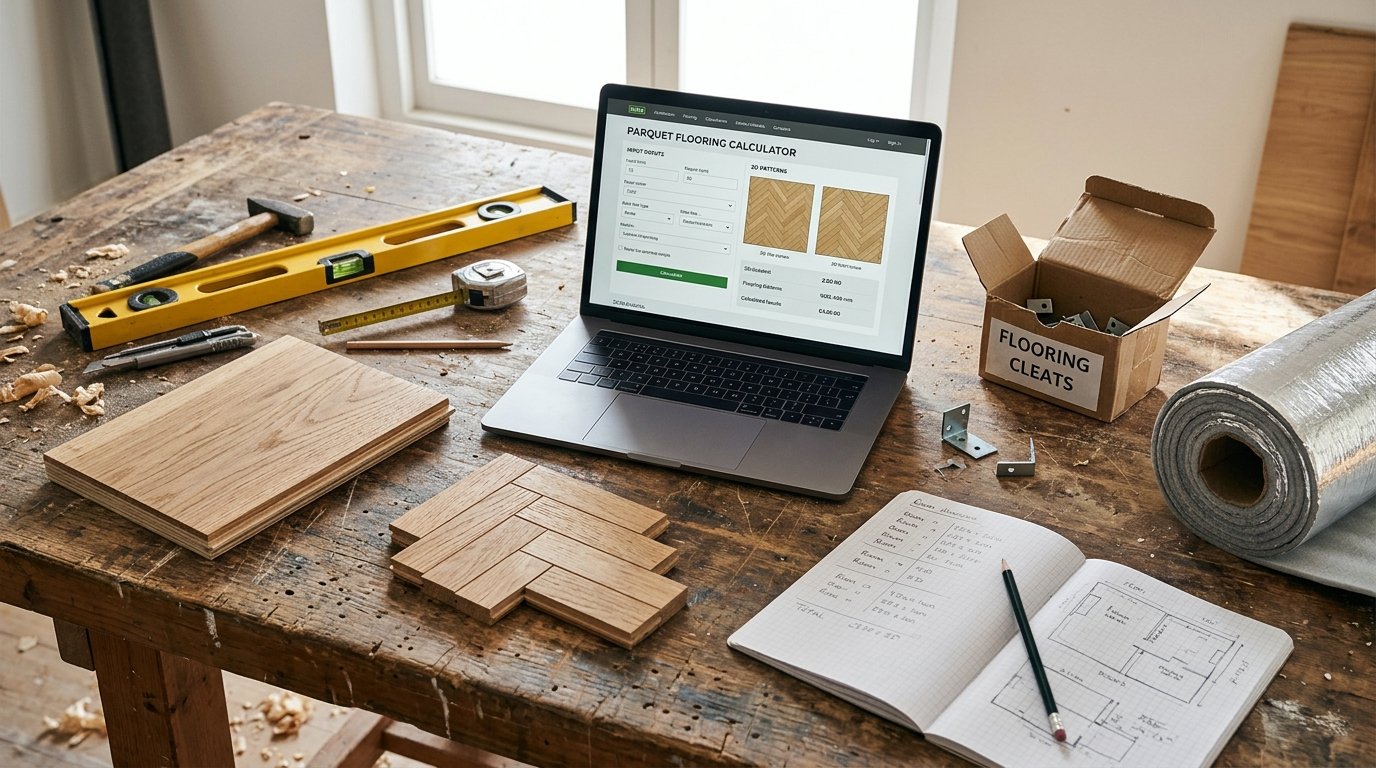
Our Parquet Flooring Calculator is a free online tool that estimates the materials and costs of a parquet or engineered floor installation. It handles engineered wood, solid parquet, chevron / herringbone, and bamboo. It calculates packs from coverage and pack weight, underlay with overlap for floating systems, adhesive for glue-down, nails / cleats for nail-down, subfloor prep, skirting with mitre waste, beading, sanding and sealing for unfinished floors, labour with product multipliers, wood mass, delivery, VAT and total installed cost per m². It also flags five common design errors — floating without a moisture barrier, nail fixing with no nail price, chevron without adequate waste, unfinished without a sanding price, and unusually small pack coverage — before you order.
In this guide, we will show you how to use the calculator, explain each input and output, walk through six examples across fixing methods and patterns, and answer eight of the most frequently asked questions about parquet and engineered flooring.
Parquet / Engineered Flooring
Construction CalculatorParquet or engineered wood: packs, underlay with overlap, adhesive, cleats, subfloor prep and total cost.
What is the Parquet Flooring Calculator?
The Parquet Flooring Calculator is a free online tool that estimates the quantity and cost of materials for a parquet or engineered wood floor installation. It supports:
- Input modes: room dimensions or direct area.
- Products: engineered wood, solid parquet, chevron / herringbone, bamboo.
- Grades: rustic, select, premium. Navigation only — the price per pack is user-entered.
- Pack details: coverage per pack, price per pack, pack weight.
- Fixing methods: floating on underlay, glue-down, nail-down with cleats.
- Underlay overlap: 5–10% allowance for floating.
- Subfloor prep: none, self-levelling compound, or moisture barrier + levelling.
- Trims: skirting with mitre waste, beading / threshold bars.
- Finish: pre-finished or unfinished (sanding and sealing).
- Pricing: pack, underlay, adhesive, nails, skirting, beading, finishing, labour, delivery, VAT.
The output includes:
- Floor area and area with waste
- Packs required
- Total wood mass in kg / lb
- Underlay area (with overlap) for floating
- Skirting length with waste
- Design check warning
- Itemised costs: wood, underlay, adhesive, nails, levelling, moisture barrier, skirting, beading, sanding, labour, delivery
- VAT, grand total and cost per m²
The tool is part of a suite of flooring calculators available on our website. For related calculations, you can use our Hardwood Flooring Calculator, Laminate Flooring Calculator, Bamboo Flooring Calculator, and Floor Underlay Calculator.
Why Accurate Parquet Estimation Matters
Parquet is one of the most expensive flooring materials per square metre. It is also the most sensitive to specification and installation errors, because unlike laminate and vinyl, parquet cannot be patched or hidden — its faults are structural and permanent.
Three Fixing Methods, Three Sets of Materials
Floating, glue-down and nail-down are not interchangeable. Floating uses underlay, glue-down uses adhesive, nail-down uses cleats and nails. Each has a different cost profile and a different labour time. The original calculator had a gap here — it did not include a nails / cleats line at all, so a user who selected nail fixing was told installation was free. The corrected calculator now includes a dedicated nail_m2 field and a warning if it is left at zero.
Chevron and Herringbone Need More Waste
Straight-plank parquet wastes 8–12%. Chevron and herringbone patterns — where each plank is angled and cut at 45° or 60° — waste 15–20% because of the intricate cuts and pattern alignment. A user who selects chevron but leaves waste at 10% will run short at the edges of the room. The calculator warns when chevron is selected without enough waste allowance.
Moisture Barrier Is Essential Over Concrete
Parquet and engineered wood are dimensionally unstable in the presence of moisture. Over concrete subfloors, a moisture barrier is not optional. The boards will cup, crown, or delaminate if they absorb moisture from below. The calculator warns when floating is selected without a moisture barrier.
Subfloor Prep Drives Longevity
A parquet floor laid over an uneven subfloor will click, flex, and eventually fail at the seams. Self-levelling compound over concrete and plywood overlay over floorboards are often necessary. The calculator includes these as separate line items so they do not get forgotten.
Wood Mass Matters on Upper Floors
A 15 mm engineered parquet floor weighs about 8 kg/m². A 20 mm solid parquet weighs about 14 kg/m². A 100 m² floor of solid parquet is around 1.4 tonnes. On upper floors or lightweight structures, this mass must be verified against the structural design. The calculator outputs total mass from pack weight × pack count.
Skirting Needs Waste
Skirting is cut at every corner, doorway, and end of run. A 5–10% waste allowance is realistic — more for rooms with bay windows or complex geometry.
Pre-Finished vs Unfinished
Pre-finished parquet arrives already sanded and sealed. Unfinished parquet needs 2–3 coats of sealer on site — a significant additional cost that is often forgotten at budget stage. The calculator includes sanding and sealing as a separate line item only when unfinished is selected.
VAT and Delivery
Parquet packs are heavy and often palletised. Delivery and VAT add real cost to the final bill.
For more information on parquet flooring, you can refer to Wikipedia’s article on parquet or the National Wood Flooring Association (NWFA).
How to Use the Parquet Flooring Calculator
Using the calculator is straightforward. Here is a breakdown of each field.
1. Area
- Input mode: “Length × width” or “Direct area”.
- Room length / width: Enter dimensions in meters or feet.
- Area: Enter direct area in m² or ft².
- Waste allowance: 10% for straight plank; 15–20% for chevron and herringbone.
2. Product
- Product: Engineered wood, solid parquet, chevron / herringbone, or bamboo. The choice affects the labour multiplier.
- Grade: Rustic, select, or premium. Navigation only — the price per pack is entered below.
- Pack coverage: m² per pack. Typically 1.5–2.5 m². Check the packaging.
- Pack weight: kg per pack. Used for total wood mass.
3. Fixing
- Fixing method: Floating on underlay, glue-down, or nail-down. Only the selected method is charged.
- Underlay overlap: 5% is standard for floating; 10% for uneven or thicker underlay.
4. Subfloor
- Subfloor preparation: Ready, self-levelling compound, or moisture barrier + levelling.
- Self-levelling price per m²: Used for both “level” and “moisture” modes.
- Moisture barrier price per m²: Used only for “moisture” mode.
5. Trims
- Skirting length: Total length in meters or feet. Set 0 if not required.
- Skirting waste: Typically 8% for mitre cuts at corners.
- Beading / threshold length: Total length in meters or feet. Set 0 if not required.
6. Finish
- Finish: Pre-finished or unfinished. Unfinished adds the sanding and sealing cost.
7. Pricing
Enter local prices for each component. Leave 0 to skip.
8. Extras
- Delivery / skip: Fixed cost for delivery and waste removal.
- VAT / tax rate: Applicable rate, or 0 if not applicable.
Once you enter all values, the calculator displays the full output, including area, packs, wood mass, underlay area, skirting length, design check, itemised costs, VAT, total and cost per m².
Understanding the Calculations
To make the most of the calculator, it is important to understand each output and the underlying formulas.
Area and Waste
area = length × width (dims) or direct area.
area_waste = area × (1 + waste / 100).
Straight plank: 8–12%. Chevron and herringbone: 15–20%.
Packs
packs = ceil(area_waste / pack coverage).
The result is rounded up — you cannot buy partial packs.
Wood Mass
mass_kg = packs × pack weight.
For engineered at 15 kg/pack and 1.8 m² coverage: 15 / 1.8 = 8.3 kg/m².
For solid parquet at 20 kg/pack and 1.5 m² coverage: 20 / 1.5 = 13.3 kg/m².
Underlay Area (Floating Only)
underlay_area = area × (1 + overlap / 100).
underlay_cost = underlay_area × underlay price per m².
Adhesive (Glue-Down Only)
adhesive_cost = area × adhesive price per m².
Nails / Cleats (Nail-Down Only)
nail_cost = area × nail price per m².
The corrected calculator includes this field — it was missing in the original, which meant nail fixing appeared free.
Subfloor Prep
- Self-levelling = area × self-levelling price (applies for both “level” and “moisture” modes).
- Moisture barrier = area × moisture barrier price (applies for “moisture” mode only).
Skirting
skirting_length_total = skirting_length × (1 + skirting_waste / 100).
skirting_cost = skirting_length_total × price per metre.
Beading / Threshold
beading_cost = beading length × price per metre.
Finishing (Unfinished Only)
finishing_cost = area × sanding price per m².
Pre-finished floors skip this cost.
Labour
labour_cost = area × labour rate × product multiplier.
Product multipliers:
- Engineered: 1.00
- Solid parquet: 1.20
- Chevron / herringbone: 1.50 (much slower to align pattern)
- Bamboo: 0.95
Design Check
The calculator performs five checks:
- Floating without a moisture barrier.
- Nail fixing but no nail price entered.
- Chevron / herringbone with waste below 15%.
- Unfinished floor with no sanding price.
- Pack coverage below 1.0 m².
VAT and Total
VAT = subtotal × VAT / 100.
Total = subtotal + VAT.
Cost per m² = total / area.
Understanding these components helps you interpret the results and adjust your order. For more information on parquet flooring standards, you can refer to Wikipedia’s article on parquet or the National Wood Flooring Association (NWFA).
Reference Table of Typical Values
| Product | Pack coverage | Pack weight | Mass per m² |
|---|---|---|---|
| Engineered 14–15 mm | 1.8 m² | 15 kg | ~8.3 kg/m² |
| Solid parquet 20 mm | 1.5 m² | 20 kg | ~13.3 kg/m² |
| Chevron engineered 14 mm | 1.6 m² | 14 kg | ~8.75 kg/m² |
| Bamboo 12–15 mm | 1.8 m² | 14 kg | ~7.8 kg/m² |
Example Calculations
Let’s run through six examples across fixing methods and patterns.
Example 1: Engineered Oak, 20 m², Floating
Inputs:
- Room: 5 × 4 m → 20 m²
- Waste: 10%
- Product: Engineered oak
- Pack coverage: 1.8 m², 15 kg
- Fixing: Floating, underlay $4/m², overlap 5%
- Subfloor: Ready
- Skirting: 18 m at $12/m, 8% waste
- Beading: 2 m at $15/m
- Finish: Pre-finished
- Prices: pack $55, labour $18/m²
- Delivery: $100
- VAT: 20%
Calculations:
- Area = 20 m²; waste → 22 m²
- Packs = ceil(22 / 1.8) = 13
- Wood cost = 13 × $55 = $715
- Mass = 13 × 15 = 195 kg
- Underlay = 20 × 1.05 × $4 = $84
- Skirting = 18 × 1.08 × $12 = $233.28
- Beading = 2 × $15 = $30
- Labour = 20 × $18 × 1.00 = $360
- Delivery = $100
- Subtotal = $1,522.28
- VAT = $304.46
- Total = $1,826.74
- Cost per m² = $91.34
- Design: floating without moisture barrier → warning
The user sees the cheaper cost but a clear warning that over concrete the floor may fail.
Example 2: Same as Example 1 with Moisture Barrier
- Subfloor: Moisture barrier + levelling ($8/m² level + $3/m² moisture)
- Self-levelling = 20 × $8 = $160
- Moisture barrier = 20 × $3 = $60
- Subtotal = $1,742.28
- VAT = $348.46
- Total = $2,090.74
- Design: OK
The additional $264 for prep is small compared to the cost of a failed floor.
Example 3: Solid Parquet, 30 m², Nail-Down
Inputs:
- Room: 6 × 5 m → 30 m²
- Waste: 12%
- Product: Solid oak parquet
- Pack: 1.5 m², 20 kg
- Fixing: Nail-down, cleats $4/m²
- Subfloor: Ready
- Skirting: 22 m at $15/m, 8% waste
- Finish: Unfinished at $25/m²
- Prices: pack $85, labour $30/m²
- Delivery: $150
- VAT: 20%
Calculations:
- Area = 30 m²; waste → 33.6 m²
- Packs = ceil(33.6 / 1.5) = 23
- Wood = 23 × $85 = $1,955
- Mass = 23 × 20 = 460 kg
- Cleats = 30 × $4 = $120
- Skirting = 22 × 1.08 × $15 = $356.40
- Sanding & sealing = 30 × $25 = $750
- Labour = 30 × $30 × 1.20 = $1,080
- Delivery = $150
- Subtotal = $4,411.40
- VAT = $882.28
- Total = $5,293.68
- Cost per m² = $176.46
- Design: OK
Example 4: Chevron, 25 m², Glue-Down, Insufficient Waste — Warning
Inputs:
- Room: 5 × 5 m → 25 m²
- Waste: 10% (user kept default)
- Product: Chevron engineered
- Pack: 1.6 m², 14 kg
- Fixing: Glue-down, adhesive $6/m²
- Subfloor: Self-levelling at $8/m²
- Skirting: 20 m at $18/m
- Finish: Pre-finished
- Prices: pack $95, labour $35/m²
- Delivery: $150
- VAT: 20%
Calculations:
- Warning: “Chevron/herringbone needs 15–20% waste for pattern alignment”
- Subtotal ≈ $4,326
- VAT = $865.20
- Total ≈ $5,191.20
- Design: waste warning
The calculator flags the design problem, even though it still calculates a total.
Example 5: Bamboo, 40 m², Floating
Inputs:
- Area: 40 m²
- Waste: 10%
- Product: Bamboo, pack 1.8 m², 14 kg
- Fixing: Floating, underlay $4/m², 5% overlap
- Subfloor: Moisture barrier + levelling
- Skirting: 26 m at $14/m
- Beading: 3 m at $15/m
- Finish: Pre-finished
- Prices: pack $48, labour $16/m²
- Delivery: $150
- VAT: 20%
Calculations:
- Packs = ceil(44 / 1.8) = 25
- Wood = 25 × $48 = $1,200
- Mass = 25 × 14 = 350 kg
- Underlay = 40 × 1.05 × $4 = $168
- Level = 40 × $8 = $320
- Moisture = 40 × $3 = $120
- Skirting = 26 × 1.08 × $14 = $393.12
- Beading = 3 × $15 = $45
- Labour = 40 × $16 × 0.95 = $608
- Delivery = $150
- Subtotal = $3,004.12
- VAT = $600.82
- Total = $3,604.94
- Cost per m² = $90.12
- Design: OK
Example 6: Nail Fixing Without Nail Price — Warning
Same as Example 3, but nail_m2 set to 0:
- Design warning: “Nail fixing but no nail price — cost excludes cleats”
- Cost drops by $120
- User sees a cheaper total but a clear warning that cleats are missing
The corrected calculator catches this — the original would have silently charged $0 for a nail-down installation.
Benefits of Using the Parquet Flooring Calculator
Tips for Accurate Parquet Flooring Estimation
- Read the pack coverage. It varies from 1.5 to 2.5 m² — do not assume.
- Allow proper waste. 10% for straight plank; 15–20% for chevron and herringbone.
- Choose the right fixing for the product. Floating engineered, glue-down for wide planks, nail-down for solid parquet over timber subfloors.
- Confirm nail price. The calculator now includes
nail_m2— do not leave it blank for nail-down. - Use a moisture barrier over concrete. Parquet will fail without it.
- Include self-levelling. Uneven subfloor telegraphs through to the finished surface.
- Add skirting waste. 8% is realistic for mitre cuts.
- Check the mass on upper floors. Solid parquet is about 14 kg/m² — a 50 m² floor is 700 kg.
- Confirm finish early. Pre-finished skips sanding and sealing; unfinished adds 20–30% to the cost.
- Acclimatise the packs. 48–72 hours in the room before installation.
- Do not forget delivery. Packs are heavy and often palletised.
- Get multiple quotes. Parquet specialists vary significantly in price and quality.
For more information on parquet flooring standards, you can refer to the National Wood Flooring Association (NWFA) or Wikipedia’s article on parquet.
Common Mistakes to Avoid
- Forgetting nails/cleats for nail-down. The most serious error — nail fixing without a nail line item is literally “free” fixing.
- Insufficient waste for chevron / herringbone. 10% is not enough — you need 15–20%.
- Floating without a moisture barrier over concrete. The floor will cup or crown within a season.
- Ignoring subfloor prep. Unevenness telegraphs through to the surface.
- Underestimating underlay. 5–10% overlap is standard.
- No skirting waste. Mitre cuts need extra length.
- Confusing pre-finished and unfinished. Unfinished adds 20–30% to the cost.
- No mass check on upper floors. Solid parquet is heavy.
- No delivery or VAT. Both significantly change the bill.
- Not acclimatising the packs. Boards installed cold will cup or gap after installation.
How to Reduce Parquet Flooring Costs
If your estimate is higher than expected, here are ways to reduce costs without compromising quality:
- Choose engineered over solid parquet. Cheaper and more dimensionally stable.
- Choose pre-finished over unfinished. Saves sanding and sealing on site.
- Choose floating over glue-down or nail-down. Faster installation and cheaper fixings.
- Choose bamboo over hardwood. Cheaper per m² with similar durability.
- Reduce waste on straight-lay. 8% instead of 10% for a clean rectangular room.
- Skip chevron / herringbone if pattern cost is prohibitive. Straight plank at 1.00 labour multiplier vs chevron at 1.50.
- Do the skirting yourself. Straightforward carpentry.
- Compare suppliers. Parquet prices vary significantly.
- Order in bulk. Multiple rooms often qualify for a discount.
- Get multiple quotes. Compare at least three installers.
Frequently Asked Questions (FAQ)
Conclusion
The Parquet Flooring Calculator is an essential tool for homeowners, installers, and specifiers. It estimates packs, underlay with overlap, adhesive, nails / cleats, subfloor prep, skirting with mitre waste, beading, sanding and sealing, wood mass, labour with product multipliers, delivery, VAT and total installed cost per m² — with five design warnings that catch the most common errors before ordering.
The corrected calculator includes nail pricing for nail-down installations, pattern-specific waste warnings for chevron and herringbone, and mass calculation for structural checks on upper floors. Whether you are laying engineered oak in a single room or solid parquet throughout a property, accurate estimation is the foundation of a durable, moisture-safe, and cost-effective installation. Try the Parquet Flooring Calculator today and take the guesswork out of your parquet project.