
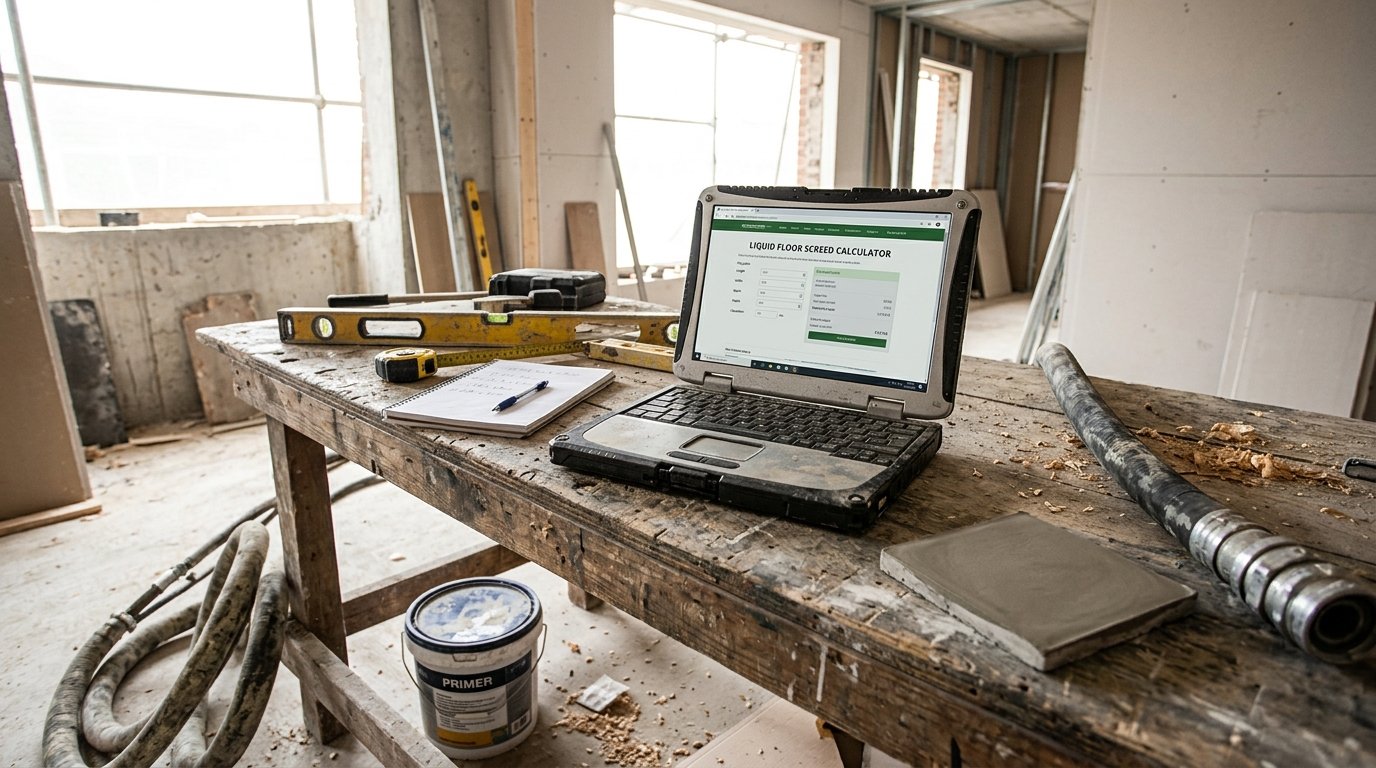
Liquid Floor Screed Calculator: Bags, Bulk & Pump Hire Costs
Liquid floor screed is one of those materials that changes completely depending on how you buy it. Self-levelling compound comes in 25 kg bags, mixed on site with water, and spread by hand. Flowing screed and anhydrite screed are delivered by tanker, pumped through a hose, and poured directly onto the floor — sometimes hundreds of square metres in a single day. Those are not the same product, and they are not estimated the same way. But most online calculators treat them identically, which leads to silent and expensive errors: 80 bags of flowing screed that do not exist, or a bulk order for a 15 m² bathroom where a bag makes more sense.
Our Liquid Floor Screed Calculator is a free online tool that estimates the volume and cost of liquid screed with delivery-mode awareness. It supports self-levelling compound, flowing screed and anhydrite screed, with a choice between bagged delivery and bulk pump delivery. It calculates screed mass, bag count or bulk volume, primer consumption for one or two coats, water requirement, pump hire, delivery, VAT and total installed cost per m². It also warns when the configuration is unusual — for example, choosing flowing screed in bagged mode, or using a coverage rate that does not match the selected type.
In this guide, we will show you how to use the calculator, explain each input and output, walk through four examples across bagged and pumped systems, and answer eight of the most frequently asked questions about liquid floor screed.
Liquid Floor Screed
Construction CalculatorLiquid / self-levelling screed: volume, bags or bulk, primer, pump hire, water and cost.
What is the Liquid Floor Screed Calculator?
The Liquid Floor Screed Calculator is a free online tool that estimates the quantity and cost of materials for a liquid screed installation. It supports:
- Input modes: length × width or direct area.
- Screed types: self-levelling compound, flowing screed, anhydrite / calcium sulfate.
- Thickness: typically 3–10 mm for self-levelling, 40–75 mm for flowing and anhydrite.
- Coverage: kg per m² per mm of thickness. Typically 1.5 for self-levelling, 2.0 for flowing / anhydrite. User override available.
- Delivery mode: bagged (25 kg) or bulk pump delivery (m³).
- Bag details: bag weight and water per bag (bagged mode only).
- Bulk details: minimum order volume and pump hire cost (bulk mode only).
- Primer: none, one coat, or two coats — with an 1.8× consumption factor for two coats.
- Pricing: bag price or bulk price per m³, primer per m², labour per m², delivery, VAT.
The output includes:
- Floor area and average thickness
- Screed volume in m³
- Screed mass with waste allowance
- Bag count and water requirement (bagged mode) or bulk order volume (bulk mode)
- Config check warning
- Itemised costs: screed, primer, labour, delivery
- VAT, grand total and cost per m²
The tool is part of a suite of flooring calculators available on our website. For related calculations, you can use our Epoxy Resin Floor Calculator, Raised Access Floor Calculator, Bamboo Flooring Calculator, and Carpet / Roll Flooring Calculator.
Why Accurate Liquid Screed Estimation Matters
Liquid screed is not a material you want to get wrong. It is applied wet, sets hard, and cannot be adjusted once it starts curing.
Bagged and Bulk Are Completely Different
Self-levelling compound is sold in 25 kg bags. Flowing screed and anhydrite screed are sold by the cubic metre, delivered by tanker, and pumped through a hose. A 20 m² floor at 5 mm thickness is around 150 kg of self-levelling compound — about 6 bags. The same 20 m² at 50 mm thickness with flowing screed is 2 m³ — about 4 tonnes. Those are not interchangeable. Using the wrong delivery mode gives either a 1000× error or a physically impossible order.
Coverage Per mm Varies by Type
Self-levelling compounds typically use around 1.5 kg per m² per mm of thickness. Flowing and anhydrite screeds are denser — closer to 2.0 kg/m²/mm — because they have a higher solids content. A 25% difference in coverage is a 25% difference in material cost, which for a large floor is thousands of pounds.
Water Is Only Relevant for Bagged Screed
Bagged screed is mixed on site with water (typically 4.5–5.5 L per 25 kg bag). Bulk screed arrives pre-mixed and does not need site water. The calculator only computes water for bagged mode, which is the right default.
Primer and Substrate Preparation
Most screeds need a primer — especially on porous substrates, which need two coats. The primer is a separate material with its own cost, and it is often forgotten at budget stage. The calculator includes it explicitly, with a consumption factor for one or two coats.
Bulk Minimums and Pump Hire
Bulk deliveries have a minimum volume — usually 1–2 m³ — because the tanker and pump have to be mobilised. If your room is smaller than the minimum, you pay for the minimum anyway. Pump hire is a separate fixed cost — often bundled with the delivery but sometimes invoiced separately. The calculator handles both.
Warning on Unusual Configurations
If a user selects flowing screed but keeps the default 1.5 kg/m²/mm coverage, or selects bagged delivery for a flowing screed, the calculator warns. This catches the most common mistakes before the order is placed.
Curing Time and Sequencing
Flowing screed needs 21+ days to dry before flooring is laid; self-levelling compound is ready for foot traffic in 2–4 hours but needs 24–48 hours before covering. This is not a cost item but it is a scheduling item — the calculator outputs the configuration check so you know whether your inputs are physically plausible.
For more information on liquid screed, you can refer to Wikipedia’s article on screed or the Liquid Screed Association.
How to Use the Liquid Floor Screed Calculator
Using the calculator is straightforward. Here is a breakdown of each field.
1. Area
- Input mode: “Length × width” or “Direct area”.
- Room length / width: Enter dimensions in meters or feet. Used when “Length × width” is selected.
- Area: Enter direct area in m² or ft². Used when “Direct area” is selected.
2. Screed
- Screed type: Select self-levelling, flowing, or anhydrite. Type drives the recommended coverage and labour multiplier.
- Average thickness: Enter in meters or inches. 0.005 m = 5 mm for self-levelling; 0.050 m = 50 mm for flowing.
- Coverage per mm: kg per m² per mm of thickness. Default 1.5 for self-levelling; use 2.0 for flowing and anhydrite.
- Waste allowance: Typically 8% — covers spillage and substrate undulations.
3. Delivery
- Delivery mode: Bagged (25 kg) or bulk pump delivery (m³).
- Bag weight: Typically 25 kg.
- Water per bag: Typically 4.5–5.5 L.
- Minimum bulk order: Typically 1–2 m³.
- Pump hire: Fixed cost. Set 0 if included in the bulk price.
4. Primer
- Primer: None, one coat, or two coats. Two coats is the correct specification for porous or highly absorbent substrates.
5. Pricing
- Bag price: Used only in bagged mode.
- Bulk price per m³: Used only in bulk mode.
- Primer price per m²: Used when a primer is selected.
- Labour price per m²: Local installation rate. Flowing screed takes longer than self-levelling because it needs a pump and specialist finishing.
- Delivery / skip: Optional fixed cost.
- VAT / tax rate: Applicable rate, or 0 if not applicable.
Once you enter all values, the calculator displays the full output, including volume, mass, bag count or bulk volume, primer, config warning, itemised costs, VAT, and cost per m².
Understanding the Calculations
To make the most of the calculator, it is important to understand each output and the underlying formulas.
Floor Area and Volume
area = length × width (dims) or direct area.
volume = area × thickness.
For 20 m² at 5 mm: 20 × 0.005 = 0.1 m³.
For 20 m² at 50 mm: 20 × 0.050 = 1 m³.
Screed Mass
mass_kg = area × thickness_mm × coverage × type multiplier × (1 + waste / 100).
Type multipliers:
- Self-levelling: 1.00
- Flowing: 1.05
- Anhydrite: 1.10
The type multiplier reflects the slightly higher density of flowing and anhydrite screeds compared with self-levelling compound.
Bagged Mode
bags = ceil(mass_kg / bag_kg).
water = bags × water_per_bag.
For 20 m² at 5 mm with 1.5 kg/m²/mm and 8% waste:
mass = 20 × 5 × 1.5 × 1.08 = 162 kg → 7 bags (7 × 25 = 175 kg).
Bulk Mode
bulk_m3 = volume × (1 + waste / 100).
If bulk_m3 < minimum, bulk_m3 = minimum.
screed_cost = bulk_m3 × bulk_price + pump_hire.
For 20 m² at 50 mm with 8% waste:
bulk_m3 = 1 × 1.08 = 1.08 m³ → 2 m³ if minimum is 2 m³.
Primer
primer_cost = area × primer_price × consumption factor.
Consumption factors:
- None: 0
- One coat: 1.0
- Two coats: 1.8 (a second coat uses 80% of the first, not 100%, because the substrate is already sealed).
Labour
labour_cost = area × labour rate × type multiplier.
Type multipliers:
- Self-levelling: 1.00
- Flowing: 1.10
- Anhydrite: 1.10
Flowing and anhydrite take longer because they need pump coordination, careful levelling and specialist finishing.
Config Check
The calculator performs three checks:
- Unusual mode: bagged delivery with flowing or anhydrite type.
- Thickness outside range: > 150 mm suggests a units error.
- Coverage mismatch: if coverage differs from the recommended value for the selected type by more than 0.4 kg/m²/mm.
The result appears as “Config OK” or a specific warning list.
VAT and Total
VAT = subtotal × VAT / 100.
Total = subtotal + VAT.
Cost per m² = total / area.
Understanding these components helps you interpret the results and adjust your order. For more information on liquid screed standards, you can refer to Wikipedia’s article on screed or the Liquid Screed Association.
Reference Table of Screed Coverage
| Screed type | Typical coverage (kg/m²/mm) | Typical thickness |
|---|---|---|
| Self-levelling compound | 1.5 | 3–10 mm |
| Flowing screed | 2.0 | 40–75 mm |
| Anhydrite screed | 2.0 | 40–75 mm |
Example Calculations
Let’s run through four examples across bagged and pumped systems.
Example 1: Bathroom Self-Levelling, 12 m², 5 mm
Inputs:
- Area: 4 m × 3 m → 12 m²
- Type: Self-levelling
- Thickness: 5 mm
- Coverage: 1.5 kg/m²/mm
- Waste: 8%
- Delivery: Bagged, 25 kg, water 5 L/bag
- Primer: One coat at $1.50/m²
- Bag price: $18
- Labour: $12/m²
- VAT: 20%
Calculations:
- Volume = 12 × 0.005 = 0.06 m³
- Mass = 12 × 5 × 1.5 × 1.08 = 97.2 kg
- Bags = ceil(97.2 / 25) = 4 bags
- Water = 4 × 5 = 20 L
- Screed cost = 4 × $18 = $72
- Primer = 12 × $1.50 × 1.0 = $18
- Labour = 12 × $12 × 1.00 = $144
- Subtotal = $234
- VAT = $46.80
- Total = $280.80
- Cost per m² = $23.40
- Config: OK
Example 2: Large Open-Plan Flowing Screed, 120 m², 50 mm, Bulk
Inputs:
- Area: 12 m × 10 m → 120 m²
- Type: Flowing
- Thickness: 50 mm
- Coverage: 2.0 kg/m²/mm
- Waste: 8%
- Delivery: Bulk, minimum 2 m³, pump hire $250
- Primer: Two coats at $2.50/m²
- Bulk price: $160/m³
- Labour: $18/m²
- Delivery: $400
- VAT: 20%
Calculations:
- Volume = 120 × 0.05 = 6 m³
- Bulk volume = 6 × 1.08 = 6.48 m³
- Mass = 120 × 50 × 2.0 × 1.05 × 1.08 = 13,608 kg (13.6 t)
- Screed cost = 6.48 × $160 + $250 = $1,286.80
- Primer = 120 × $2.50 × 1.8 = $540
- Labour = 120 × $18 × 1.10 = $2,376
- Delivery = $400
- Subtotal = $4,602.80
- VAT = $920.56
- Total = $5,523.36
- Cost per m² = $46.03
- Config: OK
Example 3: Small Anhydrite Floor in Bagged Mode — Warn
Inputs:
- Area: 25 m²
- Type: Anhydrite
- Thickness: 40 mm
- Coverage: 2.0
- Delivery: Bagged, 25 kg
- Bag price: $22
- Primer: One coat at $2/m²
- Labour: $16/m²
- VAT: 20%
Calculations:
- Volume = 25 × 0.04 = 1 m³
- Mass = 25 × 40 × 2.0 × 1.10 × 1.08 = 2,376 kg
- Bags = 96
- Screed cost = 96 × $22 = $2,112
- Primer = 25 × $2 × 1.0 = $50
- Labour = 25 × $16 × 1.10 = $440
- Subtotal = $2,602
- VAT = $520.40
- Total = $3,122.40
- Config: “Bagged anhydrite screed is unusual — typically pumped”
The warning flags that the user has made a design choice that is likely to be more expensive and logistically harder than necessary.
Example 4: Coverage Mismatch — Warn
Same as Example 1 but user leaves coverage at 1.5 while selecting flowing screed:
- Config check: “Coverage deviates from typical 2.0 kg/m²/mm for flowing”
- User is warned that the default may not be correct for the selected type.
- The cost calculation still runs, but the user knows to verify the coverage figure against the datasheet.
Benefits of Using the Liquid Floor Screed Calculator
Tips for Accurate Liquid Screed Estimation
- Choose the correct delivery mode. Self-levelling is bagged; flowing and anhydrite are pumped.
- Read the datasheet. Coverage figures vary by 20–30% between manufacturers — always confirm.
- Allow for waste. 8% is typical; 10% for undulating or absorbent substrates.
- Include primer. One or two coats — two for porous substrates.
- Check bulk minimums. Small floors may need to round up to the minimum order.
- Check pump hire separately. Some suppliers include it, some don’t.
- Verify thickness. Below 3 mm is unusual for self-levelling; above 75 mm for flowing screed is unusual.
- Plan curing time. Flowing screed needs 21+ days before flooring; self-levelling 24–48 hours.
- Use the config warning. It catches the most common errors before you order.
- Do not forget delivery and VAT. Both add real cost.
- Get multiple quotes. Screed prices vary significantly by region and supplier.
- Verify with the installer. For large or commercial projects, have a liquid screed specialist confirm the design.
For more information on liquid screed standards, you can refer to the Liquid Screed Association or Wikipedia’s article on screed.
Common Mistakes to Avoid
- Ordering flowing screed in bags. It doesn’t exist — flowing screed is bulk-only.
- Using self-levelling coverage for flowing screed. 1.5 vs 2.0 kg/m²/mm is a 25% under-order.
- Forgetting primer. Especially two coats on porous substrates.
- Ignoring bulk minimums. A 0.5 m³ order becomes a 2 m³ delivery — and a 2 m³ charge.
- Skipping pump hire. Often a separate cost from the bulk material.
- No waste allowance. 8% is realistic.
- Using the wrong thickness unit. 5 mm is 0.005 m, not 0.5 m — check the input.
- Not checking curing time. Flowing screed needs 21+ days before flooring.
- No delivery or VAT. Both significantly change the total bill.
- Choosing type by price alone. Flowing screed is easier to level but takes longer to dry.
How to Reduce Liquid Screed Costs
If your estimate is higher than expected, here are ways to reduce costs without compromising quality:
- Choose self-levelling over flowing screed for thin applications. Cheaper per kg and per m².
- Use the minimum acceptable thickness. Self-levelling can go as low as 3 mm in some products.
- Skip the second primer coat if the substrate is not porous. Check the datasheet.
- Combine deliveries. Bulk orders are cheaper per m³ for larger volumes.
- Do the primer yourself. It is simple to apply and saves labour.
- Compare suppliers. Bulk prices vary 20–30%.
- Order in bulk. If you have multiple rooms, one bulk order is cheaper.
- Time the project off-season. Contractors sometimes offer better rates.
- Verify VAT treatment. Some industrial applications may have different rules.
- Get multiple quotes. Compare at least three suppliers.
Frequently Asked Questions (FAQ)
Conclusion
The Liquid Floor Screed Calculator is an essential tool for contractors, specifiers, homeowners, and installers. It estimates volume, mass, bag count or bulk volume, primer, water, pump hire, delivery, VAT and total installed cost per m² — with delivery-mode awareness and configuration checks that catch the most common mistakes before ordering.
Whether you are levelling a bathroom with a few bags of self-levelling compound or installing a large flowing screed floor delivered by tanker, accurate estimation is the foundation of a durable, compliant, and cost-effective installation. Try the Liquid Floor Screed Calculator today and take the guesswork out of your liquid screed project.




2 Comments