Spray Foam Insulation Calculator: 3 Steps to Estimate Kits & Cost
Spray foam insulation is the highest-performance insulation material available for most residential and commercial applications. It seals every gap, fills every irregular cavity, and provides both thermal insulation and air barrier in a single application. Closed-cell spray foam gives R-values that no other commonly available material can match at the same thickness, and open-cell spray foam provides acoustic damping and cost-effective thermal performance. But spray foam is also the most expensive insulation per m², the most demanding to install, and the most sensitive to specification errors. Over-order the kits and you waste hundreds of pounds on unused chemicals. Under-order and the pour stalls mid-job, leaving a partially insulated wall that fails inspection.
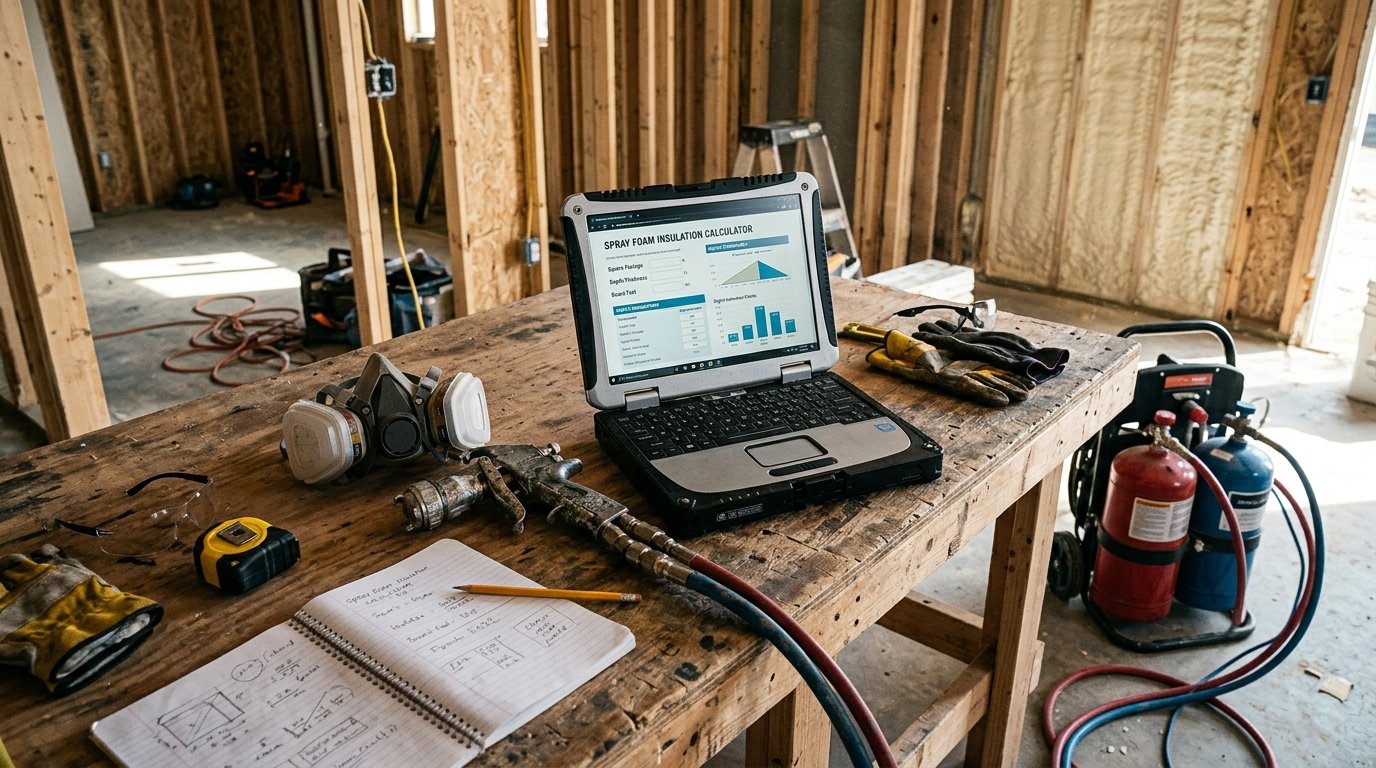
Our Spray Foam Insulation Calculator is a free online tool that estimates the materials and costs of a spray foam installation. It handles walls, roofs, floors, attics, and closed cavities; open-cell, closed-cell, and hybrid foams; and it calculates board feet, kit count from kit yield, foam mass from density, R-value from λ, masking and protection, labour with application multipliers, delivery, VAT and cost per m². It also flags six common design errors — zero kit yield, missing kit price, missing labour rate, thickness below 50 mm or above 300 mm, and R-value below 1.5 — before you order.
In this guide, we will show you how to use the calculator, explain each input and output, walk through four examples across foam types and applications, and answer eight of the most frequently asked questions about spray foam insulation.
Spray Foam Insulation
Construction CalculatorSpray foam insulation: area, thickness, foam kits, density, R-value, mass and cost.
What is the Spray Foam Insulation Calculator?
The Spray Foam Insulation Calculator is a free online tool that estimates the quantity and cost of materials for a spray polyurethane foam (SPF) installation. It supports:
- Area: length × width of the surface to be sprayed.
- Application: walls, roof/rafters, floor/joists, attic ceiling, or cavity.
- Foam types: open-cell (8 kg/m³, λ 0.038), closed-cell (32 kg/m³, λ 0.024), hybrid (18 kg/m³, λ 0.030).
- Target thickness: typically 100–200 mm for roofs.
- Overspray/waste allowance: typically 5–15%.
- Kit yield: measured in board feet (bf) — usually 200–600 bf per two-component kit.
- Pricing: kit price, masking per m², labour per m², delivery, VAT.
The output includes:
- Area
- Foam volume in m³
- Board feet required (with waste)
- Foam mass in kg
- R-value in m²K/W
- Kits required
- Design check warning
- Itemised costs: foam, masking, labour, delivery
- VAT, grand total and cost per m²
The tool is part of a suite of insulation calculators available on our website. For related calculations, you can use our Wall Insulation Calculator, Roof Insulation Calculator, Underfloor Insulation Calculator, and Cavity Wall Insulation Calculator.
Why Accurate Spray Foam Estimation Matters
Spray foam is not a commodity. It is a specialist trade, a two-component chemical reaction, and a material whose performance depends entirely on how it is mixed, sprayed, and cured. Estimating it wrong is a five-figure mistake on a typical house.
Board Feet Is the Industry Unit
Spray foam kits are sold by board feet (bf), not by m² or by kg. One board foot is 1 ft² × 1 inch thick — which is 0.002359737 m³. A 600 bf kit applied at 1 inch covers 600 ft² (about 55.7 m²); the same kit applied at 100 mm (3.94 inches) covers only 14.1 m². The corrected calculator converts volume to board feet using the correct constant, applies the waste allowance, and divides by the kit yield to get an accurate kit count.
Density and λ Differ by Foam Type
Open-cell foam is 8 kg/m³ with λ ≈ 0.038 W/m·K. Closed-cell foam is 32 kg/m³ with λ ≈ 0.024. Hybrid is around 18 kg/m³ with λ ≈ 0.030. That means 100 mm of closed-cell gives R ≈ 4.17 m²K/W while 100 mm of open-cell gives R ≈ 2.63. Same thickness, completely different performance — and completely different mass. The corrected calculator reads the foam type and applies the correct density and λ.
R-Value Is the Real Performance Measure
Spray foam is often specified by thickness — “100 mm closed-cell” — but the thermal performance depends on the R-value. Below R 1.5 m²K/W, the insulation rarely justifies its cost. The corrected calculator computes R from thickness and λ and warns when it falls below 1.5.
Mass Matters for Structure and Shipping
Closed-cell foam at 100 mm and 48 m² is 153.6 kg of cured material. Open-cell is only 38.4 kg. The mass matters for roof structure, for shipping the kits, and for the chemical load in the space during application. The corrected calculator outputs foam mass for structural checks.
Application Affects Labour
Spraying a cavity is slower than spraying a wall. Spraying a roof at head height is slower than spraying a wall at chest height. The corrected calculator applies an application multiplier: walls 1.00, attic 1.05, floor 1.10, roof 1.15, cavity 1.20.
Masking and Protection Are Real Costs
Spray foam overspray sticks to everything. Masking, polythene, and protection of adjacent surfaces are real costs — typically £2–£5/m². The corrected calculator includes masking as a line item, so it is not forgotten.
Kits Have Minimum Order Quantities
Spray foam kits are sold in fixed sizes. A 12 m² job might need only 1 kit of 200 bf, but a 48 m² job may need 4 kits — and you cannot buy 3.4 kits. The corrected calculator rounds up to whole kits and warns when the kit yield is zero.
VAT and Delivery
Spray foam kits are hazmat-classified in many jurisdictions, with specific shipping charges. VAT applies at 20% in the UK. Both are included.
For more information on spray foam insulation, you can refer to Wikipedia’s article on spray foam or the Spray Polyurethane Foam Alliance (SPFA).
How to Use the Spray Foam Insulation Calculator
Using the calculator is straightforward. Here is a breakdown of each field.
1. Area
- Area length / width: Enter dimensions in meters or feet.
2. Application
- Application: Walls, roof/rafters, floor/joists, attic ceiling, or cavity. Affects the labour multiplier.
3. Foam
- Foam type: Open-cell, closed-cell, or hybrid. Sets density and λ.
- Thickness: Typically 100–200 mm for roofs.
- Waste allowance: 10% typical for overspray and clean-up.
4. Kit
- Kit yield: Board feet per kit — check the datasheet. Typical: 200 bf (small), 600 bf (standard), 2000 bf (large).
5. Pricing
Enter local prices for each component. Leave 0 to skip.
6. Extras
- Delivery / consumables: Fixed cost.
- VAT / tax rate: Applicable rate, or 0.
Once you enter all values, the calculator displays the full output, including area, foam volume, board feet, mass, R-value, kits, design check, itemised costs, VAT, total and cost per m².
Understanding the Calculations
To make the most of the calculator, it is important to understand each output and the underlying formulas.
Area and Volume
area = length × width.
volume = area × thickness.
Board Feet
bf = volume / 0.002359737.
bf_waste = bf × (1 + waste / 100).
Foam Mass
mass_kg = volume × density.
Densities:
- Open-cell: 8 kg/m³
- Hybrid: 18 kg/m³
- Closed-cell: 32 kg/m³
R-Value
R = thickness / λ.
λ values:
- Closed-cell: 0.024
- Hybrid: 0.030
- Open-cell: 0.038
At 100 mm:
- Closed-cell: R 4.17
- Hybrid: R 3.33
- Open-cell: R 2.63
Kits
kits = ceil(bf_waste / kit yield).
Masking and Labour
masking_cost = area × masking price per m².
labour_cost = area × labour rate × application multiplier.
Application multipliers:
- Walls: 1.00
- Attic: 1.05
- Floor: 1.10
- Roof: 1.15
- Cavity: 1.20
Design Check
The calculator performs six checks:
- Kit yield zero.
- Kit price zero.
- Labour rate zero.
- Thickness below 50 mm.
- Thickness above 300 mm.
- R-value below 1.5.
VAT and Total
VAT = subtotal × VAT / 100.
Total = subtotal + VAT.
Cost per m² = total / area.
Understanding these components helps you interpret the results and adjust your order. For more information on spray foam standards, you can refer to the Spray Polyurethane Foam Alliance (SPFA) or Wikipedia’s article on spray foam.
Reference Table of Foam Types
| Type | Density (kg/m³) | λ (W/m·K) | R at 100 mm | Mass at 100 mm |
|---|---|---|---|---|
| Open-cell | 8 | 0.038 | 2.63 | 0.8 kg/m² |
| Hybrid | 18 | 0.030 | 3.33 | 1.8 kg/m² |
| Closed-cell | 32 | 0.024 | 4.17 | 3.2 kg/m² |
Example Calculations
Let’s run through four examples across foam types and applications.
Example 1: Roof / Rafters, 48 m², 100 mm Closed-Cell
Inputs:
- Area: 8 × 6 m → 48 m²
- Application: Roof
- Foam: Closed-cell, 100 mm
- Waste: 10%
- Kit yield: 600 bf
- Masking: $3/m²
- Labour: $25/m²
- Kit price: $450
- Delivery: $120
- VAT: 20%
Calculations:
- Volume = 48 × 0.10 = 4.8 m³
- Board feet = 4.8 / 0.002359737 = 2034 bf
- With 10% waste: 2237 bf
- Kits = ceil(2237 / 600) = 4
- Foam cost = 4 × $450 = $1,800
- Mass = 4.8 × 32 = 153.6 kg
- R = 0.10 / 0.024 = 4.17 ✓
- Masking = 48 × $3 = $144
- Labour = 48 × $25 × 1.15 = $1,380
- Delivery = $120
- Subtotal = $3,444
- VAT = $688.80
- Total = $4,132.80
- Cost per m² = $86.10
- Design: OK
Example 2: Walls, 22 m², 150 mm Closed-Cell
Inputs:
- Area: 22 m²
- Application: Walls
- Foam: Closed-cell, 150 mm
- Waste: 10%
- Kit yield: 600 bf
- Masking: $2/m²
- Labour: $28/m²
- Kit price: $450
- Delivery: $80
- VAT: 20%
Calculations:
- Volume = 22 × 0.15 = 3.3 m³
- bf = 3.3 / 0.002359737 = 1398 bf; waste → 1538 bf
- Kits = ceil(1538 / 600) = 3
- Foam cost = 3 × $450 = $1,350
- Mass = 3.3 × 32 = 105.6 kg
- R = 0.15 / 0.024 = 6.25 ✓
- Masking = 22 × $2 = $44
- Labour = 22 × $28 × 1.00 = $616
- Delivery = $80
- Subtotal = $2,090
- VAT = $418
- Total = $2,508
- Cost per m² = $114.00
Example 3: Attic Ceiling, 60 m², 200 mm Open-Cell
Inputs:
- Area: 60 m²
- Application: Attic
- Foam: Open-cell, 200 mm
- Waste: 10%
- Kit yield: 600 bf
- Masking: $1.50/m²
- Labour: $18/m²
- Kit price: $250
- Delivery: $60
- VAT: 20%
Calculations:
- Volume = 60 × 0.20 = 12 m³
- bf = 12 / 0.002359737 = 5085 bf; waste → 5594 bf
- Kits = ceil(5594 / 600) = 10
- Foam cost = 10 × $250 = $2,500
- Mass = 12 × 8 = 96 kg
- R = 0.20 / 0.038 = 5.26 ✓
- Masking = 60 × $1.50 = $90
- Labour = 60 × $18 × 1.05 = $1,134
- Delivery = $60
- Subtotal = $3,784
- VAT = $756.80
- Total = $4,540.80
- Cost per m² = $75.68
Example 4: Kit Yield Zero — Warning
Same as Example 1 but kit_bf = 0:
- Warning: «Kit yield is zero — no kits can be calculated»
- Kits = 0, foam cost = $0, but the design cannot be built as specified.
Benefits of Using the Spray Foam Insulation Calculator
Tips for Accurate Spray Foam Insulation Estimation
- Read the kit datasheet. Kit yield varies from 200 bf (small) to 2000 bf (large), and applied thickness changes the effective coverage dramatically.
- Confirm the foam type. Closed-cell gives the highest R-value per inch and is the standard for roofs. Open-cell is cheaper and better for acoustic damping.
- Target R ≥ 1.5 minimum. UK Building Regs typically require higher R-values — 3.5 to 6.0 depending on the element — but the calculator flags anything below 1.5 as effectively useless.
- Choose the application correctly. Roofs are slower than walls; cavities are slower still.
- Allow 10% waste. Spray foam oversprays and cleans up — the extra kit is real.
- Include masking. Overspray sticks to everything. Masking is not optional.
- Confirm the labour rate. Spray foam requires certified installers — the rate is typically £20–£40/m².
- Check the mass on roofs. 150 kg of closed-cell foam on a 48 m² roof is significant.
- Do not forget delivery. Kits are hazmat in many places — delivery is often £80–£150 per order.
- Do not forget VAT. 20% VAT applies in the UK, or 5% for qualifying energy-saving materials — check locally.
- Order one spare kit. Rounding up already happens in the calculator, but a small margin avoids mid-job stalls.
- Verify with a professional. For complex or structural work, have a spray foam specialist verify the specification.
For more information on spray foam standards, you can refer to the Spray Polyurethane Foam Alliance (SPFA) or Wikipedia’s article on spray foam.
Common Mistakes to Avoid
- Using m² instead of board feet. Kits are sold in bf — area-based kits will under- or over-order.
- Ignoring the applied thickness. A 600 bf kit covers 55 m² at 1 inch but only 14 m² at 100 mm.
- Skipping masking. Overspray damage is expensive to fix.
- Using the wrong foam type. Open-cell on a roof gives much lower R-value.
- Underestimating labour. Spray foam requires certified installers, not general labour.
- No VAT or delivery. Both add real cost.
- Ordering exactly the calculated kits. Always round up — the calculator does this automatically.
- Choosing by price alone. Cheap foam kits often have lower yield or shorter shelf life.
- Ignoring the R-value. Thickness alone means nothing.
- No professional verification on structural or hazardous work.
How to Reduce Spray Foam Insulation Costs
If your estimate is higher than expected, here are ways to reduce costs without compromising performance:
- Choose open-cell over closed-cell where R allows. Half the density, half the cost.
- Reduce thickness. Match the thickness to the R-value target, not to the maximum possible.
- Do the masking yourself. Polythene and tape are cheap; labour is not.
- Combine deliveries. Multiple kits in one delivery reduce shipping per unit.
- Compare suppliers. Kits vary 20–30% between brands.
- Check for grants. ECO and local authority grants can cover part of the cost.
- Time the project off-season. Contractors sometimes offer better rates.
- Get multiple quotes. Compare at least three certified installers.
- Verify VAT treatment. Energy-saving materials may qualify for reduced rates.
- Use smaller kits for small areas. A 200 bf kit can complete a small job where a 600 bf kit would over-order.
Frequently Asked Questions (FAQ)
Conclusion
The Spray Foam Insulation Calculator is an essential tool for homeowners, contractors, and specifiers. It estimates area, foam volume, board feet, mass, R-value, kits, masking, labour, delivery, VAT and cost per m² — with six design warnings that catch the most common errors before ordering.
The corrected calculator now reads the foam type, applies the correct density and λ to give real R-value and mass, converts volume to board feet using the industry-standard constant, includes masking and application-specific labour multipliers, and warns on zero kit yield, missing prices, or thickness outside the useful range. Whether you are spraying 48 m² of closed-cell roof or 60 m² of open-cell attic, accurate estimation is the foundation of a well-sealed, thermally efficient installation. Try the Spray Foam Insulation Calculator today and take the guesswork out of your spray foam project.