
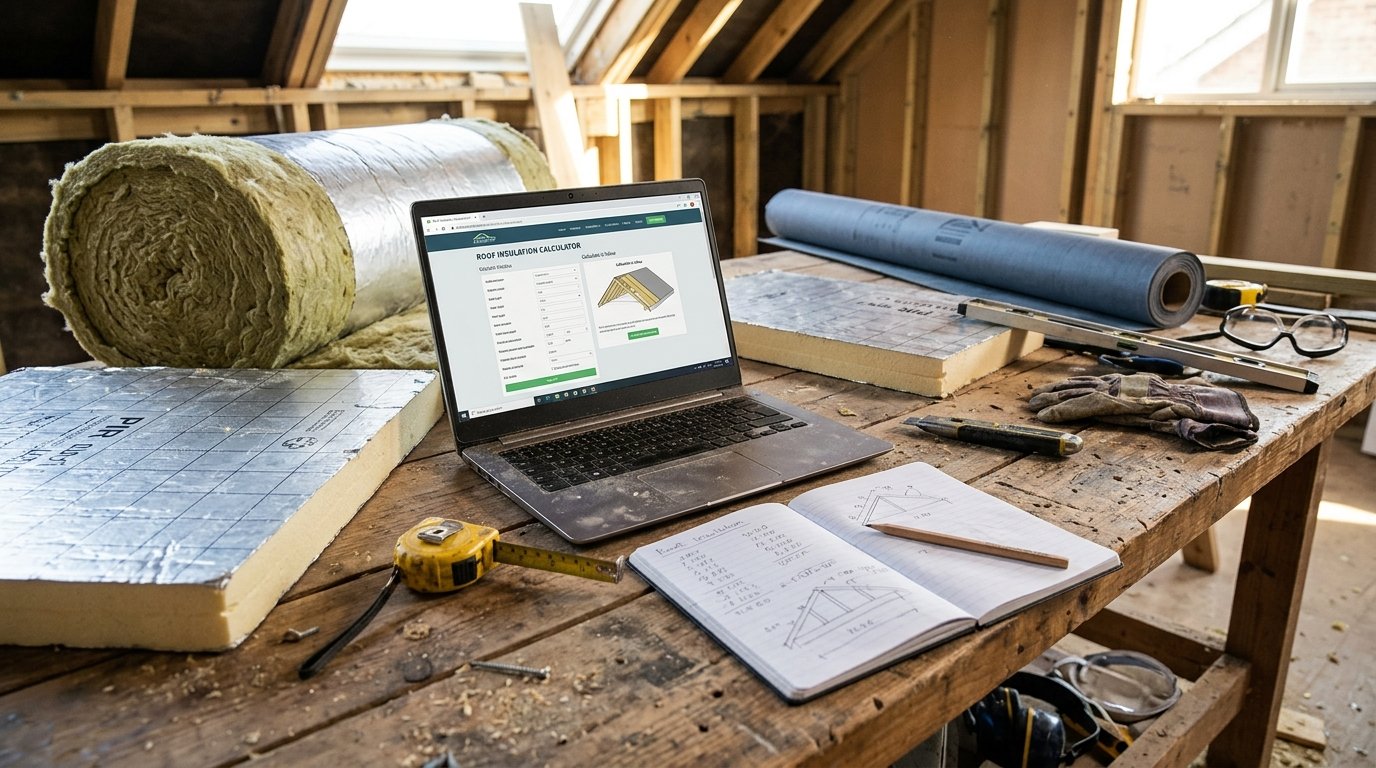
Roof Insulation Calculator: Packs, R-Value, Membrane & Cost
Roof insulation is the largest single heat loss path in an uninsulated house — up to 30% of heating energy escapes through the roof. It is also the insulation project with the most choice: warm roof or cold roof, rafter-level or ceiling-level, mineral wool, PIR, wood fibre, sheep wool or spray foam. Each combination has a different thermal performance, a different labour profile, and — crucially — a different condensation risk if the vapour barrier or breathable membrane is specified incorrectly.
Our Roof Insulation Calculator is a free online tool that estimates the materials and costs of a roof insulation installation. It handles gable, hip, and shed roof geometries; warm, cold, and loft methods; and six insulation types including mineral wool, PIR, EPS, wood fibre, sheep wool, and spray foam. It calculates roof surface area from ridge length and slope length (with the correct number of planes per roof type), R-value from material λ and thickness, insulation mass, breathable membrane and tape length, fixings, labour with method and material multipliers, delivery, VAT and cost per m². It also flags six common design errors — low R-value, thickness outside range, cold or warm roof without a breathable membrane, spray foam specified from packs, and missing pack price — before you order.
In this guide, we will show you how to use the calculator, explain each input and output, walk through four examples across methods and materials, and answer eight of the most frequently asked questions about roof insulation.
Roof Insulation
Construction CalculatorRoof insulation: rafter or loft, packs, membrane with overlap, fixings, R-value, mass and cost.
What is the Roof Insulation Calculator?
The Roof Insulation Calculator is a free online tool that estimates the quantity and cost of materials for a roof insulation installation. It supports:
- Roof geometry: length (ridge), slope length, and roof type (gable, hip, shed) — used to compute the actual roof surface area.
- Insulation method: warm roof (above rafters), cold roof (between rafters), or loft roll (between ceiling joists).
- Insulation types: mineral wool (λ 0.035, 30 kg/m³), PIR (λ 0.022, 35 kg/m³), EPS (λ 0.038, 20 kg/m³), wood fibre (λ 0.038, 160 kg/m³), sheep wool (λ 0.040, 25 kg/m³), spray foam (λ 0.025, 10 kg/m³) — each with its own R-value, mass and labour multiplier.
- Insulation thickness: typically 200–300 mm.
- Pack coverage: m² per pack at the chosen thickness.
- Waste allowance: typically 5%.
- Pricing: pack price, breathable membrane per m², tape per linear metre, fixings per m², labour per m², delivery, VAT.
The output includes:
- Roof surface area and area with waste
- R-value in m²K/W
- Insulation mass in kg
- Packs required
- Tape length
- Design check warning
- Itemised costs: insulation, membrane, tape, fixings, labour, delivery
- VAT, grand total and cost per m²
The tool is part of a suite of insulation calculators available on our website. For related calculations, you can use our Loft Roll Insulation Calculator, Roof Terrace Insulation Calculator, Cavity Wall Insulation Calculator, and External Wall Insulation Calculator.
Why Accurate Roof Insulation Estimation Matters
Roof insulation is one of the highest-return energy efficiency measures — but it is also one of the most specification-sensitive.
Roof Area Is Not Plan Area
The roof surface area is not the same as the floor plan area. It depends on the pitch and the number of planes. A gable roof has two rectangular slopes; a hip roof has two trapezoids and two triangles; a shed roof has one slope. The corrected calculator computes roof surface area as ridge length × slope length × number of planes — where gable and hip both count as 2 planes (their total area is approximately equal), and shed counts as 1. For a 10 m ridge with 6 m slope length, a gable roof has 120 m² of surface, not 60 m².
Warm, Cold, and Loft Are Different Jobs
A warm roof sits above the rafters — it requires a breathable membrane over the deck, PIR boards cut to fit, and counter-battens. A cold roof sits between the rafters — it requires a breathable membrane under the tiles, mineral wool cut to fit between the rafters, and careful ventilation. A loft roll sits on the ceiling joists — the simplest and fastest of the three. Labour multipliers reflect this: warm 1.20×, cold 1.00×, loft 0.75×.
R-Value Is the Real Measure
Thickness alone tells you nothing about thermal performance. R-value — thickness divided by λ — does. At 200 mm, PIR gives R ≈ 9.09 m²K/W; mineral wool gives R ≈ 5.71; wood fibre gives R ≈ 5.26. UK Building Regulations typically require a roof U-value of 0.16–0.18 W/m²K for new build and 0.25 for refurbishment — which corresponds to R 6.0–6.5 depending on the buildup. The corrected calculator warns when R falls below 6.0.
Mass Matters for Rafters
Insulation weight varies by material. At 200 mm thickness, mineral wool weighs about 6 kg/m², wood fibre 32 kg/m², spray foam 2 kg/m². On a 120 m² roof, that is 240 kg for spray foam up to 3,840 kg for wood fibre. Older rafters may need checking against the added load.
Breathable Membrane Is Not Optional
Warm and cold roofs both require a breathable membrane to prevent condensation from forming in the insulation or on the cold roof deck. Without it, moisture accumulates, degrades the insulation, and rots the timbers. The corrected calculator warns when the membrane price is left at zero for a warm or cold roof.
Tape Seals the Membrane Joints
Membrane strips must be taped at the laps to maintain the vapour-permeable barrier. Tape length is roughly 1.5 × the perimeter of the covered area — the multiplier accounts for both the outer perimeter and the internal overlaps.
Spray Foam Is Specialist-Installed
Spray foam is applied by a specialist with a rig and is priced by m² or by volume, not by packs. The corrected calculator warns when spray foam is selected — the estimate is approximate.
VAT and Delivery
Insulation packs are bulky but light, and delivery is often palletised. VAT applies at 20% in the UK or 5% for qualifying energy-saving materials. The corrected calculator includes both.
For more information on roof insulation standards, you can refer to Wikipedia’s article on building insulation or the Energy Saving Trust.
How to Use the Roof Insulation Calculator
Using the calculator is straightforward. Here is a breakdown of each field.
1. Roof
- Roof length (ridge): Enter the ridge length in meters or feet.
- Roof slope length: Enter the length of one slope (rafter length), in meters or feet.
- Roof type: Gable (2 planes), hip (2 planes equivalent), or shed (1 plane).
2. Method
- Insulation method: Warm roof, cold roof, or loft roll. Determines labour multiplier and membrane requirement.
3. Insulation
- Insulation type: Mineral wool, PIR, EPS, wood fibre, sheep wool, or spray foam.
- Thickness: Typically 200–300 mm for roofs.
4. Pack
- Pack coverage: m² per pack at the chosen thickness.
- Waste allowance: 5% typical; 8% for complex roofs with many penetrations.
5. Pricing
Enter local prices for each component. Leave 0 to skip.
6. Extras
- Delivery / skip: Fixed cost.
- VAT / tax rate: Applicable rate, or 0.
Once you enter all values, the calculator displays the full output, including roof area, R-value, mass, packs, tape length, design check, itemised costs, VAT, total and cost per m².
Understanding the Calculations
To make the most of the calculator, it is important to understand each output and the underlying formulas.
Roof Surface Area
area = ridge length × slope length × number of planes.
Number of planes:
- Gable: 2
- Hip: 2 (approximate; hip area is close to gable area for the same plan)
- Shed: 1
For 10 m ridge × 6 m slope length, gable roof = 120 m².
Area with Waste
area_waste = area × (1 + waste / 100).
Packs
packs = ceil(area_waste / pack coverage).
R-Value
R = thickness (m) / λ (W/m·K).
λ values:
- PIR: 0.022
- Spray foam: 0.025
- Mineral wool: 0.035
- EPS / wood fibre: 0.038
- Sheep wool: 0.040
At 200 mm:
- PIR: 9.09
- Spray foam: 8.00
- Mineral wool: 5.71
- EPS / wood fibre: 5.26
- Sheep wool: 5.00
Insulation Mass
mass_kg = area × thickness × density.
Densities:
- Spray foam: 10 kg/m³
- EPS: 20 kg/m³
- Sheep wool: 25 kg/m³
- Mineral wool: 30 kg/m³
- PIR: 35 kg/m³
- Wood fibre: 160 kg/m³
Breathable Membrane
memb_cost = area × membrane price (only when price is entered).
Tape Length
perimeter = 2 × (length + width) × planes.
tape_len = perimeter × 1.5 (accounts for internal overlaps).
Fixings
fix_cost = area × fixings price per m².
Labour
labour_cost = area × labour rate × method multiplier × material multiplier.
Method multipliers:
- Warm: 1.20
- Cold: 1.00
- Loft: 0.75
Material multipliers:
- EPS: 0.95
- Mineral: 1.00
- PIR: 1.00
- Sheep wool: 1.10
- Wood fibre: 1.15
- Spray foam: 1.40
Design Check
The calculator performs six checks:
- R-value below 6.0.
- Thickness below 100 mm.
- Thickness above 400 mm.
- Cold roof without breathable membrane.
- Warm roof without breathable membrane.
- Spray foam selected.
- Packs required but price is zero.
VAT and Total
VAT = subtotal × VAT / 100.
Total = subtotal + VAT.
Cost per m² = total / area.
Understanding these components helps you interpret the results and adjust your order. For more information on roof insulation standards, you can refer to the Energy Saving Trust or Wikipedia’s article on building insulation.
Reference Table of Insulation Types
| Material | λ (W/m·K) | Density (kg/m³) | R at 200 mm | Mass at 200 mm | Labour |
|---|---|---|---|---|---|
| PIR | 0.022 | 35 | 9.09 | 7.0 kg/m² | 1.00 |
| Spray foam | 0.025 | 10 | 8.00 | 2.0 kg/m² | 1.40 |
| Mineral wool | 0.035 | 30 | 5.71 | 6.0 kg/m² | 1.00 |
| EPS | 0.038 | 20 | 5.26 | 4.0 kg/m² | 0.95 |
| Wood fibre | 0.038 | 160 | 5.26 | 32 kg/m² | 1.15 |
| Sheep wool | 0.040 | 25 | 5.00 | 5.0 kg/m² | 1.10 |
Example Calculations
Let’s run through four examples across methods and materials.
Example 1: Standard Cold Roof, 10 × 6 m Gable, 200 mm Mineral Wool
Inputs:
- Ridge: 10 m
- Slope: 6 m
- Roof type: Gable
- Method: Cold
- Insulation: Mineral wool 200 mm
- Pack coverage: 4 m²
- Waste: 5%
- Membrane: $2.50/m²
- Tape: $0.80/m
- Fixings: $1.50/m²
- Labour: $18/m²
- Delivery: $80
- VAT: 20%
Calculations:
- Area = 10 × 6 × 2 = 120 m²; waste → 126 m²
- Packs = ceil(126 / 4) = 32
- Insulation cost = 32 × $35 = $1,120
- R = 0.200 / 0.035 = 5.71 → warning (< 6.0)
- Mass = 120 × 0.20 × 30 = 720 kg
- Membrane = 120 × $2.50 = $300
- Perimeter = 2 × (10 + 6) × 2 = 64 m; tape length = 96 m → $76.80
- Fixings = 120 × $1.50 = $180
- Labour = 120 × $18 × 1.00 × 1.00 = $2,160
- Delivery = $80
- Subtotal = $3,916.80
- VAT = $783.36
- Total = $4,700.16
- Cost per m² = $39.17
- Design: R-value warning
Example 2: Warm Roof, 8 × 5 m Gable, 240 mm PIR
Inputs:
- Ridge: 8 m
- Slope: 5 m
- Roof type: Gable
- Method: Warm
- Insulation: PIR 240 mm
- Pack coverage: 2.88 m²
- Waste: 5%
- Membrane: $3/m²
- Tape: $0.90/m
- Fixings: $2/m²
- Labour: $22/m²
- Delivery: $100
- VAT: 20%
Calculations:
- Area = 8 × 5 × 2 = 80 m²; waste → 84 m²
- Packs = ceil(84 / 2.88) = 30
- Insulation cost = 30 × $55 = $1,650
- R = 0.240 / 0.022 = 10.91 ✓
- Mass = 80 × 0.24 × 35 = 672 kg
- Membrane = 80 × $3 = $240
- Perimeter = 2 × (8 + 5) × 2 = 52 m; tape = 78 m → $70.20
- Fixings = 80 × $2 = $160
- Labour = 80 × $22 × 1.20 × 1.00 = $2,112
- Delivery = $100
- Subtotal = $4,332.20
- VAT = $866.44
- Total = $5,198.64
- Cost per m² = $64.98
- Design: OK
Example 3: Shed Roof, 6 × 4 m, 200 mm Wood Fibre, Cold
Inputs:
- Ridge: 6 m
- Slope: 4 m
- Roof type: Shed
- Method: Cold
- Insulation: Wood fibre 200 mm
- Pack coverage: 2.5 m²
- Waste: 5%
- Membrane: $3/m²
- Tape: $0.80/m
- Fixings: $1.50/m²
- Labour: $20/m²
- Delivery: $60
- VAT: 20%
Calculations:
- Area = 6 × 4 × 1 = 24 m²; waste → 25.2 m²
- Packs = ceil(25.2 / 2.5) = 11
- Insulation cost = 11 × $75 = $825
- R = 0.200 / 0.038 = 5.26 → warning (< 6.0)
- Mass = 24 × 0.20 × 160 = 768 kg (heavy!)
- Membrane = $72
- Perimeter = 2 × (6 + 4) × 1 = 20 m; tape = 30 m → $24
- Fixings = $36
- Labour = 24 × $20 × 1.00 × 1.15 = $552
- Delivery = $60
- Subtotal = $1,569
- VAT = $313.80
- Total = $1,882.80
- Cost per m² = $78.45
- Design: R-value warning
The 768 kg of wood fibre on 24 m² is 32 kg/m² — significant for shed roof rafters. Older sheds may need reinforcement.
Example 4: Cold Roof Without Membrane — Warning
Same as Example 1 but membrane price set to 0:
- Membrane cost = $0, tape cost = $0
- Warning: «Cold roof without breathable membrane — condensation risk»
- Savings of $376.80 — but with the risk of condensation damage to insulation and timbers.
Benefits of Using the Roof Insulation Calculator
Tips for Accurate Roof Insulation Estimation
- Measure the ridge length and slope length accurately. Slope length is the rafter length from eave to ridge, not the plan projection.
- Confirm the roof type. Gable = 2 planes, hip ≈ 2 planes equivalent, shed = 1.
- Choose the right method. Warm for new builds and renovations where rafter space is limited; cold for retrofits with accessible loft; loft roll for ceiling-level insulation.
- Target R ≥ 6.0 for the insulation layer. UK Building Regs typically require roof U ≤ 0.18.
- Use a breathable membrane on every warm or cold roof. No exceptions — condensation risk.
- Allow for 5–8% waste. 8% for roofs with many penetrations (chimneys, vents, dormers).
- Include tape length. Membrane strips must be taped at laps.
- Check the mass on older rafters. Wood fibre at 200 mm weighs 32 kg/m².
- Include fixings. Counter-battens, screws, washers — all needed for warm roofs.
- Do not forget delivery and VAT.
- Spray foam requires a specialist. The estimate from packs is approximate.
- Verify with a professional. For older or complex roofs, have a surveyor or roofer verify.
For more information on roof insulation standards, you can refer to the Energy Saving Trust or Wikipedia’s article on building insulation.
Common Mistakes to Avoid
- Using plan area instead of roof surface area. Factor of 2 error for gable roofs.
- Forgetting the membrane on warm or cold roofs. Condensation destroys the insulation.
- Ignoring tape for membrane joints. Laps must be sealed.
- Too thin insulation. Below 200 mm rarely meets UK targets.
- Wrong material for the method. PIR is ideal for warm roofs; mineral wool is standard for cold roofs.
- Ignoring mass on older rafters. Wood fibre is heavy.
- Underestimating waste on complex roofs. 8% not 5%.
- Spray foam from a pack-based estimate. Specialist-installed.
- No VAT or delivery. Both add real cost.
- Skipping structural check on older roofs. Verify rafter capacity.
How to Reduce Roof Insulation Costs
If your estimate is higher than expected, here are ways to reduce costs without compromising performance:
- Choose mineral wool over PIR or wood fibre. Cheaper per m² but needs greater thickness for the same R.
- Choose cold roof over warm. Lower labour multiplier (1.00 vs 1.20).
- Use loft roll if the loft is accessible. Lowest labour multiplier (0.75).
- Reduce waste. Plan cuts carefully; 5% instead of 8%.
- Do the prep work yourself. Clear the loft, move insulation.
- Compare suppliers. Insulation prices vary 20–30%.
- Check for grants. ECO and local authority grants can cover part or all of the cost.
- Time the project off-season. Contractors sometimes offer better rates.
- Get multiple quotes. Compare at least three installers.
- Verify VAT treatment. Energy-saving materials may qualify for reduced rates.
Frequently Asked Questions (FAQ)
Conclusion
The Roof Insulation Calculator is an essential tool for homeowners, roofers, and specifiers. It estimates roof surface area, R-value, insulation mass, packs, membrane, tape, fixings, labour with method and material multipliers, delivery, VAT and cost per m² — with seven design warnings that catch the most common errors before ordering.
The corrected calculator now reads the insulation type and uses material-specific λ, density, and labour multipliers, computes the correct roof surface area (with the plane count per roof type), applies tape by linear metre (not area), warns on missing membrane for warm and cold roofs, and provides realistic R-value and mass outputs for structural checks. Whether you are insulating a gable-roofed semi with mineral wool or specifying a warm PIR roof on a new build, accurate estimation is the foundation of an efficient, compliant, and durable installation. Try the Roof Insulation Calculator today and take the guesswork out of your roof insulation project.





One Comment