
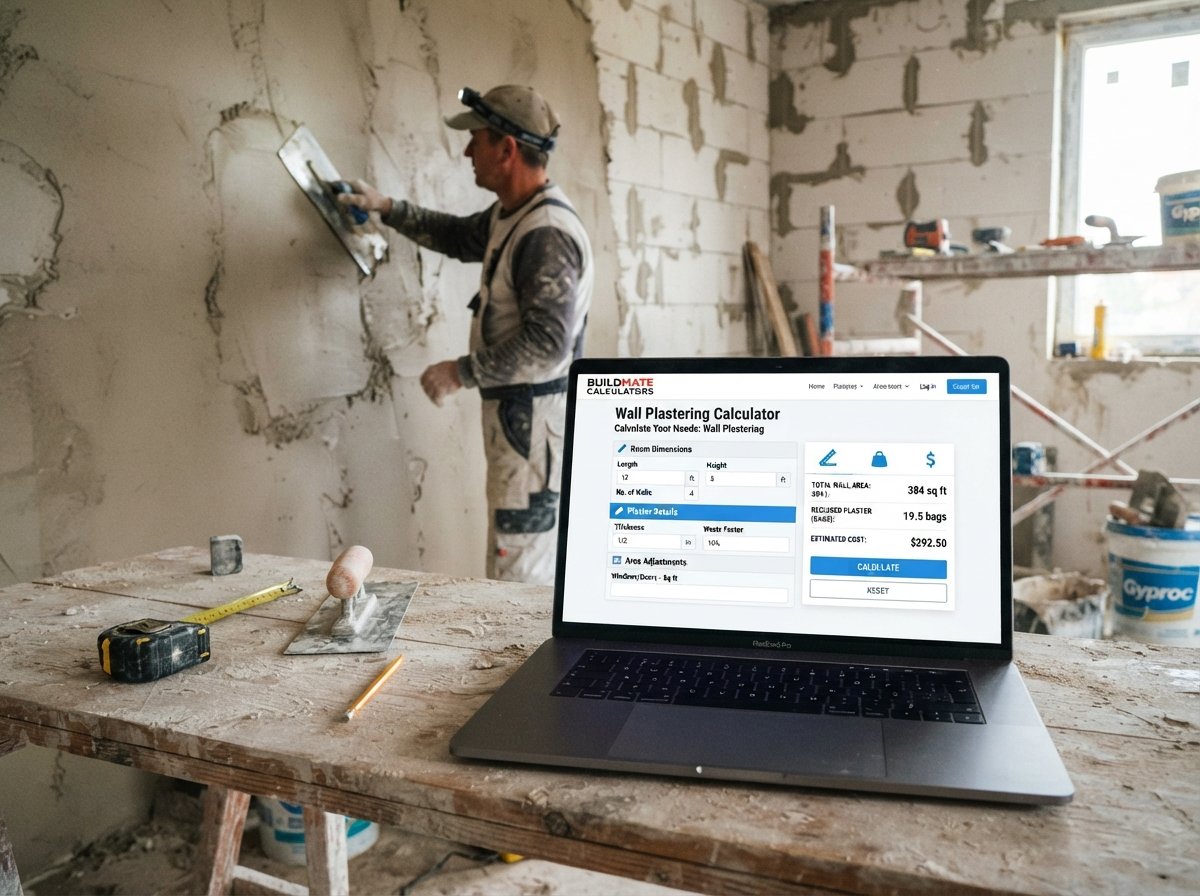
Plastering (Walls) Calculator: Estimate Plaster, Beads, and Labour Costs Accurately
Plastering is the art of creating smooth, durable, and decorative interior or exterior wall surfaces. Whether you’re skimming over plasterboard, applying a bonding coat to masonry, or finishing with a traditional float and set, getting the material quantities and costs right is essential. An undersupply of plaster stops work; an oversupply wastes money and creates storage problems. Our Plastering (Walls) Calculator is a free online tool that helps you quickly estimate plaster quantity, beads, scrim tape, bonding agent, labour, and total cost based on your wall dimensions and chosen plaster system.
In this guide, we’ll show you how to use the calculator, explain each cost component, provide real-world examples, and answer common questions. We’ll also share tips to ensure your plastering project stays on budget and achieves a professional finish.
Plastering (Walls)
Construction CalculatorWall plastering: coats, plaster quantity, beads, bonding and cost.
What is the Plastering (Walls) Calculator?
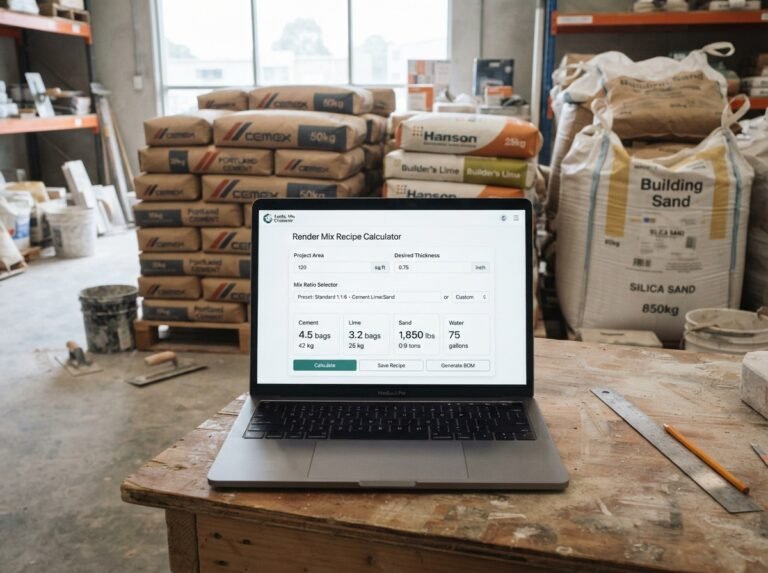
The Plastering (Walls) Calculator is a free online tool that calculates the material quantities and costs for wall plastering. It supports four common plaster systems: skim coat over plasterboard, bonding + skim over masonry, float & set (3 coats), and external render. The calculator accounts for wall length, height, openings, plaster coverage (kg/m²), bag weight, waste allowance, beads and stop ends, scrim tape, bonding agent, and local pricing for plaster bags, beads, scrim, bonding agent, and labour. It provides a clear breakdown of gross and net wall area, plaster weight, number of bags, and costs for each component. The tool is part of a suite of materials and quantities calculators available on our website. For related calculations, you can use our Rendering (Walls) Calculator, Render Mix Recipe Calculator, and Pebbledash / Harling Calculator.
How to Use the Plastering (Walls) Calculator
Using the calculator is straightforward. Here’s a breakdown of each field:
1. Wall
- Wall length: Enter the total length of the wall in meters or feet.
- Wall height: Enter the total height of the wall in meters or feet.
- Openings area: Enter the total area of doors and windows in square meters or square feet. This is deducted from the gross area to give the net plastered area.
2. Plaster
- Plaster system: Select the system: Skim coat over plasterboard, Bonding + skim (over masonry), Float & set (3 coats), or External render. This is for navigation only; enter the coverage for your chosen system below.
- Plaster coverage: Enter the kilograms of plaster required per square meter of wall. Typical values: skim ~3–4 kg/m², backing ~10 kg/m², render ~15 kg/m². The default is 4 kg/m².
- Bag weight: Enter the weight of one bag of plaster in kg or lb. The default is 25 kg.
- Waste allowance: Enter a percentage for waste. 10% is typical for plastering. The default is 10%.
3. Trims
- Beads & stop ends: Enter the total length of beads and stop ends required in meters or feet. Set to 0 if not required. Beads are used at corners and edges to provide a straight, protective finish.
4. Pricing
- Plaster bag price: Enter the local price per bag of plaster for your chosen system.
- Bead price per metre: Enter the local price per metre of beads.
- Scrim tape price per m²: Enter the local price per square meter of scrim tape. Set to 0 if not required.
- Bonding agent price per m²: Enter the local price per square meter of bonding agent. Used only for over-masonry systems (bonding, float, render).
- Labour price per m²: Enter the local installation rate per square meter. Skim is fastest, float & set the slowest.
Once you enter all values, the calculator instantly displays:
- Gross wall area (m²)
- Net plastered area (m²)
- Plaster weight (kg)
- Bags required
- Plaster cost
- Beads & trims cost
- Scrim tape cost (if entered)
- Bonding agent cost (if applicable)
- Labour cost
- Grand total
Understanding the Cost Components
To make the most of the calculator, it’s important to understand each output and the underlying formulas.
- Gross wall area:
length × height. This is the total wall area before deducting openings. - Net plastered area:
gross area − openings area. This is the area actually plastered. - Net area with waste:
net area × (1 + waste/100). This accounts for material lost during mixing, application, and cleaning. - Plaster weight:
net area with waste × coverage (kg/m²). This is the total mass of plaster required. - Bags required:
ceil(plaster weight / bag weight). You buy whole bags, so the calculator rounds up. - Plaster cost:
bags × bag price. - Beads cost:
beads length × bead price per metre. - Scrim tape cost:
net area × scrim price per m². Scrim tape is applied to joints and corners; for simplicity, the calculator applies it to the entire net area. If you prefer, you can reduce the scrim price to reflect only the taped areas. - Bonding agent cost: For bonding, float, and render systems,
net area × bonding agent price per m². This is essential for ensuring adhesion to masonry or existing surfaces. - Labour cost:
net area × labour price per m² × system multiplier. The system multiplier adjusts for the complexity of different plaster systems:- Skim: 1.00 (fastest)
- Bonding + skim: 1.50 (two coats, slower)
- Float & set: 1.85 (three coats, slowest)
- External render: 1.70 (weather-dependent, slower than skim)
- Grand total: Sum of plaster, beads, scrim, bonding, and labour costs.
Understanding these components helps you interpret the results and adjust your order. For more information on plastering, you can refer to Wikipedia’s article on plastering.
Example Calculations
Let’s run through a few examples to see how the calculator works in different scenarios.
Example 1: Skim Coat over Plasterboard, 10 m × 2.5 m Wall, 3 m² Openings
- Wall length: 10 m
- Wall height: 2.5 m
- Openings area: 3 m²
- Plaster system: Skim coat
- Plaster coverage: 4 kg/m²
- Bag weight: 25 kg
- Waste: 10%
- Beads & stop ends: 8 m
- Plaster bag price: $12
- Bead price: $3/m
- Scrim tape price: $1.50/m²
- Bonding agent price: $0 (not used for skim)
- Labour price: $20/m²
Calculations:
- Gross area = 10 × 2.5 = 25 m²
- Net area = 25 − 3 = 22 m²
- Net with waste = 22 × 1.10 = 24.2 m²
- Plaster weight = 24.2 × 4 = 96.8 kg
- Bags = ceil(96.8 / 25) = ceil(3.872) = 4
- Plaster cost = 4 × $12 = $48
- Bead cost = 8 × $3 = $24
- Scrim cost = 22 × $1.50 = $33
- Bonding cost = $0
- Labour cost = 22 × $20 × 1.00 = $440
- Total = $48 + $24 + $33 + $0 + $440 = $545
- Result: Grand total $545
Example 2: Bonding + Skim over Masonry, 12 m × 3 m Wall, 4 m² Openings
- Wall length: 12 m
- Wall height: 3 m
- Openings area: 4 m²
- Plaster system: Bonding + skim
- Plaster coverage: 10 kg/m² (combined)
- Bag weight: 25 kg
- Waste: 10%
- Beads & stop ends: 12 m
- Plaster bag price: $14
- Bead price: $3.50/m
- Scrim tape price: $1.80/m²
- Bonding agent price: $2.50/m²
- Labour price: $25/m²
Calculations:
- Gross area = 12 × 3 = 36 m²
- Net area = 36 − 4 = 32 m²
- Net with waste = 32 × 1.10 = 35.2 m²
- Plaster weight = 35.2 × 10 = 352 kg
- Bags = ceil(352 / 25) = ceil(14.08) = 15
- Plaster cost = 15 × $14 = $210
- Bead cost = 12 × $3.50 = $42
- Scrim cost = 32 × $1.80 = $57.60
- Bonding cost = 32 × $2.50 = $80
- Labour cost = 32 × $25 × 1.50 = $1,200
- Total = $210 + $42 + $57.60 + $80 + $1,200 = $1,589.60
- Result: Grand total $1,589.60
Example 3: External Render, 15 m × 4 m Wall, 6 m² Openings
- Wall length: 15 m
- Wall height: 4 m
- Openings area: 6 m²
- Plaster system: External render
- Plaster coverage: 15 kg/m²
- Bag weight: 25 kg
- Waste: 12%
- Beads & stop ends: 20 m
- Plaster bag price: $13
- Bead price: $4/m
- Scrim tape price: $2/m²
- Bonding agent price: $3/m²
- Labour price: $30/m²
Calculations:
- Gross area = 15 × 4 = 60 m²
- Net area = 60 − 6 = 54 m²
- Net with waste = 54 × 1.12 = 60.48 m²
- Plaster weight = 60.48 × 15 = 907.2 kg
- Bags = ceil(907.2 / 25) = ceil(36.288) = 37
- Plaster cost = 37 × $13 = $481
- Bead cost = 20 × $4 = $80
- Scrim cost = 54 × $2 = $108
- Bonding cost = 54 × $3 = $162
- Labour cost = 54 × $30 × 1.70 = $2,754
- Total = $481 + $80 + $108 + $162 + $2,754 = $3,585
- Result: Grand total $3,585
These examples show how different wall sizes, plaster systems, and coverage rates affect the total cost.
Benefits of Using the Plastering (Walls) Calculator
Tips for Accurate Plastering Estimation
- Measure the wall area accurately: Double-check length and height. For irregular walls, divide into rectangles and calculate separately.
- Deduct openings correctly: Subtract the total area of doors and windows to get the net plastered area.
- Choose the right plaster system: Skim coat is for plasterboard; bonding + skim is for masonry; float & set is traditional three-coat work; external render is for weatherproofing. Each has different coverage and labour requirements.
- Use the correct coverage rate: Coverage depends on the thickness and type of plaster. Check the manufacturer’s datasheet. Typical values: skim 3–4 kg/m², backing 10 kg/m², render 15 kg/m².
- Account for beads and stops: Beads are essential at corners, edges, and around openings. Measure the total length required.
- Don’t forget scrim tape: Scrim tape reinforces joints and corners. The calculator applies it to the net area; you can adjust the price to reflect actual usage.
- Consider bonding agent: For over-masonry systems, a bonding agent is essential for adhesion. Enter the correct price per m².
- Allow for waste: 10% is typical, but increase to 15% for complex work or small jobs.
- Use realistic labour rates: Labour rates vary by region and system. Skim is fastest; float & set is slowest. The calculator applies a system multiplier.
- Verify with a professional: For large or complex projects, have a qualified plasterer verify the design and quantities.
For more information on plastering techniques, you can refer to resources like Wikipedia’s article on plastering or guidelines from the Plasterers and Renderers Association.
How to Reduce Plastering Costs
If your estimate is higher than expected, here are ways to reduce costs without compromising quality:
- Choose a simpler system: Skim coat is cheaper and faster than float & set or external render.
- Optimize coverage: Ensure you’re using the correct thickness. Over-thick plaster wastes material and increases drying time.
- Reduce waste: Mix carefully and apply efficiently. Keep the site clean to avoid material loss.
- Use standard bag sizes: Standard 25 kg bags are often cheaper per kg than smaller bags.
- Do the preparation yourself: Removing old plaster, fixing beads, and applying scrim can be done by a competent DIYer, saving labour costs.
- Get multiple quotes: Compare plasterers for the best price. But never choose solely on price—quality and experience matter.
- Schedule in dry weather: External render requires dry conditions. Scheduling work in a dry period avoids delays and rework.
Frequently Asked Questions (FAQ)
Conclusion
The Plastering (Walls) Calculator is an essential tool for builders, renovators, and homeowners. It helps you estimate the plaster, beads, scrim, bonding, and labour costs for your wall plastering project. By following the tips in this article and using the calculator, you can confidently plan your plastering work. Don’t forget to explore our other materials and quantities calculators for all your construction needs.
Whether you’re skimming a single room or rendering an entire house, accurate material and cost estimation is key to a successful project. Try the Plastering (Walls) Calculator today and take the guesswork out of your plaster budget.

2 Comments