
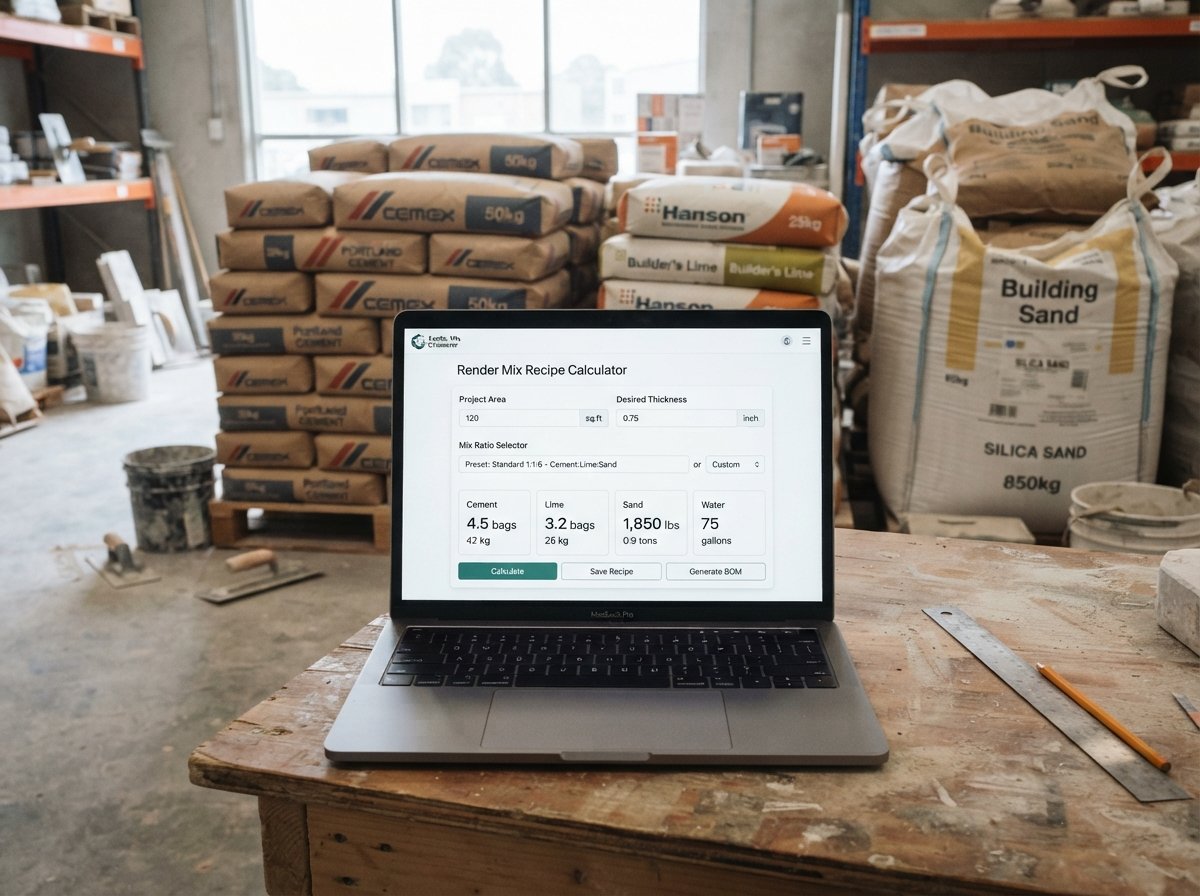
Render Mix Recipe Calculator: Estimate Cement, Sand, and Lime Accurately
Getting the right render mix is part art, part science. Too much cement and the render becomes brittle and prone to cracking; too little and it won’t adhere or weather properly. The proportions of cement, sand, lime, and water determine the strength, workability, and durability of the finished render. Whether you’re rendering a garden wall, patching a facade, or applying a full external coating, accurate material estimation is essential to avoid waste and ensure a professional result. Our Render Mix Recipe Calculator is a free online tool that helps you quickly determine the exact quantities of cement, sand, lime, water, and plasticiser required for your chosen mix ratio and volume. It also estimates the cost of materials, so you can budget with confidence.
In this guide, we’ll show you how to use the calculator, explain the calculations, provide real-world examples, and answer common questions. We’ll also share tips to ensure your render mix is accurate, workable, and cost-effective.
Render Mix Recipe
Construction CalculatorRender mix proportions: cement, sand, lime, water, plasticiser for chosen ratio.
What is the Render Mix Recipe Calculator?
The Render Mix Recipe Calculator is a free online tool that calculates the component quantities for a render mix based on your specified volume or area and thickness, mix ratio, lime content, and plasticiser choice. It supports common mix ratios (1:3, 1:4, 1:5, 1:6), three levels of lime content (none, weak, standard, strong), and three plasticiser options (none, liquid, powder). The calculator accounts for waste allowance and local pricing for cement, sand, lime, and plasticiser. It provides a clear breakdown of wet and dry mix volumes, cement weight and bags, lime weight and bags, sand weight, water volume, and costs for each component. The tool is part of a suite of materials and quantities calculators available on our website. For related calculations, you can use our Rendering (Walls) Calculator, Plastering (Walls) Calculator, and Pebbledash / Harling Calculator.
How to Use the Render Mix Recipe Calculator
Using the calculator is straightforward. Here’s a breakdown of each field:
1. Input
- Input mode: Choose whether to enter a direct volume or calculate volume from area × thickness. Only the selected source is used.
- Volume: If “Direct volume” is selected, enter the volume of wet mix required in cubic meters or cubic yards.
- Area: If “Area × thickness” is selected, enter the area to be rendered in square meters or square feet.
- Thickness: If “Area × thickness” is selected, enter the thickness of the render in meters or inches. For example, 0.018 m = 18 mm.
2. Mix
- Mix ratio: Select the cement : sand ratio: 1:3 (strong backing), 1:4 (standard base), 1:5 (top coat), or 1:6 (economy). This determines the cement and sand proportions.
- Lime content: Select the lime content: No lime, Weak (1 part lime to 8 sand), Standard (1 part lime to 6 sand), or Strong (1 part lime to 4 sand). Lime improves workability and flexibility.
- Plasticiser: Select the plasticiser type: None (use lime only), Liquid plasticiser, or Powder plasticiser. This is for navigation only; enter the price for your chosen plasticiser below.
- Waste allowance: Enter a percentage for waste. 10% is typical for render mixes. The default is 10%.
3. Pricing
- Cement bag price: Enter the local price per bag of cement.
- Cement bag weight: Enter the weight of one bag of cement in kg. The default is 25 kg.
- Sand price per tonne: Enter the local price per tonne of sharp or builder’s sand.
- Hydrated lime bag price: Enter the local price per 25 kg bag of hydrated lime. Used only when a lime content is selected.
- Total plasticiser cost: Enter the total cost of plasticiser for the whole mix. Set to 0 if not required.
Once you enter all values, the calculator instantly displays:
- Wet mix volume (m³)
- Dry mix volume (m³)
- Cement (kg)
- Cement bags
- Hydrated lime (kg) – if selected
- Lime bags (25 kg) – if selected
- Sand (tonnes)
- Water (litres)
- Cement cost
- Sand cost
- Lime cost (if selected)
- Plasticiser cost (if selected)
- Grand total
Understanding the Cost Components
To make the most of the calculator, it’s important to understand each output and the underlying formulas.
- Wet mix volume: The volume of mixed render required, based on your input. If you entered area × thickness, it’s
area × thickness. Waste is added:wet volume × (1 + waste/100). - Dry mix volume: The volume of dry materials before water is added. Render mixes typically yield about 1.25 times their dry volume when mixed with water. So
dry volume = wet volume × 1.25. - Mix ratio: The ratio of cement to sand. For example, 1:4 means 1 part cement to 4 parts sand. The calculator uses parts.
- Lime content: Lime is added as a proportion of cement. The lime factor (lk) is: none = 0, weak = 0.125, standard = 0.167, strong = 0.25. These factors represent the ratio of lime to cement by volume. For example, standard lime content means 1 part lime to 6 parts sand, which is equivalent to 0.167 parts lime per 1 part cement when the mix is 1:4 (since 1 part cement + 4 parts sand, lime replaces some sand? Actually, the calculation uses lime as additional to cement, but in practice lime is usually a replacement for some cement or sand. The calculator’s method: total parts = cement + lime + sand, where lime parts = cement parts × lk. This is a simplified approach but works for estimation.)
- Cement volume:
dry volume × (cement parts / total parts). - Lime volume:
dry volume × (lime parts / total parts). - Sand volume:
dry volume × (sand parts / total parts). - Cement mass:
cement volume × 1440 kg/m³(bulk density of cement). - Lime mass:
lime volume × 600 kg/m³(bulk density of hydrated lime). - Sand mass:
sand volume × 1600 kg/m³(bulk density of sand). Converted to tonnes by dividing by 1000. - Cement bags:
ceil(cement mass / bag weight). You buy whole bags. - Lime bags:
ceil(lime mass / 25). Hydrated lime is typically sold in 25 kg bags. - Water:
cement mass × 0.5 + lime mass × 1.0. This is a physical water demand: roughly half the cement weight plus the full lime weight, in litres. - Costs: Cement cost = bags × bag price. Sand cost = tonnes × price per tonne. Lime cost = lime bags × bag price. Plasticiser cost = total cost you entered (if not none).
- Grand total: Sum of all material costs.
Understanding these components helps you interpret the results and adjust your mix. For more information on render mixes, you can refer to Wikipedia’s article on mortar.
Example Calculations
Let’s run through a few examples to see how the calculator works in different scenarios.
Example 1: Standard Base Render, 25 m² at 18 mm, 1:4 Mix with Standard Lime
- Input mode: Area × thickness
- Area: 25 m²
- Thickness: 0.018 m
- Mix ratio: 1:4
- Lime content: Standard (lk = 0.167)
- Plasticiser: Liquid
- Waste: 10%
- Cement bag price: $12
- Bag weight: 25 kg
- Sand price: $80/tonne
- Lime bag price: $15
- Plasticiser cost: $10
Calculations:
- Wet volume = 25 × 0.018 = 0.45 m³
- Wet volume with waste = 0.45 × 1.10 = 0.495 m³
- Dry volume = 0.495 × 1.25 = 0.61875 m³
- Parts: cement = 1, lime = 1 × 0.167 = 0.167, sand = 4. Total = 1 + 0.167 + 4 = 5.167
- Cement volume = 0.61875 × (1 / 5.167) = 0.1198 m³
- Lime volume = 0.61875 × (0.167 / 5.167) = 0.0200 m³
- Sand volume = 0.61875 × (4 / 5.167) = 0.4792 m³
- Cement mass = 0.1198 × 1440 = 172.5 kg
- Lime mass = 0.0200 × 600 = 12.0 kg
- Sand mass = 0.4792 × 1600 = 766.7 kg = 0.7667 t
- Cement bags = ceil(172.5 / 25) = 7
- Lime bags = ceil(12.0 / 25) = 1
- Water = 172.5 × 0.5 + 12.0 × 1.0 = 86.25 + 12 = 98.25 L
- Cement cost = 7 × $12 = $84
- Sand cost = 0.7667 × $80 = $61.34
- Lime cost = 1 × $15 = $15
- Plasticiser cost = $10
- Total = $84 + $61.34 + $15 + $10 = $170.34
- Result: Grand total $170.34
Example 2: Strong Backing Render, 1.2 m³, 1:3 Mix with No Lime
- Input mode: Direct volume
- Volume: 1.2 m³
- Mix ratio: 1:3
- Lime content: None
- Plasticiser: None
- Waste: 8%
- Cement bag price: $11
- Bag weight: 25 kg
- Sand price: $75/tonne
- Lime bag price: $0 (not used)
- Plasticiser cost: $0
Calculations:
- Wet volume with waste = 1.2 × 1.08 = 1.296 m³
- Dry volume = 1.296 × 1.25 = 1.62 m³
- Parts: cement = 1, lime = 0, sand = 3. Total = 4
- Cement volume = 1.62 × (1/4) = 0.405 m³
- Sand volume = 1.62 × (3/4) = 1.215 m³
- Cement mass = 0.405 × 1440 = 583.2 kg
- Sand mass = 1.215 × 1600 = 1944 kg = 1.944 t
- Cement bags = ceil(583.2 / 25) = 24
- Water = 583.2 × 0.5 = 291.6 L
- Cement cost = 24 × $11 = $264
- Sand cost = 1.944 × $75 = $145.80
- Total = $264 + $145.80 = $409.80
- Result: Grand total $409.80
Example 3: Top Coat Render, 40 m² at 10 mm, 1:5 Mix with Weak Lime
- Input mode: Area × thickness
- Area: 40 m²
- Thickness: 0.010 m
- Mix ratio: 1:5
- Lime content: Weak (lk = 0.125)
- Plasticiser: Powder
- Waste: 12%
- Cement bag price: $13
- Bag weight: 25 kg
- Sand price: $85/tonne
- Lime bag price: $16
- Plasticiser cost: $8
Calculations:
- Wet volume = 40 × 0.010 = 0.40 m³
- Wet volume with waste = 0.40 × 1.12 = 0.448 m³
- Dry volume = 0.448 × 1.25 = 0.56 m³
- Parts: cement = 1, lime = 0.125, sand = 5. Total = 6.125
- Cement volume = 0.56 × (1 / 6.125) = 0.0914 m³
- Lime volume = 0.56 × (0.125 / 6.125) = 0.0114 m³
- Sand volume = 0.56 × (5 / 6.125) = 0.4571 m³
- Cement mass = 0.0914 × 1440 = 131.6 kg
- Lime mass = 0.0114 × 600 = 6.84 kg
- Sand mass = 0.4571 × 1600 = 731.4 kg = 0.7314 t
- Cement bags = ceil(131.6 / 25) = 6
- Lime bags = ceil(6.84 / 25) = 1
- Water = 131.6 × 0.5 + 6.84 × 1.0 = 65.8 + 6.84 = 72.64 L
- Cement cost = 6 × $13 = $78
- Sand cost = 0.7314 × $85 = $62.17
- Lime cost = 1 × $16 = $16
- Plasticiser cost = $8
- Total = $78 + $62.17 + $16 + $8 = $164.17
- Result: Grand total $164.17
These examples show how different mix ratios, lime contents, and volumes affect the material quantities and costs.
Benefits of Using the Render Mix Recipe Calculator
Tips for Accurate Render Mix Estimation
- Choose the right mix ratio: 1:3 is strong and used for backing coats or below ground. 1:4 is a standard base. 1:5 and 1:6 are weaker and used for top coats or economy work. Check the specification for your project.
- Use lime for workability: Lime improves the workability and flexibility of the render, reducing the risk of cracking. Standard lime content is a good default for most external renders.
- Consider plasticiser: Plasticiser can replace lime or be used in addition. It improves workability and reduces water content. If you use plasticiser, you may reduce or omit lime.
- Account for waste: 10% is typical, but increase to 15% for small jobs or complex shapes. Waste covers material lost during mixing, application, and cleaning.
- Measure volume accurately: If using area × thickness, ensure the thickness is correct. Render thickness typically ranges from 10 mm to 25 mm depending on the coat.
- Use correct bulk densities: The calculator uses standard bulk densities: cement 1440 kg/m³, lime 600 kg/m³, sand 1600 kg/m³. These are typical values; actual densities may vary slightly.
- Water quantity is a guide: The water calculation (0.5 × cement + 1.0 × lime) is a starting point. Adjust on site to achieve the desired workability. Too much water weakens the render.
- Buy materials in bulk: Cement, sand, and lime are cheaper when bought in larger quantities. Calculate your total needs and order once.
- Store materials correctly: Cement and lime must be kept dry. Sand should be covered to prevent contamination.
- Verify with a professional: For large or structural renders, have a qualified renderer or engineer verify the mix design.
For more information on render mixes, you can refer to resources like Wikipedia’s article on mortar or guidelines from the Traditional Building Skills.
How to Reduce Render Mix Costs
If your estimate is higher than expected, here are ways to reduce costs without compromising quality:
- Choose a leaner mix: A 1:5 or 1:6 mix uses less cement and is cheaper, but only use it where strength requirements allow.
- Reduce lime content: If workability allows, use less lime or replace it with plasticiser, which may be cheaper.
- Buy sand in bulk: Sand is often the cheapest component, but transport costs can add up. Order full loads.
- Use local materials: Locally sourced sand and aggregate reduce transport costs.
- Minimise waste: Mix only what you need, and apply efficiently. Keep the site clean to avoid material loss.
- Do the mixing yourself: If you’re competent, mixing on site can save on ready-mixed render costs.
- Get multiple quotes: Compare suppliers for cement, sand, and lime.
Frequently Asked Questions (FAQ)
Conclusion
The Render Mix Recipe Calculator is an essential tool for builders, plasterers, and DIY enthusiasts. It helps you determine the exact quantities of cement, sand, lime, water, and plasticiser required for your render mix, and estimates the cost of materials. By following the tips in this article and using the calculator, you can confidently plan your render project. Don’t forget to explore our other materials and quantities calculators for all your construction needs.
Whether you’re rendering a small patch or a full facade, accurate mix estimation is key to a durable and professional finish. Try the Render Mix Recipe Calculator today and take the guesswork out of your render mix.


3 Comments