
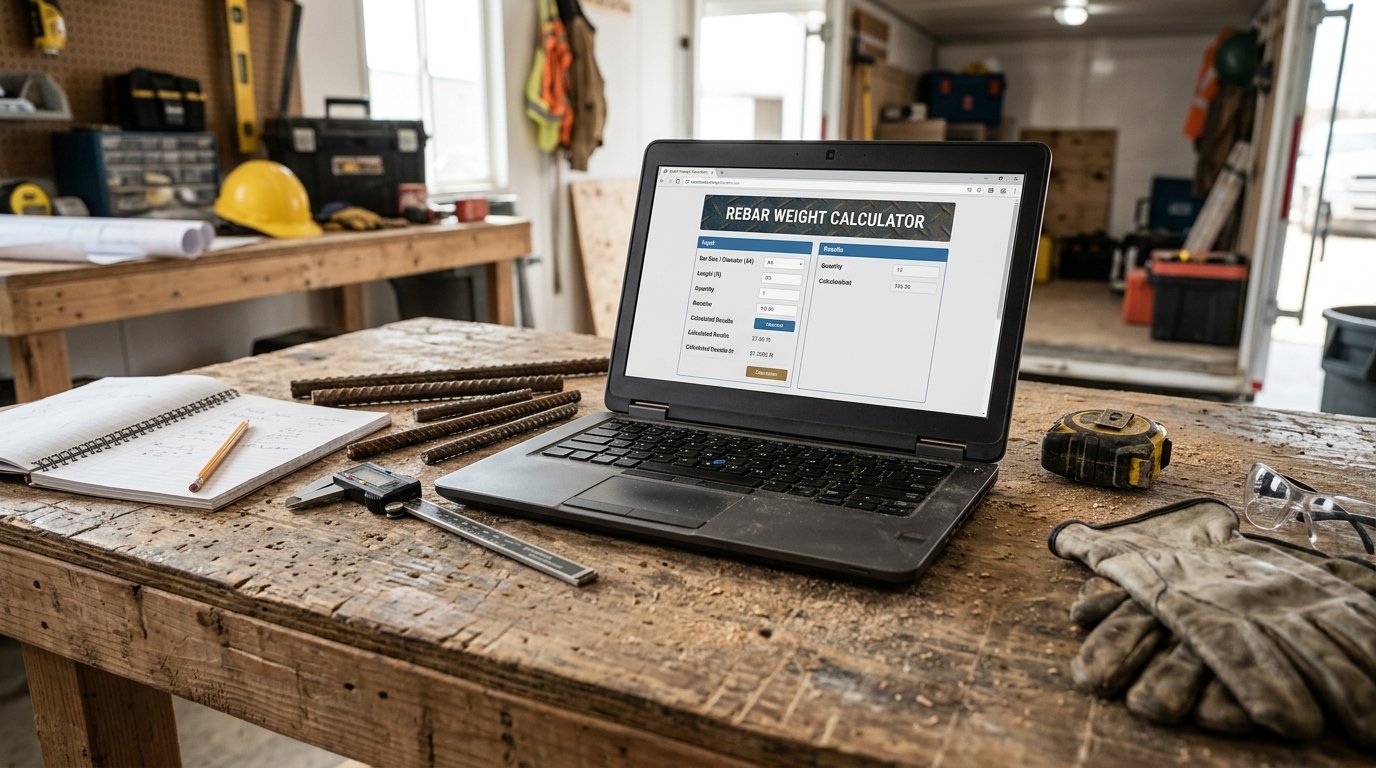
Rebar Weight Calculator: Estimate Mass, Cost & Steel Quantity
Rebar is the invisible skeleton of every reinforced concrete structure. It carries tensile forces that concrete alone cannot resist, controls cracking, and gives slabs, beams, columns, and foundations the strength to perform under load. But rebar is heavy, expensive, and sold by weight — not by length. If you cannot quickly convert bar diameter and total length into kilograms or tonnes, you cannot order materials accurately, plan transport safely, or estimate project cost with confidence.
Our Rebar Weight Calculator is a free online tool that takes the guesswork out of rebar mass estimation. It converts bar diameter, total length, and steel type into mass per metre, total mass, tonnage, and cost. It supports all common bar sizes from 6 mm to 40 mm, four steel types (mild, high-yield, stainless, and galvanised), two quantity input modes, and four pricing modes. Whether you are a contractor, engineer, fabricator, or self-builder, this calculator gives you precise numbers for every stage of the project.
In this guide, we will show you how to use the calculator, explain each input and output, provide real-world examples, and answer the most common questions. We will also share practical tips to ensure your rebar estimation is accurate, compliant, and cost-effective.
Rebar Weight
Construction CalculatorRebar weight and cost from bar diameter and total length.
What is the Rebar Weight Calculator?
The Rebar Weight Calculator is a free online tool that calculates the weight and cost of reinforcing steel based on bar geometry and quantity. Unlike approximate rules of thumb, it uses the exact formula for the volume of a cylinder and the material density of the selected steel type. The calculator supports:
- Bar sizes: 6 mm (#2), 8 mm (#3), 10 mm, 12 mm (#4), 16 mm (#5), 20 mm (#6), 25 mm (#8), 32 mm (#10), 40 mm (#11), and custom diameters.
- Steel types: Mild steel, high-yield, stainless steel, and galvanised. Each has a different density that affects the final mass.
- Quantity input modes: Total length, or number of bars × bar length.
- Pricing modes: Per kg, per tonne, per metre, or per bar.
The calculator returns bar diameter, cross-section area, total length, mass per metre, total mass in kilograms and tonnes, and total cost. It is part of a wider suite of materials and quantities calculators available on our website. For related calculations, you can use our Rebar Tonnage Calculator, Rebar Bundle Weight Calculator, Slab Rebar Calculator, and Rebar Bar Schedule Calculator.
Why Accurate Rebar Weight Matters
Rebar weight is more than a number for a delivery note. It affects every stage of a concrete project, from budgeting to transport to structural safety. Here is why accurate estimation is essential.
Cost Control
Rebar is one of the largest single material costs in a concrete project. On a medium-sized residential build, steel can account for 10–20% of the structural package. A 5% error in weight on a 20-tonne order means 1 tonne of steel — a meaningful amount of money and a significant amount of wasted material. Accurate weight estimation prevents over-ordering and ensures you pay only for what you use.
Transport and Logistics
Rebar is dense. A 12 m bar of 32 mm rebar weighs over 75 kg. A bundle of 20 such bars weighs over 1.5 tonnes. If you underestimate the weight, you risk overloading vehicles, exceeding crane capacities, or damaging storage racks. If you overestimate, you pay for unnecessary freight. Accurate weight data is critical for logistics planning.
Structural Design and Compliance
The weight of rebar is directly linked to its cross-sectional area, which determines its tensile capacity. Structural engineers specify bar size and spacing to meet load requirements. If the actual weight delivered does not match the design, the structure may not perform as intended. The calculator helps you verify that the specified bar sizes and lengths produce the expected steel quantity.
Handling and Installation
Lifting, moving, and positioning rebar requires planning. Heavier bars need more workers, mechanical lifting aids, or both. Knowing the exact weight per bar and per bundle helps you plan labour, equipment, and safe working procedures.
Waste Reduction
Accurate weight calculation supports efficient cutting and bending. When you know the exact mass of your order, you can plan cuts to minimise offcuts, reduce waste, and lower disposal costs.
Professionalism
Whether you are quoting a client, ordering from a supplier, or preparing a bar schedule, accurate weight estimation builds trust and demonstrates competence. It is one of the simplest ways to avoid disputes and delays.
For more information on rebar standards, you can refer to Wikipedia’s article on rebar or the Concrete Reinforcing Steel Institute (CRSI).
How to Use the Rebar Weight Calculator
Using the calculator is straightforward. Here is a breakdown of each field.
1. Bar
- Bar size: Select the nominal bar diameter. Options include 6 mm, 8 mm, 10 mm, 12 mm, 16 mm, 20 mm, 25 mm, 32 mm, 40 mm, or custom. The nominal diameter is the standard reference diameter used in design codes and supplier catalogues.
- Custom diameter: Used only when bar size is “Custom diameter”. Enter the actual diameter in metres or inches.
- Steel type: Select mild steel, high-yield, stainless steel, or galvanised. The steel type determines the density used in the mass calculation:
- Mild and high-yield: 7850 kg/m³
- Stainless steel: 8000 kg/m³
- Galvanised: 7900 kg/m³
2. Quantity
- Quantity input: Choose “Total length” or “Number of bars × length”.
- Total length: Enter the total length of rebar in meters or feet. Used in “Total length” mode.
- Bar length: Enter the length of one bar in meters or feet. Used in “Number of bars” mode.
- Number of bars: Enter the number of bars. Used in “Number of bars” mode. The calculator multiplies bar length × bar count to get total length.
3. Pricing
- Price mode: Select the pricing method used by your supplier:
- Per kg: Cost = total mass × price per kg.
- Per tonne: Cost = (total mass / 1000) × price per tonne.
- Per metre: Cost = total length × price per metre.
- Per bar: Cost = number of bars × price per bar. Requires “Number of bars” quantity mode.
- Price per kg / tonne / metre / bar: Enter the local price for the selected mode.
Once you enter all values, the calculator instantly displays bar diameter, cross-section area, total length, mass per metre, total mass in kg, total mass in tonnes, and total cost.
Understanding the Calculations
To make the most of the calculator, it is important to understand each output and the underlying formulas.
Bar Diameter
The nominal diameter of the selected bar, converted to millimetres for display. For custom bars, the diameter is taken from the “Custom diameter” field.
Cross-Section Area
The area of the circular cross-section of the bar, calculated as π × (diameter/2)². This is the fundamental geometric property that determines how much steel is present in a given length.
Total Length
The combined length of all bars in the order. In “Total length” mode, this is the value you entered. In “Number of bars” mode, it is bar length × number of bars.
Mass per Metre
The weight of one metre of the bar. Formula: cross-section area × density. For a 12 mm bar of mild steel: π × 0.006² × 7850 = 0.888 kg/m. This value matches the standard reference mass used across the industry, which confirms that the calculator is consistent with supplier catalogues.
Total Mass
The total weight of the order. Formula: mass per metre × total length. Expressed in kilograms and tonnes.
Total Cost
Based on the selected price mode. For per kg: total mass × price per kg. For per tonne: (total mass / 1000) × price per tonne. For per metre: total length × price per metre. For per bar: number of bars × price per bar.
Understanding these components helps you interpret the results and verify them against supplier quotes and design documents. For more information on rebar design, you can refer to the American Concrete Institute (ACI).
Standard Rebar Mass per Metre
The following table shows the standard mass per metre for common bar diameters. These values are widely used in design codes and supplier catalogues, and they are built into the calculator.
| Bar Diameter | Mass per Metre (kg/m) | Mass per 6 m Bar (kg) | Mass per 12 m Bar (kg) |
|---|---|---|---|
| 6 mm | 0.222 | 1.33 | 2.66 |
| 8 mm | 0.395 | 2.37 | 4.74 |
| 10 mm | 0.617 | 3.70 | 7.40 |
| 12 mm | 0.888 | 5.33 | 10.66 |
| 16 mm | 1.579 | 9.47 | 18.95 |
| 20 mm | 2.466 | 14.80 | 29.59 |
| 25 mm | 3.854 | 23.12 | 46.25 |
| 32 mm | 6.313 | 37.88 | 75.76 |
| 40 mm | 9.865 | 59.19 | 118.38 |
These values assume a density of 7850 kg/m³. For stainless steel, multiply by approximately 1.019 (about 2% heavier). For galvanised steel, multiply by approximately 1.006 (about 0.6% heavier).
Example Calculations
Let’s run through two examples to see how the calculator works in different scenarios.
Example 1: Total Length Mode with 12 mm High-Yield Rebar
Inputs:
- Bar size: 12 mm
- Steel type: High-yield
- Quantity input: Total length
- Total length: 200 m
- Price mode: Per kg
- Price per kg: $1.20
Calculations:
- Diameter = 0.012 m
- Cross-section area = π × (0.012/2)² = π × 0.000036 = 0.0001131 m²
- Volume = 0.0001131 × 200 = 0.02262 m³
- Density = 7850 kg/m³
- Mass = 0.02262 × 7850 = 177.57 kg
- Mass per metre = 177.57 / 200 = 0.888 kg/m
- Mass in tonnes = 0.17757 t
- Cost = 177.57 × $1.20 = $213.08
Result: 200 m of 12 mm high-yield rebar weighs 177.57 kg (0.178 tonnes) and costs $213.08.
Example 2: Number of Bars Mode with 20 mm Stainless Steel Rebar
Inputs:
- Bar size: 20 mm
- Steel type: Stainless steel
- Quantity input: Number of bars × length
- Bar length: 6 m
- Number of bars: 15
- Price mode: Per bar
- Price per bar: $55
Calculations:
- Diameter = 0.020 m
- Cross-section area = π × (0.010)² = 0.0003142 m²
- Total length = 6 × 15 = 90 m
- Volume = 0.0003142 × 90 = 0.02828 m³
- Density = 8000 kg/m³ (stainless)
- Mass = 0.02828 × 8000 = 226.24 kg
- Mass per metre = 226.24 / 90 = 2.514 kg/m
- Mass in tonnes = 0.22624 t
- Cost = 15 × $55 = $825
Result: 15 bars of 6 m, 20 mm stainless steel rebar weigh 226.24 kg (0.226 tonnes) and cost $825.
These examples show how bar size, steel type, and quantity mode affect the final weight and cost.
Benefits of Using the Rebar Weight Calculator
Tips for Accurate Rebar Weight Estimation
- Confirm the nominal diameter. Design codes and supplier catalogues use nominal diameters, which may differ slightly from actual measured diameters. Use the nominal value for consistency with standards.
- Select the correct steel type. Stainless steel is about 2% heavier than mild steel. Galvanised steel is about 0.6% heavier. These differences matter on large orders.
- Use realistic total lengths. Include all bars of that diameter across the project. Do not forget distribution bars, link bars, and starter bars.
- Account for laps and waste. This calculator does not automatically apply a lap or waste allowance. If your project requires laps, multiply the total length by 1.05–1.10 before entering it, or calculate the additional mass separately.
- Double-check unit conversions. If you are working in feet, convert to metres before using the total length field, or use the calculator’s built-in unit selector.
- Verify against standard tables. The mass per metre values produced by the calculator should match industry-standard tables. If they do not, check the diameter and density values.
- Use the correct price mode. Match the calculator’s price mode to your supplier’s quote. If your supplier quotes per tonne, use “Per tonne”; if per kg, use “Per kg”.
- Include fixings separately. This calculator covers rebar only. Chairs, ties, spacers, and mesh are separate items. For fixings, use our Slab Rebar Calculator.
- Consider corrosion protection. Stainless and galvanised bars cost more and weigh slightly more. Factor this into the project budget.
- Verify with a professional. For large or complex projects, have a reinforcement detailer or engineer verify the quantities before ordering.
For more information on rebar standards, you can refer to Wikipedia’s article on rebar or the Concrete Reinforcing Steel Institute (CRSI).
Common Mistakes to Avoid
- Using the wrong diameter. Mass depends on the square of the diameter. A 10% error in diameter causes a 21% error in mass.
- Ignoring steel density. Stainless steel is heavier than mild steel. Using the wrong density skews the result.
- Forgetting laps. Laps add 5–10% to the total length and mass. If your project has many splices, the effect is significant.
- Mixing up kg and tonnes. 1 tonne = 1000 kg. Always check the unit displayed by your supplier.
- Using the wrong quantity mode. If you select “Total length” but enter values in the “Number of bars” fields, the result will be wrong.
- Skipping waste allowance. Cutting and bending produce offcuts. 3–5% waste is realistic for most projects.
- Confusing rebar weight with bar schedule weight. This calculator estimates the total weight of rebar bars. It does not replace a formal bar schedule.
- Not verifying with a supplier. Prices and stock availability vary. Always confirm with a supplier before placing an order.
How to Reduce Rebar Weight and Cost
If your estimate is higher than expected, here are ways to reduce rebar weight and cost without compromising structural integrity:
- Optimize bar sizes. Smaller bars weigh less and cost less per metre, but may require more ties and labour. Work with your engineer to find the most efficient size and spacing.
- Reduce laps. Laps are one of the largest sources of wasted steel. Use longer stock lengths or design splices in low-stress zones.
- Reduce waste. Plan cuts carefully. Use offcuts for smaller bars where design allows.
- Choose standard lengths. Custom cut lengths are more expensive and generate more waste.
- Compare suppliers. Rebar prices vary by region and market conditions. Get multiple quotes.
- Order in bulk. Larger orders often attract discounts per tonne.
- Use mild or high-yield steel unless stainless is required. Stainless steel is much more expensive and slightly heavier.
- Consider alternative reinforcement. In some applications, welded wire mesh or fibre reinforcement can reduce steel tonnage. Check with your engineer.
- Plan transport efficiently. Full truckloads reduce freight costs per tonne.
- Schedule deliveries carefully. Storing rebar on site for extended periods ties up capital and risks damage.
Frequently Asked Questions (FAQ)
Conclusion
The Rebar Weight Calculator is an essential tool for anyone working with reinforced concrete. It converts bar diameter, total length, and steel type into mass per metre, total mass, tonnage, and cost — quickly, accurately, and transparently. By following the tips in this article and using the calculator alongside our other rebar tools, you can plan your steel order with confidence, reduce waste, and keep your project on budget.
Whether you are fabricating a small domestic slab or managing a large commercial frame, accurate rebar weight estimation is the foundation of a successful project. Try the Rebar Weight Calculator today and take the guesswork out of your reinforcement quantities.






5 Comments