
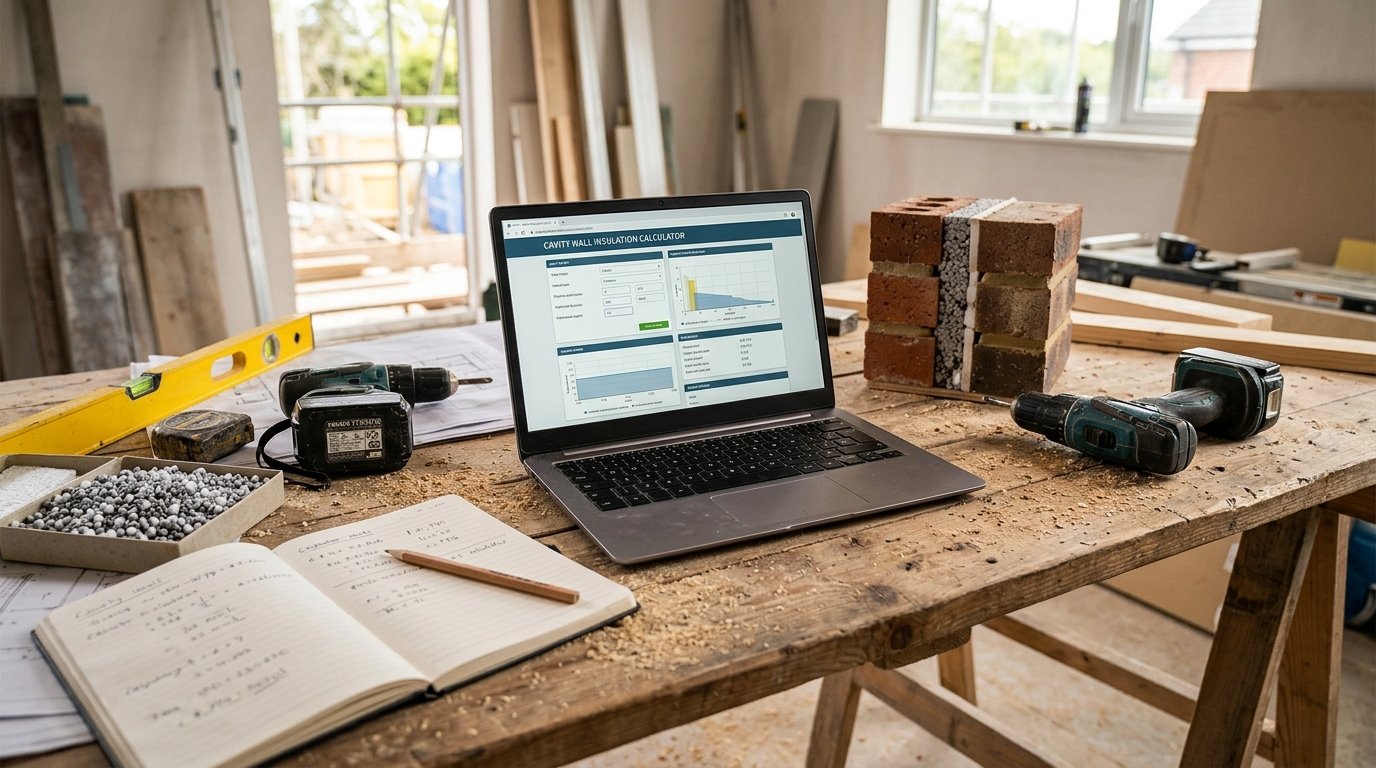
Cavity Wall Insulation Calculator: Drill Holes & Cost
Cavity wall insulation is one of the most effective energy efficiency upgrades a UK home can have. A typical uninsulated cavity wall loses heat at a U-value of around 1.5 W/m²K; with full-fill insulation, that drops to 0.2–0.3 W/m²K — an 80% reduction in wall heat loss. The installation is fast, the disruption is minimal, and the payback is often measured in 3–5 years. But cavity insulation is also an installation where the details matter: the number of drill holes, the number of rows, the method, the width of the cavity, and the repair of every drilled hole. Getting any of those wrong leads to either a failed installation, a non-compliant wall, or a bill that does not match what actually happened.
Our Cavity Wall Insulation Calculator is a free online tool that estimates the materials and costs of a cavity wall insulation installation. It calculates gross area, net area after openings, cavity volume, drill holes per row, total drill holes from rows × positions, hole repair, weather sealing, labour with method multipliers, delivery, VAT and cost per m². It also flags three design errors — cavity below 50 mm, too few drill rows for the wall height, and per-hole pricing with no hole price — before the installation begins.
In this guide, we will show you how to use the calculator, explain each input and output, walk through four examples across methods and wall types, and answer eight of the most frequently asked questions about cavity wall insulation.
Cavity Wall Insulation
Construction CalculatorCavity wall insulation: injected or blown, area, hole layout, method multipliers and cost.
What is the Cavity Wall Insulation Calculator?
The Cavity Wall Insulation Calculator is a free online tool that estimates the quantity and cost of materials for a cavity wall insulation installation. It supports:
- Wall dimensions: length, height, openings (doors and windows deducted).
- Cavity width: typically 50–100 mm; below 50 mm is not suitable for retrofit.
- Insulation methods: blown mineral wool, expanded polystyrene beads, phenolic / PU foam.
- Drill hole layout: horizontal spacing (typically 500 mm centres) and number of rows (typically 1 per 1–1.35 m of height).
- Pricing modes: per m² or per drill hole — only the selected mode is charged.
- Cost items: insulation, hole repair, weather sealing, labour, delivery, VAT.
The output includes:
- Gross and net wall area
- Cavity volume
- Holes per row and total drill holes
- Recommended rows based on height
- Design check warning
- Itemised costs: insulation, hole repair, weather sealing, labour, delivery
- VAT, grand total and cost per m²
The tool is part of a suite of insulation calculators available on our website. For related calculations, you can use our Attic Insulation Calculator, External Wall Insulation Calculator, Floor Insulation Calculator, and Loft Roll Insulation Calculator.
Why Accurate Cavity Wall Insulation Estimation Matters
Cavity wall insulation is not expensive per m², but the quality of the installation and the accuracy of the drill-hole estimate determine whether the installation performs as it should.
Drill Holes Are the Biggest Source of Callbacks
Every drill hole in a cavity wall is a potential defect: mortar repair that cracks, weather sealing that fails, or a hole in the wrong place. Retrofit installations typically drill 500 mm horizontally and 1–1.35 m vertically — so a 12 × 5 m wall needs 24 holes per row × 4–5 rows = 96–120 holes. Underestimating the rows (the most common mistake) leads to incomplete fill, cold spots, and a wall that does not achieve its rated U-value. The corrected calculator now defaults to 5 rows for a 5 m wall, warns when the user enters fewer rows than recommended, and outputs the recommended row count for comparison.
Cavity Width Must Be Adequate
Most modern UK cavities are 50–100 mm, with 75–100 mm being the optimum for full-fill beads. Cavities under 50 mm are not suitable for retrofit — the installer cannot guarantee a complete fill, and the beads may bridge the cavity. The calculator warns when the cavity is below 50 mm.
Method Affects Labour
Beads are the fastest to install — they are blown in dry and fill quickly. Blown mineral wool is slower because it requires more careful injection. Phenolic / PU foam is the slowest because it expands and must be injected precisely. The calculator applies labour multipliers: beads 1.00, blown mineral 1.15, foam 1.30.
Hole Repair Is Not Optional
Every drill hole must be repaired — typically with mortar or a proprietary plug — and the repair must be weather-tight. The cost of hole repair is often bundled into the per-hole price but can also be charged separately. The calculator includes hole repair as a separate line item so the cost is not forgotten.
Weather Sealing Prevents Water Ingress
Cavity wall insulation must be protected from water ingress. Every drilled hole is a potential entry point. Weather sealing — applying a bead of sealant around each hole — is often included in the per-m² or per-hole price, but if not, it adds real cost. The calculator includes weather sealing as a separate cost item.
Pricing Modes Must Match Supplier Quotes
Some installers quote per m², others per drill hole. The cost difference can be significant, especially on taller walls where the number of rows dominates the price. The calculator lets you choose the pricing mode that matches your supplier’s quote so the estimate reflects the actual charge.
VAT and Delivery
Insulation for retrofit arrives on a van or a small lorry. Delivery is often included in the price but can be separate. VAT applies at 20% in the UK (or 5% for some qualifying energy-saving materials — check locally). The calculator includes both.
For more information on cavity wall insulation, you can refer to Wikipedia’s article on cavity wall insulation or the Energy Saving Trust.
How to Use the Cavity Wall Insulation Calculator
Using the calculator is straightforward. Here is a breakdown of each field.
1. Wall
- Wall length: Enter the total length in meters or feet.
- Wall height: Enter the total height in meters or feet.
- Openings area: Total area of windows and doors in m² or ft². This is deducted from the gross area to give the net wall area.
2. Cavity
- Cavity width: Enter the cavity width in meters or inches. 50–100 mm is typical.
3. Method
- Insulation method: Blown mineral wool, expanded polystyrene beads, or phenolic / PU foam. Method affects labour multiplier.
4. Retrofit
- Horizontal hole spacing: Typically 500 mm centres. Enter in meters or inches.
- Rows of drill holes: Number of rows of drill holes. Enter 4–5 for a 5 m wall; the calculator warns if the entered value is below the recommended row count.
5. Pricing
- Price mode: Per m² or per drill hole. Only the selected mode is used.
- Price per m²: Used only in m² mode.
- Price per drill hole: Used only in hole mode.
- Hole repair per hole: Mortar or plug cost. Set 0 if included in the price.
- Weather sealing price per m²: Set 0 if not required.
- Labour price per m²: Local installation rate.
- Delivery / access: Fixed cost. Set 0 if included.
- VAT / tax rate: Applicable rate, or 0 if not applicable.
Once you enter all values, the calculator displays the full output, including gross and net area, cavity volume, holes per row, total drill holes, recommended rows, design check, itemised costs, VAT, total and cost per m².
Understanding the Calculations
To make the most of the calculator, it is important to understand each output and the underlying formulas.
Gross and Net Area
gross = length × height.
net = max(0, gross − openings).
The net area is what is actually insulated — not the gross area.
Cavity Volume
cavity_vol = net × cavity_width.
This is the physical volume of insulation material required to fill the cavity. For 100 m² of wall with a 75 mm cavity, the volume is 7.5 m³.
Drill Holes
holes_per_row = ceil(length / horizontal_spacing).
holes = holes_per_row × rows.
Example: 12 m wall, 500 mm spacing → 24 holes per row. 5 rows → 120 holes total.
Recommended Rows
recommended_rows = ceil(height / 1.35).
For a 5 m wall, the recommended number of rows is 4. The calculator outputs this number so you can compare with your input.
Labour Multiplier by Method
labour_cost = net × labour_rate × method_multiplier.
Multipliers:
- Beads: 1.00
- Blown mineral wool: 1.15
- Phenolic / PU foam: 1.30
Insulation Cost
- Per m² mode: net × price per m².
- Per hole mode: total holes × price per hole.
Hole Repair
repair_cost = holes × hole_repair_price.
Set the price to 0 if the repair is included in the per-m² or per-hole price.
Weather Sealing
seal_cost = net × seal_price_per_m².
Set to 0 if weather sealing is not required or is included.
Design Check
The calculator performs three checks:
- Cavity below 50 mm — not suitable for retrofit.
- Fewer drill rows than recommended — incomplete fill.
- Per-hole pricing mode with no per-hole price.
VAT and Total
VAT = subtotal × VAT / 100.
Total = subtotal + VAT.
Cost per m² = total / net.
Understanding these components helps you interpret the results and adjust your order. For more information on cavity wall insulation standards, you can refer to the Energy Saving Trust or Wikipedia’s article on cavity wall insulation.
Reference Table of Typical Values
| Parameter | Typical value |
|---|---|
| Cavity width | 50–100 mm |
| Horizontal hole spacing | 500 mm |
| Vertical row spacing | 1.0–1.35 m |
| Rows for 5 m wall | 4–5 |
| Holes per 1 m² | 4–6 |
| Labour multiplier (beads) | 1.00 |
| Labour multiplier (blown mineral) | 1.15 |
| Labour multiplier (foam) | 1.30 |
Example Calculations
Let’s run through four examples across methods and wall types.
Example 1: Standard 12 × 5 m Wall, Beads, Per m²
Inputs:
- Wall: 12 × 5 m → 60 m² gross
- Openings: 8 m²
- Net: 52 m²
- Cavity: 75 mm
- Method: Beads
- Hole spacing: 0.5 m
- Rows: 5 (recommended for 5 m)
- Price mode: Per m² at $12
- Hole repair: $1/hole
- Weather sealing: $2/m²
- Labour: $0/m² (included in $12)
- Delivery: $80
- VAT: 20%
Calculations:
- Cavity volume = 52 × 0.075 = 3.9 m³
- Holes per row = ceil(12 / 0.5) = 24
- Total holes = 24 × 5 = 120
- Recommended rows = ceil(5 / 1.35) = 4 → OK (5 ≥ 4)
- Insulation cost = 52 × $12 = $624
- Hole repair = 120 × $1 = $120
- Weather sealing = 52 × $2 = $104
- Labour = 52 × $0 × 1.00 = $0
- Delivery = $80
- Subtotal = $928
- VAT = $185.60
- Total = $1,113.60
- Cost per m² = $21.42
- Design: OK
Example 2: Tall Wall, Blown Mineral Wool, Per Hole
Inputs:
- Wall: 10 × 8 m → 80 m² gross
- Openings: 12 m²
- Net: 68 m²
- Cavity: 100 mm
- Method: Blown mineral wool
- Hole spacing: 0.6 m
- Rows: 6
- Price mode: Per hole at $3
- Hole repair: $1.5/hole
- Weather sealing: $1.5/m²
- Labour: $2/m²
- Delivery: $100
- VAT: 20%
Calculations:
- Holes per row = ceil(10 / 0.6) = 17
- Total holes = 17 × 6 = 102
- Recommended rows = ceil(8 / 1.35) = 6 → OK
- Insulation cost = 102 × $3 = $306
- Hole repair = 102 × $1.5 = $153
- Weather sealing = 68 × $1.5 = $102
- Labour = 68 × $2 × 1.15 = $156.40
- Delivery = $100
- Subtotal = $817.40
- VAT = $163.48
- Total = $980.88
- Cost per m² = $14.42
- Design: OK
Example 3: Narrow Cavity, Warning
- Cavity: 40 mm → warning «Cavity < 50 mm — retrofit not recommended»
- Cost calculates, but the design is flagged as unsuitable.
Example 4: Too Few Rows, Warning
- Wall: 12 × 5 m, rows entered = 2
- Recommended = 4
- Warning: «Only 2 rows for 5 m height — recommend 4 rows (1 per 1.35 m)»
- Holes = 24 × 2 = 48 (vs 96 for 4 rows) — the wall will be under-filled.
Benefits of Using the Cavity Wall Insulation Calculator
Tips for Accurate Cavity Wall Insulation Estimation
- Measure the wall accurately. Length and height drive everything else.
- Deduct openings correctly. Doors and windows cannot be insulated.
- Confirm cavity width. Measure it, do not assume 50 mm.
- Choose the right method. Beads for most retrofit; mineral for irregular cavities; foam for narrow or irregular.
- Confirm the hole layout. 500 mm horizontal, 1–1.35 m vertical.
- Enter enough rows. 4 rows for 5 m; 6 for 8 m.
- Use the pricing mode that matches your quote. Per m² and per hole are not interchangeable.
- Include hole repair. Every hole must be made good.
- Include weather sealing. Every hole is a potential water entry.
- Do not forget delivery and VAT. Both add real cost.
- Verify with a professional. For listed buildings or unusual cavities, have a surveyor verify.
- Check for existing damage. Damp walls or defective bricks need repair before insulation.
For more information on cavity wall insulation standards, you can refer to the Energy Saving Trust or Wikipedia’s article on cavity wall insulation.
Common Mistakes to Avoid
- Insulating a narrow cavity. Below 50 mm is not suitable for retrofit.
- Too few drill rows. Leads to incomplete fill and cold spots.
- Missing hole repair. Every hole must be made good.
- Skipping weather sealing. Water ingress damages insulation.
- Mismatched pricing mode. Per hole and per m² give different totals.
- Ignoring delivery and VAT. Both add real cost.
- Blocking existing vents. Cavity ventilation must be maintained.
- Not checking the wall for existing defects. Damp or cracked walls need repair first.
- Choosing the cheapest installer. Cavity wall insulation has a 25-year guarantee — quality matters.
- No surveyor verification on older properties. Older cavities may have debris or defects.
How to Reduce Cavity Wall Insulation Costs
If your estimate is higher than expected, here are ways to reduce costs without compromising quality:
- Choose beads over foam. Beads are cheaper and faster.
- Use per-m² pricing if your supplier offers it. Simpler and often cheaper on tall walls.
- Bundle with other insulation work. Some installers discount for combined jobs.
- Check for grants. ECO and local authority grants can cover part or all of the cost.
- Time the project off-season. Installers sometimes offer better rates.
- Compare suppliers. Prices vary 20–30% for the same specification.
- Verify VAT treatment. Energy-saving materials may qualify for reduced VAT.
- Get multiple quotes. Compare at least three CIGA-registered installers.
- Do the pre-work yourself. Clear access, move furniture, remove fixtures.
- Check the guarantee. A 25-year CIGA guarantee adds value even if the upfront cost is slightly higher.
Frequently Asked Questions (FAQ)
Conclusion
The Cavity Wall Insulation Calculator is an essential tool for homeowners, installers and specifiers. It estimates gross and net area, cavity volume, drill holes per row, total holes, hole repair, weather sealing, labour with method multipliers, delivery, VAT and cost per m² — with design warnings that catch the most common errors before installation.
The corrected calculator now reads the insulation method, applies the correct labour multiplier, validates the drill-row count against the wall height, warns when the cavity is below 50 mm, and flags per-hole pricing with no per-hole price. Whether you are insulating a standard 12 × 5 m wall or a tall 10 × 8 m wall, accurate estimation of drill holes and materials is the foundation of a complete, compliant, and durable installation. Try the Cavity Wall Insulation Calculator today and take the guesswork out of your cavity wall project.





9 Comments