
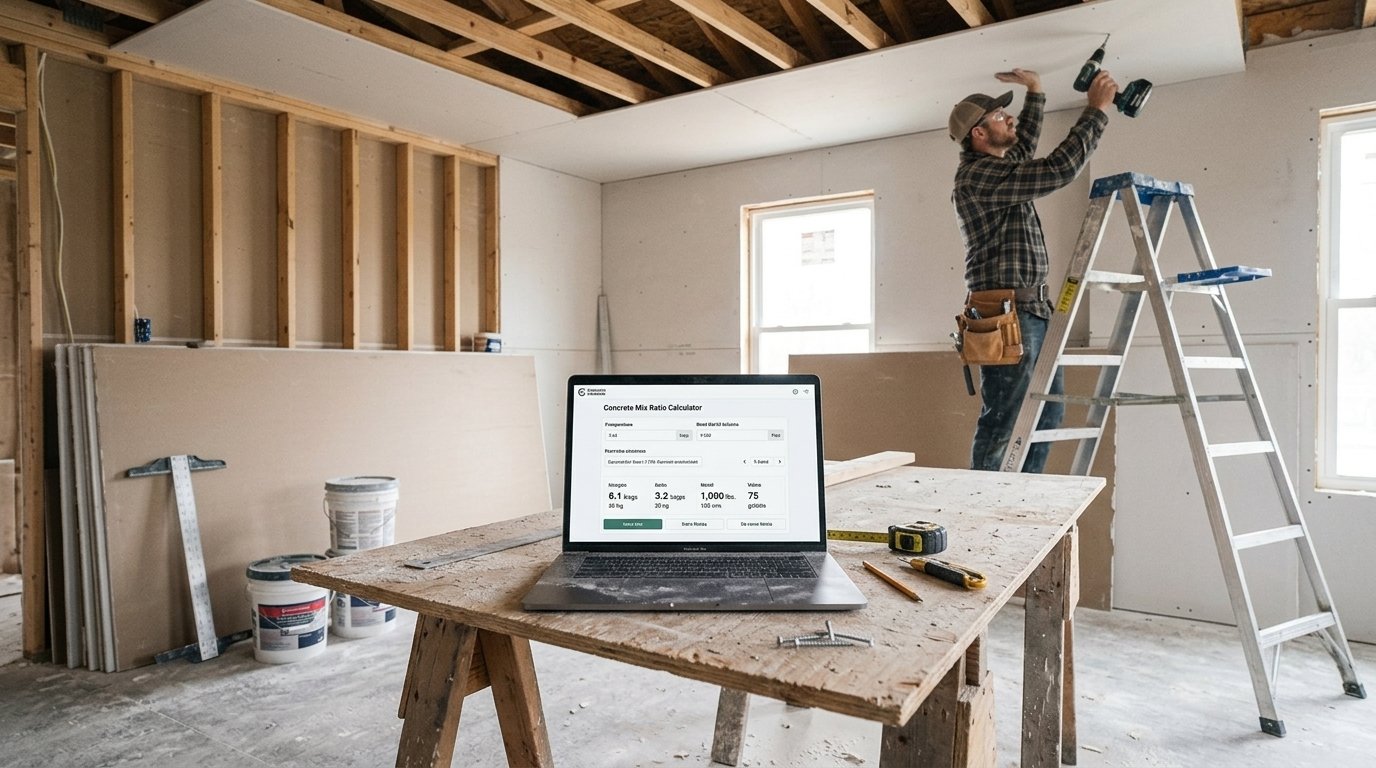
Drywall Ceiling Calculator 2026: Estimate Sheets, Screws & Costs
Installing drywall on a ceiling is one of the most physically demanding and messy phases of a renovation. Unlike walls, ceilings require working overhead, which leads to faster fatigue, more material waste, and a higher risk of mistakes. Because of this, estimating materials and costs for ceiling drywall can be particularly tricky. If you under-order, you risk delaying the project; if you over-order, you’re left with expensive unused boards taking up space.
Our Drywall Ceiling Calculator is a free online tool designed to take the guesswork out of your ceiling project. It helps you quickly estimate the number of sheets, screws, joint compound, tape, and total labour costs based on your ceiling dimensions and chosen materials.
In this guide, we’ll show you how to use the calculator, explain each cost component, provide real-world examples, and answer common questions. We’ll also share tips to ensure your drywall ceiling project stays on budget and achieves a professional finish.
Drywall Sheets (Ceiling)
Construction CalculatorDrywall for ceilings: sheets, screws, compound, tape and cost.
What is the Drywall Ceiling Calculator?
The Drywall Ceiling Calculator is a free online tool that calculates the material quantities and costs for installing drywall on ceilings. It supports various sheet sizes (standard and custom), single or double layering (for fire or acoustic ratings), waste allowance, and local pricing for sheets, screws, joint compound, tape, and labour. It provides a clear breakdown of ceiling area, materials required, and costs for each component.
The tool is part of a suite of materials and quantities calculators available on our website. For related calculations, you can use our Drywall Sheets (Walls) Calculator, Metal Stud & Track Profiles Calculator, and Acoustic Drywall Calculator.
How to Use the Drywall Ceiling Calculator
Using the calculator is straightforward. Here’s a breakdown of each field:
1. Ceiling Dimensions
- Ceiling length: Enter the total length of the ceiling in meters or feet.
- Ceiling width: Enter the total width of the ceiling in meters or feet.
2. Layers
- Number of layers: Select single layer for standard ceilings, or double layer for fire-rated or acoustic applications. Double layering significantly increases material requirements and labour time.
3. Sheet Details
- Sheet size: Select from standard sizes (2400×1200 mm, 2700×1200 mm, 3000×1200 mm) or choose “Custom” to enter your own dimensions.
- Custom sheet length/width: Used only when “Custom” is selected.
- Waste allowance: Enter a percentage for waste. Ceilings produce more offcuts than walls due to awkward angles and overhead cutting. 12% is typical, but complex ceilings may require 15% or more.
- Screws per m²: Enter the number of screws required per square meter. Ceilings need more screws than walls to combat gravity. Typical values are 25–30 pcs/m².
- Joint compound: Enter the kilograms of joint compound required per square meter. Typical values are 0.4–0.6 kg/m².
4. Pricing
- Price per sheet: Enter the local price per ceiling board. Note that ceiling boards are often thicker and heavier, which may increase the price.
- Price per screw: Enter the local price per screw.
- Compound price per kg: Enter the local price per kg of joint compound.
- Tape price per m²: Enter the local tape cost per square meter of board area. Set to 0 if not required.
- Labour price per m²: Enter the local labour rate per square meter. Ceilings are slower to install, so labour rates are often higher than for standard wall drywalling.
Once you enter all values, the calculator instantly displays the ceiling area, area with layers, number of sheets, screws, joint compound, and a full cost breakdown.
Understanding the Cost Components
To make the most of the calculator, it’s important to understand each output and the underlying formulas.
- Ceiling area: length × width. This is the total surface area of the ceiling.
- Area × layers: ceiling area × number of layers. This is the total area of drywall to be installed.
- Area with waste: area × layers × (1 + waste/100). This accounts for material lost during cutting and fitting.
- Sheets required: ceil(area with waste / sheet area). You buy whole sheets, so the calculator rounds up.
- Screws: ceil(area × layers × screws per m²).
- Joint compound: area × layers × compound per m².
- Tape cost: area × layers × tape price per m².
- Labour cost: area × layers × labour price per m². Labour is calculated on the installed area, not the area with waste, because waste is a material allowance.
- Grand total: Sum of sheets, screws, compound, tape, and labour costs.
Understanding these components helps you interpret the results and adjust your order. For more information on drywall standards, you can refer to Wikipedia’s article on drywall.
Example Calculations
Let’s run through a couple of examples to see how the calculator works in different scenarios.
Example 1: Standard Single-Layer Ceiling
Inputs:
- Ceiling length: 6 m
- Ceiling width: 4 m
- Layers: 1
- Sheet size: 2400 × 1200 mm
- Waste: 12%
- Screws per m²: 25
- Compound: 0.5 kg/m²
- Sheet price: $15 per sheet
- Screw price: $0.05 per screw
- Compound price: $2 per kg
- Tape price: $0.50 per m²
- Labour price: $20 per m²
Calculations:
- Ceiling area = 6 × 4 = 24 m²
- Area × layers = 24 m²
- Area with waste = 24 × 1.12 = 26.88 m²
- Sheet area = 2.4 × 1.2 = 2.88 m²
- Sheets required = ceil(26.88 / 2.88) = ceil(9.33) = 10 sheets
- Sheets cost = 10 × $15 = $150
- Screws = ceil(24 × 25) = 600 screws
- Screws cost = 600 × $0.05 = $30
- Compound = 24 × 0.5 = 12 kg
- Compound cost = 12 × $2 = $24
- Tape cost = 24 × $0.50 = $12
- Labour cost = 24 × $20 = $480
- Total = $150 + $30 + $24 + $12 + $480 = $696
Example 2: Double-Layer Ceiling with Custom Sheets
Inputs:
- Ceiling length: 8 m
- Ceiling width: 5 m
- Layers: 2
- Sheet size: Custom (2.5 m × 1.2 m)
- Waste: 15%
- Screws per m²: 30
- Compound: 0.6 kg/m²
- Sheet price: $18 per sheet
- Screw price: $0.06 per screw
- Compound price: $2.50 per kg
- Tape price: $0.60 per m²
- Labour price: $25 per m²
Calculations:
- Ceiling area = 8 × 5 = 40 m²
- Area × layers = 40 × 2 = 80 m²
- Area with waste = 80 × 1.15 = 92 m²
- Sheet area = 2.5 × 1.2 = 3.0 m²
- Sheets required = ceil(92 / 3.0) = ceil(30.67) = 31 sheets
- Sheets cost = 31 × $18 = $558
- Screws = ceil(80 × 30) = 2400 screws
- Screws cost = 2400 × $0.06 = $144
- Compound = 80 × 0.6 = 48 kg
- Compound cost = 48 × $2.50 = $120
- Tape cost = 80 × $0.60 = $48
- Labour cost = 80 × $25 = $2,000
- Total = $558 + $144 + $120 + $48 + $2,000 = $2,870
Tips for Accurate Drywall Ceiling Estimation
These examples show how different ceiling sizes, layering, anMeasure the ceiling accurately: Double-check length and width. For irregular ceilings, divide into rectangles and calculate separately.
Account for layers: If you are installing a double layer for fire or acoustic reasons, ensure the “Number of layers” is set to 2. This doubles your material and labour requirements.
Choose the right sheet size: Larger sheets mean fewer joints, but they are heavier and harder to install overhead. Standard 2400×1200 mm sheets are manageable for most DIYers.
Select the correct waste allowance: Ceilings produce more offcuts than walls. 12% is standard, but complex ceilings may require 15% or more.
Consider screws carefully: Ceilings need more screws than walls to combat gravity. 25–30 pcs/m² is typical.
Use realistic labour rates: Ceilings are slower to install. Labour rates are often higher than for standard wall drywalling. Enter a local rate per m².
Include scaffolding: If the ceiling is high, scaffolding or stilts may be required. Add this as a separate cost or include it in the labour rate.
Verify with a professional: For large or complex projects, have a qualified drywaller verify the design and quantities.
For more information on drywall installation standards, you can refer to resources like the Gypsum Association.d material choices affect the total cost.
Benefits of Using the Drywall Ceiling Calculator
How to Reduce Drywall Ceiling Costs
If your estimate is higher than expected, here are ways to reduce costs without compromising quality:
- Choose standard sheet sizes: Custom sizes are often more expensive and may require special orders.
- Reduce waste: Measure twice, cut once. Plan your cuts carefully to maximize the use of each sheet.
- Use standard joint compound: Standard all-purpose compound is cheaper than specialized lightweight or setting-type compounds.
- Install beads efficiently: Measure twice, cut once. Beads are relatively expensive, so avoid unnecessary cuts.
- Do the preparation yourself: Removing old drywall, cleaning the ceiling, and fixing beads can be done by a competent DIYer, saving labour costs.
- Get multiple quotes: Compare drywallers for the best price. But never choose solely on price—quality and experience matter.
Frequently Asked Questions (FAQ)
Conclusion
The Drywall Ceiling Calculator is an essential tool for builders, renovators, and homeowners. It helps you estimate the sheets, screws, joint compound, tape, and total cost for your ceiling project. By following the tips in this article and using the calculator, you can confidently plan your drywall ceiling work. Don’t forget to explore our other materials and quantities calculators for all your construction needs.
Whether you’re renovating a small room or a full house, accurate material and cost estimation is key to a successful project. Try the Drywall Ceiling Calculator today and take the guesswork out of your ceiling budget.



One Comment