Vinyl / LVT Flooring Calculator: Packs, Underlay & Total Cost
Vinyl flooring has quietly become the most popular hard floor in Europe and North America. It is cheaper than hardwood, more water-resistant than laminate, easier to install than tile, and available in finishes that look almost indistinguishable from real wood or stone. LVT — luxury vinyl tile — takes the format further: individual planks or tiles with realistic photographic layers, click-lock or glue-down installation, and rigid SPC cores that resist indentation and temperature change. But the choice between sheet vinyl, glue-down LVT, click LVT, and SPC is not cosmetic. Each has its own fixing method, its own subfloor requirements, and its own waste profile. Getting the specification wrong leads to a floor that lifts at the edges, telegraphs subfloor imperfections, or simply does not lock together.
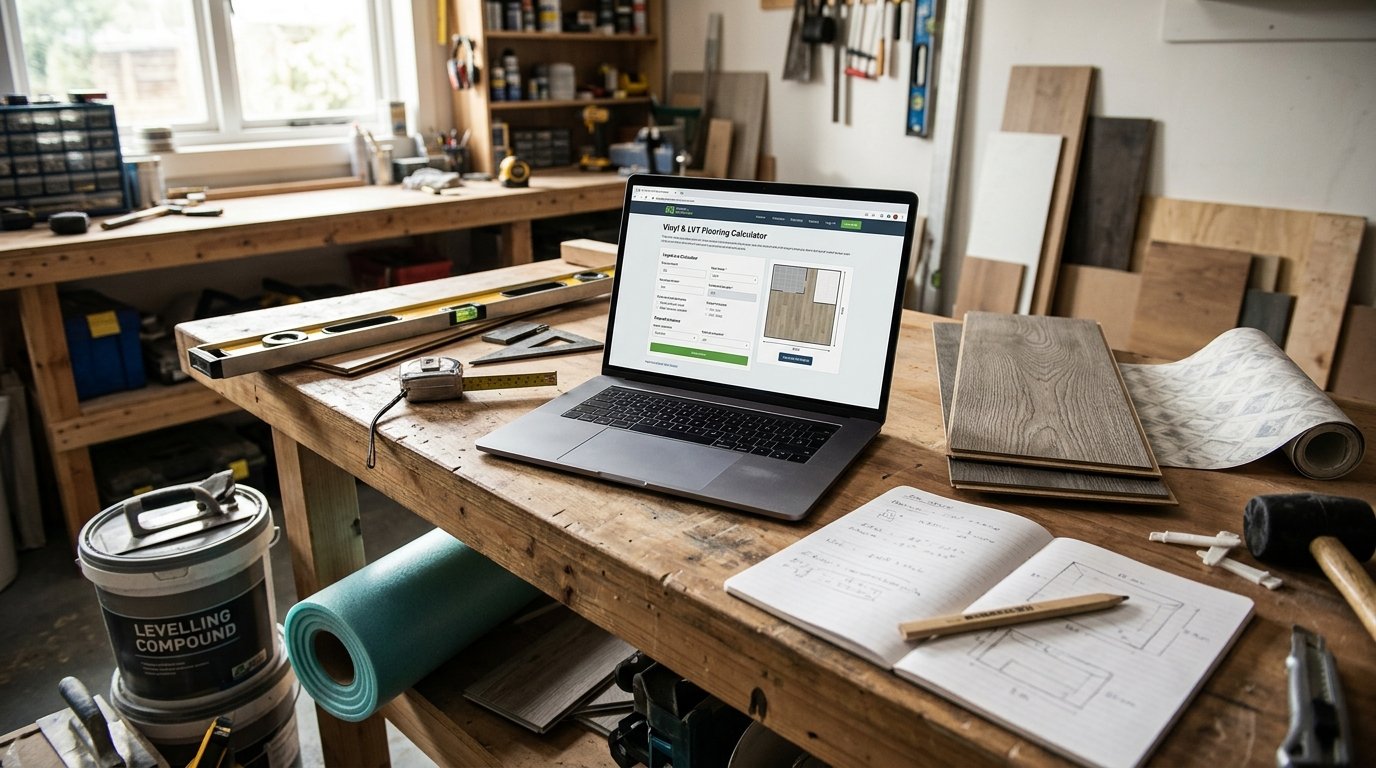
Our Vinyl / LVT Flooring Calculator is a free online tool that estimates the materials and costs of a vinyl or LVT floor installation. It handles sheet vinyl, glue-down LVT, click LVT, and SPC rigid core — with type-aware fixing compatibility, underlay with overlap for click systems, subfloor levelling, moisture barrier over concrete, skirting with mitre waste, beading, mass calculation, labour with type multipliers, delivery, VAT and cost per m². It also flags five common design errors — incompatible type/fixing combinations, sheet vinyl without skim coat, missing moisture barrier, glue fixing without adhesive price, and unusually small pack coverage — before the floor is ordered.
In this guide, we will show you how to use the calculator, explain each input and output, walk through four examples across product types, and answer eight of the most frequently asked questions about vinyl and LVT flooring.
Vinyl / LVT Flooring
Construction CalculatorVinyl / LVT flooring: packs, adhesive, underlay with overlap, subfloor levelling, trims and total cost.
What is the Vinyl / LVT Flooring Calculator?
The Vinyl / LVT Flooring Calculator is a free online tool that estimates the quantity and cost of materials for a vinyl or LVT floor installation. It supports:
- Input modes: room dimensions or direct area.
- Product types: sheet vinyl, LVT glue-down, LVT click, and SPC rigid core.
- Pack details: coverage per pack, price per pack, pack weight.
- Fixing methods: glue-down or click — with type-compatibility checks.
- Underlay overlap: 5–10% for click systems.
- Subfloor levelling: skim coat, levelling compound, plywood overlay, or none.
- Moisture barrier: recommended over concrete.
- Trims: skirting with mitre waste, beading / threshold bars.
- Pricing: pack, adhesive, underlay, levelling, moisture, skirting, beading, labour, delivery, VAT.
The output includes:
- Floor area and area with waste
- Packs required
- Total vinyl mass in kg
- Underlay area (with overlap) for click systems
- Skirting length with waste
- Design check warning
- Itemised costs: packs, adhesive, underlay, levelling, moisture barrier, skirting, beading, labour, delivery
- VAT, grand total and cost per m²
The tool is part of a suite of flooring calculators available on our website. For related calculations, you can use our Laminate Flooring Calculator, Hardwood Flooring Calculator, Parquet Flooring Calculator, and Floor Underlay Calculator.
Why Accurate Vinyl / LVT Flooring Estimation Matters
Vinyl is cheap per square metre, but the specification and installation account for most of the cost — and the specification is what determines whether the floor looks good for two years or twenty.
Sheet Vinyl, LVT Glue-Down, LVT Click and SPC Are Not Interchangeable
Each format has a specific fixing method, and using the wrong combination produces a floor that fails.
- Sheet vinyl is glued to the subfloor over its full area. It cannot be floated or clicked.
- LVT glue-down is bonded directly to the subfloor with adhesive.
- LVT click is a floating system — planks lock together and sit on underlay.
- SPC rigid core is usually click, sometimes glue; the rigid core resists indentation and temperature movement.
The calculator flags incompatible combinations — for example, sheet vinyl selected with click fixing, or LVT click with glue fixing — before the design is finalised.
Sheet Vinyl Requires a Very Flat Subfloor
Sheet vinyl is thin — 2–3 mm — and it telegraphs every imperfection in the subfloor. It needs at least a skim coat over the entire surface, and often a full levelling compound if the subfloor is uneven. The calculator warns when sheet vinyl is selected without any levelling method.
Underlay Is Only Used for Click Systems
Click LVT is a floating floor — planks are not glued. It needs underlay for cushioning, sound absorption, and to level minor imperfections. Glue-down LVT and sheet vinyl do not use underlay. The calculator only applies underlay cost for click fixing.
Underlay Needs Overlap
Underlay is laid in strips that must overlap at the seams. 5–10% overlap is standard. Using area alone underestimates underlay by 5–10%. The calculator applies the overlap automatically.
Moisture Barrier Over Concrete
Concrete releases moisture for years, and vinyl absorbs it from below. Without a moisture barrier, glue-down vinyl and LVT can bubble, lift, and delaminate. The calculator warns when a moisture barrier is not selected.
Skirting Needs Waste
Skirting is cut at every corner, doorway, and end of run. Mitre cuts at corners and short pieces at doorways mean a 5–10% waste allowance is realistic. The calculator applies waste to the skirting length and outputs the total length to order.
Mass Matters on Upper Floors
Vinyl is lighter than hardwood but still significant. A 2 mm LVT with underlay weighs around 5 kg/m². A 5 mm SPC plank weighs 10–12 kg/m². On upper floors or lightweight construction, the mass must be checked against the structural design.
Labour Varies by Product
Sheet vinyl is slower to install than click LVT — 1.10 vs 0.95 multiplier — because it requires precise cutting, adhesive application, and seam welding. Glue-down LVT is the baseline at 1.00. SPC is 1.05 because of the heavier planks and tighter locking joints.
VAT and Delivery
Vinyl packs are bulky and often delivered on a pallet. Delivery and VAT add real cost to the final bill.
For more information on vinyl flooring, you can refer to Wikipedia’s article on vinyl composition tile or the Resilient Floor Covering Institute (RFCI).
How to Use the Vinyl / LVT Flooring Calculator
Using the calculator is straightforward. Here is a breakdown of each field.
1. Area
- Input mode: “Length × width” or “Direct area”.
- Room length / width: Enter dimensions in meters or feet.
- Area: Enter direct area in m² or ft².
- Waste allowance: 10–15% for sheet vinyl; 5–8% for click LVT; 3–5% for glue-down LVT.
2. Product
- Type: Sheet vinyl, LVT glue-down, LVT click, or SPC rigid core. The type determines the allowed fixing method and the labour multiplier.
- Pack coverage: m² per pack. Typically 2.0–3.5 m². Check the packaging.
- Pack weight: kg per pack. Used for total mass.
3. Fixing
- Fixing method: Glue-down or click. Must match the type.
- Underlay overlap: 5–10% for click systems.
4. Prep
- Subfloor levelling: None, skim coat, levelling compound, or plywood overlay. Sheet vinyl needs at least a skim coat.
- Levelling price per m²: Price depends on the chosen method (skim ~$4, compound ~$12, ply ~$20).
- Moisture barrier: Recommended over concrete.
- Moisture barrier price per m²: Local price.
5. Trims
- Skirting length: Total length in meters or feet. Set 0 if not required.
- Skirting waste: Typically 8% for mitre cuts.
- Beading / threshold length: Total length in meters or feet. Set 0 if not required.
6. Pricing
Enter local prices for each component. Leave 0 to skip.
7. Extras
- Delivery / skip: Fixed cost for delivery and waste removal.
- VAT / tax rate: Applicable rate, or 0 if not applicable.
Once you enter all values, the calculator displays the full output, including packs, mass, underlay area, skirting length, design check, itemised costs, VAT, total and cost per m².
Understanding the Calculations
To make the most of the calculator, it is important to understand each output and the underlying formulas.
Area and Waste
area = length × width (dims) or direct area.
area_waste = area × (1 + waste / 100).
Waste varies: sheet vinyl 10–15%, click LVT 5–8%, glue-down LVT 3–5%.
Packs
packs = ceil(area_waste / pack coverage).
Vinyl Mass
mass_kg = packs × pack weight.
For 2 mm LVT at 5 kg/m²: a 20 m² room is 100 kg. For 5 mm SPC at 12 kg/m²: a 20 m² room is 240 kg.
Underlay Area (Click Only)
underlay_area = area × (1 + overlap / 100).
underlay_cost = underlay_area × underlay price per m².
Adhesive (Glue Only)
adhesive_cost = area × adhesive price per m².
Levelling
levelling_cost = area × levelling price per m² (only when a method other than “none” is selected).
The price is user-entered, but should reflect the chosen method — skim coat, compound, or ply.
Moisture Barrier
moisture_cost = area × moisture price per m² (only when selected).
Skirting
skirting_length_total = skirting_length × (1 + skirting_waste / 100).
skirting_cost = skirting_length_total × skirting price per metre.
Beading / Threshold
beading_cost = beading length × price per metre.
Labour
labour_cost = area × labour rate × product multiplier.
Product multipliers:
- LVT glue-down: 1.00
- LVT click: 0.95
- SPC: 1.05
- Sheet vinyl: 1.10
Design Check
The calculator performs five checks:
- Sheet vinyl with click fixing.
- LVT click with glue fixing.
- LVT glue with click fixing.
- Sheet vinyl without any levelling.
- No moisture barrier over concrete.
- Glue fixing without adhesive price.
- Pack coverage below 1.0 m².
VAT and Total
VAT = subtotal × VAT / 100.
Total = subtotal + VAT.
Cost per m² = total / area.
Understanding these components helps you interpret the results and adjust your order. For more information on vinyl flooring standards, you can refer to Wikipedia’s article on vinyl composition tile or the Resilient Floor Covering Institute (RFCI).
Reference Table of Product Types
| Type | Fixing | Underlay | Levelling | Labour |
|---|---|---|---|---|
| Sheet vinyl | Glue | No | Skim minimum | 1.10 |
| LVT glue-down | Glue | No | Compound | 1.00 |
| LVT click | Click | Yes | Compound or skim | 0.95 |
| SPC rigid core | Click or glue | Yes if click | Compound or ply | 1.05 |
Example Calculations
Let’s run through four examples across product types.
Example 1: Bedroom, 20 m², Click LVT on Underlay
Inputs:
- Room: 5 × 4 m → 20 m²
- Waste: 8%
- Type: LVT click
- Pack: 2.2 m², 12 kg
- Fixing: Click, underlay $4/m², 5% overlap
- Levelling: Skim coat at $4/m²
- Moisture: Yes, $3/m²
- Skirting: 18 m at $12/m, 8% waste
- Beading: 2 m at $15/m
- Prices: pack $42, labour $15/m²
- Delivery: $80
- VAT: 20%
Calculations:
- Area = 20 m²; waste → 21.6 m²
- Packs = ceil(21.6 / 2.2) = 10
- Pack cost = 10 × $42 = $420
- Mass = 10 × 12 = 120 kg
- Underlay = 20 × 1.05 × $4 = $84
- Skim = 20 × $4 = $80
- Moisture = 20 × $3 = $60
- Skirting = 18 × 1.08 × $12 = $233.28
- Beading = 2 × $15 = $30
- Labour = 20 × $15 × 0.95 = $285
- Delivery = $80
- Subtotal = $1,272.28
- VAT = $254.46
- Total = $1,526.74
- Cost per m² = $76.34
- Design: OK
Example 2: Kitchen, 15 m², Sheet Vinyl Glue-Down
Inputs:
- Room: 5 × 3 m → 15 m²
- Waste: 12% (sheet vinyl needs more cutting)
- Type: Sheet vinyl
- Pack: 4 m², 6 kg
- Fixing: Glue at $3/m²
- Levelling: Levelling compound at $12/m²
- Moisture: Yes, $3/m²
- Skirting: 16 m at $10/m, 8% waste
- Prices: pack $65, labour $18/m²
- Delivery: $60
- VAT: 20%
Calculations:
- Area = 15 m²; waste → 16.8 m²
- Packs = ceil(16.8 / 4) = 5
- Pack cost = 5 × $65 = $325
- Mass = 5 × 6 = 30 kg
- Adhesive = 15 × $3 = $45
- Levelling = 15 × $12 = $180
- Moisture = 15 × $3 = $45
- Skirting = 16 × 1.08 × $10 = $172.80
- Labour = 15 × $18 × 1.10 = $297
- Delivery = $60
- Subtotal = $1,124.80
- VAT = $224.96
- Total = $1,349.76
- Cost per m² = $89.98
- Design: OK
Example 3: Large Living Room, 35 m², SPC Rigid Core
Inputs:
- Room: 7 × 5 m → 35 m²
- Waste: 8%
- Type: SPC
- Pack: 2.5 m², 22 kg
- Fixing: Click at $5/m², 5% overlap
- Levelling: Levelling compound at $10/m²
- Moisture: Yes, $3/m²
- Skirting: 24 m at $15/m, 8% waste
- Prices: pack $55, labour $16/m²
- Delivery: $120
- VAT: 20%
Calculations:
- Waste → 37.8 m²
- Packs = ceil(37.8 / 2.5) = 16
- Pack cost = 16 × $55 = $880
- Mass = 16 × 22 = 352 kg
- Underlay = 35 × 1.05 × $5 = $183.75
- Levelling = 35 × $10 = $350
- Moisture = 35 × $3 = $105
- Skirting = 24 × 1.08 × $15 = $388.80
- Labour = 35 × $16 × 1.05 = $588
- Delivery = $120
- Subtotal = $2,615.55
- VAT = $523.11
- Total = $3,138.66
- Cost per m² = $89.68
- Design: OK
Example 4: Sheet Vinyl Without Levelling — Warning
Same as Example 2 but levelling = none:
- Design warning: “Sheet vinyl requires at least a skim coat — ‘none’ is not viable”
- Cost drops by $180
- User sees a cheaper total but a clear warning that the floor will fail
The calculator catches a design error that would otherwise cost the entire sheet vinyl to be replaced.
Benefits of Using the Vinyl / LVT Flooring Calculator
Tips for Accurate Vinyl / LVT Flooring Estimation
- Choose the type before the price. Sheet vinyl, glue-down, click, and SPC have different fixing methods and different labour times.
- Read the pack coverage. It varies from 2.0 to 4.0 m² depending on product.
- Allow correct waste. Sheet vinyl 10–15%; click 5–8%; glue-down 3–5%.
- Confirm the fixing matches the type. Sheet vinyl must be glued. Click LVT must be clicked.
- Prepare the subfloor properly. Sheet vinyl needs at least a skim coat. LVT needs a flat surface.
- Include a moisture barrier over concrete. No exceptions.
- Add skirting waste. 8% is realistic for mitre cuts.
- Check the mass on upper floors. SPC at 5 mm weighs 10–12 kg/m² — 35 m² is 350–420 kg.
- Acclimatise the packs. 24–48 hours in the room before installation.
- Do not forget delivery and VAT. Both significantly change the total.
- Choose AC rating for SPC carefully. Commercial-grade SPC is heavier and more expensive.
- Get multiple quotes. Vinyl installers vary significantly in price.
For more information on vinyl flooring standards, you can refer to the Resilient Floor Covering Institute (RFCI) or Wikipedia’s article on vinyl composition tile.
Common Mistakes to Avoid
- Floating sheet vinyl. Sheet vinyl cannot be clicked — it must be glued.
- Gluing LVT click. Click planks are floating systems — glue fixing damages the locking mechanism.
- Skipping the skim coat under sheet vinyl. The surface will telegraph every subfloor imperfection.
- Using area alone for underlay. Underlay needs 5–10% overlap.
- Ignoring the moisture barrier over concrete. Vinyl lifts and bubbles without it.
- No skirting waste. Mitre cuts at corners need extra length.
- Underestimating mass. SPC is heavier than standard LVT.
- Using the wrong waste. 5% for sheet vinyl is not enough — it needs 10–15%.
- No delivery or VAT. Both significantly change the total bill.
- Choosing by price alone. Cheap vinyl fails faster and costs more long-term.
How to Reduce Vinyl / LVT Flooring Costs
If your estimate is higher than expected, here are ways to reduce costs without compromising quality:
- Choose LVT click over sheet vinyl. Faster and cheaper to install, and no adhesive.
- Choose LVT glue over SPC where appropriate. Cheaper per m², still durable.
- Skip the moisture barrier if the subfloor is dry. Test first — but do not skip it over concrete.
- Do the skirting yourself. Straightforward carpentry.
- Do the levelling yourself. Skim coat is within reach of a competent DIYer.
- Compare suppliers. LVT prices vary 30% between brands.
- Order in bulk. Multiple rooms qualify for larger orders.
- Time the project off-season. Retailers discount in quieter months.
- Get multiple quotes. Compare at least three installers.
- Consider glue-down over click. Lower material cost, but requires more subfloor prep.
Frequently Asked Questions (FAQ)
Conclusion
The Vinyl / LVT Flooring Calculator is an essential tool for homeowners, installers, and specifiers. It estimates packs, adhesive, underlay with overlap, subfloor levelling, moisture barrier, skirting with waste, beading, mass, labour with type multipliers, delivery, VAT and cost per m² — with design warnings that catch incompatible type/fixing combinations, sheet vinyl without skim coat, missing moisture barrier, and glue fixing without adhesive price.
The corrected calculator now applies the correct labour multiplier for each product, checks fixing-type compatibility, adds underlay overlap for click systems, and flags subfloor preparation requirements that are easy to miss. Whether you are laying click LVT in a bedroom or sheet vinyl in a wet room, accurate estimation is the foundation of a durable, moisture-safe, and cost-effective installation. Try the Vinyl / LVT Flooring Calculator today and take the guesswork out of your vinyl project.