
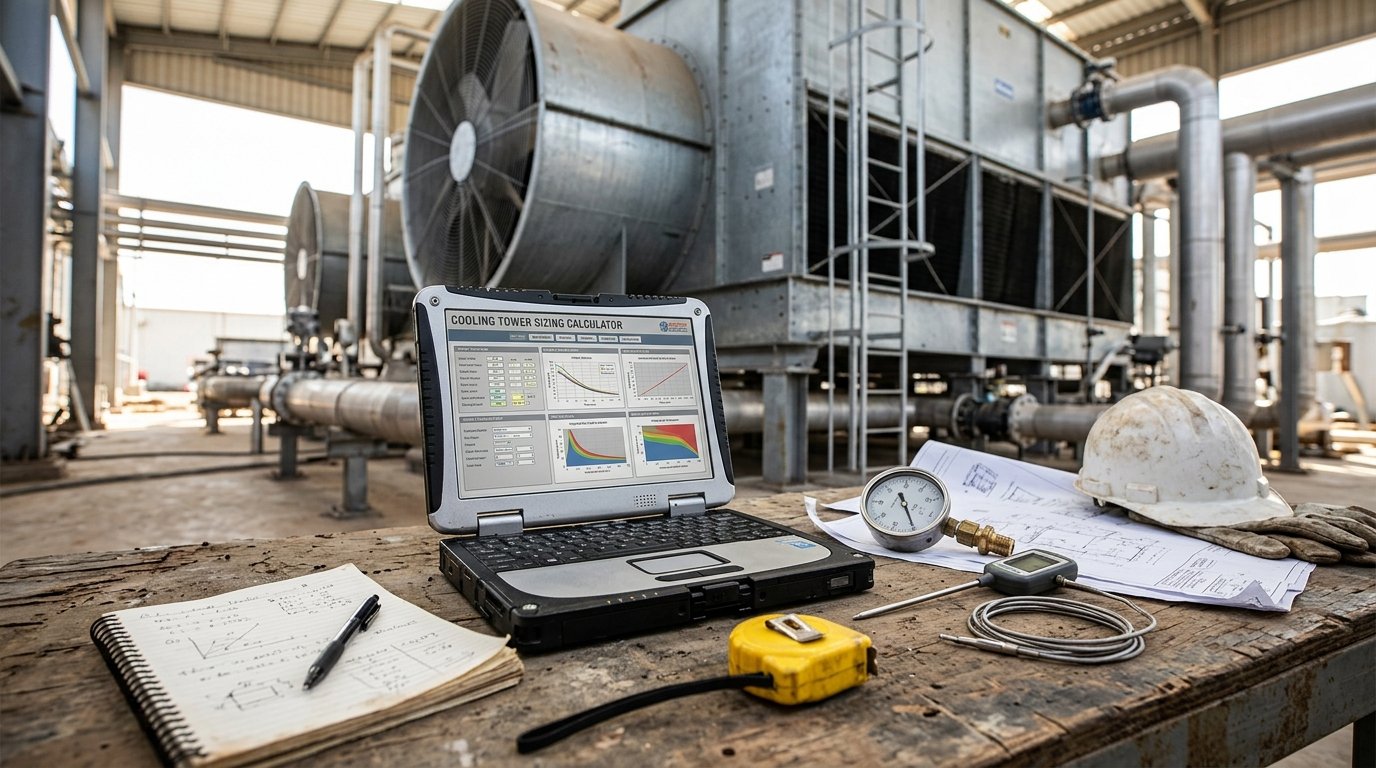
Cooling Tower Sizing Calculator: Estimate Heat Rejection & Costs
Cooling towers are the heat rejection backbone of water-cooled chiller systems. They reject condenser heat to the atmosphere through evaporation, allowing chillers to operate at high efficiency. But a cooling tower is not a simple piece of equipment — it is a thermodynamic system that must be sized for the specific heat rejection, wet-bulb temperature, approach, and water chemistry of each project. Under-size the tower and the chiller loses capacity on hot days; over-size it and you pay for unnecessary capital, fan energy, and water treatment.
Our Cooling Tower Sizing Calculator is a free online tool that takes the guesswork out of cooling tower design. It estimates heat rejection from either direct input or chiller capacity, calculates the required tower capacity with corrections for approach, altitude, and tower type, determines circulating water flow, evaporation, drift, blowdown, and make-up water, and provides annual fan energy, water consumption, running cost, and installed cost. Whether you are an HVAC engineer, contractor, facilities manager, or building owner, this calculator gives you the numbers you need to specify the right tower.
In this guide, we will show you how to use the calculator, explain each input and output, walk through real-world examples, and answer the questions we hear most often. We will also share practical tips to ensure your cooling tower design is efficient, compliant, and cost-effective.
Cooling Tower Sizing
Construction CalculatorCooling tower: heat rejection, water flow, approach, evaporation and cost.
What is the Cooling Tower Sizing Calculator?
The Cooling Tower Sizing Calculator is a free online tool that estimates the required capacity and operating characteristics of an evaporative cooling tower. It supports two heat rejection input modes — direct kW or derived from chiller cooling capacity and COP. It allows you to specify condenser flow and return temperatures, design wet-bulb temperature, altitude, tower type, approach temperature, cycles of concentration, fan type, fan speed control, fan power as a percentage of heat rejection, and a sizing margin. The calculator returns:
- Heat rejection
- Water ΔT (range)
- Design approach
- Required tower capacity
- Circulating flow in L/s and m³/h
- Evaporation loss
- Drift loss
- Blowdown
- Make-up water
- Annual make-up water
- Fan power
- Annual electricity
- Annual electricity cost
- Annual water cost
- Annual running cost
- Cooling tower installed cost
The tool is part of a suite of materials and quantities calculators available on our website. For related calculations, you can use our Chiller Sizing Calculator, Cold Room Cooling Load Calculator, Air Conditioner Sizing Calculator, and Data Centre Cooling Calculator.
Why Accurate Cooling Tower Sizing Matters
A cooling tower is a long-term asset. It runs for thousands of hours per year, consumes electricity and water, and directly affects chiller efficiency. Sizing errors are expensive to correct and often go unnoticed until the system fails to meet design conditions on the hottest day of the year.
Chiller Performance
The cooling tower determines the condenser water temperature returning to the chiller. If the tower is undersized, the condenser water runs warmer than design, the chiller lifts more, and both capacity and COP drop. At 35 °C condenser water, a chiller might deliver 100% capacity; at 40 °C, the same chiller might deliver only 90%. Accurate tower sizing protects chiller performance year-round.
Energy Efficiency
Cooling tower fans consume 1–2% of heat rejection as electrical power. On a 500 kW heat rejection system, that is 5–10 kW of continuous fan power. With VFD control, this can be cut by 45% at part load. Correct sizing combined with appropriate fan control yields significant energy savings over the life of the tower.
Water Consumption
Evaporation, drift, and blowdown determine make-up water consumption. A 500 kW tower evaporates roughly 0.77 m³/h, with blowdown and drift adding another 0.3–0.5 m³/h. Over a 4000-hour year, that is thousands of cubic metres of water. Accurate estimation is essential for water budgeting, treatment planning, and regulatory compliance.
Capital Cost
Cooling towers are capital-intensive. Oversizing wastes money on unnecessary structure, fan power, and water treatment. Undersizing leads to retrofit costs and operational penalties. Accurate sizing ensures you pay for the right tower.
Compliance and Legionella Control
Cooling towers are subject to regulations for Legionella control in many jurisdictions. Tower type, water treatment, and blowdown management are all part of compliance. Correct sizing ensures the tower operates within its designed range, reducing risk.
Acoustics and Footprint
Larger towers have larger footprints and produce more noise. On constrained sites, tower selection must balance capacity, footprint, and acoustic requirements. Correct sizing avoids over-engineering that creates unnecessary site problems.
For more information on cooling tower principles, you can refer to Wikipedia’s article on cooling towers or the ASHRAE Handbook.
How to Use the Cooling Tower Sizing Calculator
Using the calculator is straightforward. Here is a breakdown of each field.
1. Load
- Load input: Choose how to determine heat rejection:
- Heat rejection (kW): Use this when you already know the condenser heat rejection from a chiller selection or load calculation.
- From chiller capacity: Use this when you know the chiller cooling capacity and COP.
- Heat rejection: Enter the total heat to be rejected in kW. Used in “Heat rejection” mode.
- Chiller cooling capacity: Enter the chiller cooling capacity in kW. Used in “From chiller capacity” mode.
- Chiller COP: Enter the chiller COP. The calculator derives heat rejection as cooling × (1 + 1/COP). Typical COP values: 3.0 for air-cooled, 4.5–6.0 for water-cooled.
2. Water Circuit
- Condenser flow (hot water): Enter the temperature of the hot water returning from the condenser to the tower in °C or °F. Typical 35–40 °C.
- Condenser return (cooled water): Enter the temperature of the cooled water leaving the tower in °C or °F. Typical 29–34 °C. The difference between the two is the water range (ΔT), typically 5–7 K.
3. Ambient
- Design wet-bulb: Enter the design wet-bulb temperature in °C or °F. This is the single most important parameter for cooling tower performance. Typical values: 20–28 °C depending on climate.
- Altitude: Enter the site altitude in meters. Above 1000 m, air is less dense and towers must be larger. The calculator applies a derating factor.
4. Tower
- Tower type: Select open circuit (evaporative), closed circuit (fluid cooler), hybrid, or adiabatic. The type affects physical size and cost. Open circuit is the most common; closed circuit and adiabatic require 20–50% more capacity for the same heat rejection.
- Approach temperature: Enter the approach in K. Approach is the difference between the cooled water temperature and the wet-bulb temperature. 3–5 K is typical. Tighter approach requires a larger tower.
5. Blowdown
- Cycles of concentration: Enter the number of cycles. 3–5 is typical with water treatment. Higher cycles reduce blowdown and make-up water, but require better water treatment.
6. Fan
- Fan type: Select axial, centrifugal, induced draft, or forced draft. Axial fans are common for large towers; centrifugal fans are quieter and used in acoustically sensitive locations.
- Fan speed control: Select single speed, two speed, or VFD. VFD reduces fan energy significantly at part load.
- Fan power: Enter fan power as a percentage of heat rejection. 1–2% is typical. If you have a specific tower datasheet, use the exact value.
7. Safety
- Sizing margin: Enter a percentage for fouling and future load. 10–20% is typical.
8. Pricing and Running
- Tower installed cost per kW: Enter the local installed cost per kW of heat rejection.
- Electricity price: Enter the local price per kWh.
- Water price per m³: Enter the local price per cubic metre of make-up water.
- Running hours per year: Enter the expected annual running hours. 4000 hours is typical for a seasonal cooling system.
Once you enter all values, the calculator instantly displays heat rejection, water range, design approach, required tower capacity, circulating flow in L/s and m³/h, evaporation, drift, blowdown, make-up water, annual make-up water, fan power, annual electricity, annual electricity and water costs, total annual running cost, and tower installed cost.
Understanding the Calculations
To make the most of the calculator, it is important to understand each output and the underlying formulas.
Heat Rejection
In “Heat rejection” mode, this is the value you entered. In “From chiller capacity” mode, heat rejection is cooling × (1 + 1/COP). For a 200 kW chiller at COP 4.0, heat rejection is 200 × 1.25 = 250 kW.
Water ΔT (Range)
The difference between the hot water entering the tower and the cooled water leaving it. Typical range is 5–7 K. Larger range means less circulating flow for the same heat rejection.
Design Approach
The approach is the difference between the cooled water temperature and the wet-bulb temperature. It is the single most important parameter in cooling tower sizing. A tight approach (e.g., 3 K) requires a much larger tower than a loose approach (e.g., 6 K).
Required Tower Capacity
Heat rejection × (1 + sizing margin / 100) × approach factor × altitude factor × tower type factor. Each correction reflects a physical requirement of the application.
Circulating Flow
Heat rejection / (4.18 × ΔT). The 4.18 is the specific heat of water in kJ/kg·K. The flow is expressed in L/s and m³/h.
Evaporation Loss
Heat rejection × 0.00153 m³/h per kW. This constant comes from the latent heat of vaporisation of water and typical tower efficiency.
Drift Loss
Circulating flow × 0.0002 (0.02%). Drift is water lost as fine droplets entrained in the air stream.
Blowdown
Evaporation loss / (cycles of concentration − 1). Higher cycles of concentration mean less blowdown and less make-up water.
Make-up Water
Evaporation + drift + blowdown. This is the total water that must be supplied to the tower.
Fan Power
Tower capacity × fan power percentage × fan type factor × fan control factor. VFD control reduces annual fan energy by 45% compared to single-speed operation.
Annual Energy and Running Cost
Fan power × running hours per year for electricity. Make-up water × running hours per year for water. Costs depend on local prices.
Tower Installed Cost
Required tower capacity × cost per kW. Tower type factor is already included in the capacity, so closed circuit and adiabatic towers correctly cost more.
Understanding these components helps you interpret the results and adjust your design. For more information on cooling tower design, you can refer to Wikipedia’s article on cooling towers or the ASHRAE Handbook.
Example Calculations
Let’s run through two examples to see how the calculator works in different scenarios.
Example 1: Open Circuit Tower from Direct Heat Rejection
Inputs:
- Load input: Heat rejection (kW)
- Heat rejection: 300 kW
- Condenser flow: 37 °C
- Condenser return: 32 °C
- Design wet-bulb: 21 °C
- Altitude: 0 m
- Tower type: Open circuit
- Approach: 4 K
- Cycles: 3
- Fan type: Axial
- Fan control: VFD
- Fan power: 1.5%
- Margin: 15%
- Tower cost per kW: $250
- Electricity: $0.15/kWh
- Water: $2.50/m³
- Running hours: 4000 h
Calculations:
- Heat rejection = 300 kW
- ΔT water = 37 − 32 = 5 K
- Tower type factor (open) = 1.00
- Approach factor = 1 + (4 − 4) × 0.15 = 1.00
- Altitude factor = 1.00
- Required tower capacity = 300 × 1.15 × 1.00 × 1.00 × 1.00 = 345 kW
- Circulating flow = 300 / (4.18 × 5) = 14.35 kg/s = 14.35 L/s = 51.66 m³/h
- Evaporation = 300 × 0.00153 = 0.459 m³/h
- Drift = 51.66 × 0.0002 = 0.0103 m³/h
- Blowdown = 0.459 / (3 − 1) = 0.2295 m³/h
- Make-up = 0.459 + 0.0103 + 0.2295 = 0.699 m³/h
- Annual water = 0.699 × 4000 = 2796 m³
- Fan power = 345 × 0.015 × 1.00 × 0.55 = 2.85 kW
- Annual electricity = 2.85 × 4000 = 11,400 kWh
- Annual electricity cost = 11,400 × $0.15 = $1,710
- Annual water cost = 2796 × $2.50 = $6,990
- Annual running cost = $8,700
- Tower cost = 345 × $250 = $86,250
Result: The tower must reject 300 kW, requiring a 345 kW tower. It circulates 51.66 m³/h, consumes 0.699 m³/h of make-up water, and uses 2.85 kW of fan power. Annual running cost is approximately $8,700.
Example 2: Closed Circuit Tower from Chiller Capacity
Inputs:
- Load input: From chiller capacity
- Chiller cooling capacity: 400 kW
- Chiller COP: 5.0
- Condenser flow: 38 °C
- Condenser return: 32 °C
- Design wet-bulb: 24 °C
- Altitude: 1200 m
- Tower type: Closed circuit
- Approach: 3 K
- Cycles: 4
- Fan type: Centrifugal
- Fan control: Two speed
- Fan power: 1.8%
- Margin: 20%
- Tower cost per kW: $350
- Electricity: $0.12/kWh
- Water: $3.00/m³
- Running hours: 5000 h
Calculations:
- Heat rejection = 400 × (1 + 1/5) = 480 kW
- ΔT water = 38 − 32 = 6 K
- Tower type factor (closed) = 1.30
- Approach factor = 1 + (4 − 3) × 0.15 = 1.15
- Altitude factor = 1 + ((1200 − 1000) / 1000) × 0.10 = 1.02
- Required tower capacity = 480 × 1.20 × 1.15 × 1.02 × 1.30 = 877.5 kW
- Circulating flow = 480 / (4.18 × 6) = 19.14 kg/s = 68.9 m³/h
- Evaporation = 480 × 0.00153 = 0.734 m³/h
- Drift = 68.9 × 0.0002 = 0.0138 m³/h
- Blowdown = 0.734 / (4 − 1) = 0.245 m³/h
- Make-up = 0.734 + 0.0138 + 0.245 = 0.993 m³/h
- Annual water = 0.993 × 5000 = 4,965 m³
- Fan power = 877.5 × 0.018 × 1.30 × 0.75 = 15.4 kW
- Annual electricity = 15.4 × 5000 = 77,000 kWh
- Annual electricity cost = 77,000 × $0.12 = $9,240
- Annual water cost = 4,965 × $3.00 = $14,895
- Annual running cost = $24,135
- Tower cost = 877.5 × $350 = $307,125
Result: The tower must reject 480 kW, requiring an 877.5 kW closed circuit tower due to the tower type, tight approach, and altitude corrections. Annual running cost is approximately $24,135.
These examples show how chiller capacity, COP, wet-bulb, tower type, approach, altitude, and fan control affect tower size and running cost.
Benefits of Using the Cooling Tower Sizing Calculator
Tips for Accurate Cooling Tower Sizing
- Use the correct wet-bulb. Wet-bulb temperature is the single most important parameter. Use the design wet-bulb for the site, not the annual average.
- Confirm the water range. ΔT is typically 5–7 K for condenser water. A larger range reduces flow but may affect chiller performance.
- Choose the right tower type. Open circuit is the simplest and cheapest. Closed circuit, hybrid, and adiabatic towers are larger and more expensive but offer benefits in water quality and plume control.
- Use the correct approach. 3–5 K is typical. Tighter approach means a larger, more expensive tower.
- Account for altitude. Above 1000 m, towers lose capacity. The calculator applies a derating factor.
- Choose the right fan type. Axial fans are common for large towers. Centrifugal fans are quieter but use more power.
- Select VFD control where possible. VFD reduces fan energy by up to 45% at part load.
- Check cycles of concentration. Higher cycles reduce blowdown and make-up water. 3–5 is typical with water treatment.
- Include a sizing margin. 10–20% is typical for fouling and future load.
- Verify with a professional. For large or critical projects, have a qualified HVAC engineer verify the tower selection.
For more information on cooling tower standards, you can refer to the ASHRAE Handbook or Wikipedia’s article on cooling towers.
Common Mistakes to Avoid
- Using the wrong wet-bulb. Wet-bulb is not the same as dry-bulb. Using dry-bulb over-sizes the tower dramatically.
- Forgetting approach correction. A 3 K approach requires a much larger tower than a 5 K approach.
- Ignoring tower type. Closed circuit and adiabatic towers are physically larger and more expensive than open circuit towers.
- Underestimating make-up water. Evaporation, drift, and blowdown all contribute. High cycles reduce blowdown but require water treatment.
- Using single-speed fans on variable loads. VFD control saves significant fan energy at part load.
- Ignoring altitude. Above 1000 m, towers lose capacity. Failing to account for this leads to undersizing.
- Skipping the sizing margin. Fouling and future load require a margin.
- Not accounting for water quality. Poor water quality increases blowdown and treatment costs.
- Ignoring Legionella risk. Cooling towers must be managed under a water treatment and maintenance programme.
- Skipping professional verification. For large or critical projects, always consult an HVAC engineer.
How to Reduce Cooling Tower Running Costs
If your estimated running cost is higher than expected, here are ways to reduce it without compromising cooling:
- Use VFD fan control. VFD reduces fan energy significantly at part load.
- Increase cycles of concentration. Higher cycles reduce blowdown and make-up water. Requires good water treatment.
- Optimise approach. A slightly looser approach allows a smaller tower with lower fan power.
- Use a hybrid or adiabatic tower only when required. These types are larger and more expensive.
- Reduce heat rejection. Improving chiller efficiency reduces the heat that must be rejected.
- Schedule cooling. Pre-cool during off-peak hours to reduce peak tower load.
- Maintain the tower. Clean fill, nozzles, and fan blades to maintain efficiency.
- Monitor water quality. Good water treatment reduces fouling and blowdown.
- Use a plume-abatement strategy if required. Plume control increases cost but may be mandatory in some locations.
- Get multiple quotes. Compare tower suppliers for the best price and performance.
Frequently Asked Questions (FAQ)
Conclusion
The Cooling Tower Sizing Calculator is an essential tool for HVAC engineers, contractors, facilities managers, and building owners. It helps you estimate heat rejection, required tower capacity, circulating flow, evaporation, drift, blowdown, make-up water, fan power, annual running cost, and installed cost. By following the tips in this article and using the calculator, you can confidently specify the right cooling tower and avoid costly sizing mistakes.
Whether you are cooling a small chiller plant or a large industrial process, accurate tower sizing is the foundation of efficient heat rejection and long-term reliability. Try the Cooling Tower Sizing Calculator today and take the guesswork out of your cooling tower design.



2 Comments