
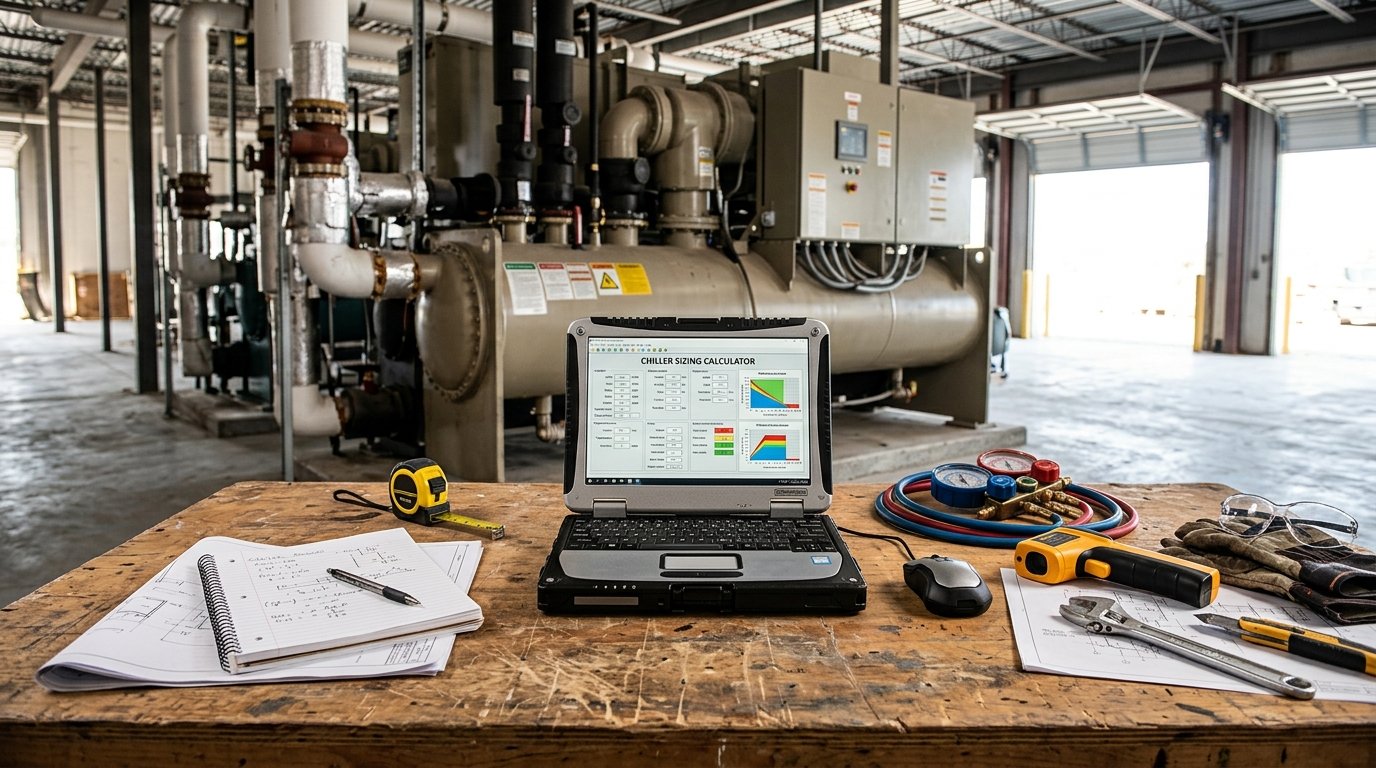
Chiller Sizing Calculator: Estimate Cooling Load, Flow & Costs
Chillers are the workhorses of commercial and industrial cooling. They provide chilled water for air conditioning, process cooling, data centres, cold rooms, and industrial equipment. But sizing a chiller is not simply a matter of matching it to the floor area. It requires understanding the cooling load, the chilled water flow rate, the temperature difference across the circuit, the efficiency of the chiller, and the site conditions such as ambient temperature and altitude. Get it wrong and the chiller will either short-cycle, fail to meet the load, or consume far more energy than necessary.
Our Chiller Sizing Calculator is a free online tool that takes the guesswork out of chiller selection. It estimates the cooling load from three different inputs (direct kW, floor area, or water flow), calculates the required chiller capacity with a sizing margin, determines the chilled water flow rate, estimates electrical input and annual running cost, and provides an installed cost. It supports air-cooled, water-cooled, absorption, scroll, screw, and centrifugal chillers, with corrections for glycol concentration, altitude, and ambient temperature. Whether you are an HVAC engineer, contractor, facilities manager, or building owner, this calculator gives you the numbers you need to specify the right chiller.
In this guide, we will show you how to use the calculator, explain each input and output, provide real-world examples, and answer common questions. We will also share tips to ensure your chiller installation is efficient, compliant, and cost-effective.
Chiller Sizing
Construction CalculatorChiller sizing: cooling load, flow rate, temperature rise and cost.
What is the Chiller Sizing Calculator?
The Chiller Sizing Calculator is a free online tool that estimates the cooling load and required chiller capacity for a project. It supports three load input modes: direct cooling load in kW, load from floor area with a cooling density in W/m², and load from chilled water flow rate with a temperature difference. It also allows you to specify chilled water flow and return temperatures, glycol concentration, chiller type, COP, sizing margin, design ambient temperature, altitude, pricing mode (per kW or fixed unit price), electricity price, and annual running hours. The calculator returns:
- Cooling load
- Effective COP after derating
- Required capacity with margin
- Chilled water ΔT
- Required flow in L/s and m³/h
- Electrical input
- Annual electricity consumption
- Annual running cost
- Annual cooling delivered
- Chiller installed cost
The tool is part of a suite of materials and quantities calculators available on our website. For related calculations, you can use our Air Conditioner Sizing Calculator, Cooling Tower Sizing Calculator, Cold Room Cooling Load Calculator, and Data Centre Cooling Calculator.
Why Accurate Chiller Sizing Matters
A chiller is one of the largest single energy users in a commercial building. In air-conditioned offices, chillers can account for 30–50% of total electricity consumption. In data centres and industrial processes, the proportion can be even higher. Sizing errors have serious consequences.
Comfort and Process Reliability
An undersized chiller cannot meet the cooling load on design days. Temperatures rise, processes slow down, and occupants complain. In data centres, inadequate cooling can lead to equipment failure. An oversized chiller short-cycles, wastes energy, and may not dehumidify properly.
Energy Efficiency
Chillers operate most efficiently at part load with proper staging. An oversized chiller rarely runs at its optimal point. An undersized chiller runs at full load continuously, consuming more energy than necessary. Correct sizing, combined with accurate flow and temperature design, ensures efficient operation.
Equipment Lifespan
Frequent cycling, high head pressures, and continuous full-load operation all shorten compressor life. Correct sizing reduces wear and extends the life of the chiller, pumps, and associated equipment.
Capital Cost
Chillers are expensive. Oversizing wastes capital on capacity that is rarely used. Undersizing leads to callbacks, retrofits, and unhappy clients. Accurate sizing ensures you pay for the right capacity.
Compliance
Building codes and standards (such as ASHRAE 90.1, Part L of the UK Building Regulations, and local energy codes) specify minimum efficiency requirements for chillers. Correct sizing, combined with a compliant COP, ensures the installation meets these requirements.
Environmental Impact
Chillers use refrigerants with global warming potential. Oversizing increases refrigerant charge, energy consumption, and carbon emissions. Correct sizing reduces environmental impact.
For more information on chiller principles, you can refer to Wikipedia’s article on chillers or the ASHRAE Handbook.
How to Use the Chiller Sizing Calculator
Using the calculator is straightforward. Here is a breakdown of each field.
1. Load
- Load input: Choose how you want to estimate the cooling load:
- Cooling load (kW): Use this when you already know the load from a formal calculation.
- From floor area: Use this for early-stage estimates based on the cooled area and a cooling density.
- From water flow: Use this when you know the chilled water flow rate and temperatures.
- Cooling load: Enter the load in kW. Used in “Cooling load” mode.
- Cooled area: Enter the area in m² or ft². Used in “From floor area” mode.
- Cooling density: Enter the cooling density in W/m². Typical values: office 80–150 W/m², data centre 400–1000 W/m². Used in “From floor area” mode.
- Chilled water flow: Enter the flow in L/s. Used in “From water flow” mode.
2. Water Circuit
- Chilled water flow temp: Enter the supply temperature in °C or °F. Typical 6–8 °C.
- Chilled water return temp: Enter the return temperature in °C or °F. Typical 11–13 °C.
- Glycol concentration: Enter the glycol percentage. 0% for indoor circuits, 20–40% for outdoor or low-temperature circuits. Glycol reduces the specific heat capacity of the water, slightly reducing the cooling capacity for a given flow.
3. Chiller
- Chiller type: Select air-cooled, water-cooled, absorption, scroll, screw, or centrifugal. The type applies a COP correction factor.
- Chiller COP: Enter the rated COP of your chiller. Air-cooled: 2.8–3.2. Water-cooled: 4.5–6.0. The calculator applies type, altitude, and ambient corrections.
- Sizing margin: Enter a percentage for sizing margin. 10–20% is typical. This accounts for pick-up load, future additions, and uncertainties.
4. Ambient
- Design ambient: Enter the outdoor design dry-bulb temperature in °C or °F. Above 35 °C, the calculator applies a derating factor to the COP.
- Altitude: Enter the altitude above sea level in meters. Above 1000 m, the calculator applies a derating factor.
5. Pricing
- Price mode: Select “Per kW cooling” or “Fixed unit price”.
- Price per kW: Enter the local installed cost per kW of cooling. Used in “Per kW cooling” mode.
- Fixed unit price: Enter the local fixed equipment price. Used in “Fixed unit price” mode.
6. Running
- Electricity price: Enter the local price per kWh.
- Running hours per year: Enter the expected annual running hours. 2000 hours is typical for a single-shift office.
Once you enter all values, the calculator instantly displays cooling load, effective COP, required capacity, chilled water ΔT, required flow in L/s and m³/h, electrical input, annual electricity, annual running cost, annual cooling delivered, and chiller installed cost.
Understanding the Calculations
To make the most of the calculator, it is important to understand each output and the underlying formulas.
- Cooling load: Depends on input mode.
- Direct kW: the value you entered.
- From floor area: (area × cooling density) / 1000.
- From water flow: flow (L/s) × 4.18 × ΔT × glycol factor. The 4.18 is the specific heat capacity of water in kJ/kg·K.
- Chilled water ΔT: return temperature − flow temperature. The calculator enforces a minimum of 0.5 K.
- Effective COP: rated COP × type factor × altitude factor × ambient factor.
- Required capacity: cooling load × (1 + sizing margin / 100).
- Required flow: capacity / (4.18 × ΔT × glycol factor). Expressed in L/s, then multiplied by 3.6 for m³/h.
- Electrical input: required capacity / effective COP.
- Annual electricity: electrical input × running hours.
- Annual running cost: annual electricity × electricity price.
- Annual cooling delivered: required capacity × running hours. Note that this is based on installed capacity, not actual load, so it represents the maximum cooling the chiller can deliver if run at full load for the specified hours.
- Chiller installed cost: based on price mode.
Understanding these components helps you interpret the results and adjust your specification. For more information on chiller design, you can refer to the ASHRAE Handbook or Wikipedia’s article on chillers.
Example Calculations
Let’s run through two examples to see how the calculator works in different scenarios.
Example 1: Air-Cooled Chiller from Floor Area
Inputs:
- Load input: From floor area
- Cooled area: 200 m²
- Cooling density: 120 W/m²
- Flow temp: 7 °C
- Return temp: 12 °C
- Glycol: 0%
- Chiller type: Air-cooled
- COP: 3.0
- Sizing margin: 15%
- Design ambient: 35 °C
- Altitude: 0 m
- Price mode: Per kW cooling
- Price per kW: $400
- Electricity price: $0.15/kWh
- Running hours: 2000 h
Calculations:
- Cooling load = (200 × 120) / 1000 = 24 kW
- ΔT water = 12 − 7 = 5 K
- Type factor (air-cooled) = 1.00
- Altitude factor = 1.00 (below 1000 m)
- Ambient factor = 1.00 (at 35 °C, no derating)
- Effective COP = 3.0 × 1.00 × 1.00 × 1.00 = 3.0
- Required capacity = 24 × 1.15 = 27.6 kW
- Required flow = 27.6 / (4.18 × 5 × 1.0) = 1.32 L/s
- Required flow in m³/h = 1.32 × 3.6 = 4.75 m³/h
- Electrical input = 27.6 / 3.0 = 9.2 kW
- Annual electricity = 9.2 × 2000 = 18,400 kWh
- Annual running cost = 18,400 × $0.15 = $2,760
- Annual cooling delivered = 27.6 × 2000 = 55,200 kWh
- Chiller cost = 27.6 × $400 = $11,040
Result: You need a 27.6 kW chiller with a flow of 1.32 L/s (4.75 m³/h). Annual running cost is approximately $2,760.
Example 2: Water-Cooled Screw Chiller from Water Flow, with Glycol
Inputs:
- Load input: From water flow
- Chilled water flow: 3.0 L/s
- Flow temp: 6 °C
- Return temp: 12 °C
- Glycol: 20%
- Chiller type: Water-cooled
- COP: 5.0
- Sizing margin: 10%
- Design ambient: 40 °C
- Altitude: 1500 m
- Price mode: Fixed unit price
- Fixed unit price: $25,000
- Electricity price: $0.12/kWh
- Running hours: 3000 h
Calculations:
- ΔT water = 12 − 6 = 6 K
- Glycol factor = 1 − (20/100) × 0.05 = 0.99
- Cooling load = 3.0 × 4.18 × 6 × 0.99 = 74.48 kW
- Type factor (water-cooled) = 1.45
- Base COP = 5.0 × 1.45 = 7.25
- Altitude factor = 1 − ((1500−1000)/300) × 0.015 = 1 − 0.025 = 0.975
- Ambient factor = 1 − (40−35) × 0.02 = 1 − 0.10 = 0.90
- Effective COP = 7.25 × 0.975 × 0.90 = 6.36
- Required capacity = 74.48 × 1.10 = 81.93 kW
- Required flow = 81.93 / (4.18 × 6 × 0.99) = 3.30 L/s
- Required flow in m³/h = 3.30 × 3.6 = 11.88 m³/h
- Electrical input = 81.93 / 6.36 = 12.88 kW
- Annual electricity = 12.88 × 3000 = 38,640 kWh
- Annual running cost = 38,640 × $0.12 = $4,636.80
- Annual cooling delivered = 81.93 × 3000 = 245,790 kWh
- Chiller cost = $25,000
Result: You need an 81.93 kW chiller with a flow of 3.30 L/s (11.88 m³/h). Annual running cost is approximately $4,637.
These examples show how load input mode, glycol, altitude, ambient, and chiller type affect the required capacity and running cost.
Benefits of Using the Chiller Sizing Calculator
Tips for Accurate Chiller Sizing
- Use a formal load calculation where possible. The floor area method is a quick estimate. For critical applications, use ASHRAE or a similar load calculation method.
- Confirm the chilled water ΔT. Typical ΔT is 5–7 K. Higher ΔT reduces flow and pump energy but may affect chiller performance.
- Account for glycol. Glycol reduces the specific heat capacity of water, slightly increasing the required flow. Use the correct concentration for your climate.
- Check altitude and ambient derating. Above 1000 m and above 35 °C, chiller performance drops. The calculator applies derating factors.
- Select the correct chiller type. Water-cooled chillers are more efficient but require a cooling tower. Air-cooled chillers are simpler but less efficient.
- Use a realistic COP. Rated COP is measured at specific conditions. The calculator corrects for type, altitude, and ambient.
- Include a sizing margin. 10–20% is typical. This accounts for uncertainties and future load.
- Consider part-load performance. Chillers rarely run at full load. Part-load efficiency (IPLV/NPLV) is more important than full-load COP.
- Check flow and pressure drop. The required flow must be matched by the pump and pipework.
- Verify with a professional. For large or critical projects, have a qualified HVAC engineer verify the chiller selection.
For more information on chiller standards, you can refer to the ASHRAE Handbook or Wikipedia’s article on chillers.
Common Mistakes to Avoid
- Sizing by floor area alone. Rule-of-thumb methods ignore internal gains, ventilation, and process loads.
- Ignoring glycol. Glycol reduces capacity. Failing to account for it leads to undersizing.
- Using rated COP without correction. Rated COP is measured at standard conditions. Altitude and ambient temperature reduce performance.
- Forgetting the sizing margin. Uncertainties and future loads require a safety margin.
- Mismatching flow and ΔT. The required flow depends on ΔT. If ΔT is too low, flow increases, wasting pump energy.
- Ignoring altitude. Above 1000 m, air-cooled chillers lose capacity.
- Overlooking part-load efficiency. Full-load COP is not representative of annual energy use.
- Not accounting for piping and pump losses. The chiller is only part of the system. Pumps, pipes, and valves add pressure drop and energy use.
- Skipping professional verification. For large or critical projects, always consult an HVAC engineer.
How to Reduce Chiller Running Costs
If your estimated running cost is higher than expected, here are ways to reduce it without compromising cooling:
- Improve part-load efficiency. Select a chiller with a high IPLV/NPLV.
- Optimize chilled water ΔT. Higher ΔT reduces flow and pump energy.
- Use variable-speed drives. VSD compressors and pumps reduce energy at part load.
- Implement free cooling. In cool climates, an economizer or water-side free cooling can bypass the chiller.
- Use a cooling tower with water-cooled chillers. Water-cooled chillers are more efficient than air-cooled.
- Reduce the cooling load. Improve insulation, shading, and lighting efficiency.
- Schedule cooling. Pre-cool during off-peak hours and reduce load during peak.
- Maintain the chiller. Fouled heat exchangers, low refrigerant charge, and dirty filters increase energy use.
- Use thermal storage. Ice or chilled water storage can shift load to off-peak hours.
- Monitor and optimize. Building management systems can detect inefficiencies and optimize operation.
- Get multiple quotes. Compare chiller suppliers for the best price and performance.
Frequently Asked Questions (FAQ)
Conclusion
The Chiller Sizing Calculator is an essential tool for HVAC engineers, contractors, facilities managers, and building owners. It helps you estimate cooling load, required capacity, chilled water flow, electrical input, annual running cost, and installed cost. By following the tips in this article and using the calculator, you can confidently specify the right chiller and avoid costly sizing mistakes.
Whether you are cooling a small office or a large data centre, accurate chiller sizing is the foundation of comfort, efficiency, and equipment longevity. Try the Chiller Sizing Calculator today and take the guesswork out of your cooling system.




5 Comments