
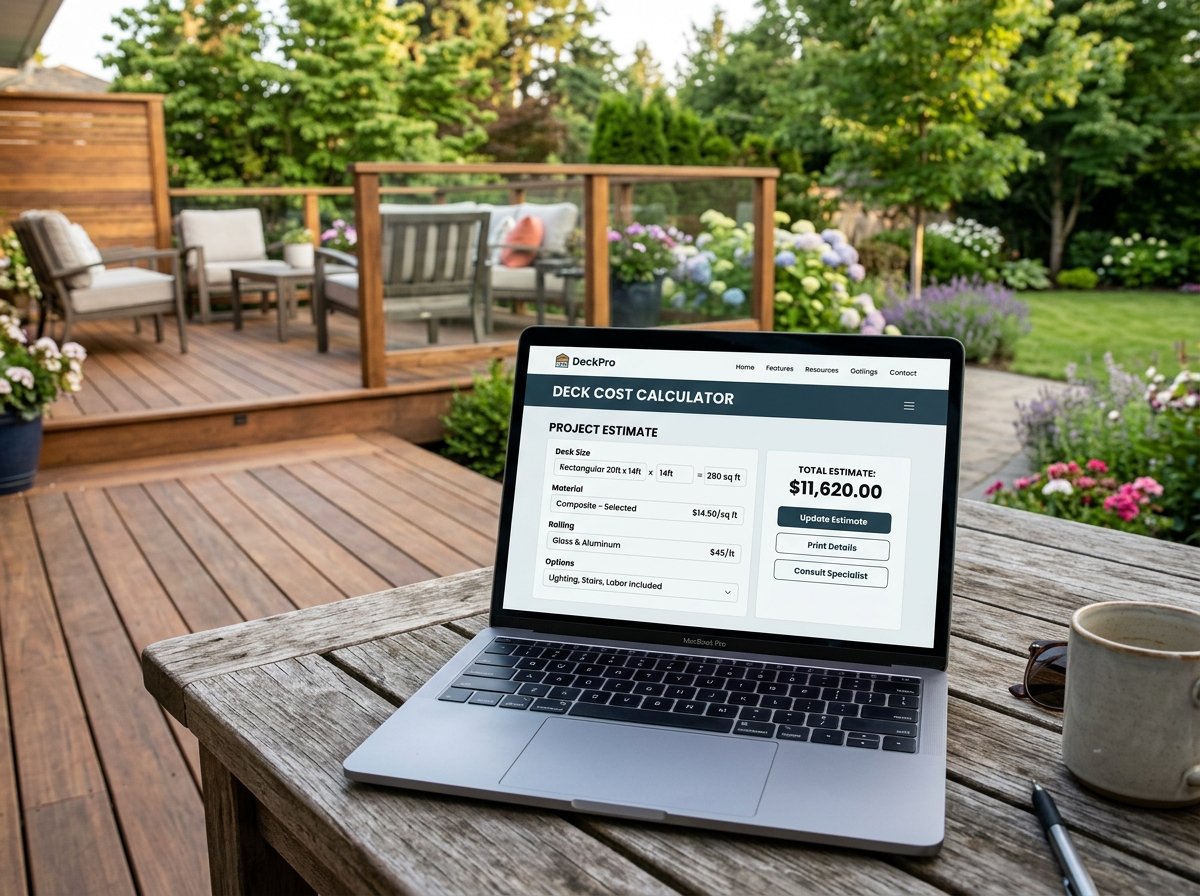
Deck Cost Calculator: Estimate Your Deck Build Costs Accurately
Building a deck is one of the most rewarding home improvement projects. It extends your living space, adds value to your property, and provides a beautiful outdoor area for relaxation and entertaining. But before you start digging post holes and ordering timber, you need a realistic budget. Deck costs can vary widely depending on the size, materials, foundation type, and labour rates. An undersupply of materials delays the project; an oversupply wastes money. Our Deck Cost Calculator is a free online tool that helps you estimate the total cost of your deck build, including decking boards, joists, fixings, foundation, and labour. It provides a clear breakdown so you can plan with confidence.
In this guide, we’ll show you how to use the calculator, explain each cost component, provide real-world examples, and answer common questions. We’ll also share tips to ensure your deck project stays on budget.
Deck Cost
Construction CalculatorDeck build cost: boards, joists, fixings, foundation and labour.
What is the Deck Cost Calculator?
The Deck Cost Calculator is a free online tool that calculates the material and labour costs for building a timber or composite deck. It supports various decking materials (pine, larch, cedar, ipe/hardwood, composite), different foundation types (on ground, concrete pads, screw piles, existing base), and user-defined joist spacing, waste allowance, and contingency. The calculator accounts for deck area, board price per m², joist price per metre, fixings per m², foundation price per m², labour rate per m², and a contingency percentage. It provides a clear breakdown of area with waste, joists required, decking board cost, joist cost, fixings cost, foundation cost, labour cost, contingency, and grand total. The tool is part of a suite of cost and finance calculators available on our website. For related estimates, you can use our Concrete Quote Calculator for foundations, Masonry Quote Calculator for brick or block work, and Roof Repair Cost Calculator for any roofing repairs.
How to Use the Deck Cost Calculator
Using the calculator is straightforward. Here’s a breakdown of each field:
1. Dimensions
- Deck area: Enter the total area of the deck in square meters or square feet. For example, a 5 m × 4 m deck has an area of 20 m².
- Waste allowance: Enter a percentage for cuts and offcuts. Typically 8–12% for decking boards. The default is 10%.
2. Boards
- Decking material: Select the material: Pine, Larch, Cedar, Ipe / hardwood, or Composite. This affects the installation difficulty and labour rate.
- Decking price per m²: Enter the local price per square meter for the selected material. This should include the cost of the boards themselves.
3. Framing
- Joist spacing: Enter the centre-to-centre spacing of the joists in meters or inches. Usually 0.3–0.5 m (300–500 mm). The default is 0.4 m (400 mm).
- Joist price per metre: Enter the local price per linear metre of joist timber. This should include the cost of the joists.
4. Fixings
- Fixings per m²: Enter the cost of screws, clips, brackets, and other fixings per square meter of deck. This is a local rate that you can obtain from your supplier.
5. Foundation
- Foundation: Select the foundation type: On ground, Concrete pads, Screw piles, or Existing base (no cost). This determines whether foundation cost is included.
- Foundation price per m²: Enter the local price per square meter for the foundation. Set to 0 if you have an existing base.
6. Labour
- Labour rate per m²: Enter the local installation rate per square meter. This should reflect the cost of labour to install the deck, including framing and board fixing.
7. Costs
- Contingency: Enter a percentage for unforeseen costs. Typically 5–15%. The default is 10%.
Once you enter all values, the calculator instantly displays:
- Area with waste (m²)
- Joists required (linear metres)
- Decking boards cost
- Joists cost
- Fixings cost
- Foundation cost (if applicable)
- Installation labour cost
- Contingency amount
- Grand total
Understanding the Cost Components
To make the most of the calculator, it’s important to understand each output and the underlying formulas.
- Area with waste:
deck area × (1 + waste/100). This is the area of decking boards you need to purchase, accounting for cuts and offcuts. - Joists required:
deck area / joist spacing. This gives the total linear metres of joist timber required. It assumes joists run parallel at the specified spacing. For a more precise estimate, you would add the length of the deck to account for the extra joist at the edge, but the formula used is a common approximation. - Decking boards cost:
area with waste × decking price per m². You buy boards to cover the area including waste. - Joists cost:
joists required × joist price per metre. - Fixings cost:
deck area × fixings per m². Fixings are calculated on the actual deck area, not the area with waste. - Foundation cost:
deck area × foundation price per m² × foundation factor. The foundation factor is 1 for all types except “Existing base”, where it is 0. This means you pay for the foundation area, which is typically the same as the deck area. - Labour cost:
deck area × labour rate per m² × material multiplier. The material multiplier adjusts for the difficulty of installing different decking materials: pine 0.90, larch 1.00, cedar 1.15, ipe 1.60, composite 1.30. Harder materials take longer to install, so labour costs more. - Subtotal: Sum of boards, joists, fixings, foundation, and labour.
- Contingency:
subtotal × contingency percentage / 100. This is a reserve for unexpected costs. - Grand total: Subtotal + contingency.
Understanding these components helps you interpret the results and adjust your budget. For more information on deck construction, you can refer to Wikipedia’s article on deck.
Example Calculations
Let’s run through a few examples to see how the calculator works in different scenarios.
Example 1: Larch Deck, 20 m², Concrete Pads
- Deck area: 20 m²
- Waste: 10%
- Decking material: Larch
- Decking price: $45/m²
- Joist spacing: 0.4 m
- Joist price: $6/m
- Fixings per m²: $8
- Foundation: Concrete pads
- Foundation price: $30/m²
- Labour rate: $40/m²
- Contingency: 10%
Calculations:
- Area with waste = 20 × 1.10 = 22 m²
- Joists required = 20 / 0.4 = 50 m
- Board cost = 22 × $45 = $990
- Joist cost = 50 × $6 = $300
- Fixings cost = 20 × $8 = $160
- Foundation cost = 20 × $30 = $600
- Labour cost = 20 × $40 × 1.00 (larch) = $800
- Subtotal = $990 + $300 + $160 + $600 + $800 = $2,850
- Contingency = 10% of $2,850 = $285
- Total = $2,850 + $285 = $3,135
- Result: Grand total $3,135
Example 2: Composite Deck, 30 m², Screw Piles
- Deck area: 30 m²
- Waste: 8%
- Decking material: Composite
- Decking price: $80/m²
- Joist spacing: 0.3 m
- Joist price: $7/m
- Fixings per m²: $10
- Foundation: Screw piles
- Foundation price: $50/m²
- Labour rate: $50/m²
- Contingency: 12%
Calculations:
- Area with waste = 30 × 1.08 = 32.4 m²
- Joists required = 30 / 0.3 = 100 m
- Board cost = 32.4 × $80 = $2,592
- Joist cost = 100 × $7 = $700
- Fixings cost = 30 × $10 = $300
- Foundation cost = 30 × $50 = $1,500
- Labour cost = 30 × $50 × 1.30 (composite) = $1,950
- Subtotal = $2,592 + $700 + $300 + $1,500 + $1,950 = $7,042
- Contingency = 12% of $7,042 = $845.04
- Total = $7,042 + $845.04 = $7,887.04
- Result: Grand total $7,887.04
Example 3: Ipe Hardwood Deck, 15 m², Existing Base
- Deck area: 15 m²
- Waste: 12%
- Decking material: Ipe / hardwood
- Decking price: $120/m²
- Joist spacing: 0.4 m
- Joist price: $9/m
- Fixings per m²: $12
- Foundation: Existing base (no cost)
- Foundation price: $0 (not used)
- Labour rate: $60/m²
- Contingency: 8%
Calculations:
- Area with waste = 15 × 1.12 = 16.8 m²
- Joists required = 15 / 0.4 = 37.5 m
- Board cost = 16.8 × $120 = $2,016
- Joist cost = 37.5 × $9 = $337.50
- Fixings cost = 15 × $12 = $180
- Foundation cost = $0 (existing base)
- Labour cost = 15 × $60 × 1.60 (ipe) = $1,440
- Subtotal = $2,016 + $337.50 + $180 + $0 + $1,440 = $3,973.50
- Contingency = 8% of $3,973.50 = $317.88
- Total = $3,973.50 + $317.88 = $4,291.38
- Result: Grand total $4,291.38
These examples show how different deck sizes, materials, and foundations affect the total cost.
Benefits of Using the Deck Cost Calculator
Tips for Accurate Deck Cost Estimation
- Measure the deck area accurately: Double-check length and width. For irregular decks, divide into rectangles and calculate separately.
- Choose the right decking material: Pine and larch are affordable; cedar and ipe are premium. Composite offers low maintenance but higher upfront cost. The material affects both material and labour costs.
- Set the correct joist spacing: 400 mm is standard for most decking. For composite, 300 mm may be required. Closer spacing increases joist cost but may be necessary for the board manufacturer’s warranty.
- Account for waste: 10% is typical. For complex layouts with many cuts, increase to 15%.
- Select the appropriate foundation: Concrete pads are common and cost-effective. Screw piles are faster but more expensive. If you have an existing concrete base, select “Existing base” to avoid foundation cost.
- Include fixings: Stainless steel screws are essential for exterior decks, especially for hardwood. They cost more than standard screws but prevent rust stains.
- Labour rates vary: Installation rates depend on the material, complexity, and local labour market. The calculator applies a material multiplier to the base labour rate.
- Add contingency: 10% is a good starting point. Increase to 15% for complex designs or uncertain site conditions.
- Consider additional costs: The calculator does not include planning permission, structural calculations, or lighting. Add these separately if required.
- Verify with a professional: For elevated decks or those attached to a building, have a structural engineer check the design.
For more information on deck design and construction, you can refer to resources like Wikipedia’s article on deck or guidelines from the Timber Research and Development Association.
How to Reduce Deck Costs
If your estimate is higher than expected, here are ways to reduce costs without compromising quality:
- Choose a cheaper material: Pine is the most economical. Larch is a good mid-range option. Avoid exotic hardwoods unless budget allows.
- Optimize joist spacing: Wider spacing reduces joist material, but ensure it meets the decking manufacturer’s requirements.
- Reduce waste: Plan your cuts carefully. Use standard board lengths that fit your deck dimensions.
- Install the deck yourself: If you’re handy, DIY installation saves labour costs. However, ensure you have the right tools and skills.
- Use an existing base: If you have a suitable concrete slab, you can save on foundation costs.
- Buy in bulk: Negotiate discounts for large orders of decking and joists.
- Get multiple quotes: Compare suppliers and contractors for the best price.
Frequently Asked Questions (FAQ)
Conclusion
The Deck Cost Calculator is an essential tool for homeowners, builders, and contractors. It helps you estimate the total cost of your deck build, including decking boards, joists, fixings, foundation, and labour. By following the tips in this article and using the calculator, you can confidently plan your deck project and avoid budget surprises. Don’t forget to explore our other cost and finance calculators for all your construction needs.
Whether you’re building a small garden deck or a large outdoor entertaining area, accurate cost estimation is key to a successful project. Try the Deck Cost Calculator today and take the guesswork out of your deck budget.

3 Comments