
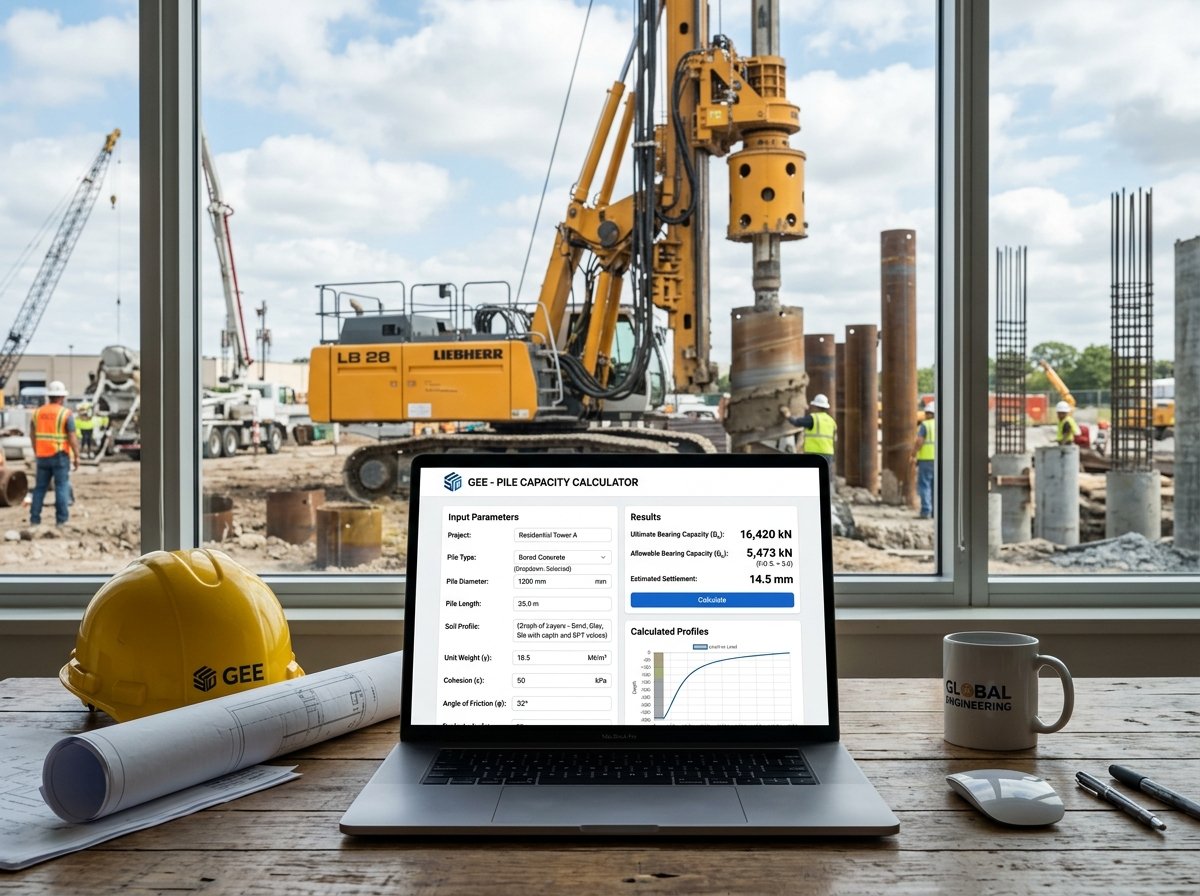
Pile Capacity Calculator: Estimate Shaft Friction, End Bearing, and Settlement
Piles are deep foundation elements used to transfer structural loads through weak upper soil layers to stronger, more competent strata at depth. They are essential for supporting buildings, bridges, and industrial structures where shallow foundations would be inadequate. Designing a pile requires determining its ultimate capacity—the sum of shaft friction along its length and end bearing at its toe—and then applying a factor of safety to obtain the allowable working load. Our Pile Capacity Calculator is a free online tool that helps you quickly estimate shaft friction, end bearing, ultimate capacity, working load, group capacity, and settlement for a range of pile types and soil conditions.
In this guide, we’ll show you how to use the calculator, explain the calculations, provide real-world examples, and answer common questions. We’ll also share tips to ensure your pile design is safe, efficient, and cost-effective.
Pile Capacity
Construction CalculatorPile capacity: shaft friction, end bearing, working load and settlement estimate.
What is the Pile Capacity Calculator?
The Pile Capacity Calculator is a free online tool that calculates the axial capacity of a single pile or a group of piles based on the pile type, diameter, length, soil conditions around the shaft and at the bearing stratum, factor of safety, and group efficiency. It supports bored, driven, continuous flight auger (CFA), screw, and helical piles. Soil types include soft, firm, stiff, and hard clay; loose, medium, and dense sand; gravel; and weak or strong rock. The calculator provides a clear breakdown of pile perimeter, cross-sectional area, volume, shaft friction, end bearing, ultimate capacity, working load, group capacity, settlement estimate, and costs. The tool is part of a suite of structural and foundation calculators available on our website. For related calculations, you can use our Foundation Excavation Calculator, Backfill Volume Calculator, Retaining Wall Design Calculator, and Column Axial Load Calculator.
How to Use the Pile Capacity Calculator
Using the calculator is straightforward. Here’s a breakdown of each field:
1. Pile
- Pile type: Select the type of pile: Bored / cast in situ, Driven (precast), Continuous flight auger (CFA), Screw pile, or Helical pile. The pile type affects the shaft friction multiplier.
- Pile diameter: Enter the pile diameter in meters or inches. For example, 0.300 m = 300 mm.
- Pile length: Enter the embedded length of the pile below ground in meters or feet.
2. Soil around shaft
- Soil around shaft: Select the predominant soil type along the pile shaft: Soft clay (cu = 20 kPa), Firm clay (cu = 50 kPa), Stiff clay (cu = 100 kPa), Loose sand (N = 10), Medium dense sand (N = 20), Dense sand (N = 35), or Gravel (N = 50). This controls the shaft friction along the pile length.
3. Bearing stratum at pile toe
- Bearing stratum at pile toe: Select the soil or rock type at the pile toe: Soft clay, Firm clay, Stiff clay, Hard clay, Loose sand, Medium dense sand, Dense sand, Gravel, Weak rock (UCS = 1 MPa), or Strong rock (UCS = 5 MPa). This controls the end-bearing resistance.
4. Safety
- Factor of safety: Enter the factor of safety to apply to the ultimate capacity. Typically 2.0–3.0 for pile design. The default is 2.5.
5. Group
- Piles per group: Enter the number of piles in the group. Set to 1 for a single pile.
- Group efficiency: Select the group efficiency: Single pile (1.0), Pair of piles (0.90), Row of piles (0.85), or Block of piles (0.75). This reduction factor accounts for interaction between closely spaced piles.
6. Costs
- Pile cost per metre: Enter the local cost per metre of pile. Leave 0 to skip.
- Mobilisation / rig setup: Enter the mobilisation cost. Leave 0 to skip.
Once you enter all values, the calculator instantly displays:
- Pile perimeter (m)
- Pile cross-section (m²)
- Pile volume (m³)
- Shaft friction (kN)
- End bearing (kN)
- Ultimate capacity (kN)
- Working load with factor of safety (kN)
- Group capacity (kN) – if more than one pile
- Settlement estimate (mm)
- Pile cost (each), mobilisation, and grand total (if costs entered)
Understanding the Cost Components
To make the most of the calculator, it’s important to understand each output and the underlying formulas.
- Pile perimeter:
π × diameter. Used to calculate shaft friction. - Pile cross-section:
π × (diameter/2)². Used to calculate end bearing and volume. - Pile volume:
area × length. Used for concrete volume or material take-off. - Shaft friction (Q_s): The resistance developed along the pile shaft. It depends on the soil type and pile type.
- For clay:
Q_s = α × cu × perimeter × L × pile_type_factor, where α = 0.45 (adhesion factor), cu is the undrained shear strength in kPa. - For sand:
Q_s = β × γ' × L² / 2 × perimeter × pile_type_factor, where β = 0.40 (friction coefficient), γ’ = 9 kN/m³ (effective unit weight). - Pile type factors: bored 1.00, driven 1.30, CFA 1.05, screw 1.15, helical 1.20.
- For clay:
- End bearing (Q_b): The resistance at the pile toe.
- For clay:
Q_b = 9 × cu × area. - For sand:
q_b = 40 × N × (L/d)capped at400 × N; thenQ_b = q_b × area. The depth ratio L/d is capped at 5. - For rock:
q_b = 0.3 × UCS; thenQ_b = q_b × area.
- For clay:
- Ultimate capacity (Q_ult):
Q_s + Q_b. - Working load (Q_allow):
Q_ult / FoS. - Group capacity:
Q_allow × number of piles × group efficiency. - Settlement estimate: Elastic shortening of the pile under working load:
δ = (Q_allow / area) × L × 1000 / E_pile, where E_pile = 30 GPa = 30,000,000 kPa. This is a simplified estimate for a rigid pile in elastic soil. - Costs: Pile cost per metre × length × number of piles + mobilisation.
Understanding these components helps you interpret the results and adjust your design. For more information on pile design, you can refer to Wikipedia’s article on piles.
Example Calculations
Let’s run through a few examples to see how the calculator works in different scenarios.
Example 1: Bored Pile in Firm Clay, 300 mm Diameter, 6 m Long, Single Pile
- Pile type: Bored (factor 1.00)
- Diameter: 0.300 m
- Length: 6 m
- Soil around shaft: Firm clay (cu = 50 kPa)
- Bearing stratum: Medium dense sand (N = 20)
- Factor of safety: 2.5
- Piles per group: 1
- Group efficiency: Single (1.0)
- Cost per metre: $150
- Mobilisation: $2,000
Calculations:
- Perimeter = π × 0.300 = 0.9425 m
- Area = π × (0.150)² = 0.07069 m²
- Volume = 0.07069 × 6 = 0.4241 m³
- Shaft friction (clay): α = 0.45, cu = 50 kPa
- Q_s = 0.45 × 50 × 0.9425 × 6 × 1.00 = 127.24 kN
- End bearing (sand, N=20, L/d = 6/0.3 = 20, capped at 5)
- q_b = 40 × 20 × 5 = 4,000 kPa; cap = 400 × 20 = 8,000 kPa, so q_b = 4,000 kPa
- Q_b = 4,000 × 0.07069 = 282.76 kN
- Ultimate capacity = 127.24 + 282.76 = 410.00 kN
- Working load = 410.00 / 2.5 = 164.00 kN
- Settlement: σ = 164.00 / 0.07069 = 2,320 kPa
- δ = (2,320 × 6 × 1000) / 30,000,000 = 0.464 mm
- Pile cost = 6 × $150 = $900
- Total cost = $900 + $2,000 = $2,900
- Result: Working load 164 kN, settlement 0.46 mm, total cost $2,900
Example 2: Driven Pile in Dense Sand, 400 mm Diameter, 10 m Long, Group of 4
- Pile type: Driven (factor 1.30)
- Diameter: 0.400 m
- Length: 10 m
- Soil around shaft: Dense sand (N = 35)
- Bearing stratum: Gravel (N = 50)
- Factor of safety: 3.0
- Piles per group: 4
- Group efficiency: Block (0.75)
- Cost per metre: $200
- Mobilisation: $3,500
Calculations:
- Perimeter = π × 0.400 = 1.2566 m
- Area = π × (0.200)² = 0.12566 m²
- Volume = 0.12566 × 10 = 1.2566 m³
- Shaft friction (sand): β = 0.40, γ’ = 9 kN/m³
- Q_s = 0.40 × 9 × (10² / 2) × 1.2566 × 1.30 = 0.40 × 9 × 50 × 1.2566 × 1.30 = 294.2 kN
- End bearing (gravel, N=50, L/d = 10/0.4 = 25, capped at 5)
- q_b = 40 × 50 × 5 = 10,000 kPa; cap = 400 × 50 = 20,000 kPa, so q_b = 10,000 kPa
- Q_b = 10,000 × 0.12566 = 1,256.6 kN
- Ultimate capacity = 294.2 + 1,256.6 = 1,550.8 kN
- Working load (single) = 1,550.8 / 3.0 = 516.9 kN
- Group capacity = 516.9 × 4 × 0.75 = 1,550.7 kN
- Settlement: σ = 516.9 / 0.12566 = 4,113 kPa
- δ = (4,113 × 10 × 1000) / 30,000,000 = 1.371 mm
- Pile cost = 10 × $200 = $2,000 each; total piles = 4 × $2,000 = $8,000
- Total cost = $8,000 + $3,500 = $11,500
- Result: Group capacity 1,551 kN, settlement 1.37 mm, total cost $11,500
Example 3: Helical Pile in Stiff Clay, 200 mm Diameter, 8 m Long, Single Pile
- Pile type: Helical (factor 1.20)
- Diameter: 0.200 m
- Length: 8 m
- Soil around shaft: Stiff clay (cu = 100 kPa)
- Bearing stratum: Weak rock (UCS = 1 MPa = 1,000 kPa)
- Factor of safety: 2.0
- Piles per group: 1
- Group efficiency: Single (1.0)
- Cost per metre: $250
- Mobilisation: $1,500
Calculations:
- Perimeter = π × 0.200 = 0.6283 m
- Area = π × (0.100)² = 0.03142 m²
- Volume = 0.03142 × 8 = 0.2513 m³
- Shaft friction (clay): α = 0.45, cu = 100 kPa
- Q_s = 0.45 × 100 × 0.6283 × 8 × 1.20 = 271.4 kN
- End bearing (rock): q_b = 0.3 × 1,000 = 300 kPa
- Q_b = 300 × 0.03142 = 9.43 kN
- Ultimate capacity = 271.4 + 9.43 = 280.8 kN
- Working load = 280.8 / 2.0 = 140.4 kN
- Settlement: σ = 140.4 / 0.03142 = 4,469 kPa
- δ = (4,469 × 8 × 1000) / 30,000,000 = 1.192 mm
- Pile cost = 8 × $250 = $2,000
- Total cost = $2,000 + $1,500 = $3,500
- Result: Working load 140 kN, settlement 1.19 mm, total cost $3,500
These examples show how different pile types, soil conditions, and group configurations affect the capacity and cost.
Benefits of Using the Pile Capacity Calculator
Tips for Accurate Pile Capacity Estimation
- Use site-specific soil data: The calculator uses typical values for soil types. For accurate design, obtain a geotechnical investigation report with measured cu, N-values, or UCS.
- Choose the correct pile type: Driven piles develop higher shaft friction than bored piles. The pile type factor accounts for this.
- Consider the bearing stratum: End bearing depends heavily on the soil or rock at the toe. Ensure the pile penetrates sufficiently into the bearing layer.
- Apply an appropriate factor of safety: Typically 2.0–3.0. Higher factors are used for uncertain soil conditions or critical structures.
- Account for group effects: Closely spaced piles interact, reducing overall capacity. Use the group efficiency factor.
- Estimate settlement: The calculator provides an elastic shortening estimate. For critical structures, perform a full settlement analysis.
- Check uplift and lateral loads: This calculator only considers axial compression. Piles may also need to resist uplift, lateral, or seismic loads.
- Consider negative skin friction: In consolidating soils, negative skin friction can reduce capacity.
- Verify with a professional: Pile design is a specialized field. Always have a qualified geotechnical engineer verify your final design.
For more information on pile design, you can refer to resources like Wikipedia’s article on pile foundations or guidelines from the Institution of Civil Engineers.
How to Optimize Pile Design
If your calculated capacity is insufficient or costs are too high, here are ways to optimize:
- Increase pile length: Longer piles develop more shaft friction and may reach a stronger bearing stratum.
- Increase pile diameter: Larger diameter increases both shaft area and end-bearing area, but may require larger rigs.
- Change pile type: Driven piles have higher shaft friction than bored piles; helical piles can be installed quickly in suitable ground.
- Improve group efficiency: Increase pile spacing to reduce interaction, but this may require a larger pile cap.
- Consider alternative foundations: In some cases, raft foundations or ground improvement may be more cost-effective. Use our Raft Foundation Calculator to compare.
- Optimize factor of safety: If soil data is reliable, a lower FoS may be justified, but never compromise safety.
Frequently Asked Questions (FAQ)
Conclusion
The Pile Capacity Calculator is an essential tool for structural and geotechnical engineers, architects, and builders. It helps you quickly estimate the axial capacity of piles, including shaft friction, end bearing, working load, group capacity, and settlement. By following the tips in this article and using the calculator, you can confidently perform preliminary pile design. Don’t forget to explore our other foundation and structural calculators for all your construction needs.
Whether you’re designing a small residential extension or a large industrial facility, accurate pile capacity estimation is key to a safe and cost-effective foundation. Try the Pile Capacity Calculator today and take the guesswork out of your deep foundation design.

3 Comments