
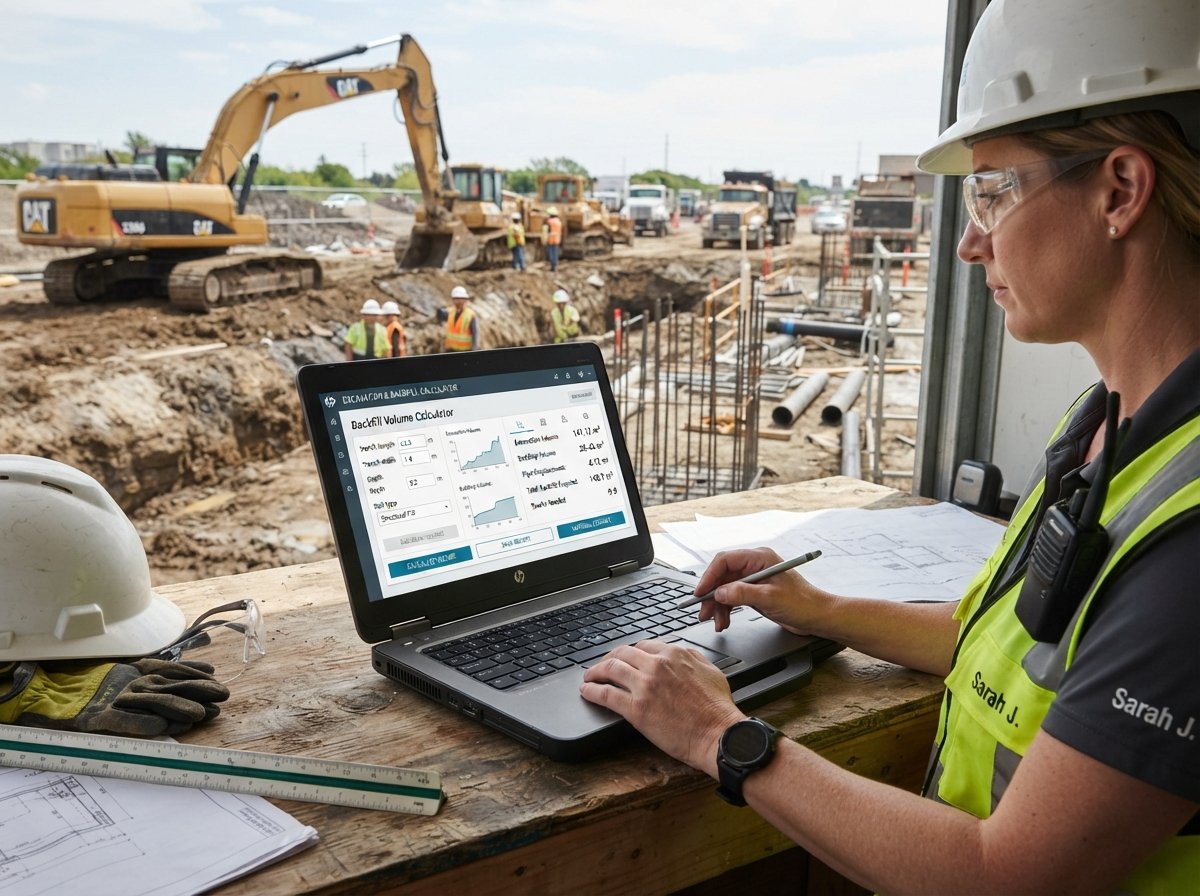
Backfill Volume Calculator: Estimate Backfill Volume and Costs Accurately
Backfilling is a critical step in any excavation project, from trenches for utilities to foundations and basements. Getting the backfill volume right ensures you order the correct amount of material, avoid costly delays, and achieve proper compaction. Our Backfill Volume Calculator is a free online tool that helps you estimate the loose fill volume required, taking into account compaction and residual bulking, and calculates material and labour costs.
In this guide, we’ll show you how to use the calculator, explain the calculations, provide real-world examples, and answer common questions. We’ll also share tips to improve accuracy and reduce costs.
Backfill Volume
Construction CalculatorBackfill volume with compaction allowance and residual bulking factor.
What is the Backfill Volume Calculator?
The Backfill Volume Calculator is a free online tool that calculates the volume of loose fill material needed to backfill an excavation to a specified compacted volume. It accounts for the type of fill material, the level of compaction, and the residual bulking factor. It also estimates material and labour costs, plus a contingency allowance. The calculator is part of a suite of earthworks calculators available on our website, including the Trench Volume Calculator, Trench Excavation / Spoil Calculator, and Foundation Excavation Calculator.
For a complete project estimate, you can also use our Construction Estimate Calculator and Labour Cost Calculator.
How to Use the Backfill Volume Calculator
Using the calculator is straightforward. Here’s a breakdown of each field:
1. Dimensions
- Length: Enter the length of the excavation in meters or feet.
- Width: Enter the width of the excavation in meters or feet.
- Layer thickness: Enter the thickness of the backfill layer in meters or inches. This is the depth you need to fill.
2. Fill material
- Fill material: Select the material you will use: Site-won soil, Sand, Gravel / shingle, or Crushed stone. This is informational—it reminds you to enter the correct price per m³ for the material you actually place.
3. Compaction
- Compaction: Select the compaction method: None, Light (plate compactor), or Heavy (roller). This affects the compaction factor.
- Residual bulking: Enter the residual bulking factor. This accounts for the expansion of soil when excavated and its residual looseness after placement. Typical values: 1.02–1.10 for sand, 1.05–1.15 for clay. The default is 1.05.
4. Cost
- Material price per m³: Enter the local price per loose cubic meter. Set to 0 if using site-won soil.
- Placing & compacting per m³: Enter the local labour or machine rate per loose cubic meter placed.
- Contingency: Enter a percentage for unforeseen conditions. Typically 3–8%. The default is 5%.
Once you enter all values, the calculator instantly displays:
- Compacted volume (in place)
- Loose fill required
- Fill material cost (if applicable)
- Placing & compaction cost
- Contingency amount
- Grand total
Understanding the Cost Components
To make the most of the calculator, it’s important to understand each cost component.
- Compacted volume (in place): This is the geometric volume of the hole to be filled:
length × width × depth. It represents the final volume the backfill must occupy after compaction. - Loose fill required: This is the volume of loose material you need to order. It is calculated as
compacted volume × compaction factor × residual bulking factor. The compaction factor ranges from 1.00 (no compaction) to 1.10 (heavy compaction). The residual bulking factor accounts for the fact that excavated soil occupies more volume than in its natural state. Together, these factors ensure you order enough material to achieve the required compacted volume. - Fill material cost: If you are buying imported fill, enter the price per loose m³. The calculator multiplies the loose volume by this price. If you are using site-won soil, set the price to 0.
- Placing & compaction cost: This is the labour or machine cost to place and compact the fill. It is calculated as
loose volume × labour rate per m³. Even if you use site-won soil, you still have labour costs for placing and compacting. - Contingency: A reserve for unexpected costs, such as additional fill needed due to over-excavation or poor compaction. Typically 3–8%.
- Grand total: The final estimated cost.
Understanding these components helps you order the right amount of material and budget accurately. For more information on earthworks, you can refer to Wikipedia’s article on earthworks.
Example Calculations
Let’s run through a few examples to see how the calculator works in different scenarios.
Example 1: Trench Backfill with Site-Won Soil
- Length: 10 m
- Width: 0.6 m
- Depth: 1.0 m
- Fill material: Site-won soil (price = 0)
- Compaction: Light (plate compactor)
- Residual bulking: 1.05
- Material price: $0/m³
- Labour rate: $15/m³
- Contingency: 5%
Calculations:
- Compacted volume: 10 × 0.6 × 1.0 = 6 m³
- Compaction factor: 1.05 (light)
- Loose volume: 6 × 1.05 × 1.05 = 6.615 m³
- Material cost: $0
- Labour cost: 6.615 × $15 = $99.23
- Subtotal: $99.23
- Contingency: 5% of $99.23 = $4.96
- Grand total: $104.19
Example 2: Foundation Backfill with Imported Gravel
- Length: 20 m
- Width: 1.5 m
- Depth: 0.8 m
- Fill material: Gravel / shingle
- Compaction: Heavy (roller)
- Residual bulking: 1.08
- Material price: $40/m³
- Labour rate: $20/m³
- Contingency: 8%
Calculations:
- Compacted volume: 20 × 1.5 × 0.8 = 24 m³
- Compaction factor: 1.10 (heavy)
- Loose volume: 24 × 1.10 × 1.08 = 28.512 m³
- Material cost: 28.512 × $40 = $1,140.48
- Labour cost: 28.512 × $20 = $570.24
- Subtotal: $1,710.72
- Contingency: 8% of $1,710.72 = $136.86
- Grand total: $1,847.58
Example 3: Pit Backfill with Crushed Stone
- Length: 5 m
- Width: 5 m
- Depth: 0.5 m
- Fill material: Crushed stone
- Compaction: None
- Residual bulking: 1.02
- Material price: $50/m³
- Labour rate: $10/m³
- Contingency: 3%
Calculations:
- Compacted volume: 5 × 5 × 0.5 = 12.5 m³
- Compaction factor: 1.00 (none)
- Loose volume: 12.5 × 1.00 × 1.02 = 12.75 m³
- Material cost: 12.75 × $50 = $637.50
- Labour cost: 12.75 × $10 = $127.50
- Subtotal: $765.00
- Contingency: 3% of $765.00 = $22.95
- Grand total: $787.95
These examples show how different dimensions, materials, and compaction levels affect the required loose volume and total cost.
Benefits of Using the Backfill Volume Calculator
Tips for Accurate Backfill Volume Estimation
- Measure dimensions accurately: Double-check length, width, and depth. For irregular shapes, divide into rectangles and calculate separately.
- Choose the right compaction method: Light compaction with a plate compactor is typical for trenches. Heavy compaction with a roller is used for larger areas like foundations. The compaction factor increases the loose volume needed.
- Use realistic residual bulking factors: Sand and gravel bulk less than clay. Typical values: sand 1.02–1.10, clay 1.05–1.15. If you’re unsure, use 1.05 as a starting point.
- Account for over-excavation: If the excavation is deeper than planned, you’ll need more fill. Add a contingency.
- Consider material settlement: Some materials settle more than others. The residual bulking factor helps account for this, but always allow a little extra.
- Check local prices: Material and labour rates vary by region. Contact local suppliers for current prices.
- Don’t forget compaction equipment: If you don’t own a compactor, rental costs should be added to labour or as a separate line.
For more information on backfilling and compaction, you can refer to resources like Wikipedia’s article on compaction or guidelines from the National Institute for Occupational Safety and Health.
How to Reduce Backfill Costs
If your estimate is higher than expected, here are some ways to reduce costs:
- Use site-won soil: If the excavated soil is suitable, reuse it as backfill. This eliminates material costs. Test the soil for suitability (e.g., no organic matter, proper gradation).
- Optimize compaction: Over-compacting wastes time and fuel. Use the minimum compaction required by the specification.
- Order the right amount: Accurate volume calculation prevents expensive over-ordering and disposal of excess.
- Negotiate material prices: For large volumes, ask for bulk discounts.
- Schedule efficiently: Combine backfilling with other earthworks to reduce machine mobilisation costs.
- Consider alternative materials: Sometimes crushed concrete or recycled aggregate is cheaper than virgin gravel.
Frequently Asked Questions (FAQ)
Conclusion
The Backfill Volume Calculator is an essential tool for anyone planning excavation and backfilling work. It helps you order the correct amount of fill, estimate costs accurately, and avoid delays. By following the tips in this article and using the calculator, you can confidently manage your backfill project. Don’t forget to explore our other earthworks calculators for all your sitework needs.
Whether you’re backfilling a trench, foundation, or basement, accurate volume estimation is key to a successful project. Try the Backfill Volume Calculator today and take the guesswork out of your material orders.




One Comment