Padstone Design Calculator: Size Padstones for Beam Bearings Accurately
When a steel or timber beam bears onto a masonry wall, the concentrated load can crush the masonry unless it is spread over a larger area. A padstone—a block of concrete placed under the beam—serves exactly this purpose. It distributes the beam reaction over a sufficient area of masonry, preventing local crushing and ensuring the structural integrity of the wall. Sizing a padstone correctly is essential: too small, and the masonry may fail; too large, and you waste material and space. Our Padstone Design Calculator is a free online tool that helps you determine the required padstone dimensions, bearing area, concrete grade, and cost.
In this guide, we’ll show you how to use the calculator, explain the calculations, provide real-world examples, and answer common questions. We’ll also share tips to ensure your padstone design is safe and efficient.
Padstone Design
Construction CalculatorPadstone sizing under a beam: bearing area, concrete grade and cost.
What is the Padstone Design Calculator?
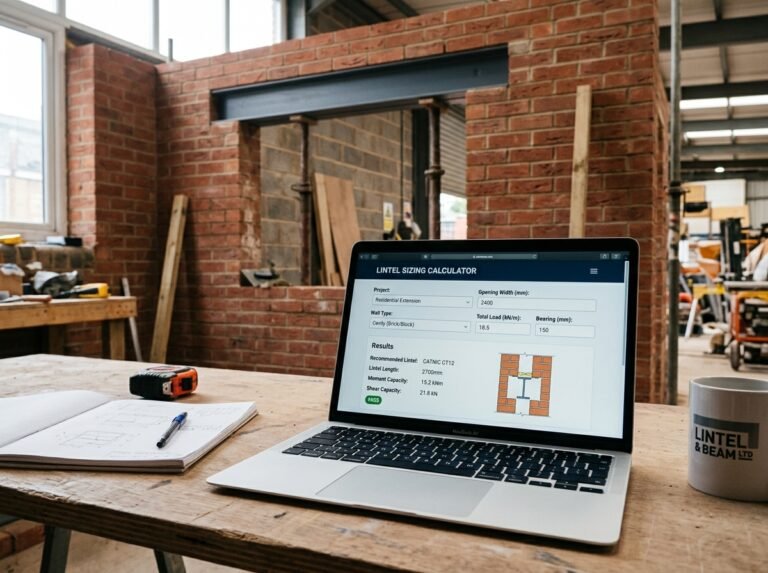
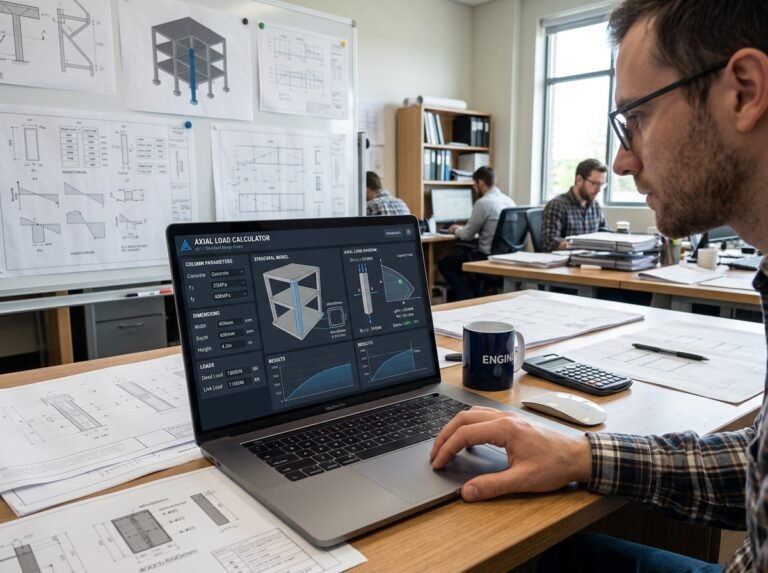
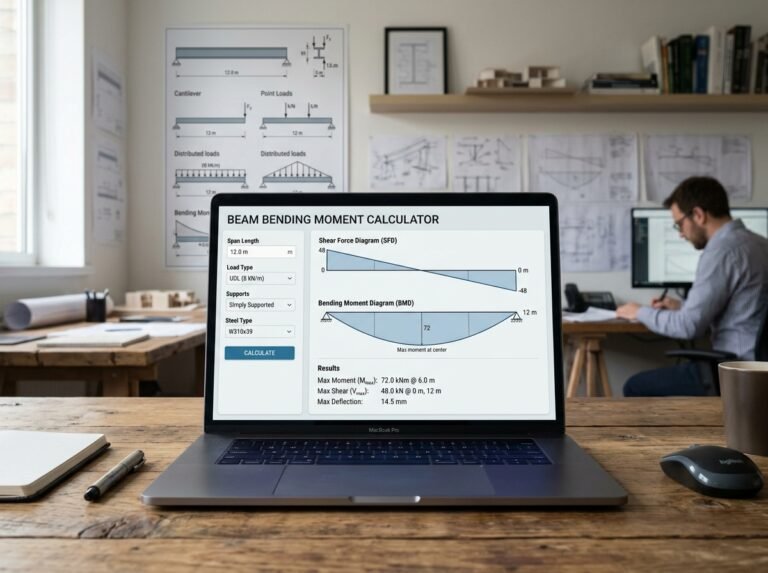
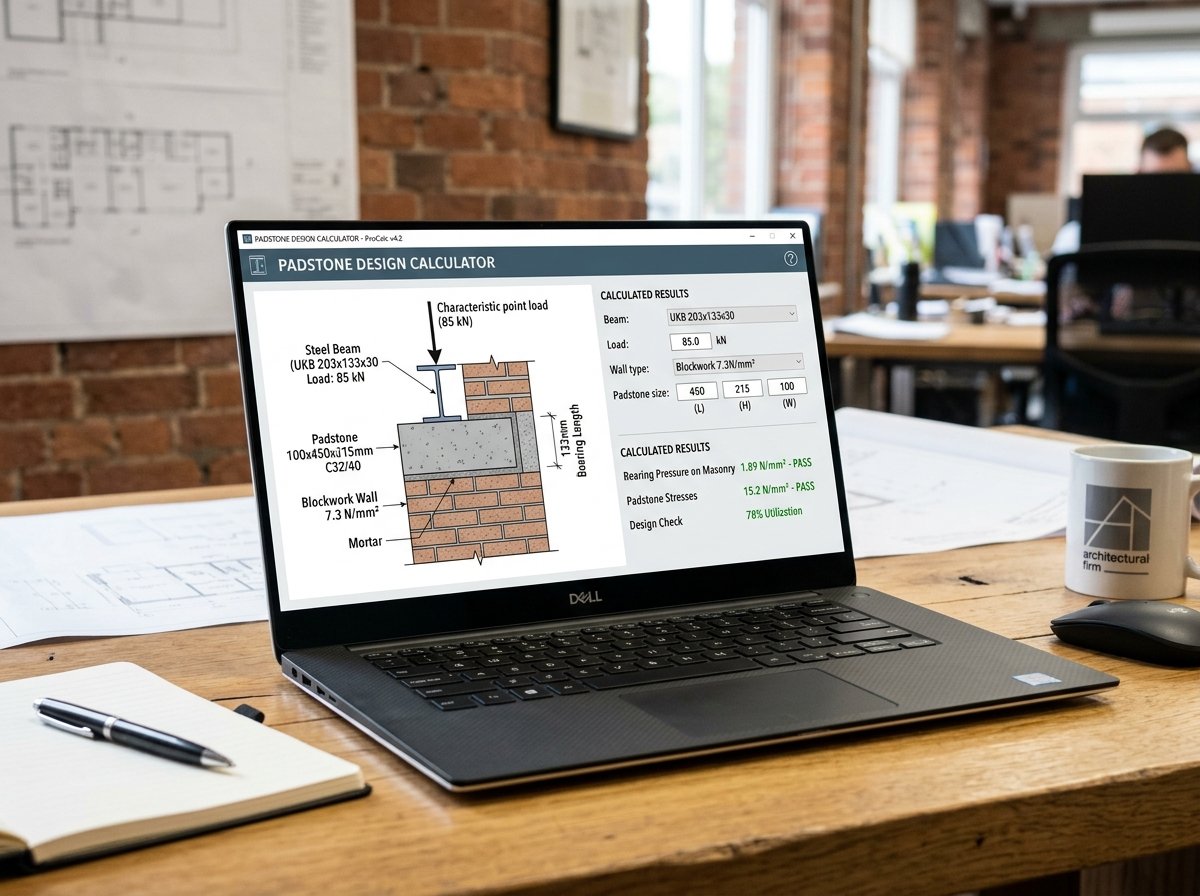
The Padstone Design Calculator is a free online tool that calculates the minimum padstone size required under a beam bearing. It accounts for the beam reaction, beam bearing width, masonry type, design stress factor, concrete grade, padstone thickness, and reinforcement. The calculator provides a clear breakdown of beam reaction, masonry characteristic strength, design stress on masonry, concrete grade strength, required padstone length, actual padstone length, padstone width, effective thickness, padstone volume, and costs for precast or cast-in-situ options. The tool is part of a suite of structural calculators available on our website. For related calculations, you can use our Lintel Sizing Calculator, Beam Bending Moment Calculator, Column Axial Load Calculator, and Floor Joist Sizing Calculator.
How to Use the Padstone Design Calculator
Using the calculator is straightforward. Here’s a breakdown of each field:
1. Load
- Beam reaction: Enter the load at the bearing point in kN. This is the reaction force from the beam onto the padstone. If you have multiple beams, calculate each padstone separately.
- Beam bearing width: Enter the width of the beam that sits on the padstone, in meters or inches. For example, a 100 mm wide beam is 0.10 m.
2. Masonry
- Masonry type: Select the type of masonry under the padstone: Brick — high strength (20+ N/mm²), Brick — standard (10 N/mm²), Brick — weak (5 N/mm²), Block — 7.3 N/mm², Block — 3.6 N/mm², Block — 2.8 N/mm², or Natural stone (20+ N/mm²). The characteristic compressive strength is used to determine the design stress.
- Design stress factor: Enter the multiplier applied to the masonry characteristic strength to get the design stress. Typically 0.5 for a simplified calculation. This accounts for safety factors and long-term effects.
3. Padstone
- Padstone concrete: Select the concrete grade: C20/25, C25/30, C30/37, or C35/45. Higher grades are used for higher loads. The calculator uses the concrete strength to check bearing on the padstone itself.
- Padstone thickness: Enter the thickness of the padstone in meters or inches. Often one brick course, e.g., 0.215 m (215 mm).
- Reinforcement: Select Plain concrete or Light mesh (A142). Reinforced padstones can be thinner; the calculator reduces the effective thickness by a factor of 0.75 when reinforcement is selected.
4. Costs
- Price mode: Select Precast unit price or Cast in situ. If precast, enter the price per padstone. If cast in situ, enter the concrete price per m³ and formwork price per m².
- Precast padstone price: Enter the local price per precast padstone. Leave 0 to skip.
- Concrete price per m³: Enter the local price for concrete. Used only when cast in situ. Leave 0 to skip.
- Formwork per m²: Enter the local price for formwork. Used only when cast in situ. Leave 0 to skip.
- Installation per padstone: Enter the local installation cost per padstone. Leave 0 to skip.
Once you enter all values, the calculator instantly displays:
- Beam reaction (kN)
- Masonry characteristic strength (N/mm²)
- Design stress on masonry (N/mm²)
- Concrete grade strength (N/mm²)
- Required padstone length (mm)
- Padstone length (mm)
- Padstone width (mm)
- Padstone thickness (mm)
- Padstone volume (m³)
- Padstone cost, installation, and grand total (if costs entered)
Understanding the Cost Components
To make the most of the calculator, it’s important to understand each output and the underlying formulas.
- Beam reaction: The load applied by the beam onto the padstone, in kN. It is converted to Newtons (N) for calculations.
- Masonry characteristic strength (fk): The compressive strength of the masonry unit and mortar combination. Typical values: 20 N/mm² for high-strength brick, 10 N/mm² for standard brick, 3.6 N/mm² for standard block.
- Design stress on masonry: The allowable compressive stress on the masonry, calculated as
fk × design stress factor. The factor is typically 0.5, giving a design stress of half the characteristic strength. This is a simplified approach; actual design codes use more complex factors. - Concrete grade strength (fck): The characteristic cylinder strength of the concrete padstone. Used to check bearing stress on the padstone itself. The allowable bearing stress is taken as
0.6 × fckin this simplified calculator. - Padstone width: Determined as the greater of
beam width + 100 mmor1.5 × beam width. This ensures the padstone extends beyond the beam on both sides, providing a stable bearing. - Required padstone area: The maximum of the area required to keep masonry stress below the design stress (
reaction / design stress) and the area required to keep concrete bearing stress below the allowable (reaction / (0.6 × fck)). This ensures both materials are adequate. - Required padstone length:
required area / padstone width, rounded up to the nearest 10 mm. A minimum length of 440 mm (two-brick pad) is enforced for practical construction. - Padstone thickness: The actual thickness entered, reduced by a factor of 0.75 if reinforcement is selected. This is a simplification; reinforced padstones can be thinner because the reinforcement helps distribute stresses.
- Padstone volume:
length × width × effective thickness. Used for cost calculation when cast in situ. - Costs: If precast, the cost is simply the unit price. If cast in situ, the cost is the sum of concrete volume × price per m³ and formwork area × price per m². Installation cost is added separately. The grand total is the sum.
Understanding these components helps you interpret the results and adjust your design. For more information on padstone design, you can refer to Wikipedia’s article on padstones.
Example Calculations
Let’s run through a few examples to see how the calculator works in different scenarios.
Example 1: Standard Brick Masonry, 40 kN Reaction, C30 Concrete
- Beam reaction: 40 kN
- Beam bearing width: 0.10 m (100 mm)
- Masonry type: Brick — standard (10 N/mm²)
- Design stress factor: 0.5
- Padstone concrete: C30/37
- Padstone thickness: 0.215 m
- Reinforcement: Yes (A142)
- Price mode: Precast unit price
- Precast padstone price: $50
- Installation: $30
Calculations:
- Design stress on masonry: 10 × 0.5 = 5 N/mm²
- Concrete strength: 30 N/mm²; allowable concrete = 0.6 × 30 = 18 N/mm²
- Reaction: 40,000 N
- Beam width: 100 mm
- Padstone width: max(100+100, 100×1.5) = max(200, 150) = 200 mm
- Required area for masonry: 40,000 / 5 = 8,000 mm²
- Required area for concrete: 40,000 / 18 = 2,222 mm²
- Governing area: 8,000 mm²
- Required length: 8,000 / 200 = 40 mm → round up to 40 mm
- Minimum length: 440 mm
- Padstone length: 440 mm
- Effective thickness: 215 × 0.75 = 161.25 mm (reinforced)
- Volume: 0.44 × 0.2 × 0.16125 = 0.01419 m³
- Cost: $50 + $30 = $80
- Result: Padstone 440 × 200 × 215 mm (effective 161 mm), total $80
Example 2: Weak Block Masonry, 80 kN Reaction, Cast In Situ
- Beam reaction: 80 kN
- Beam bearing width: 0.15 m (150 mm)
- Masonry type: Block — weak (2.8 N/mm²)
- Design stress factor: 0.5
- Padstone concrete: C25/30
- Padstone thickness: 0.215 m
- Reinforcement: No
- Price mode: Cast in situ
- Concrete price per m³: $150
- Formwork per m²: $40
- Installation: $50
Calculations:
- Design stress on masonry: 2.8 × 0.5 = 1.4 N/mm²
- Concrete strength: 25 N/mm²; allowable concrete = 0.6 × 25 = 15 N/mm²
- Reaction: 80,000 N
- Beam width: 150 mm
- Padstone width: max(150+100, 150×1.5) = max(250, 225) = 250 mm
- Required area for masonry: 80,000 / 1.4 = 57,143 mm²
- Required area for concrete: 80,000 / 15 = 5,333 mm²
- Governing area: 57,143 mm²
- Required length: 57,143 / 250 = 228.57 mm → round up to 230 mm
- Minimum length: 440 mm
- Padstone length: 440 mm
- Effective thickness: 215 mm (no reinforcement)
- Volume: 0.44 × 0.25 × 0.215 = 0.02365 m³
- Concrete cost: 0.02365 × $150 = $3.55
- Formwork area: ((0.44+0.25)×2/1000)×0.215 + (0.44×0.25/1e6) = (0.69×2×0.215) + 0.00011 = 0.2967 + 0.00011 = 0.2968 m²
- Formwork cost: 0.2968 × $40 = $11.87
- Padstone cost: $3.55 + $11.87 = $15.42
- Total: $15.42 + $50 = $65.42
- Result: Padstone 440 × 250 × 215 mm, total $65.42
Example 3: High-Strength Brick, 120 kN Reaction, Precast
- Beam reaction: 120 kN
- Beam bearing width: 0.20 m (200 mm)
- Masonry type: Brick — high strength (20 N/mm²)
- Design stress factor: 0.5
- Padstone concrete: C35/45
- Padstone thickness: 0.215 m
- Reinforcement: Yes
- Price mode: Precast unit price
- Precast padstone price: $80
- Installation: $40
Calculations:
- Design stress on masonry: 20 × 0.5 = 10 N/mm²
- Concrete strength: 35 N/mm²; allowable concrete = 0.6 × 35 = 21 N/mm²
- Reaction: 120,000 N
- Beam width: 200 mm
- Padstone width: max(200+100, 200×1.5) = max(300, 300) = 300 mm
- Required area for masonry: 120,000 / 10 = 12,000 mm²
- Required area for concrete: 120,000 / 21 = 5,714 mm²
- Governing area: 12,000 mm²
- Required length: 12,000 / 300 = 40 mm → round up to 40 mm
- Minimum length: 440 mm
- Padstone length: 440 mm
- Effective thickness: 215 × 0.75 = 161.25 mm
- Volume: 0.44 × 0.3 × 0.16125 = 0.02129 m³
- Cost: $80 + $40 = $120
- Result: Padstone 440 × 300 × 215 mm (effective 161 mm), total $120
These examples show how different loads, masonry types, and concrete grades affect the required padstone size and cost.
Benefits of Using the Padstone Design Calculator
Tips for Accurate Padstone Design
- Determine the beam reaction accurately: The reaction depends on the loads on the beam. Use a beam analysis tool or consult an engineer. For simple cases, the reaction is half the total load for a simply supported beam with uniform load.
- Use the correct masonry strength: The characteristic strength of the masonry depends on the unit strength and mortar. Refer to local codes or manufacturer data. If unsure, use a conservative (lower) value.
- Apply an appropriate design stress factor: The factor of 0.5 is a simplified approach. Actual design codes use partial safety factors and may give different allowable stresses. Check local regulations.
- Choose the right concrete grade: Higher grades are stronger but more expensive. C30/37 is common for padstones. Ensure the concrete strength is adequate for the bearing stress under the beam.
- Consider reinforcement: Light mesh can reduce the required thickness, but it adds complexity. The calculator reduces the effective thickness by 25% when reinforcement is selected. This is a simplification; consult an engineer for reinforced design.
- Check bearing length: The padstone must be long enough to spread the load. A minimum of 440 mm (two bricks) is typical for practical construction. The calculator enforces this minimum.
- Account for eccentricity: If the beam is not centered on the padstone, the bearing stress may be uneven. Ensure the beam is centered and the padstone is wide enough.
- Verify with a professional: For any structural work, have a qualified engineer verify your calculations and ensure compliance with local building codes.
For more information on masonry design, you can refer to resources like Wikipedia’s article on masonry or guidelines from the Institution of Structural Engineers.
How to Reduce Padstone Costs
If your calculated padstone size is larger than desired, here are ways to reduce costs without compromising safety:
- Increase masonry strength: Using stronger masonry units (e.g., high-strength brick instead of weak block) increases the allowable design stress, reducing the required padstone area.
- Use a higher concrete grade: A stronger concrete padstone can carry higher bearing stress, potentially reducing length.
- Add reinforcement: Light mesh allows a thinner padstone, reducing volume and cost.
- Optimize padstone width: A wider padstone reduces the required length. The calculator sets width based on beam width; you can increase it manually to reduce length.
- Compare precast vs cast in situ: Precast is often faster and simpler; cast in situ may be cheaper for large or unusual sizes. Compare local prices.
- Reduce the beam reaction: If possible, reduce loads on the beam or add additional supports to lower the reaction at each bearing point.
Frequently Asked Questions (FAQ)
Conclusion
The Padstone Design Calculator is an essential tool for builders, architects, engineers, and DIY enthusiasts. It helps you determine the correct padstone size for beam bearings, ensuring safety and serviceability without over-engineering. By following the tips in this article and using the calculator, you can confidently size your padstones. Don’t forget to explore our other structural calculators for all your design needs.
Whether you’re installing a steel beam in a load-bearing wall or supporting a timber floor, accurate padstone design is key to a successful project. Try the Padstone Design Calculator today and take the guesswork out of your structural design.