
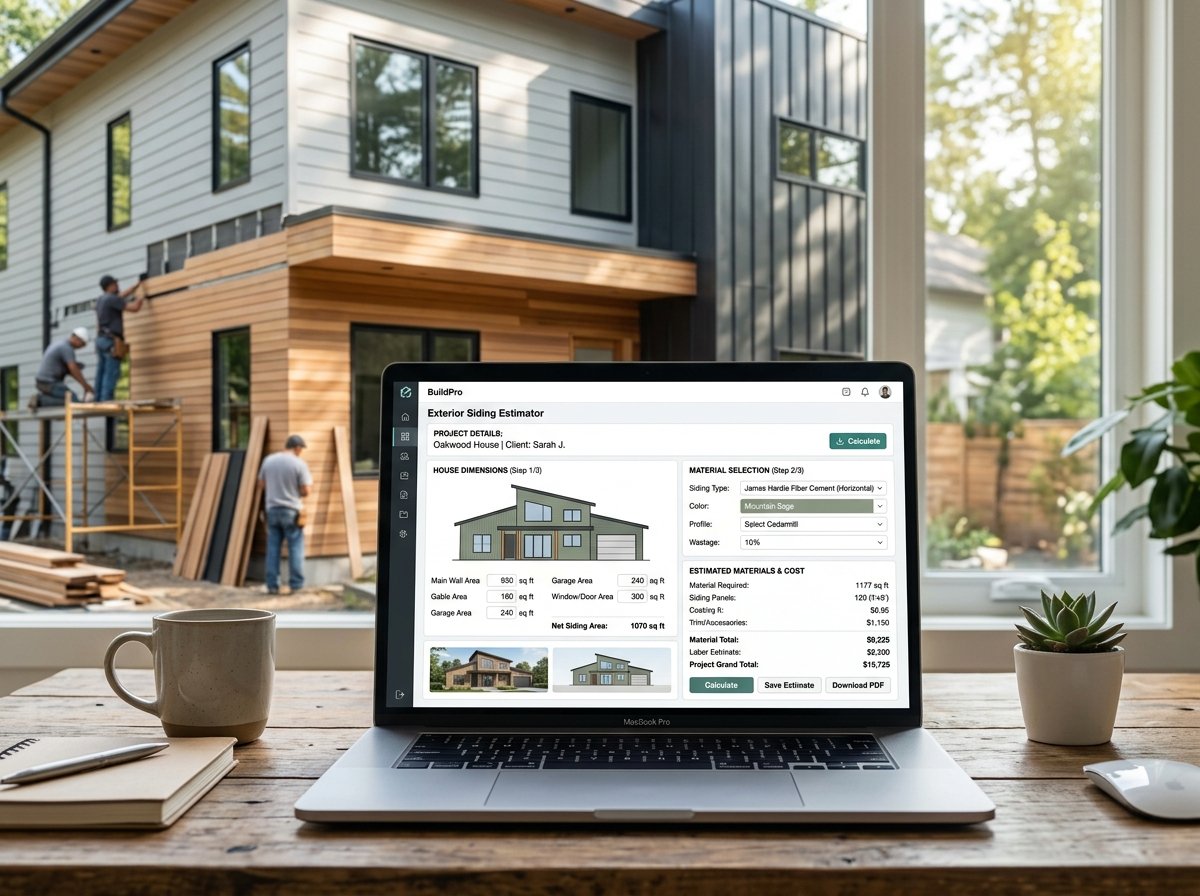
Exterior Siding / Cladding Calculator: Estimate Materials and Costs Accurately
Exterior siding or cladding is the protective and decorative layer that shields a building from the weather while defining its appearance. Whether you’re using fibre cement, timber, composite, vinyl, metal, or brick slips, getting the material quantities and costs right is essential for a successful project. An undersupply causes delays; an oversupply wastes money. Our Exterior Siding / Cladding Calculator is a free online tool that helps you estimate the number of boards, total batten length, membrane area, fixings, and total installed cost based on your wall dimensions and chosen materials.
In this guide, we’ll show you how to use the calculator, explain the calculations, provide real-world examples, and answer common questions. We’ll also share tips to ensure your siding project stays on budget.
Exterior Siding / Cladding
Construction CalculatorExterior siding / cladding: boards, battens, breather membrane, fixings and cost.
What is the Exterior Siding / Cladding Calculator?
The Exterior Siding / Cladding Calculator is a free online tool that calculates the material quantities and costs for exterior wall cladding. It supports various cladding types (fibre cement, timber, composite, vinyl, metal, brick slips) and profiles (shiplap, tongue & groove, panel, brick). The calculator accounts for wall dimensions, openings, board cover width and length, waste allowance, batten spacing, and local pricing for boards, battens, membrane, tape, fixings, and labour. It provides a clear breakdown of gross and net wall area, boards required, batten length, and costs for each component. The tool is part of a suite of materials and quantities calculators available on our website. For related calculations, you can use our Rainscreen Cladding Calculator, Cladding Support System Calculator, Cladding Fire Rating Calculator, and Stone Cladding Calculator.
How to Use the Exterior Siding / Cladding Calculator
Using the calculator is straightforward. Here’s a breakdown of each field:
1. Wall
- Wall length: Enter the total length of the wall in meters or feet.
- Wall height: Enter the total height of the wall in meters or feet.
- Openings area: Enter the total area of windows and doors in square meters or square feet. This is deducted from the gross area to give the net clad area.
2. Cladding
- Cladding type: Select the material: Fibre cement, Timber / wood, Composite / WPC, Vinyl, Metal / steel, or Brick slips. This is informational only; enter the price per board for your chosen type below.
- Profile: Select the profile: Shiplap / lap, Tongue & groove, Panel / sheet, or Brick / tile. This affects the effective cover width and fixing pattern.
3. Board
- Board cover width: Enter the effective cover width of one board in meters or inches. This is the visible width after overlapping, not the total width.
- Board length: Enter the length of one board in meters or feet.
- Waste allowance: Enter the waste percentage for cuts around openings and edges. Typical value is 10%.
4. Battens
- Batten spacing: Enter the centre-to-centre spacing of vertical battens in meters or inches. Typically 600 mm.
5. Membrane
- No options — the calculator always includes membrane and tape if you enter a price greater than zero. Enter 0 to exclude.
6. Pricing
- Board price each: Enter the local price per board for your chosen material.
- Batten price per metre: Enter the local price per metre of batten.
- Membrane price per m²: Enter the local price per square meter of breather membrane. Set to 0 if not required.
- Tape price per m²: Enter the local price per square meter of tape. Set to 0 if not required.
- Fixings price per m²: Enter the local rate for screws, clips, and miscellaneous fixings.
- Labour price per m²: Enter the local installation rate per square meter.
Once you enter all values, the calculator instantly displays:
- Gross wall area (m²)
- Net clad area (m²)
- Boards required
- Batten length (m)
- Cladding boards cost
- Battens cost
- Breather membrane cost
- Tape cost
- Fixings cost
- Labour cost
- Grand total
Understanding the Cost Components
To make the most of the calculator, it’s important to understand each output and the underlying logic.
- Gross wall area:
length × height. This is the total wall area before deducting openings. - Net clad area:
gross area − openings area. This is the area actually covered by cladding and membrane. - Boards required: Calculated as
ceil(net area with waste / (board cover width × board length)). Waste isnet area × (1 + waste%/100). You buy whole boards, so the calculator rounds up. - Batten length: Vertical battens are spaced at
batten_spacing. The number of battens isceil(length / batten_spacing) + 1. Each batten runs the full height, so total length =batten count × height. - Membrane and tape: If a price greater than zero is entered, the cost is
net area × price per m². The calculator does not add extra for overlaps; you may adjust the price or area manually if needed. - Fixings:
net area × fixings price per m². - Labour:
net area × labour price per m². - Grand total: Sum of all material and labour costs.
Understanding these components helps you interpret the results and adjust your design. For more information on exterior cladding, you can refer to Wikipedia’s article on siding.
Example Calculations
Let’s run through a few examples to see how the calculator works in different scenarios.
Example 1: Fibre Cement Shiplap, 12 m × 5 m Wall, 6 m² Openings
- Wall length: 12 m
- Wall height: 5 m
- Openings area: 6 m²
- Cladding type: Fibre cement
- Profile: Shiplap / lap
- Board cover width: 0.15 m
- Board length: 3.6 m
- Waste: 10%
- Batten spacing: 0.6 m
- Board price: $25 each
- Batten price: $3/m
- Membrane price: $2/m²
- Tape price: $1/m²
- Fixings price: $1.50/m²
- Labour price: $20/m²
Calculations:
- Gross area = 12 × 5 = 60 m²
- Net area = 60 − 6 = 54 m²
- Net with waste = 54 × 1.10 = 59.4 m²
- Board cover area = 0.15 × 3.6 = 0.54 m²
- Boards required = ceil(59.4 / 0.54) = ceil(110) = 110
- Boards cost = 110 × $25 = $2,750
- Battens count = ceil(12 / 0.6) + 1 = 20 + 1 = 21
- Batten length = 21 × 5 = 105 m
- Batten cost = 105 × $3 = $315
- Membrane cost = 54 × $2 = $108
- Tape cost = 54 × $1 = $54
- Fixings cost = 54 × $1.50 = $81
- Labour cost = 54 × $20 = $1,080
- Total = $2,750 + $315 + $108 + $54 + $81 + $1,080 = $4,388
- Result: Total $4,388
Example 2: Timber Tongue & Groove, 8 m × 3 m Wall, 2 m² Openings
- Wall length: 8 m
- Wall height: 3 m
- Openings area: 2 m²
- Cladding type: Timber
- Profile: Tongue & groove
- Board cover width: 0.10 m
- Board length: 2.4 m
- Waste: 8%
- Batten spacing: 0.4 m
- Board price: $15 each
- Batten price: $2.50/m
- Membrane price: $1.80/m²
- Tape price: $0.80/m²
- Fixings price: $1/m²
- Labour price: $25/m²
Calculations:
- Gross area = 8 × 3 = 24 m²
- Net area = 24 − 2 = 22 m²
- Net with waste = 22 × 1.08 = 23.76 m²
- Board cover area = 0.10 × 2.4 = 0.24 m²
- Boards required = ceil(23.76 / 0.24) = ceil(99) = 99
- Boards cost = 99 × $15 = $1,485
- Battens count = ceil(8 / 0.4) + 1 = 20 + 1 = 21
- Batten length = 21 × 3 = 63 m
- Batten cost = 63 × $2.50 = $157.50
- Membrane cost = 22 × $1.80 = $39.60
- Tape cost = 22 × $0.80 = $17.60
- Fixings cost = 22 × $1 = $22
- Labour cost = 22 × $25 = $550
- Total = $1,485 + $157.50 + $39.60 + $17.60 + $22 + $550 = $2,271.70
- Result: Total $2,271.70
Example 3: Vinyl Panel, 15 m × 6 m Wall, 10 m² Openings
- Wall length: 15 m
- Wall height: 6 m
- Openings area: 10 m²
- Cladding type: Vinyl
- Profile: Panel / sheet
- Board cover width: 0.20 m
- Board length: 3.0 m
- Waste: 12%
- Batten spacing: 0.6 m
- Board price: $20 each
- Batten price: $2/m
- Membrane price: $1.50/m²
- Tape price: $0.60/m²
- Fixings price: $1.20/m²
- Labour price: $18/m²
Calculations:
- Gross area = 15 × 6 = 90 m²
- Net area = 90 − 10 = 80 m²
- Net with waste = 80 × 1.12 = 89.6 m²
- Board cover area = 0.20 × 3.0 = 0.60 m²
- Boards required = ceil(89.6 / 0.60) = ceil(149.33) = 150
- Boards cost = 150 × $20 = $3,000
- Battens count = ceil(15 / 0.6) + 1 = 25 + 1 = 26
- Batten length = 26 × 6 = 156 m
- Batten cost = 156 × $2 = $312
- Membrane cost = 80 × $1.50 = $120
- Tape cost = 80 × $0.60 = $48
- Fixings cost = 80 × $1.20 = $96
- Labour cost = 80 × $18 = $1,440
- Total = $3,000 + $312 + $120 + $48 + $96 + $1,440 = $5,016
- Result: Total $5,016
These examples show how different materials, board sizes, and spacings affect the total cost.
Benefits of Using the Exterior Siding / Cladding Calculator
Tips for Accurate Siding / Cladding Estimation
- Measure the wall accurately: Double-check length and height. For irregular walls, divide into rectangles and calculate separately.
- Deduct openings correctly: Subtract the total area of windows and doors to get the net clad area.
- Use the correct board cover width: For shiplap and tongue & groove, the cover width is less than the total board width. Check the manufacturer’s data.
- Choose a realistic waste allowance: 10% is typical for standard installations. For complex designs with many cuts, increase to 15%.
- Set batten spacing correctly: Batten spacing depends on the cladding type and wind load. 400–600 mm is common.
- Include membrane and tape: A breather membrane protects the structure from moisture while allowing vapour to escape. Tape seals joints. Enter prices to include them.
- Don’t forget fixings: Screws, clips, and miscellaneous fixings add up. Enter a realistic rate per m².
- Labour rates vary: Installation rates depend on complexity, height, and access. Adjust the labour rate accordingly.
- Verify with a professional: For any structural work, have a qualified engineer verify your design.
For more information on exterior cladding, you can refer to resources like Wikipedia’s article on siding or guidelines from the National Association of Home Builders.
How to Reduce Siding / Cladding Costs
If your estimate is higher than expected, here are ways to reduce costs without compromising quality:
- Optimize board size: Choose a board size that minimizes waste. For example, if your wall dimensions are multiples of the board size, waste is reduced.
- Use a simpler profile: Shiplap and tongue & groove are more efficient than panel systems.
- Reduce batten spacing: Wider spacing reduces material, but ensure it meets structural requirements.
- Choose locally available materials: Locally sourced boards and battens can reduce transport costs.
- Buy in bulk: Negotiate discounts for large orders.
- Consider alternative cladding: Vinyl and composite are often cheaper than fibre cement or metal.
- Get multiple quotes: Compare suppliers and contractors for the best price.
Frequently Asked Questions (FAQ)
Conclusion
The Exterior Siding / Cladding Calculator is an essential tool for builders, architects, and DIY enthusiasts. It helps you estimate the boards, battens, membrane, fixings, and total installed cost for your facade. By following the tips in this article and using the calculator, you can confidently plan your siding project. Don’t forget to explore our other materials and quantities calculators for all your construction needs.
Whether you’re cladding a small house or a large commercial building, accurate material and cost estimation is key to a successful project. Try the Exterior Siding / Cladding Calculator today and take the guesswork out of your facade budget.


One Comment