
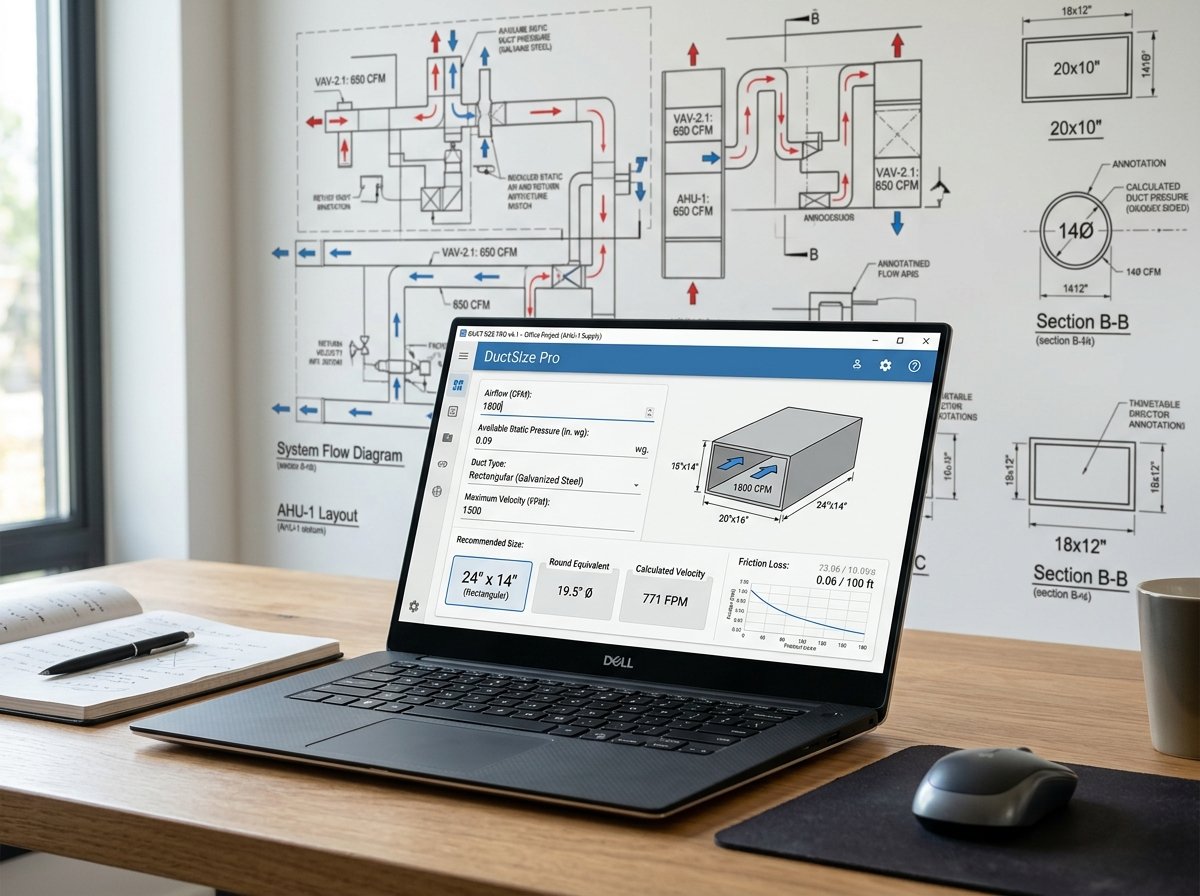
Duct Sizing Calculator: Find the Right Duct Size for Your Airflow
Correct duct sizing is fundamental to any efficient HVAC or ventilation system. If ducts are too small, air velocity increases, causing noise, high pressure drop, and excessive energy consumption. If ducts are too large, they waste material, take up valuable space, and increase installation costs. Our Duct Sizing Calculator is a free online tool that helps you determine the optimal round or rectangular duct size based on your required airflow and target velocity. Whether you’re designing a residential ventilation system, a commercial HVAC layout, or an industrial exhaust network, this calculator gives you accurate results in seconds.
In this guide, we’ll show you how to use the calculator, explain the calculations, provide real-world examples, and answer common questions. We’ll also share tips to ensure your duct design is efficient, quiet, and cost-effective.
Duct Sizing
Construction CalculatorRound or rectangular duct size from airflow and target velocity.
What is the Duct Sizing Calculator?
The Duct Sizing Calculator is a free online tool that calculates the required duct cross-sectional area and recommends a standard round diameter or rectangular dimensions. It supports three flow units (m³/h, L/s, CFM), five application presets for target velocity (main duct low noise, main duct standard, branch duct, high velocity, and custom), and both round and rectangular duct shapes. For rectangular ducts, you can specify the aspect ratio (width to height), and the calculator returns dimensions rounded up to the nearest 25 mm, plus the equivalent round diameter using the Huebscher formula. The tool is part of a suite of HVAC calculators available on our website. For related calculations, you can use our Duct Pressure Drop Calculator, Ventilation Airflow Calculator, MVHR Sizing Calculator, and Extract Fan Sizing Calculator.
How to Use the Duct Sizing Calculator
Using the calculator is straightforward. Here’s a breakdown of each field:
1. Airflow
- Flow unit: Select the unit for your airflow: Cubic metres per hour (m³/h), Litres per second (L/s), or Cubic feet per minute (CFM).
- Airflow: Enter the numeric value in the selected unit.
2. Velocity
- Application: Select the intended application to set a recommended target velocity:
- Main duct, low noise (4 m/s)
- Main duct, standard (6 m/s)
- Branch duct (4 m/s)
- High velocity (10 m/s)
- Custom velocity
- Target velocity override: If you want to use a velocity different from the preset, enter it here in m/s. Leave 0 to use the preset.
3. Shape
- Duct shape: Select Round or Rectangular.
- Aspect ratio (W:H): For rectangular ducts only, enter the ratio of width to height. Typically between 1.0 and 3.0. The default is 2.0.
Once you enter all values, the calculator instantly displays:
- Airflow in m³/h, L/s, and CFM
- Target velocity (m/s)
- Required duct area (cm²)
- For round ducts: minimum round diameter (mm) and recommended standard round diameter (mm)
- For rectangular ducts: recommended width (mm), height (mm), and equivalent round diameter (mm)
Understanding the Cost Components
To make the most of the calculator, it’s important to understand each output and the underlying formulas.
- Airflow conversion: The calculator converts your input to m³/s for internal calculations. 1 m³/h = 1/3600 m³/s; 1 L/s = 1/1000 m³/s; 1 CFM = 1/2118.88 m³/s.
- Target velocity: The speed of air in the duct, in metres per second (m/s). It is chosen based on the application. Lower velocities reduce noise and pressure drop but require larger ducts. Higher velocities allow smaller ducts but increase noise and energy consumption.
- Required duct area:
Area = Airflow / Velocity. It is the cross-sectional area needed to achieve the target velocity at the given flow rate. - Round duct diameter:
D = √(4 × Area / π). This is the minimum internal diameter required. The calculator then recommends the nearest standard round size from a list of common diameters (80, 100, 125, 150, 160, 200, 250, 315, 355, 400, 450, 500, 630, 710, 800 mm). The smallest standard size that is greater than or equal to the minimum diameter is selected. - Rectangular duct dimensions: For a given aspect ratio (W:H), the height is
H = √(Area / aspect), and the width isW = aspect × H. These are rounded up to the nearest 25 mm to match standard manufacturing sizes. - Equivalent round diameter: For rectangular ducts, the equivalent round diameter is calculated using the Huebscher formula:
De = 1.30 × (W × H)^0.625 / (W + H)^0.25. This is useful for estimating pressure drop using round duct data.
Understanding these components helps you interpret the results and adjust your design. For more information on duct sizing, you can refer to Wikipedia’s article on duct design.
Example Calculations
Let’s run through a few examples to see how the calculator works in different scenarios.
Example 1: Round Duct, 500 m³/h, Main Duct Standard
- Flow unit: m³/h
- Airflow: 500
- Application: Main duct, standard (6 m/s)
- Duct shape: Round
Calculations:
- Q = 500 / 3600 = 0.1389 m³/s
- Velocity = 6.0 m/s
- Area = 0.1389 / 6.0 = 0.02315 m² = 231.5 cm²
- Minimum diameter: D = √(4 × 0.02315 / π) = √(0.02947) = 0.1717 m = 171.7 mm
- Recommended standard round size: smallest ≥ 171.7 is 200 mm
- Result: Recommended round duct 200 mm
Example 2: Rectangular Duct, 200 L/s, Branch Duct
- Flow unit: L/s
- Airflow: 200
- Application: Branch duct (4 m/s)
- Duct shape: Rectangular
- Aspect ratio: 2.0
Calculations:
- Q = 200 / 1000 = 0.200 m³/s
- Velocity = 4.0 m/s
- Area = 0.200 / 4.0 = 0.050 m² = 500 cm²
- Aspect = 2.0
- H = √(0.050 / 2.0) = √(0.025) = 0.1581 m = 158.1 mm → round up to 175 mm
- W = 2.0 × 158.1 = 316.2 mm → round up to 325 mm
- Equivalent round diameter: De = 1.30 × (325 × 175)^0.625 / (325 + 175)^0.25 = 1.30 × (56875)^0.625 / (500)^0.25
- 56875^0.625 ≈ 56875^(5/8) = (56875^5)^(1/8). 56875^5 ≈ 5.96e23, 8th root ≈ 178.5
- 500^0.25 ≈ 4.729
- De = 1.30 × 178.5 / 4.729 = 232.1 / 4.729 = 49.1? Wait, let’s compute properly: 56875^0.625 = exp(0.625 * ln(56875)) = exp(0.625 * 10.948) = exp(6.8425) = 936.3. Then 936.3 / 500^0.25 (500^0.25 = 4.7287) = 198.0. Then × 1.30 = 257.4 mm. Actually, I need to recalc: 56875^0.625 = 936.3, divided by 4.7287 = 198.0, times 1.30 = 257.4 mm. So equivalent round ≈ 257 mm.
- Result: Rectangular duct 325 × 175 mm, equivalent round Ø 257 mm
Example 3: Round Duct, 100 CFM, High Velocity
- Flow unit: CFM
- Airflow: 100
- Application: High velocity (10 m/s)
- Duct shape: Round
Calculations:
- Q = 100 / 2118.88 = 0.04719 m³/s
- Velocity = 10.0 m/s
- Area = 0.04719 / 10.0 = 0.004719 m² = 47.19 cm²
- Minimum diameter: D = √(4 × 0.004719 / π) = √(0.006009) = 0.0775 m = 77.5 mm
- Recommended standard round size: smallest ≥ 77.5 is 80 mm
- Result: Recommended round duct 80 mm
These examples show how different airflow rates, velocities, and duct shapes affect the sizing.
Benefits of Using the Duct Sizing Calculator
Tips for Accurate Duct Sizing
- Choose the right target velocity: Recommended velocities: 3–5 m/s in main ducts for low noise, 4–6 m/s for standard, 2–3 m/s in branches, and up to 10 m/s for high-velocity systems. Higher velocities increase noise and pressure drop.
- Consider noise: Air velocity above 6 m/s in main ducts can generate noticeable noise. Use low-noise presets for occupied spaces.
- Account for fittings: Duct sizing alone doesn’t include pressure drop from fittings. Use our Duct Pressure Drop Calculator after sizing.
- Use standard sizes: The calculator recommends standard round and rectangular sizes. Using standard sizes reduces cost and lead time.
- Check aspect ratio: For rectangular ducts, keep aspect ratio ≤ 4:1 to avoid excessive pressure drop and noise. The default 2:1 is a good balance.
- Verify with a professional: For critical HVAC systems, have a qualified engineer verify the design.
- Consider future expansion: If you may increase airflow later, size ducts for the future to avoid costly upgrades.
For more information on duct design, you can refer to resources like Wikipedia’s article on duct design or guidelines from ASHRAE.
How to Reduce Duct Costs
If your calculated duct size is larger than desired, here are ways to reduce costs without compromising performance:
- Increase velocity: Higher velocity reduces duct size but increases noise and pressure drop. Balance carefully.
- Use rectangular ducts: Rectangular ducts can fit into tight spaces and may be cheaper to install in some buildings.
- Optimize routing: Shorter, straighter runs reduce pressure drop and allow smaller ducts.
- Choose standard sizes: Standard sizes are cheaper and readily available.
- Consider flexible ducts: For short runs, flexible ducts can be cheaper, but they have higher pressure drop.
- Get multiple quotes: Compare suppliers and installers for the best price.
Frequently Asked Questions (FAQ)
Conclusion
The Duct Sizing Calculator is an essential tool for HVAC engineers, designers, and installers. It helps you determine the correct round or rectangular duct size based on airflow and target velocity, ensuring efficient and quiet operation. By following the tips in this article and using the calculator, you can confidently design your ductwork. Don’t forget to explore our other HVAC calculators for all your ventilation needs.
Whether you’re sizing a simple extract fan or a complex MVHR system, accurate duct sizing is key to a successful project. Try the Duct Sizing Calculator today and take the guesswork out of your duct design.






3 Comments