
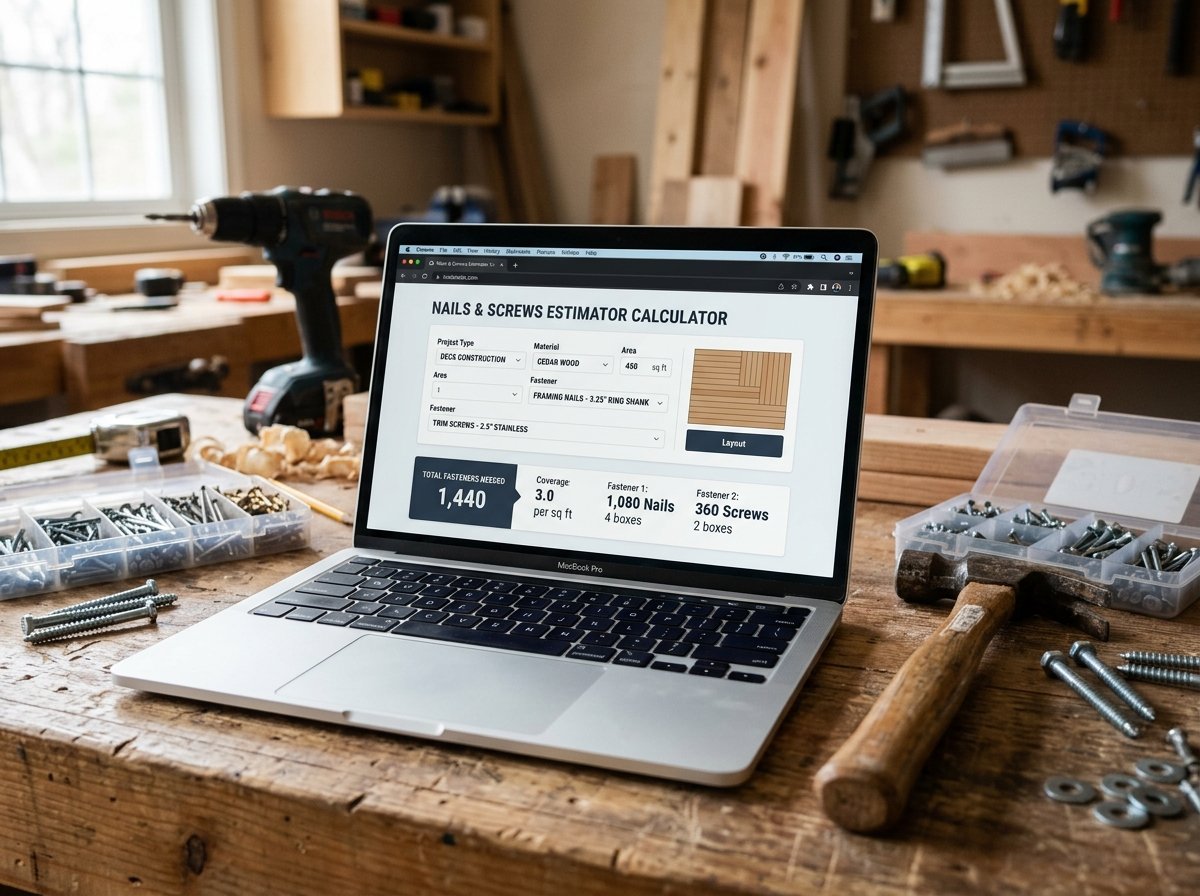
Nails & Screws Estimator Calculator: Estimate Fixings and Costs Accurately
Nails and screws are the most common fasteners in construction, used for everything from drywall and decking to fencing and roof battens. Whether you’re a professional contractor or a DIY enthusiast, ordering the right quantity of fixings is essential to avoid delays and wasted trips to the supplier. An undersupply stops work; an oversupply leaves you with boxes of unused fasteners. Our Nails & Screws Estimator Calculator is a free online tool that helps you quickly determine the total number of fixings required, the number of retail boxes to buy, the need for washers or plugs, and the total cost including labour.
In this guide, we’ll show you how to use the calculator, explain the calculations, provide real-world examples, and answer common questions. We’ll also share tips to ensure your fixing procurement is accurate and cost-effective.
Nails & Screws Estimator
Construction CalculatorNails and screws: total fixings, boxes, washers, cost.
What is the Nails & Screws Estimator Calculator?
The Nails & Screws Estimator Calculator is a free online tool that calculates the quantity and cost of nails, screws, staples, or bolts for a given application. It supports a wide range of applications including drywall to studs, sheathing to frame, decking boards to joists, fence boards to rails, skirting, roof battens, tile backer board, subfloor panels, and plasterboard to metal stud. The calculator accounts for run length, number of parallel rows, spacing along the run, fixings per crossing, waste allowance, fixing type and size, washers or plugs, and local pricing for fixings, washers, and labour. It provides a clear breakdown of total fixings required, boxes of 100, 500, and 1000, washer count, and costs for fixings, washers, labour, and grand total. The tool is part of a suite of materials and quantities calculators available on our website. For related calculations, you can use our Bolts & Nuts Estimator Calculator, Anchor Bolts & Wall Fixings Calculator, Timber Connectors Calculator, and Exterior Siding / Cladding Calculator.
How to Use the Nails & Screws Estimator Calculator
Using the calculator is straightforward. Here’s a breakdown of each field:
1. Application
- Application: Select the intended use: Drywall to studs, Sheathing / OSB to frame, Decking boards to joists, Fence boards to rails, Skirting / trim, Roof battens to rafters, Tile backer board, Subfloor panels, Plasterboard to metal stud, or Custom. The application applies a fixing density multiplier to the count, reflecting typical patterns for that trade.
2. Dimensions
- Run length: Enter the length along which fixings are placed in meters or feet.
- Number of parallel rows: Enter how many parallel lines of fixing you have. For example, when fixing sheathing to studs, each stud is a row. If you have 10 studs, enter 10.
3. Spacing
- Spacing along run: Enter the distance between fixings along each row in meters or inches. Typical values: 300 mm for drywall, 150–200 mm for decking edges, 300 mm for fencing.
- Fixings per crossing: Enter the number of fixings at each intersection (usually 1 or 2). For example, 2 screws per stud for sheathing.
4. Count
- Count method: Select Auto (spacing × rows) or Manual total count. Only the selected method is used.
- Manual total fixings: If “Manual total count” is selected, enter the total number of fixings directly.
- Waste allowance: Enter a percentage for damaged heads, overdriven screws, and dropped fixings. Typical value is 10%.
5. Fixing
- Fixing type: Select Screw, Nail, Staple, or Bolt. This is informational only; enter the price for your chosen type below.
- Fixing size: Select Small (3.5 × 35 mm), Medium (4 × 50 mm), Large (4.5 × 75 mm), or XL (5 × 100 mm). This is informational; enter the price for your chosen size below.
6. Accessories
- Washers / plugs: Select Yes if you need one washer or plug per fixing. Select No otherwise.
7. Pricing
- Fixing price each: Enter the local price per fixing for your chosen type and size.
- Washer / plug price each: Enter the local price per washer or plug. Used only when washers / plugs are selected.
- Labour per fixing: Enter the average labour cost per fixing across the installation. This can be a rough estimate or based on time studies.
Once you enter all values, the calculator instantly displays:
- Total fixings required (including waste)
- Boxes of 100
- Boxes of 500
- Boxes of 1000
- Washers / plugs (if selected)
- Fixings cost
- Washers / plugs cost
- Labour cost
- Grand total
Understanding the Cost Components
To make the most of the calculator, it’s important to understand each output and the underlying logic.
- Total fixings required: Calculated as follows:
- If Manual count is selected:
count = manual_count. - If Auto is selected:
per_row = floor(run_length / spacing) + 1(the +1 ensures a fixing at the start and end of each row). Thencount = per_row × rows × fixings_per_crossing × application_multiplier. Finally, waste is added:count = ceil(count × (1 + waste/100)). - The application multiplier adjusts the count based on typical density for that trade. For example, drywall uses 1.30, fencing 0.90, skirting 0.70. This reflects that some applications require more or fewer fixings per length.
- If Manual count is selected:
- Boxes of 100, 500, 1000: The total fixings are divided by the box size and rounded up. This helps you decide how many boxes to purchase. You can choose the box size that best suits your quantity and budget.
- Washers / plugs: If selected, the calculator assumes one washer or plug per fixing. The count equals the total fixings.
- Fixings cost:
total fixings × fixing price each. - Washers / plugs cost:
washer count × washer price each(if selected). - Labour cost:
total fixings × labour per fixing. This is a simple way to estimate installation labour. Adjust the rate based on your local labour costs and the complexity of the work. - Grand total: Sum of all material and labour costs.
Understanding these components helps you interpret the results and adjust your order. For more information on fasteners, you can refer to Wikipedia’s article on fasteners.
Example Calculations
Let’s run through a few examples to see how the calculator works in different scenarios.
Example 1: Drywall to Studs, 10 m Run, 5 Rows, 300 mm Spacing
- Application: Drywall to studs (multiplier 1.30)
- Run length: 10 m
- Number of parallel rows: 5
- Spacing along run: 0.300 m
- Fixings per crossing: 1
- Count method: Auto
- Waste: 10%
- Fixing type: Screw
- Fixing size: Medium (4 × 50 mm)
- Washers / plugs: No
- Fixing price: $0.05 each
- Labour per fixing: $0.10
Calculations:
- per_row = floor(10 / 0.3) + 1 = 33 + 1 = 34
- count = 34 × 5 × 1 × 1.30 = 221
- waste: 221 × 1.10 = 243.1 → ceil = 244
- Boxes of 100: ceil(244/100) = 3
- Boxes of 500: ceil(244/500) = 1
- Boxes of 1000: ceil(244/1000) = 1
- Fixings cost: 244 × $0.05 = $12.20
- Labour cost: 244 × $0.10 = $24.40
- Total: $12.20 + $24.40 = $36.60
- Result: 244 fixings, total $36.60
Example 2: Decking Boards to Joists, 20 m Run, 8 Rows, 150 mm Spacing
- Application: Decking boards to joists (multiplier 1.00)
- Run length: 20 m
- Number of parallel rows: 8
- Spacing along run: 0.150 m
- Fixings per crossing: 2
- Count method: Auto
- Waste: 8%
- Fixing type: Screw
- Fixing size: Large (4.5 × 75 mm)
- Washers / plugs: No
- Fixing price: $0.12 each
- Labour per fixing: $0.15
Calculations:
- per_row = floor(20 / 0.15) + 1 = 133 + 1 = 134
- count = 134 × 8 × 2 × 1.00 = 2144
- waste: 2144 × 1.08 = 2315.52 → ceil = 2316
- Boxes of 100: ceil(2316/100) = 24
- Boxes of 500: ceil(2316/500) = 5
- Boxes of 1000: ceil(2316/1000) = 3
- Fixings cost: 2316 × $0.12 = $277.92
- Labour cost: 2316 × $0.15 = $347.40
- Total: $277.92 + $347.40 = $625.32
- Result: 2316 fixings, total $625.32
Example 3: Fencing, 50 m Run, 1 Row, 300 mm Spacing, Manual Count
- Application: Fence boards to rails (multiplier 0.90)
- Run length: 50 m
- Number of parallel rows: 1
- Spacing along run: 0.300 m
- Fixings per crossing: 1
- Count method: Manual
- Manual total fixings: 200
- Waste: 12%
- Fixing type: Nail
- Fixing size: Medium (4 × 50 mm)
- Washers / plugs: No
- Fixing price: $0.03 each
- Labour per fixing: $0.08
Calculations:
- count = 200
- waste: 200 × 1.12 = 224 → ceil = 224
- Boxes of 100: ceil(224/100) = 3
- Boxes of 500: ceil(224/500) = 1
- Boxes of 1000: ceil(224/1000) = 1
- Fixings cost: 224 × $0.03 = $6.72
- Labour cost: 224 × $0.08 = $17.92
- Total: $6.72 + $17.92 = $24.64
- Result: 224 fixings, total $24.64
These examples show how different applications, spacings, and count methods affect the total fixings and cost.
Benefits of Using the Nails & Screws Estimator Calculator
Tips for Accurate Nail and Screw Estimation
- Choose the right application: The application multiplier reflects typical fixing densities. If you’re unsure, start with the default or use Manual count for precise control.
- Measure the run length accurately: Double-check the length along which fixings are placed. For multiple rows, count the number of studs, joists, or rails.
- Set realistic spacing: Spacing depends on the material and load. Drywall typically uses 300 mm centres; decking edges may need 150 mm. Check local building codes.
- Account for fixings per crossing: Some connections require two fixings per intersection (e.g., sheathing to studs). Enter 2 if needed.
- Allow for waste: 10% is typical, but increase to 15% for complex installations or when using small fixings that are easily dropped.
- Choose the right fixing type and size: Screws are stronger than nails and can be removed. Nails are faster. Staples are for thin materials. Bolts are for heavy connections.
- Consider washers or plugs: Washers distribute load and prevent pull-through. Plugs are used for fixing into masonry or hollow walls.
- Include labour: Labour per fixing helps you estimate total installed cost. Adjust the rate based on your local labour market and the complexity of the work.
- Verify with a professional: For critical structural fixings, have a qualified engineer verify the design.
For more information on fixings, you can refer to resources like Wikipedia’s article on nails or screws.
How to Reduce Fixing Costs
If your estimate is higher than expected, here are ways to reduce costs without compromising quality:
- Optimize spacing: Wider spacing reduces the number of fixings. Ensure it meets structural requirements.
- Choose a simpler application: Some applications require fewer fixings per length. Compare multipliers.
- Use a less expensive fixing: Nails are cheaper than screws. Plain finish is cheaper than galvanised.
- Buy in bulk: Larger boxes (500 or 1000) are often cheaper per fixing.
- Reduce waste: Order accurately and handle fixings carefully to avoid dropping.
- Do the labour yourself: If you’re handy, DIY installation saves labour costs.
- Get multiple quotes: Compare suppliers for the best price.
Frequently Asked Questions (FAQ)
Conclusion
The Nails & Screws Estimator Calculator is an essential tool for builders, contractors, and DIY enthusiasts. It helps you determine the correct quantity of fixings, the number of boxes to buy, and the total cost including labour. By following the tips in this article and using the calculator, you can confidently order your fasteners. Don’t forget to explore our other materials and quantities calculators for all your construction needs.
Whether you’re installing drywall or building a deck, accurate fixing estimation is key to a successful project. Try the Nails & Screws Estimator Calculator today and take the guesswork out of your fastener budget.




One Comment