Paint Job Cost Calculator: Estimate Your Painting Project Costs Accurately
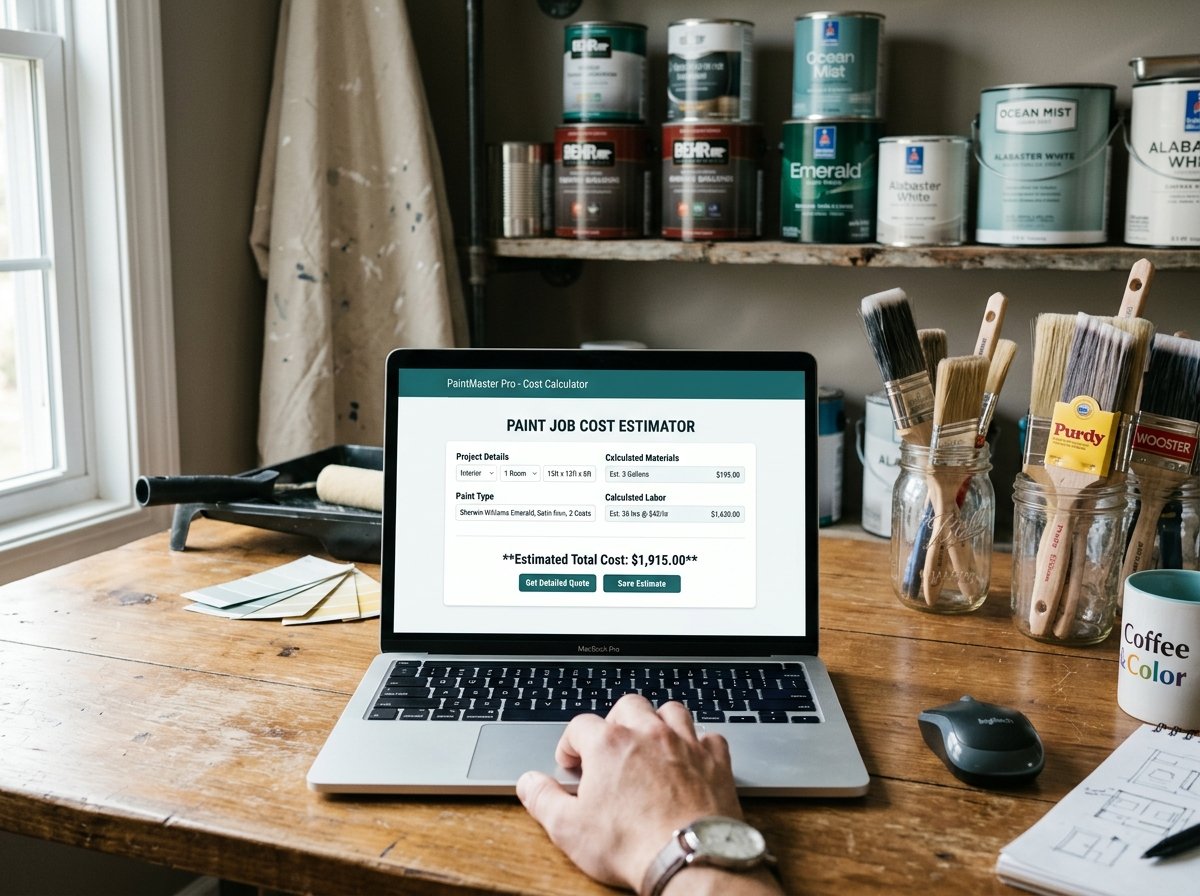
Painting is one of the most cost-effective ways to refresh a space, but it still requires careful budgeting. Whether you’re repainting a single room or an entire house, knowing the total cost—paint, primer, and labour—helps you avoid surprises. Our Paint Job Cost Calculator is a free online tool that gives you an instant, detailed estimate for your painting project.
In this guide, we’ll show you how to use the calculator, provide real-world examples, and answer common questions. We’ll also share tips to keep your painting project on budget.
Paint Job Cost
Construction CalculatorPainting project cost: paint, primer, labour and full breakdown.
What is the Paint Job Cost Calculator?
The Paint Job Cost Calculator is a free online tool that calculates the total cost of a painting job based on the area to be painted, number of coats, paint coverage, can size, paint price, primer price, and labour rate. It accounts for paint waste and calculates the exact number of cans you need to buy. The calculator is part of a suite of construction and renovation calculators available on our website, including the Tiling Job Cost Calculator, Roofing Job Cost Calculator, Flooring Job Cost Calculator, and Construction Estimate Calculator.
How to Use the Paint Job Cost Calculator
Using the calculator is simple. Here’s a breakdown of each field:
1. Dimensions
- Painting area: Enter the total wall or ceiling area to paint in square meters or square feet. For example, a room 5 m long, 4 m wide, and 2.5 m high has a wall area of 2 * (5 + 4) * 2.5 = 45 m². Subtract doors and windows if you’re not painting them.
- Number of coats: Enter the number of coats you plan to apply. Two coats are standard for full coverage and durability. One coat may be enough if you’re refreshing a similar color, but two is recommended.
2. Paint
- Paint coverage: Enter the coverage of your paint in m² per litre. This is usually printed on the tin and typically ranges from 8 to 12 m²/L. Check the manufacturer’s specification.
- Can size: Enter the size of the paint can you plan to buy, in litres. Common sizes are 2.5 L, 5 L, and 10 L.
- Paint price per litre: Enter the price of paint per litre. If a 5 L can costs $50, the price per litre is $10.
- Paint waste allowance: Enter a percentage to account for touch-ups, absorption, and roller loss. A typical allowance is 10%. For porous surfaces or dark colors, you may need 15%.
3. Primer
- Primer price per litre: Enter the cost of primer per litre. If you’re not using primer, set to 0. Primer is recommended for bare surfaces, stains, or when switching from dark to light colors.
4. Labour
- Labour rate per m²: Enter the painter’s rate per square meter. This varies by region and complexity. For ceilings or intricate trim, the rate may be higher.
Once you enter all values, the calculator displays a detailed breakdown: paint required, number of cans, paint cost, primer required, primer cost, labour cost, and grand total.
Understanding the Cost Components
To make the most of the calculator, it’s important to understand each cost component.
- Paint: This is the main material cost. Paint is sold in cans, and you must buy whole cans. The calculator rounds up the number of cans to the nearest whole number. Paint cost is calculated as
cans * can_size * price_per_litre. This means you pay for the full volume of paint you buy, even if you don’t use every drop. - Primer: Primer prepares the surface, improves adhesion, and can reduce the number of topcoats needed. It’s especially important for bare wood, drywall, or when painting over dark colors. The calculator assumes one coat of primer. Primer is also sold in cans, but our calculator multiplies litres by price per litre without rounding to cans. For accuracy, you may want to round up to the nearest can size manually.
- Waste allowance: This accounts for paint left in the roller, tray, or can, as well as touch-ups. A 10% allowance is standard.
- Labour: Labour is often the largest cost. The calculator multiplies the area by your labour rate. It does not adjust for ceiling height or intricate trim—you can adjust the rate to reflect complexity.
Example Calculations
Let’s run through a few examples to see how the calculator works.
Example 1: Painting a Bedroom (Walls Only)
- Area: 45 m²
- Coats: 2
- Coverage: 10 m²/L
- Can size: 5 L
- Paint price: $12/L
- Waste: 10%
- Primer: $8/L (using primer)
- Labour rate: $10/m²
Calculations:
- Liters needed: 45 * 2 / 10 = 9 L
- With waste: 9 * 1.10 = 9.9 L
- Cans to buy: ceil(9.9 / 5) = 2 cans (10 L total)
- Paint cost: 2 * 5 * $12 = $120
- Primer needed: 45 / 10 = 4.5 L
- Primer cost: 4.5 * $8 = $36
- Labour cost: 45 * $10 = $450
- Total: $606
Example 2: Painting a Ceiling
- Area: 20 m²
- Coats: 2
- Coverage: 12 m²/L
- Can size: 10 L
- Paint price: $10/L
- Waste: 10%
- Primer: $0 (no primer)
- Labour rate: $15/m² (ceiling is more difficult)
Calculations:
- Liters needed: 20 * 2 / 12 = 3.33 L
- With waste: 3.33 * 1.10 = 3.67 L
- Cans to buy: ceil(3.67 / 10) = 1 can (10 L)
- Paint cost: 1 * 10 * $10 = $100
- Primer cost: $0
- Labour cost: 20 * $15 = $300
- Total: $400
Note: You buy a 10 L can but only need 3.67 L. You’ll have leftover paint for touch-ups.
Example 3: Repainting a Living Room with Primer
- Area: 80 m²
- Coats: 2
- Coverage: 9 m²/L
- Can size: 5 L
- Paint price: $15/L
- Waste: 12%
- Primer: $10/L
- Labour rate: $12/m²
Calculations:
- Liters needed: 80 * 2 / 9 = 17.78 L
- With waste: 17.78 * 1.12 = 19.91 L
- Cans to buy: ceil(19.91 / 5) = 4 cans (20 L)
- Paint cost: 4 * 5 * $15 = $300
- Primer needed: 80 / 9 = 8.89 L
- Primer cost: 8.89 * $10 = $88.90
- Labour cost: 80 * $12 = $960
- Total: $1,348.90
These examples show how different areas, coverages, and can sizes affect the total cost.
Benefits of Using the Paint Job Cost Calculator
- Accuracy: Avoid underestimating paint quantities and costs.
- Time-saving: Get instant results without manual calculations.
- Transparency: See a clear breakdown of paint, primer, and labour.
- Flexibility: Compare different paint prices, can sizes, and coverage rates.
- Professionalism: Create detailed quotes for clients.
Tips for Accurate Painting Cost Estimation
- Measure the paintable area carefully: For walls, measure the height and width of each wall, then subtract doors and windows. For ceilings, measure length and width. For trim, measure linear feet and convert to area.
- Check the paint coverage: Coverage varies by brand, finish, and color. Dark or vibrant colors may require more coats or a tinted primer. Always read the tin.
- Choose the right can size: Larger cans are more economical per litre, but only if you’ll use the paint within its shelf life. For small jobs, smaller cans may be more cost-effective.
- Don’t skip primer: Primer improves adhesion, blocks stains, and can reduce the number of topcoats. It’s a small cost for a better finish.
- Account for waste: A 10% waste allowance is typical. For textured surfaces or spray application, increase to 15–20%.
- Labour rates vary: Ceilings, trim, and tall walls are more difficult to paint. Adjust the labour rate accordingly.
- Consider surface preparation: Filling cracks, sanding, and cleaning are not included in the calculator. Add these costs if needed.
For more information on painting techniques and materials, you can refer to resources like Wikipedia’s article on painting or guidelines from the Painting and Decorating Contractors of America.
How to Reduce Painting Costs
If your estimate is higher than expected, here are some ways to reduce costs:
- Choose a less expensive paint: Premium paints offer better durability and coverage, but mid-range paints can be sufficient for low-traffic areas.
- Do the prep work yourself: Cleaning, sanding, and taping can be done by a homeowner, saving on labour.
- Paint yourself: If you have the time and skills, DIY painting can save significantly on labour. However, ceilings and tall walls can be challenging.
- Buy paint in bulk: Many suppliers offer discounts on 5-gallon (19 L) buckets. Calculate your total needs and buy once.
- Use a paint sprayer: For large areas, a sprayer can apply paint faster than brushes and rollers, reducing labour time. However, it requires masking and cleanup.
- Get multiple quotes: Compare at least three painters. Prices can vary widely.
Frequently Asked Questions (FAQ)
Conclusion
The Paint Job Cost Calculator is an essential tool for anyone planning a painting project. It helps you budget accurately, compare paint options, and avoid surprises. By following the tips in this article and using the calculator, you can confidently estimate your painting costs. Don’t forget to explore our other calculators for all your construction and renovation needs.
Whether you’re painting a single room or an entire house, accurate cost estimation is key to a successful project. Try the Paint Job Cost Calculator today and take the guesswork out of your budget.