
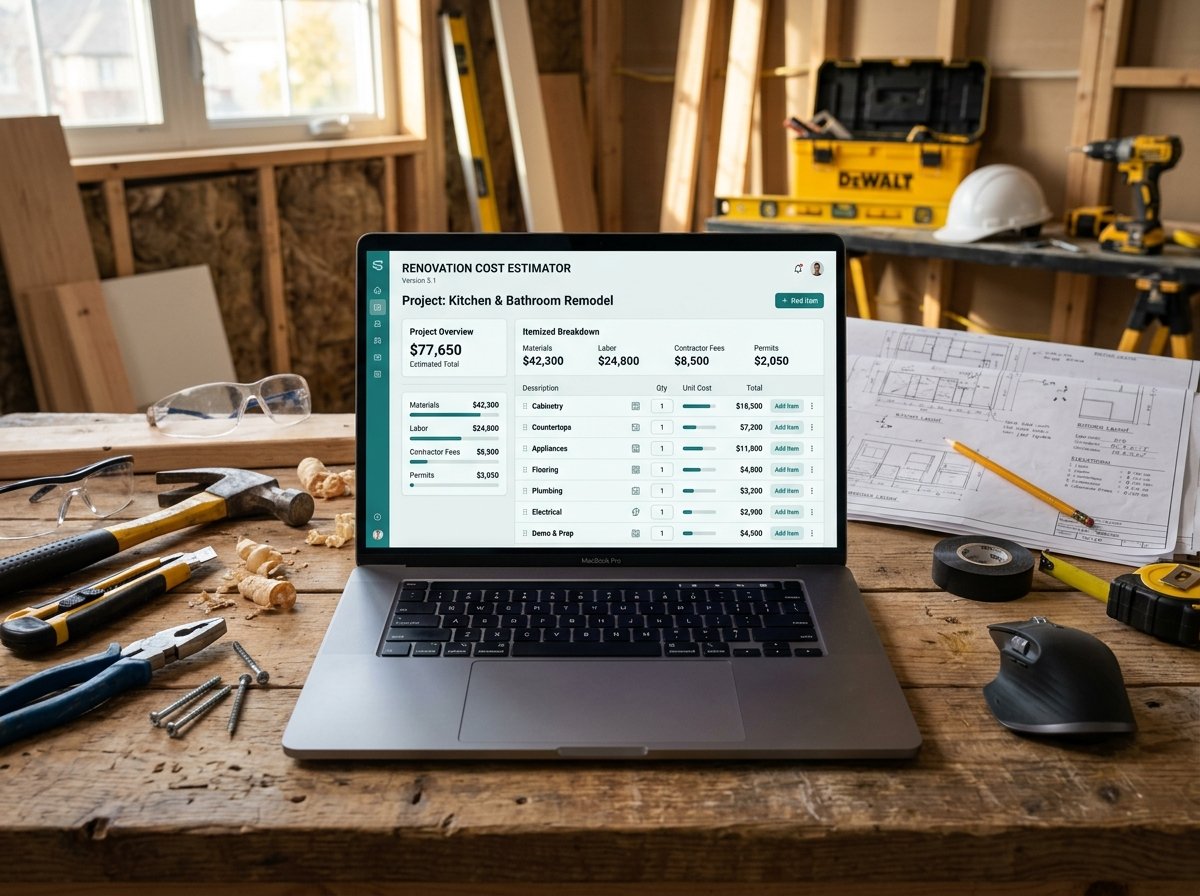
Renovation Cost Estimator: Estimate Your Renovation Budget Accurately
Renovating a home or commercial space is an exciting project, but it can also be a significant financial undertaking. Whether you’re updating a single room or remodeling an entire property, having a clear and realistic budget is essential. Our Renovation Cost Estimator is a free online tool that helps you calculate a comprehensive renovation budget, including labour, materials, contingency, and price per square meter.
In this guide, we’ll show you how to use the calculator, explain each cost component, provide real-world examples, and answer common questions. We’ll also share tips to improve the accuracy of your renovation estimates and keep your project on track.
Renovation Cost Estimator
Construction CalculatorFull renovation budget: labour, materials, contingency and price per m².
What is the Renovation Cost Estimator?
The Renovation Cost Estimator is a free online tool that calculates the total cost of a renovation project based on the floor area, ceiling height, renovation level, labour rate, materials rate, and contingency. It provides a clear breakdown of labour, materials, approximate wall area, contingency, grand total, and price per m². The calculator is part of a suite of construction and renovation calculators available on our website. For a complete project budget, you can combine it with our Construction Estimate Calculator, Material Cost Calculator, and Labour Cost Calculator.
How to Use the Renovation Cost Estimator
Using the calculator is straightforward. Here’s a breakdown of each field:
1. Dimensions
- Floor area: Enter the total area being renovated in square meters or square feet. This is the floor area of the space, not the wall area. For example, a room 5 m long and 4 m wide has a floor area of 20 m².
- Ceiling height: Enter the actual ceiling height of the space in meters or feet. This is used to compute the approximate wall area and to adjust labour and material costs for higher ceilings.
- Reference ceiling height: Enter the ceiling height that the base rates are quoted for. Typically, this is 2.7 m (about 9 ft). If your ceiling is higher or lower, the calculator adjusts the costs accordingly.
2. Scope
- Renovation level: Select the level of renovation: Cosmetic, Standard, Premium, or Luxury. This applies a multiplier to both labour and material rates. Cosmetic (0.8×) is for light updates like painting and flooring. Standard (1.0×) is a typical full renovation. Premium (1.6×) includes high-end finishes. Luxury (2.4×) is for top-of-the-line materials and custom work.
- Labour rate per m²: Enter the local labour cost per square meter, excluding materials. This should reflect the cost of tradespeople, project management, and any other labour.
- Materials rate per m²: Enter the local materials cost per square meter. This includes all building materials, fixtures, and finishes.
3. Costs
- Contingency: Enter a percentage for unforeseen costs. This is a buffer for surprises like hidden damage, design changes, or price increases. Typically 5–15% is recommended. We suggest 10% for most renovations.
Once you enter all values, the calculator instantly displays:
- Labour cost
- Materials cost
- Approximate wall area
- Contingency amount
- Grand total
- Price per m²
Understanding the Cost Components
To make the most of the calculator, it’s important to understand each cost component and how they interact.
- Labour: This is the cost of all tradespeople, including carpenters, electricians, plumbers, painters, and general labourers. It is calculated as
floor area × labour rate × level multiplier × height multiplier. The level multiplier adjusts for complexity, while the height multiplier accounts for the extra work required for higher ceilings. - Materials: This includes all building materials, fixtures, and finishes. It is calculated as
floor area × materials rate × level multiplier × height multiplier. Higher-end renovations use more expensive materials, hence the multiplier. - Ceiling height adjustment: The calculator uses a height multiplier that ranges from 0.85 to 1.25. If your ceiling is higher than the reference height, costs increase because more wall area needs to be covered and scaffolding may be required. If lower, costs decrease slightly.
- Approximate wall area: This is an estimate of the total wall area, calculated as
perimeter × ceiling height. The perimeter is approximated from the floor area assuming a square footprint. This is useful for estimating paint, wallpaper, or tiling needs. - Contingency: This is a reserve for unexpected costs. It is calculated as a percentage of the subtotal (labour + materials). Contingency is essential because renovations often reveal hidden issues like water damage, outdated wiring, or structural problems.
- Grand total: This is the final estimated cost, including all components.
- Price per m²: This is the total cost divided by the floor area. It gives you a quick benchmark to compare with other projects or contractor quotes.
Understanding these components helps you build a realistic budget and communicate it effectively to contractors. For more information on renovation cost estimating, you can refer to Wikipedia’s article on renovation.
Example Calculations
Let’s run through a few examples to see how the calculator works in different scenarios.
Example 1: Standard Kitchen Renovation
- Floor area: 20 m²
- Ceiling height: 2.7 m
- Reference ceiling height: 2.7 m
- Renovation level: Standard (1.0×)
- Labour rate: $150/m²
- Materials rate: $200/m²
- Contingency: 10%
Calculations:
- Height multiplier: 1.0 (ceiling equals reference)
- Labour: 20 × $150 × 1.0 × 1.0 = $3,000
- Materials: 20 × $200 × 1.0 × 1.0 = $4,000
- Subtotal: $3,000 + $4,000 = $7,000
- Contingency: 10% of $7,000 = $700
- Grand total: $7,700
- Price per m²: $7,700 / 20 = $385
Example 2: Premium Bathroom Renovation with High Ceiling
- Floor area: 10 m²
- Ceiling height: 3.2 m
- Reference ceiling height: 2.7 m
- Renovation level: Premium (1.6×)
- Labour rate: $200/m²
- Materials rate: $300/m²
- Contingency: 12%
Calculations:
- Height multiplier: 1 + (3.2 – 2.7) / 2.7 × 0.5 = 1 + 0.5/2.7×0.5 = 1 + 0.0926 = 1.0926 (capped at 1.25)
- Labour: 10 × $200 × 1.6 × 1.0926 = $3,496.32
- Materials: 10 × $300 × 1.6 × 1.0926 = $5,244.48
- Subtotal: $3,496.32 + $5,244.48 = $8,740.80
- Contingency: 12% of $8,740.80 = $1,048.90
- Grand total: $9,789.70
- Price per m²: $9,789.70 / 10 = $978.97
Example 3: Cosmetic Living Room Update
- Floor area: 30 m²
- Ceiling height: 2.4 m
- Reference ceiling height: 2.7 m
- Renovation level: Cosmetic (0.8×)
- Labour rate: $100/m²
- Materials rate: $80/m²
- Contingency: 8%
Calculations:
- Height multiplier: 1 + (2.4 – 2.7) / 2.7 × 0.5 = 1 – 0.3/2.7×0.5 = 1 – 0.0556 = 0.9444 (capped at min 0.85, so 0.9444)
- Labour: 30 × $100 × 0.8 × 0.9444 = $2,266.56
- Materials: 30 × $80 × 0.8 × 0.9444 = $1,813.25
- Subtotal: $2,266.56 + $1,813.25 = $4,079.81
- Contingency: 8% of $4,079.81 = $326.38
- Grand total: $4,406.19
- Price per m²: $4,406.19 / 30 = $146.87
These examples show how different renovation levels, ceiling heights, and areas affect the total cost.
Benefits of Using the Renovation Cost Estimator
- Accuracy: Get a structured estimate that includes labour, materials, and contingency.
- Time-saving: Instantly calculate a preliminary budget without manual spreadsheets.
- Transparency: See a clear breakdown of costs and price per m².
- Flexibility: Adjust area, rates, renovation level, and contingency to compare scenarios.
- Professionalism: Present a credible budget to clients, contractors, or lenders.
For a complete project budget, combine this with our Material Cost Calculator and Labour Cost Calculator.
Tips for Accurate Renovation Cost Estimation
- Measure carefully: Double-check your floor area and ceiling height. For irregular spaces, divide into rectangles and add them up.
- Choose the right renovation level: Be realistic about the quality of finishes you want. Cosmetic updates are cheaper, while luxury renovations can cost several times more.
- Use current local rates: Labour and material costs vary significantly by region. Use recent quotes or consult local contractors.
- Don’t skip contingency: Renovations always reveal surprises. A 10–15% contingency is standard, but older homes may need 20%.
- Account for permits and fees: The calculator does not include permit fees, inspections, or professional fees (architect, engineer). Add these separately.
- Consider temporary relocation: If you can’t live in the space during renovation, add temporary housing costs.
- Review the wall area estimate: The calculator provides an approximate wall area. For accurate paint or tile quantities, measure each wall separately.
For more information on renovation planning, you can refer to resources like Wikipedia’s article on home renovation or guidelines from the National Association of the Remodeling Industry.
How to Reduce Renovation Costs
If your estimate is higher than expected, here are some ways to reduce costs without compromising quality:
- Prioritize your goals: Focus on the most important updates first. You can phase the renovation over time.
- Keep the layout: Moving plumbing, electrical, or walls is expensive. Keeping the existing layout can save significantly.
- Choose standard materials: Custom or imported materials cost more. Standard sizes and finishes are often just as attractive.
- Do some work yourself: Demolition, painting, and cleaning can be done by a handy homeowner, saving on labour.
- Get multiple quotes: Compare at least three contractors. Prices can vary widely.
- Buy materials yourself: Some contractors mark up materials. Buying directly can save money, but ensure they are compatible with the contractor’s plan.
- Avoid peak season: Contractors may offer lower rates during slower months.
Frequently Asked Questions (FAQ)
Conclusion
The Renovation Cost Estimator is an essential tool for anyone planning a renovation. It helps you build a realistic budget, understand cost drivers, and communicate effectively with contractors. By following the tips in this article and using the calculator, you can confidently estimate your renovation costs. Don’t forget to explore our other calculators for all your construction and renovation needs.
Whether you’re updating a single room or remodeling an entire property, accurate cost estimation is key to a successful project. Try the Renovation Cost Estimator today and take the guesswork out of your budget.



2 Comments