
High-Yield Savings Calculator: The Ultimate Guide to Growing Your Money Faster
If you’re like most people, you have a savings account that pays a pitiful 0.01% annual percentage yield (APY). But in today’s world, you don’t have to settle for such low returns. High-yield savings accounts (HYSAs) offer interest rates of 4% or even 5%, which can turn a modest savings balance into a significant asset over time. However, many people don’t realize how much they’re leaving on the table by not switching. Our advanced High-Yield Savings Calculator is designed to show you exactly how much more you could earn. It compares your current regular savings account against a high-yield account, factoring in different contribution amounts, compounding frequencies, annual fees, taxes, inflation, and even growing contributions. This free tool isn’t just a simple interest calculator—it’s a comprehensive savings optimizer that helps you make the smartest choice for your money.
High-Yield Savings Calculator
Why You Need a High-Yield Savings Account
For decades, traditional banks have paid depositors tiny amounts of interest. With inflation often exceeding savings rates, leaving money in a regular savings account effectively means you’re losing purchasing power every year. High-yield savings accounts, on the other hand, are typically offered by online banks that have lower overhead costs. They pass those savings on to you in the form of higher interest rates. As of 2026, the best HYSAs are offering between 4% and 5.5% APY. That may not sound like much, but over 10 years, the difference is staggering.
According to the Consumer Financial Protection Bureau (CFPB), Americans lose billions of dollars each year by keeping their money in low-yield accounts. Switching to an online bank can increase your interest earnings by thousands of dollars over the long term. Our calculator helps you quantify this benefit precisely.
How Our Advanced Calculator Works
We designed this tool to be the most comprehensive savings comparison calculator available. Here’s how it works:
- Initial Deposit: How much you have saved right now.
- Regular Contributions (NEW): You can now set different contribution amounts for each account. For example, you might contribute $300/month to your regular account but $400/month to your HYSA, because you’ve budgeted to save more aggressively once you switch to a higher-yield option.
- Contribution Frequency: Choose monthly, quarterly, or annually.
- Years: How long you plan to save.
- Regular Rate & HYSA Rate: Enter the APY for your current account and your target high-yield account.
- Compounding Frequency: Daily, monthly, quarterly, or annually. Most banks compound monthly, but some do daily.
- Annual Fees: Some accounts charge maintenance fees. These can eat into your returns, and our calculator accounts for them.
- Tax Rate (NEW): Interest earned is taxable income. We apply your marginal tax rate to show your net return.
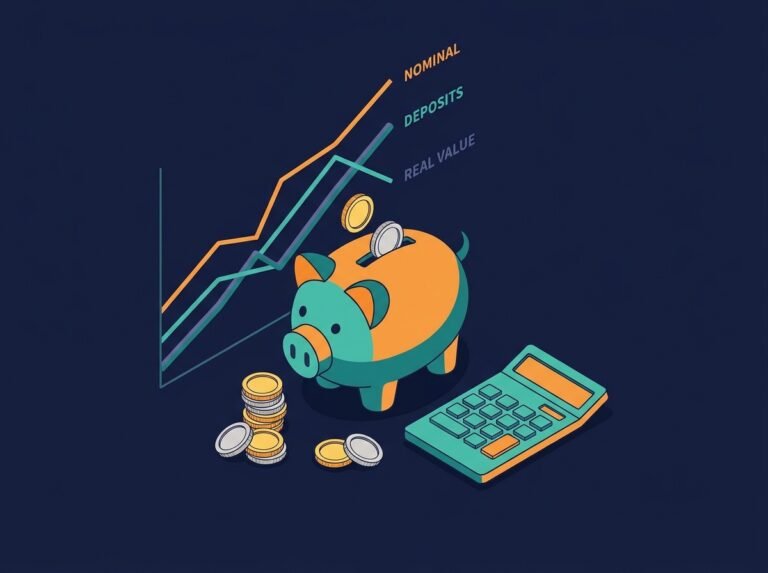
- Inflation Rate (NEW): The rising cost of living erodes your purchasing power. We adjust your final balance to show its real value in today’s dollars.
- Contribution Growth (NEW): If you plan to increase your monthly contributions over time (e.g., as your income grows), we model that automatically, making your plan more realistic.
The Impact of Compounding
Compounding is the engine of wealth. When your interest earns its own interest, growth accelerates. Our calculator lets you test different compounding frequencies. For example, $10,000 at 5% APY compounded daily will grow to $16,470 in 10 years, while compounded annually it grows to $16,288—a difference of $182. That’s not huge, but for larger balances and longer periods, it adds up. Most online banks compound daily, which is one more reason to switch.
Real-World Example: Sarah’s Savings Transformation
Let’s test the calculator with a realistic scenario.
- Initial Deposit: $5,000
- Regular Contribution: $200/month
- HYSA Contribution: $300/month (she decides to boost her savings after switching)
- Contribution Frequency: Monthly
- Years: 10
- Regular Rate: 0.5% (typical big bank)
- HYSA Rate: 4.5% (current average)
- Compounding Frequency: Monthly
- Regular Fee: $0
- HYSA Fee: $0
- Tax Rate: 22% (assumed)
- Inflation Rate: 2.5%
- Contribution Growth: 1% annually
Results:
- Future Value (Regular): With $200/month at 0.5%, after 10 years, your balance grows to roughly **$29,500** (before tax). After 22% tax on interest, it’s about $28,900**. In today’s dollars, that’s only **$22,600.
- Future Value (HYSA): With $300/month at 4.5%, after 10 years, your balance grows to **$50,000** (before tax). After tax, it’s about $45,000**. In today’s dollars, that’s **$35,000.
- Difference: The HYSA gives you an extra $16,000 in real purchasing power.
This example shows the massive difference. Not only does the HYSA pay more interest, but you’re also saving more each month. Our calculator reveals that the combination of a higher rate and increased contributions can transform your savings.
The Role of Taxes
Interest income is generally taxable at your federal marginal tax rate. If you’re in the 22% bracket, you will owe 22% of your interest earnings to the IRS. That’s a real cost. Our calculator subtracts this tax to show you the actual amount you’ll have to spend. Many people forget this and overestimate their returns. For a detailed breakdown of how interest income is taxed, you can refer to the IRS Publication 550. By accounting for taxes, you get a realistic picture of your net gains.
The Impact of Inflation
Inflation is silent but deadly. If your HYSA pays 4.5% but inflation is 2.5%, your real return is only 2%. Our calculator shows your final balance in today’s dollars, so you know what that money will actually buy in the future. For example, $50,000 in 10 years might only buy what $35,000 buys today. This is crucial for understanding whether you’re truly building wealth or just keeping up with costs. You can track current inflation data from the Bureau of Labor Statistics.
Why Contribution Growth Matters
If you’re still working and saving, you’ll likely increase your contributions over time due to raises, promotions, or side income. Our calculator lets you model an annual growth rate for your contributions. For example, starting at $300/month and increasing by 1% annually means you’ll be contributing $331/month by year 10. This small percentage adds up to thousands of dollars. Most savings calculators ignore this, but our tool does it automatically.
How to Use This Calculator for Smart Decisions
Your Next Steps: Related Tools
Understanding how to compare savings accounts is just one part of your financial strategy. Explore our suite of savings calculators: