

Emergency Fund Calculator: The Ultimate Guide to Building Your Safety Net
Life is unpredictable. A sudden job loss, an unexpected medical bill, or a major car repair can wreak havoc on your finances if you’re unprepared. An emergency fund is your financial shield against these shocks. But how much should you actually save? The standard advice is 3-6 months of expenses, but the right number depends on your income stability, inflation, and savings rate. Our advanced Emergency Fund Calculator takes the guesswork out of this process. It allows you to set a custom coverage period, factors in inflation (so your target stays realistic), accounts for returns on high-yield savings accounts, and even lets you set a deadline to see exactly how much you need to save monthly. This free tool is your roadmap to financial security.
Emergency Fund Calculator
Why an Emergency Fund is Essential
According to the Consumer Financial Protection Bureau, nearly 40% of Americans cannot cover a $400 emergency expense. Without a safety net, these unexpected costs often lead to high-interest credit card debt, which can spiral out of control. An emergency fund breaks this cycle. It provides a cushion that lets you handle life’s curveballs without going into debt. It’s not an investment—it’s insurance for your daily life.
How Much Do You Really Need?
The classic rule of thumb is 3-6 months of essential expenses. However, this is a baseline. If you’re a freelancer or have an irregular income, you should aim for 6-12 months. If you have a stable job, 3-6 may suffice. Our calculator lets you enter any number of months (from 1 to 24), so you can tailor your target to your unique situation. We also factor in inflation to ensure your target isn’t eroded over time.
How Our Advanced Calculator Works
We’ve upgraded this tool to be your complete emergency fund planner:
- Monthly Expenses: Your rent, utilities, groceries, insurance, and minimum debt payments.
- Coverage Months: The number of months you want to cover. Now you can enter any value, not just preset options.
- Current Savings: What you’ve already set aside.
- Monthly Savings: How much you can add each month.
- Expected Annual Return: If your fund is in a high-yield savings account (currently 4-5%), this accelerates your growth. Enter the APY here.
- Expected Inflation: Rising costs mean your target grows over time. We adjust for this.
- Desired Time (Optional): If you want to hit your target by a specific date (e.g., 12 months), enter that here. The calculator will tell you exactly how much you need to save monthly.
The Impact of High-Yield Savings Accounts
Why keep your emergency fund in a checking account earning 0%? A high-yield savings account (HYSA) can earn 4-5% interest, which helps your fund grow faster. For example, if you have $10,000 saved, a 4% APY earns you $400 in a year—money that would otherwise sit idle. Our calculator incorporates this return, showing you how much faster you’ll reach your goal. To find the best HYSA, check out NerdWallet’s guide.
Why Inflation Matters
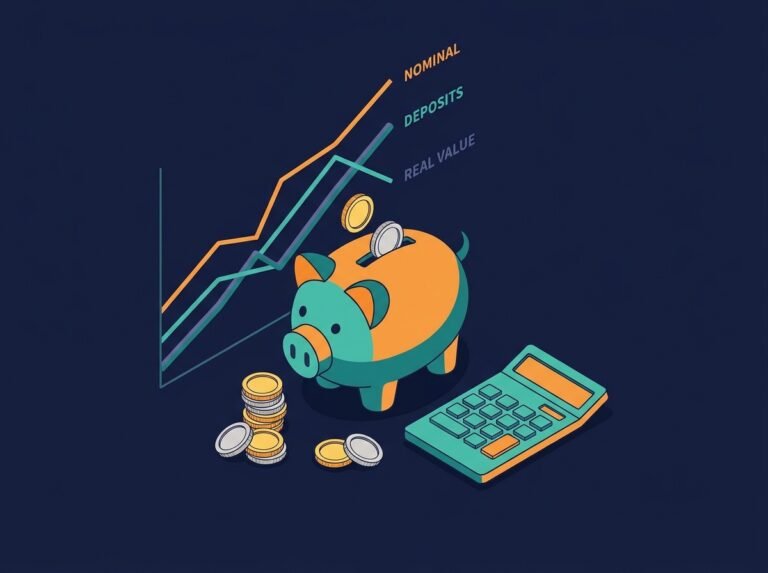
If your monthly expenses are $3,000 today, they might be $3,200 in a year (at 2.5% inflation). If your target is based solely on current expenses, you’ll come up short. Our calculator adjusts your target for inflation over your savings timeline, ensuring your fund remains sufficient. The Bureau of Labor Statistics publishes inflation data, so you can use recent trends to estimate future costs.
Real-World Example: Sarah’s Emergency Fund
Let’s test the calculator with a realistic scenario.
- Monthly Expenses: $3,000
- Coverage Months: 6 (target = $18,000)
- Current Savings: $5,000
- Monthly Contribution: $500
- Expected Annual Return: 4% (HYSA)
- Inflation Rate: 2.5%
- Desired Time: 18 months
Results:
- Target Fund (after inflation): $18,000 × (1 + 0.025/12)^18 ≈ **$18,700**
- Gap: $18,700 – $5,000 = $13,700
- Months to Goal (at current rate): With $500/month and 4% return, it will take about 25 months.
- Required Monthly (to hit in 18 months): You need to save $720/month to reach your goal in 18 months.
The calculator gives Sarah a clear action plan. She either increases her monthly savings or extends her timeline.
How to Build Your Fund Faster
- Automate your savings. Set up a recurring transfer on payday.
- Cut discretionary spending. Redirect unused money to your fund.
- Use windfalls. Tax refunds, bonuses, and gifts can accelerate progress.
- Open a HYSA. Maximize your interest earnings.
When Should You Recalculate?
- When your expenses change (e.g., rent increase, new baby).
- When you get a raise and can save more.
- At least annually to adjust for inflation and returns.
Your Next Steps: Related Tools
Building an emergency fund is just one part of financial planning. Explore our suite of savings calculators:
- Rainy Day Fund Calculator
- Savings Goal Calculator
- Compound Savings Calculator
- Savings Rate Calculator





3 Comments