
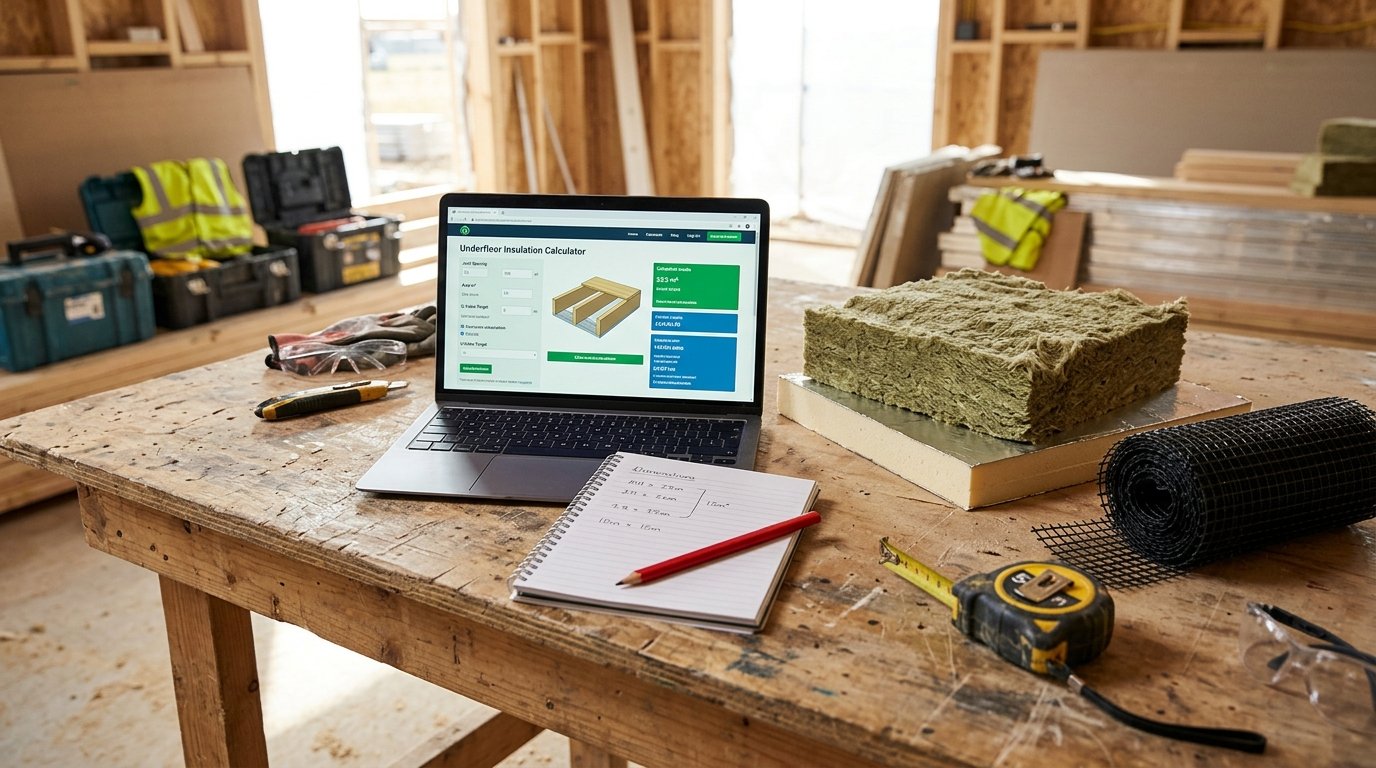
Underfloor Insulation Calculator: Packs, R-Value & Total Cost
Underfloor insulation is the forgotten insulation measure. Loft insulation gets the attention, cavity wall insulation gets the grants, but the floor beneath your feet is often the largest source of cold draughts and heat loss in an older home. A suspended timber floor with a vented void below can lose heat at the rate of a single-glazed window — and because the losses are hidden, most homeowners do not realise they exist until they lift the floorboards.
Our Underfloor Insulation Calculator estimates the materials and costs of a suspended floor insulation installation. It handles five insulation types — mineral wool, PIR, EPS, wood fibre, and sheep wool — each with its own thermal conductivity (λ) and density. It calculates R-value from thickness and material, insulation mass, packs from coverage, battens (automatically when insulation exceeds joist depth), netting and tape, fixings, labour with type and batten multipliers, delivery, VAT and cost per m². It also flags six common design errors — compressible insulation forced into joists without battens, battens required but not priced, low R-value, thickness below the useful minimum, excessive thickness beyond the joists, and missing pack price — before you order.
In this guide, we will show you how to use the calculator, explain each input and output, walk through four examples across materials and joist depths, and answer eight of the most frequently asked questions about underfloor insulation.
Underfloor Insulation
Construction CalculatorUnderfloor insulation: suspended floor, joist depth, packs, netting, R-value, mass and cost.
What is the Underfloor Insulation Calculator?
The Underfloor Insulation Calculator is a free online tool that estimates the quantity and cost of materials for a suspended timber floor insulation installation. It supports:
- Floor dimensions: length, width.
- Joist depth: used to determine whether insulation fits between the joists or requires battens.
- Insulation types: mineral wool slab (λ 0.035, 30 kg/m³), PIR (λ 0.022, 35 kg/m³), EPS (λ 0.038, 20 kg/m³), wood fibre (λ 0.038, 160 kg/m³), sheep wool (λ 0.040, 25 kg/m³).
- Insulation thickness: typically 100 mm between joists.
- Pack coverage: m² per pack at the chosen thickness.
- Waste allowance: typically 8% for cuts around pipes and noggins.
- Netting and tape: to hold insulation in place from below.
- Battens: automatically required when the insulation is thicker than the joists.
- Pricing: pack price, batten per m², netting per m², tape per m², fixings per m², labour per m², delivery, VAT.
The output includes:
- Floor area and area with waste
- R-value in m²K/W
- Insulation mass in kg
- Packs required
- Battens requirement
- Design check warning
- Itemised costs: insulation, battens, netting, tape, fixings, labour, delivery
- VAT, grand total and cost per m²
The tool is part of a suite of insulation calculators available on our website. For related calculations, you can use our Floor Insulation Calculator, Loft Roll Insulation Calculator, Cavity Wall Insulation Calculator, and Roof Insulation Calculator.
Why Accurate Underfloor Insulation Estimation Matters
Underfloor insulation is cheap per m², but the specification is more sensitive than it looks. Getting it wrong leads to either an under-performing floor or a system that cannot physically be installed.
Insulation Must Fit Between or Below the Joists
A suspended timber floor has joists — typically 100 mm or 150 mm deep — with a vented void below. Insulation is fitted between the joists, held in place with netting, or fixed beneath the joists on battens. If the insulation is thicker than the joists, it cannot simply be compressed — mineral wool, sheep wool, and wood fibre all lose R-value when compressed. PIR and EPS are rigid and can be fitted below the joists on battens. The corrected calculator checks whether the insulation exceeds the joist depth, forces the battens cost when it does, and warns when compressible insulation is used without battens.
λ Varies Dramatically Between Materials
At 100 mm thickness, PIR gives R 4.55 m²K/W; mineral wool gives R 2.86; EPS gives R 2.63. That is a factor of 1.7 — enough to make the difference between meeting UK Building Regulations (typically floor U ≤ 0.25 W/m²K) and falling short. The corrected calculator reads the material type and uses its actual λ to compute R-value, and warns when R falls below 2.5.
Mass Matters for Old Joists
Insulation weight varies from 20 kg/m³ (EPS) to 160 kg/m³ (wood fibre). At 100 mm thickness, a 48 m² floor holds 96 kg of EPS or 768 kg of wood fibre. On an older property, the added load must be checked against the joist capacity. The corrected calculator outputs total insulation mass so the check can be made.
Battens Are Not Optional When Needed
If the insulation is thicker than the joist depth, battens are required to hold it in place beneath the joists. Battens are not just a material cost — they add labour time because they must be fixed from below, and the insulation must be pushed up between them. The corrected calculator adds 15% to labour when battens are required, and warns when the batten price is zero.
Netting Holds Insulation in Place
Mineral wool, sheep wool, and wood fibre are not rigid — they need netting to hold them in place between the joists. Without netting, they sag, compress, and lose performance. The corrected calculator treats netting as a line item and warns when fixings are not priced despite netting being specified.
R-Value Is the Real Measure
Thickness alone does not tell you the thermal performance. R-value does. A 100 mm PIR slab gives R 4.55; 150 mm of mineral wool gives R 4.29; 200 mm of EPS gives R 5.26. The target for most UK retrofits is R ≥ 3.5 for a suspended floor — the corrected calculator warns below 2.5, which is a clear under-specification.
Air-Tightness and Vapour Control
Suspended floors must be allowed to ventilate — blocking the underfloor vents causes rot. The insulation itself should not be a vapour barrier unless it is a rigid board fitted below the joists (in which case a separate vapour barrier may be required on the warm side). The calculator does not check ventilation, but the warnings steer toward correct design.
VAT and Delivery
Insulation packs are bulky but light, and delivery is often included by the supplier but can be a separate charge. VAT applies at 20% in the UK, or 5% for qualifying energy-saving materials — check locally.
For more information on underfloor insulation, you can refer to Wikipedia’s article on building insulation or the Energy Saving Trust.
How to Use the Underfloor Insulation Calculator
Using the calculator is straightforward. Here is a breakdown of each field.
1. Floor
- Floor length / width: Enter dimensions in meters or feet.
- Joist depth: Enter the depth of the floor joists in meters or mm. 100 mm for older floors, 150 mm for modern.
2. Insulation
- Insulation type: Mineral wool, PIR, EPS, wood fibre, or sheep wool. Type determines R-value, mass, labour, and whether compression is an issue.
- Thickness: Typically 100 mm between joists.
3. Pack
- Pack coverage: m² per pack at the chosen thickness.
- Waste allowance: 8% typical — more for pipes, noggins, and irregular layouts.
4. Pricing
Enter local prices for each component. Leave 0 to skip.
5. Extras
- Delivery / skip: Fixed cost.
- VAT / tax rate: Applicable rate, or 0.
Once you enter all values, the calculator displays the full output, including area, R-value, mass, packs, battens requirement, design check, itemised costs, VAT, total and cost per m².
Understanding the Calculations
To make the most of the calculator, it is important to understand each output and the underlying formulas.
Area and Waste
area = length × width.
area_waste = area × (1 + waste / 100).
Packs
packs = ceil(area_waste / pack coverage).
R-Value
R = thickness / λ.
λ values:
- PIR: 0.022
- Mineral wool: 0.035
- EPS: 0.038
- Wood fibre: 0.038
- Sheep wool: 0.040
At 100 mm:
- PIR: 4.55
- Mineral wool: 2.86
- EPS: 2.63
- Wood fibre: 2.63
- Sheep wool: 2.50
Insulation Mass
mass_kg = area × thickness × density.
Densities:
- EPS: 20 kg/m³
- Sheep wool: 25 kg/m³
- Mineral wool: 30 kg/m³
- PIR: 35 kg/m³
- Wood fibre: 160 kg/m³
Battens
needs_battens = thickness > joist_depth + 0.001.
Battens required when the insulation is thicker than the joists. Battens are fixed below the joists, holding the insulation in place.
Netting and Tape
net_cost = area × netting price (only when netting price is entered).
tape_cost = area × tape price (only when netting price is entered).
Fixings
fix_cost = area × fixings price per m² (nails or staples for netting).
Labour
labour_cost = area × labour rate × type multiplier × (battens ? 1.15 : 1.00).
Type multipliers:
- EPS: 0.95
- Mineral wool: 1.00
- PIR: 1.00
- Sheep wool: 1.10
- Wood fibre: 1.15
Batten labour uplift: +15% when battens are required, reflecting the extra time to fix them from below.
Design Check
The calculator performs six checks:
- Compressible insulation thicker than joists without battens.
- Battens required but no batten price.
- R-value below 2.5.
- Thickness below 50 mm.
- Thickness exceeds joists by more than 50 mm (service void).
- Packs required but pack price is zero.
VAT and Total
VAT = subtotal × VAT / 100.
Total = subtotal + VAT.
Cost per m² = total / area.
Understanding these components helps you interpret the results and adjust your order. For more information on underfloor insulation standards, you can refer to the Energy Saving Trust or Wikipedia’s article on building insulation.
Reference Table of Insulation Types
| Material | λ (W/m·K) | Density (kg/m³) | R at 100 mm | Mass at 100 mm | Labour |
|---|---|---|---|---|---|
| PIR | 0.022 | 35 | 4.55 | 3.5 kg/m² | 1.00 |
| Mineral wool | 0.035 | 30 | 2.86 | 3.0 kg/m² | 1.00 |
| EPS | 0.038 | 20 | 2.63 | 2.0 kg/m² | 0.95 |
| Wood fibre | 0.038 | 160 | 2.63 | 16 kg/m² | 1.15 |
| Sheep wool | 0.040 | 25 | 2.50 | 2.5 kg/m² | 1.10 |
Example Calculations
Let’s run through four examples across materials and joist depths.
Example 1: Standard Suspended Floor, 48 m², 100 mm Mineral Wool
Inputs:
- Floor: 8 × 6 m → 48 m²
- Joist depth: 150 mm
- Insulation: Mineral wool 100 mm
- Pack coverage: 4 m²
- Waste: 8%
- Netting: $2/m²
- Tape: $0.40/m²
- Fixings: $1.20/m²
- Labour: $15/m²
- Delivery: $60
- VAT: 20%
Calculations:
- Area = 48 m²; waste → 51.84 m²
- Packs = ceil(51.84 / 4) = 13
- Insulation cost = 13 × $25 = $325
- R = 0.100 / 0.035 = 2.86 ✓
- Mass = 48 × 0.10 × 30 = 144 kg
- Battens = 100 ≤ 150 → not needed
- Netting = 48 × $2 = $96
- Tape = 48 × $0.40 = $19.20
- Fixings = 48 × $1.20 = $57.60
- Labour = 48 × $15 × 1.00 × 1.00 = $720
- Delivery = $60
- Subtotal = $1,277.80
- VAT = $255.56
- Total = $1,533.36
- Cost per m² = $31.95
- Design: OK
Example 2: Old Terrace Floor, 40 m², 100 mm PIR, Shallow Joists (100 mm)
Inputs:
- Floor: 8 × 5 m → 40 m²
- Joist depth: 100 mm
- Insulation: PIR 100 mm
- Pack coverage: 2.88 m²
- Waste: 8%
- Netting: $0 (PIR is rigid — not needed)
- Tape: $0
- Fixings: $1.50/m²
- Labour: $18/m²
- Delivery: $80
- VAT: 20%
Calculations:
- Area = 40 m²; waste → 43.2 m²
- Packs = ceil(43.2 / 2.88) = 15
- Insulation cost = 15 × $55 = $825
- R = 0.100 / 0.022 = 4.55 ✓
- Mass = 40 × 0.10 × 35 = 140 kg
- Battens: 100 = 100 → not needed
- Netting = $0
- Fixings = 40 × $1.50 = $60
- Labour = 40 × $18 × 1.00 × 1.00 = $720
- Delivery = $80
- Subtotal = $1,685
- VAT = $337
- Total = $2,022
- Cost per m² = $50.55
- Design: OK
Example 3: Deep Joists, 40 m², 150 mm Wood Fibre
Inputs:
- Floor: 8 × 5 m → 40 m²
- Joist depth: 150 mm
- Insulation: Wood fibre 150 mm
- Pack coverage: 3 m²
- Waste: 8%
- Netting: $2/m²
- Tape: $0.40/m²
- Fixings: $1.20/m²
- Labour: $20/m²
- Delivery: $80
- VAT: 20%
Calculations:
- Area = 40 m²; waste → 43.2 m²
- Packs = ceil(43.2 / 3) = 15
- Insulation cost = 15 × $65 = $975
- R = 0.150 / 0.038 = 3.95 ✓
- Mass = 40 × 0.15 × 160 = 960 kg (heavy!)
- Battens: 150 = 150 → not needed
- Netting = $80
- Tape = $16
- Fixings = $48
- Labour = 40 × $20 × 1.15 × 1.00 = $920
- Delivery = $80
- Subtotal = $2,119
- VAT = $423.80
- Total = $2,542.80
- Cost per m² = $63.57
- Design: OK
The 960 kg mass is significant — for older joists, this needs verification.
Example 4: Insulation Thicker Than Joists — Warning
Same as Example 1 but thickness = 200 mm and joist depth = 100 mm:
- Warnings: «Insulation is thicker than joist depth and compressible — battens required», «Battens required but no batten price — cost excludes battens»
- The user sees the material cost but clear warnings that battens are needed and not priced.
Benefits of Using the Underfloor Insulation Calculator
Tips for Accurate Underfloor Insulation Estimation
- Measure the floor accurately. For irregular rooms, divide into rectangles.
- Confirm the joist depth. Insulation must fit within it or battens are required.
- Choose the right material for the joist depth. PIR and EPS are rigid and can be fitted below joists if needed. Mineral wool, sheep wool, and wood fibre need to fit between joists.
- Target R ≥ 3.5 for the insulation layer. UK Building Regs typically require floor U ≤ 0.25 for refurbishment.
- Allow 8% waste. Suspended floors have pipes, noggins, and irregular cuts.
- Include netting and fixings. Soft insulation needs both.
- Include battens when the insulation exceeds the joists. No exceptions.
- Check mass on older joists. Wood fibre at 100 mm is 16 kg/m².
- Do not block underfloor vents. Ventilation keeps the void dry.
- Use the correct labour rate. Working from below is slower than above.
- Do not forget delivery and VAT.
- Verify with a professional. For older or complex floors, have a surveyor verify.
For more information on underfloor insulation standards, you can refer to the Energy Saving Trust or Wikipedia’s article on building insulation.
Common Mistakes to Avoid
- Compressing insulation into shallow joists. Loses R-value and performance.
- Not adding battens when needed. Insulation falls out, sags, or is left exposed.
- Skipping the netting. Soft insulation sags without support.
- Forgetting fixings for netting. Staples or nails are essential.
- Blocking underfloor vents. Causes condensation and rot.
- Using the wrong material for the joist depth. Mineral wool cannot be forced into 100 mm joists at 150 mm thickness.
- Ignoring the mass on older joists. Wood fibre is heavy.
- No VAT or delivery. Both add real cost.
- Using warm-roof materials under a suspended floor. Some boards are not suitable for the humidity of a vented void.
- Skipping the ventilation check. Fresh air must circulate below the floor.
How to Reduce Underfloor Insulation Costs
If your estimate is higher than expected, here are ways to reduce costs without compromising performance:
- Choose mineral wool over PIR. Cheaper per m² but lower R-value at the same thickness.
- Choose EPS over PIR where thickness allows. Cheaper and adequate for many retrofits.
- Do the installation yourself. Suspended floor insulation is a DIY-friendly job if you have access below.
- Use netting you already have. Staples and netting are cheap but reusable.
- Reduce waste by planning cuts. 8% is standard but 5% achievable on a clean rectangular floor.
- Compare suppliers. Insulation prices vary 20–30%.
- Check for grants. ECO and local authority grants can cover part of the cost.
- Time the project off-season. Contractors sometimes offer better rates.
- Get multiple quotes. Compare at least three installers.
- Verify VAT treatment. Energy-saving materials may qualify for reduced rates.
Frequently Asked Questions (FAQ)
Conclusion
The Underfloor Insulation Calculator is an essential tool for homeowners, installers, and specifiers. It estimates floor area, R-value, insulation mass, packs, battens requirement, netting, tape, fixings, labour with type and batten multipliers, delivery, VAT and cost per m² — with six design warnings that catch the most common errors before ordering.
The corrected calculator now reads the insulation type, applies material-specific λ, density, and labour multipliers, computes R-value and mass for structural checks, forces battens when the insulation exceeds joist depth, warns when compressible insulation would be compressed without battens, and includes netting and fixings as separate line items. Whether you are insulating a Victorian terrace with mineral wool or specifying PIR boards under a modern suspended floor, accurate estimation is the foundation of a warm, dry, and compliant installation. Try the Underfloor Insulation Calculator today and take the guesswork out of your suspended floor project.





One Comment