Trench Fill Foundation Calculator: Estimate Concrete, Rebar, and Costs
Trench fill foundations—also known as trench fill footings—are a common and cost-effective solution for supporting domestic extensions, garden walls, and light commercial buildings. Unlike traditional strip foundations with separate footings and walls, trench fill involves excavating a trench and filling it almost entirely with concrete, often to within a short distance of ground level. This method is quick, simple, and eliminates the need for bricklaying below ground. However, getting the concrete volume, cement, sand, aggregate, and reinforcement right is essential to avoid costly over-ordering or structural weaknesses. Our Trench Fill Foundation Calculator is a free online tool that helps you estimate all these quantities and costs in seconds.
In this guide, we’ll show you how to use the calculator, explain the calculations, provide real-world examples, and answer common questions. We’ll also share tips to ensure your trench fill foundation is accurate, efficient, and compliant with building regulations.
Trench Fill Foundation
Construction CalculatorTrench fill foundation: concrete volume, cement, sand, aggregate, rebar and cost.
What is the Trench Fill Foundation Calculator?
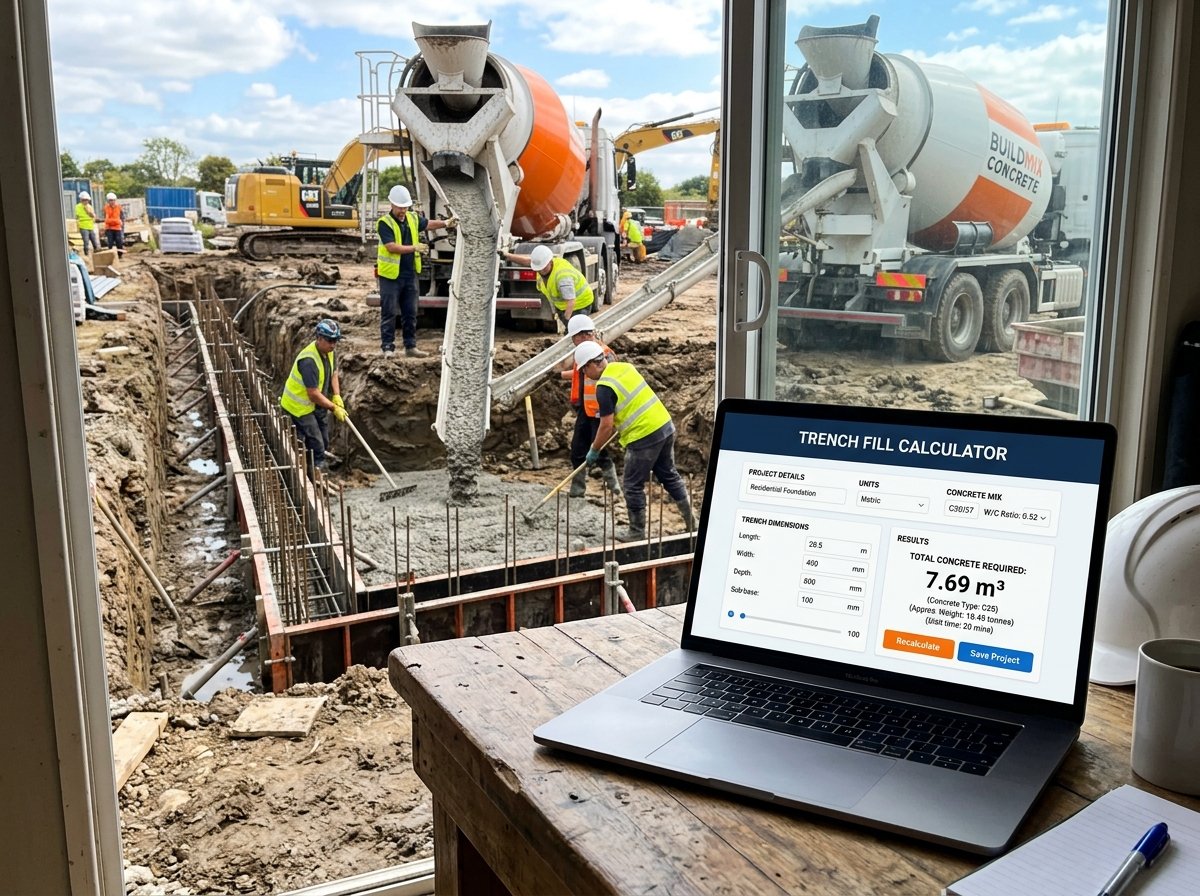
The Trench Fill Foundation Calculator is a free online tool that calculates the material quantities and costs for a trench fill foundation. It supports custom trench dimensions, three fill levels (concrete to within 200 mm of ground, to ground level, or a custom height), four reinforcement options (none, light mesh A142, medium mesh A193, heavy bars), and three concrete grades (C20/25, C25/30, C30/37). The calculator accounts for waste allowance, cement content, bag weight, and local prices for ready-mix concrete, rebar, and labour. It provides a clear breakdown of concrete fill height, geometric volume, total concrete volume with waste, cement, bags, sand, aggregate, reinforcement, and costs for each component. The tool is part of a suite of structural and foundation calculators available on our website. For related calculations, you can use our Raft Foundation Calculator, Pile Capacity Calculator, and Gravity Retaining Wall Calculator. If you’re designing a reinforced concrete retaining wall, our Retaining Wall Design Calculator provides stability checks.
How to Use the Trench Fill Foundation Calculator
Using the calculator is straightforward. Here’s a breakdown of each field:
1. Trench
- Trench length: Enter the total run of trench fill in meters or feet. This is typically the perimeter of the building plus any internal load-bearing walls. For example, a 10 m × 8 m building with one internal wall might have a total trench length of about 40 m.
- Trench width: Enter the width of the trench in meters or inches. Typically 500–700 mm for domestic strip footings. For example, 0.600 m = 600 mm.
- Trench depth: Enter the depth of the trench in meters or inches. Typically 800–1200 mm, depending on the depth of firm soil and frost line. For example, 1.000 m = 1000 mm.
- Fill level: Select where the top of the concrete will sit within the trench:
- Concrete to within 200 mm of ground (sub-base)
- Concrete to ground level
- Custom fill height
- Concrete fill height: If you selected “Custom fill height”, enter the height of concrete in the trench in meters or inches. For example, 0.800 m = 800 mm.
2. Reinforcement
- Reinforcement: Select the reinforcement option: Mass fill (no rebar), Light mesh (A142), Medium mesh (A193), or Heavy bars. Mass fill is standard for domestic trench foundations.
- Rebar per m³: Enter the reinforcement density in kg/m³. Typical 60–120 kg/m³ for reinforced trench fill. Used only when reinforcement is selected. The default is 80 kg/m³.
3. Mix
- Concrete grade: Select C20/25 (mass fill), C25/30, or C30/37. Higher grades add approximately 10% per step to the cement content.
- Cement per m³: Enter the cement content in kg/m³. Typical 250–350 kg/m³ for trench fill mixes. The default is 300 kg/m³.
- Bag weight: Enter the weight of one cement bag in kg or lb. The default is 25 kg.
- Waste allowance: Enter a percentage for additional concrete due to uneven excavation, spillage, and over-dig. Typical value is 5%.
4. Costs
- Ready-mix concrete per m³: Enter the local price per cubic meter of concrete. Leave 0 to skip.
- Rebar price per kg: Enter the local price per kg of reinforcement. Leave 0 to skip.
- Labour per m³: Enter the local labour cost per cubic meter of concrete. Leave 0 to skip.
Once you enter all values, the calculator instantly displays:
- Concrete fill height (mm)
- Geometric volume (m³)
- Concrete volume with waste (m³)
- Cement (kg)
- Cement bags
- Sand (m³) – for site mixing
- Aggregate (m³) – for site mixing
- Reinforcement (kg) – if selected
- Concrete cost, rebar cost, labour cost, and grand total (if prices entered)
Understanding the Cost Components
To make the most of the calculator, it’s important to understand each output and the underlying formulas.
- Concrete fill height: Based on your selected fill level. If “sub-base”, it is
depth − 200 mm. If “ground level”, it equals the trench depth. If “custom”, it is the value you enter, capped at the trench depth. - Geometric volume:
trench length × trench width × concrete fill height. This is the theoretical volume of concrete required. - Concrete volume with waste:
geometric volume × (1 + waste/100). This accounts for uneven excavation, spillage, and over-dig. - Cement:
concrete volume × cement per m³ × mix multiplier. The mix multiplier is 1.00 for C20/25, 1.10 for C25/30, and 1.20 for C30/37. - Cement bags:
ceil(cement kg / bag weight). You buy whole bags, so the calculator rounds up. - Sand and aggregate: Rough volumetric ratios for site mixing: sand =
concrete volume × 0.50, aggregate =concrete volume × 0.80. These are approximate and assume you are mixing on site. If you use ready-mix concrete, you can ignore these outputs. - Reinforcement:
geometric volume × rebar per m³ × reinforcement factor. The reinforcement factor is 0.0 for none, 1.0 for light mesh, 1.3 for medium mesh, and 2.0 for heavy bars. Note that reinforcement is calculated on the geometric volume, not the volume with waste, which is correct because rebar is not lost to spillage in the same way. - Costs: Concrete cost is based on volume with waste. Rebar cost is based on rebar weight. Labour cost is based on geometric volume. The grand total is the sum of all costs.
Understanding these components helps you interpret the results and adjust your design. For more information on trench fill foundations, you can refer to Wikipedia’s article on shallow foundations.
Example Calculations
Let’s run through a few examples to see how the calculator works in different scenarios.
Example 1: Domestic Extension, 30 m Trench, 600 mm Wide, 1.0 m Deep, Mass Fill
- Trench length: 30 m
- Trench width: 0.600 m
- Trench depth: 1.000 m
- Fill level: Concrete to within 200 mm of ground
- Reinforcement: Mass fill (no rebar)
- Concrete grade: C20/25
- Cement: 300 kg/m³
- Bag weight: 25 kg
- Waste: 5%
- Concrete price: $120/m³
- Rebar price: $0
- Labour price: $60/m³
Calculations:
- Fill height = 1.000 − 0.200 = 0.800 m
- Geometric volume = 30 × 0.600 × 0.800 = 14.4 m³
- Volume with waste = 14.4 × 1.05 = 15.12 m³
- Cement = 15.12 × 300 × 1.00 = 4,536 kg
- Bags = ceil(4536 / 25) = 182
- Sand = 15.12 × 0.50 = 7.56 m³
- Aggregate = 15.12 × 0.80 = 12.10 m³
- Reinforcement = 0 kg
- Concrete cost = 15.12 × $120 = $1,814.40
- Labour cost = 14.4 × $60 = $864
- Total = $1,814.40 + $864 = $2,678.40
- Result: Total concrete 15.12 m³, total cost $2,678.40
Example 2: Garden Wall Foundation, 12 m Trench, 500 mm Wide, 0.8 m Deep, Light Mesh
- Trench length: 12 m
- Trench width: 0.500 m
- Trench depth: 0.800 m
- Fill level: Concrete to ground level
- Reinforcement: Light mesh (A142)
- Rebar per m³: 80 kg/m³
- Concrete grade: C25/30
- Cement: 320 kg/m³
- Bag weight: 25 kg
- Waste: 7%
- Concrete price: $130/m³
- Rebar price: $1.20/kg
- Labour price: $70/m³
Calculations:
- Fill height = 0.800 m
- Geometric volume = 12 × 0.500 × 0.800 = 4.8 m³
- Volume with waste = 4.8 × 1.07 = 5.136 m³
- Cement = 5.136 × 320 × 1.10 = 1,807.87 kg
- Bags = ceil(1807.87 / 25) = 73
- Sand = 5.136 × 0.50 = 2.568 m³
- Aggregate = 5.136 × 0.80 = 4.109 m³
- Reinforcement = 4.8 × 80 × 1.0 = 384 kg
- Concrete cost = 5.136 × $130 = $667.68
- Rebar cost = 384 × $1.20 = $460.80
- Labour cost = 4.8 × $70 = $336
- Total = $667.68 + $460.80 + $336 = $1,464.48
- Result: Total concrete 5.136 m³, total cost $1,464.48
Example 3: Commercial Footing, 50 m Trench, 700 mm Wide, 1.2 m Deep, Heavy Bars, Custom Fill
- Trench length: 50 m
- Trench width: 0.700 m
- Trench depth: 1.200 m
- Fill level: Custom fill height
- Concrete fill height: 1.000 m
- Reinforcement: Heavy bars
- Rebar per m³: 120 kg/m³
- Concrete grade: C30/37
- Cement: 350 kg/m³
- Bag weight: 25 kg
- Waste: 5%
- Concrete price: $140/m³
- Rebar price: $1.30/kg
- Labour price: $80/m³
Calculations:
- Fill height = 1.000 m
- Geometric volume = 50 × 0.700 × 1.000 = 35.0 m³
- Volume with waste = 35.0 × 1.05 = 36.75 m³
- Cement = 36.75 × 350 × 1.20 = 15,435 kg
- Bags = ceil(15435 / 25) = 618
- Sand = 36.75 × 0.50 = 18.375 m³
- Aggregate = 36.75 × 0.80 = 29.4 m³
- Reinforcement = 35.0 × 120 × 2.0 = 8,400 kg
- Concrete cost = 36.75 × $140 = $5,145
- Rebar cost = 8,400 × $1.30 = $10,920
- Labour cost = 35.0 × $80 = $2,800
- Total = $5,145 + $10,920 + $2,800 = $18,865
- Result: Total concrete 36.75 m³, total cost $18,865
These examples show how different trench dimensions, fill levels, and reinforcement options affect the total cost.
Benefits of Using the Trench Fill Foundation Calculator
Tips for Accurate Trench Fill Foundation Estimation
- Measure the trench length accurately: Include the entire perimeter and any internal load-bearing walls. For complex shapes, divide into straight runs and sum.
- Choose the correct trench width: Typically 500–700 mm for domestic walls, wider for heavier loads. The width should be at least three times the wall thickness.
- Determine the correct trench depth: The foundation must be deep enough to reach firm soil and below the frost line. Check local building regulations.
- Select the appropriate fill level: Concrete to within 200 mm of ground is common, leaving room for the wall above. Concrete to ground level is used for garden walls. Custom fill allows flexibility.
- Use the right reinforcement: Mass fill is often sufficient for domestic trench foundations. Light mesh is used for lightly loaded walls; heavy bars for heavy loads or poor soil.
- Choose the correct concrete grade: C20/25 is standard for mass fill. C25/30 or C30/37 may be required for reinforced or chemically aggressive ground.
- Account for waste: 5% is typical, but increase to 10% for uneven excavation or difficult access.
- Consider site mixing vs ready-mix: If you mix on site, the sand and aggregate quantities are useful. If you use ready-mix, ignore them.
- Include labour: Labour for placing and compacting concrete can be significant. Enter a realistic rate.
- Verify with a professional: For structural design, have a qualified engineer verify the trench width, depth, and reinforcement.
For more information on trench fill foundations, you can refer to resources like Wikipedia’s article on shallow foundations or guidelines from the Institution of Structural Engineers.
How to Reduce Trench Fill Foundation Costs
If your estimate is higher than expected, here are ways to reduce costs without compromising safety:
- Optimize trench dimensions: Work with your engineer to minimize width and depth while meeting structural requirements.
- Use mass fill instead of reinforced: If the loads are light and the soil is good, mass fill is cheaper.
- Choose a lower concrete grade: If structural design permits, C20/25 is cheaper than C30/37.
- Reduce waste: Order accurate quantities and handle materials carefully.
- Consider alternative foundations: In some cases, raft or pile foundations may be more economical. Compare using our other calculators.
- Get multiple quotes: Compare suppliers for concrete, rebar, and labour.
Frequently Asked Questions (FAQ)
Conclusion
The Trench Fill Foundation Calculator is an essential tool for builders, engineers, and DIY enthusiasts. It helps you estimate the concrete volume, cement, sand, aggregate, reinforcement, and total cost for a trench fill foundation. By following the tips in this article and using the calculator, you can confidently plan your foundation project. Don’t forget to explore our other foundation and structural calculators for all your construction needs.
Whether you’re building a small extension or a commercial footing, accurate trench fill estimation is key to a successful project. Try the Trench Fill Foundation Calculator today and take the guesswork out of your foundation budget.